ShodhKosh: Journal of Visual and Performing ArtsISSN (Online): 2582-7472
|
|
08 December 2025Management Strategies for AI-Integrated Craft Industries
Dr. Chaitrali Dilip Kale 1
 ,
Gurpreet Kaur 2
,
Gurpreet Kaur 2 , Bipin Sule 3
 ,
Rajendra Subhash Jarad 4
,
Rajendra Subhash Jarad 4 ,
Dr. Prabha D. 5
,
Dr. Prabha D. 5 ,
Dr. Daljeet Singh Bawa 6
,
Dr. Daljeet Singh Bawa 6 , Priyadharshini K. 7
1 Assistant Professor, Bharati Vidyapeeth
(Deemed to be University), Institute of Management and Entrepreneurship
Development, 411038, India
2 Associate
Professor, School of Business Management, Noida International University, Greater
Noida, 203201, India
3 Sr. Professor, Department of DESH, Vishwakarma Institute of
Technology, Pune, Maharashtra, 411037, India
4 MBA, Neville Wadia Institute of Management Studies and Research,
Pune Affiliated to Savitribai Phule, Pune University, (SPPU), Pune, India
5 Assistant professor, School of Business and Management, St Francis
de Sales College, (Autonomous), Electronics City, Bengaluru, India
6 Assistant Professor, Department of Management Studies, Bharati
Vidyapeeth (Deemed to be University) Institute of Management and Research
(BVIMR), New Delhi, India
7 Assistant Professor, Meenakshi College of Arts and Science,
Meenakshi Academy of Higher Education and Research, Chennai, Tamil Nadu,
600084, India
|
|
|
ABSTRACT |
|
|
Traditional
craft industry is crucial in preserving culture, rural livelihoods, and
creative economies but continues to encounter the same issues with
fragmentation of value chains, lack of market confidence, loss of skills and
the inability to be sustainable. Artificial intelligence (AI) brings fresh
possibilities to overcome these issues, but there is a need to use it in
craft ecosystems mindfully, so as to prevent a degradation of culture and
marginalization of artisans. This paper looks at AI implementation in craft
industries and how to manage these industries, presenting the argument that
the main challenge of implementing AI in craft industry is management and
governance-related, and not a technological issue. The paper suggests a
conceptual model that places strategic management in the mediating role
between the traditional craft foundations and the AI capabilities. In the
systematic discussion on the strategic alignment, human and AI work,
operational integration, and ethical governance, the study proves that AI
could be used to improve coordination, quality assurance, market
responsiveness, and sustainability without compromising cultural
authenticity. The operational mappings and pictorial performance analyses
also indicate that the balanced improvement of supply-chain functions through
the use of phased and collaborative AI adoption models is still possible
without losing handcrafted variability. The results reported add up to
strategic management and creative industry publications by reshaping AI as a
supplementary technology that enhances the power of artisans instead of
eliminating them. The article also brings out the significance of governance
systems in respect to intellectual property, ownership of data and
representation of cultures. Further studies must apply the suggested
frameworks to different craft settings empirically and research involved
design strategies of participatory AI development to create inclusive
innovation. |
|||
|
Received 11 September 2025 Accepted 09 December 2025 Published 17 February 2026 Corresponding Author Dr. Chaitrali
Dilip Kale, Chaitrali.kale@bharatividyapeeth.edu DOI 10.29121/shodhkosh.v7.i1s.2026.7086 Funding: This research
received no specific grant from any funding agency in the public, commercial,
or not-for-profit sectors. Copyright: © 2026 The
Author(s). This work is licensed under a Creative Commons
Attribution 4.0 International License. With the
license CC-BY, authors retain the copyright, allowing anyone to download,
reuse, re-print, modify, distribute, and/or copy their contribution. The work
must be properly attributed to its author.
|
|||
|
Keywords: Artificial Intelligence, Craft Industries, Strategic
Management, Human–AI Collaboration, Cultural Heritage Preservation, Supply
Chain Management |
|||


1. INTRODUCTION
Craft industries Craft industries are some of the oldest economic and cultural systems, which are based on indigenous knowledge, community-based production, and intergenerational transfer of skills. They are important in the creation of jobs, sustenance of the rural areas, involvement of women and cultural identity in most areas. In spite of this significance, craft industries have continued to struggle with fragmented production, market access, lack of quality, and low bargaining power that has been augmented by globalization and mass production Aboada et al. (2023). Lately, the latest technologies of artificial intelligence (AI) present an opportunity to transform craft industries through the support of creativity by designing, quality testing, demand prediction, and digital marketing. Thoughtfully used, AI may serve to seize the gap between tradition and technology, and it will help save cultural value and increase productivity, scalability, and responsiveness to the market.
Figure 1

Figure 1 Three-Layer
or Triangular Conceptual Model
The introduction of artificial intelligence (AI) in craft industries is not a technological problem, but essentially a management and governance issue. Small, decentralized and socio-cultural ecosystem-based craft enterprises are typical of craft enterprises, making unstructured implementation of AI potentially hazardous to craft enterprises in terms of marginalization of artisans, cultural loss and unequal value capture Auth et al. (2021). A successful AI implementation must thus be context-aware, meaning that management must develop strategies that are sensitive to technological innovation and craft values, ethical management, and inclusivity, as shown in Figure 1. The current literature on AI applications in the field of the creative industries is to a great extent technology-based with little focus on organizational preparedness and effects on culture Du et al. (2024). In filling this gap, the current paper focuses on strategic, operational, and policy-based management models of AI-based craft industries, to make AI as an augmentative management tool to supplement the livelihood of artisans, cultural heritage, and inclusive and sustainable innovation.
2. Traditional Craft Industries: Structure and Management Challenges
The historical craft industries are based on the artisan communities, cultural legacy and tacit manual skills which are passed down across generations. The socio-economic and cultural foundation of craft ecosystems is these foundations in which the production cannot be detached to identity and symbolism and localized knowledge Gil et al. (2021). Crafts are more done organizationally in micro-enterprises, household units, self-help groups or informal groups as opposed to formal organized firms. Making decisions is normally experience-based and intuitive, and it is not much based on standardized managerial tools Hariyani and Mishra (2023). Table 1 summarises the structural features of the traditional craft industries and Gaikwad and Damodaran (2024) the implications these features have on management. The table shows that informality and decentralization are culturally ingrained to result in disintegrated production systems and ineffective governance structures. Artisans are usually in seclusion which leads to inefficiencies in the supply chain, manufacturing planning, quality control and even in the marketplace Karadimas et al. (2025). Lack of collective management systems inhibits cost of scale and lowers the bargaining strength of the artisans in the value chains. As a result, the middle men tend to control pricing and distribution of products, taking disproportionate amount of value and leaving the artisans economically weak.
Table 1
|
Table 1 Structural Characteristics of Traditional Craft Industries and Associated Management Challenges |
|||
|
Dimension |
Typical
Characteristics in Craft Industries |
Management
Implications |
Resulting Challenges |
|
Organizational
Structure Kombaya et al.
(2022) |
Micro-enterprises,
family-based units, informal clusters |
Limited formal
governance and coordination mechanisms |
Fragmented production,
weak collective bargaining |
|
Skill System Misra et al. (2022) |
Tacit knowledge, oral
transmission, apprenticeship-based learning |
Absence of
documentation and standardization |
Skill erosion,
intergenerational knowledge loss |
|
Production Model Napoleone et al. (2022) |
Manual, low-volume,
customized production |
High dependence on
individual artisan expertise |
Low scalability,
inconsistent output quality |
|
Market Linkages Pansare et al. (2023) |
Reliance on
intermediaries and local markets |
Minimal customer
feedback and demand intelligence |
Price vulnerability,
weak branding |
|
Resource Management Polonevych et al. (2020) |
Use of traditional
materials and tools |
Limited data-driven
planning or optimization |
Inefficiencies in
material use and scheduling |
In craft industries outside the structural fragmentation, transmission of skills and preservation of knowledge is a significant management challenge. A lot of craft knowledge is emotional and experiential and it is hard to be documented, scaled and institutionalized using formal training. The traditional systems of apprenticeship, though essential to culture, are becoming diluted by the urban flight, rising ages of artisans and the vanishing youth interest Prifti (2022). As a managerial factor, this means that the organizational resiliency is diminished as well as innovation is limited since the market conditions absorb consistency and adaptability, Market access worsens these problems further. A large number of the artisans are not in touch with end consumers and other global markets, which restricts the feedback of demand patterns, prices and differentiation. Low branding, poor quality and lack of market intelligence destroy competitiveness in digitally motivated markets places Zheng et al. (2021). The sum of these issues can be summarized in Table 1, which reflects that the fragmentation, market uncertainty, and the loss of knowledge, as well as quality variability, are dangerous to the long-term sustainability.
3. Artificial Intelligence Applications in Craft Industries
AI is not a technological layer but its efficacy is conditional on the alignment of managers, governance systems, and human-AI models of collaboration. In line with this, AI applications in craft industries should not only be measured in the light of technical competence but also in the light of addressing certain management bottlenecks inherent in the traditional craft ecosystems. Value chain fragmentation is one of the most urgent problems of craft industries where sourcing, production, and market access exist in disintegrated silos Zidi et al. (2023). The coordination of these fragmented activities through the creation of shared information environments by AI-driven digital platforms and data integration tools is a possibility. Inventory systems driven by machine learning, demand analytics, and platform mediated coordination can coordinate production planning with market demand, eliminating the need to rely on intermediaries Ullah et al. (2023). In management terms, these AI systems allow the cooperative model of governance, where the artisans can keep artistic control and enjoy the benefits of scale and transparency. Knowledge weakness, especially the danger of losing tacit craft skills is another urgent issue. Documentation systems that rely on AI, including computer vision based motion capture, multimodal knowledge graphs, pattern recognition models can document and organize artisanal processes that had not been previously documented Ullah et al. (2025). These tools are not however replacing the apprenticeship models but complement them by building digital repositories which support training, preservation and innovation. Intelligently handled, AI will be a tool of protecting intangible cultural heritage and allow the transfer of adaptive skills across generations.
Table 2
|
Table 2 Mapping of Traditional Craft Industry Challenges to AI Capabilities and Management Strategies |
|||
|
Challenge |
AI Capability Applied |
Management Strategy Enabled |
Strategic Outcome |
|
Value Chain Fragmentation Vavrík et al. (2022) |
AI-enabled digital platforms, ML-based coordination
tools |
Cooperative management and integrated value chain
governance |
Improved efficiency and fair value distribution |
|
Knowledge Vulnerability |
Computer vision, multimodal documentation, knowledge
graphs |
Digital preservation and skill augmentation |
Intergenerational knowledge continuity |
|
Market Uncertainty Yazdani et al. (2022) |
Predictive analytics, recommender systems |
Data-driven production and pricing decisions |
Income stability and market responsiveness |
|
Quality Variability |
AI-based quality inspection and benchmarking |
Standardized yet flexible quality assurance |
Enhanced brand trust and competitiveness |
|
Sustainability Constraints |
AI-driven optimization and simulation models |
Resource-efficient production planning |
Environmental and economic sustainability |
Uncertainty in the market and the instability of incomes come mainly due to the inability of artisans to get a glimpse of the consumers and demand prediction tools. Predictive models and recommendation systems that are AI-based will be capable of analyzing consumer behavior, trends during seasons and pricing dynamics across digital marketplaces. As part of management decision-making processes, the tools enable craft enterprises to match the production volumes, diversify product lines, and be flexible in terms of pricing strategies. Notably, the managerial control is key to making sure that market optimization would not result in homogenization and loss of cultural uniqueness. Another problem is quality inconsistency, especially when the craft goods are shifted in the global and digital sphere where consistency is an added demand along with authenticity. Artisans can be assisted using computer vision, and AI-assisted quality assessment tools to detect defects and create materials of consistent quality and measure the results against agreed standards. These systems could have been structured to accommodate the acceptable variance in products made by hand, instead of bringing industrial uniformity. There is the management perspective where AI-based quality assurance promotes trust, branding and decreases rejection rates without limiting the creativity. Lastly, the artificial intelligence-based optimization tools can be used to overcome sustainability limitations associated with ineffective resource consumption and planning. Predictive analytics and simulation models may be used to help in planning the usage of materials, reduce wastes, and in production planning that is environmentally aware. When integrated into the management policies that focus on the ecological and cultural sustainability, AI fosters the economic sustainability in the long term, as well as the strengthens the ethos of low impact that is traditionally linked to the craft production.
4. Strategic Management Frameworks for AI Integration
The effective application of artificial intelligence to craft industries is not based on the presence of technology itself, and rather, it relies on the direction of strategic management structures that inform its application, utilization, and development. Craft industries do not exist in the type of socio-cultural ecosystem that assumes coexistence of economic goals with heritage preservation, community identity and ethical responsibility, as opposed to conventional industrial sectors. Therefore, the strategic management AI integration systems will need to go beyond the efficiency-based models and focus on the alignment of the technological innovation, cultural values, and artisan-oriented governance as discussed in Figure 2. One of the key aspects of strategic AI implementation is strategic alignment when AI projects are directly associated with the Mission and values of craft enterprises. Instead of trying to follow the direction of AI adoption, managers should specify what they are trying to achieve through it, which could be skill maintenance, market entry, revenue stabilisation or increased sustainability. This correspondence will make sure that AI systems be it design aids, market analytics, or quality monitoring are contrasted with cultural and social performance indicators alongside the financial metrics. Practically, this will mean introducing cultural authenticity criteria, artisan feedback loops and ethical constraints in AI deployment strategies, and thus changing AI into a productivity tool into a value-preserving managerial tool.
Figure 2
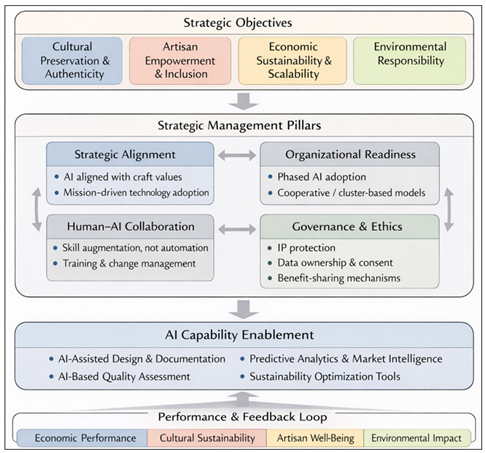
Figure 2 Strategic Management Acts as the Mediating Layer Between AI Capabilities and Sustainable Craft Outcomes
Another dimension of strategic management that is important is organizational readiness. The great number of craft businesses is not formalized, digital, and lacks managerial skills to adopt AI. The strategic frameworks should hence also include the adoption models of phased adoption, whereby AI tools are launched in stages and changed to fit the context. The management models based on cooperative and artisan communities, as well as the cluster-level governance arrangements, are especially well-adjusted to this practice, as they enable distributing the AI resources but sharing costs and risks. Human-AI integration is the foundation of Ai integration in craft sectors in a sustainable manner. The strategic management systems should clearly outline the role separation between the human creativity and machine intelligence. Artificial intelligence systems must be framed as assistance to artisans to explore design, identify mistakes, and analyze the market, and not as autonomous systems that steal the human. This will need one to invest in reskilling and digital literacy courses that can enable artisans to engage with AI systems meaningfully. Resistance can be mitigated with the help of effective change management strategies such as training, learning through peers, and demonstration project to create trust in AI-enabled workflow. Ethical control and governance are also very crucial elements of strategic AI control. When trained on traditional designs and practices, craft industries are especially sensitive to the problems of intellectual property, ownership of data, and cultural appropriation. Such strategic frameworks should thus put in place clear governance systems that spell ownership of AI generated outputs, consent mechanisms of using the data and benefit sharing provisions. These mechanisms justify artisans against exploitation besides ensuring responsible innovation. Collaboration between craft organizations, technology providers and the public institutions can be utilized at the policy level to facilitate the production of guidelines and standards to protect cultural heritage in the AI-driven environments.
5. Operational and Supply Chain Management Strategies in AI-Integrated Craft Industries
Strategic management frameworks that are addressed in Section 4 only have an operational meaning when they are converted into day-to-day supply chain and production activities. The past operational models of the traditional craft industries have been characterized by decentralization and the use of intuition in their operations, which have led to inefficiency in procurement, production planning, logistics, and sustainability management. Artificial intelligence when integrated into the selectively managed operational procedures can help craft enterprises align these fragmented operations maintaining artisan freedom and cultural genuineness. At the procurement and inventory, AI predictive analytics are essential in balancing the input supply and maximizing the use of resources. Seasonal, locally available or natural raw materials tend to affect craft enterprises that tend to be susceptible to scarcity and volatility of prices. Demand forecasting and inventory optimization applications based on machine learning can enable managers to predict the needs of materials and plan massive acquisitions at a cooperative or cluster level.
Figure 3
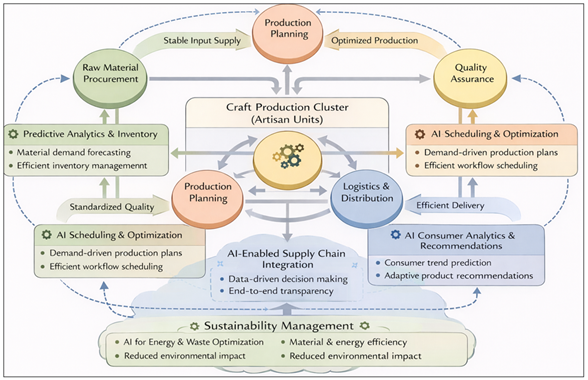
Figure 3
Supply chain workflow diagram
Another area of operation where AI can greatly boost the decision-making process of managers is production planning. The traditional craft production is normally structured by personal craftsman routines and unstructured coordination, restricting to the responsiveness to the changing demand. The application of AI in quality assurance processes in craft industries is also advantageous and especially when an enterprise is growing into the digital and global market where consistency is essential. Inspection systems that use computer vision help the artisans detect flaws and compare the output against agreed quality standards, without compromising on the acceptability of acceptable variation in handcrafted work. Geographic dispersion and intermediaries have been the traditional weaknesses in craft supply chains in terms of logistics and distribution.
Sustainability-oriented operations can be considered an increasingly significant aspect of craft supply chain management. The use of AI-based optimization and simulation models helps managers to look after the material consumption and waste minimization, as well as to design environment-friendly production cycles. These tools facilitate the sustainable scaling and also the traditionally low impact ethos of craft production is strengthened.
6. Governance, Ethics, and Policy Dimensions of AI-Integrated Craft Industries
Optimization of routes and fulfillment analytics made with the help of AI allow planning distribution more efficiently and improving delivery schedules, as well as increasing transparency of the supply chain. The craft enterprises can access domestic and international consumers with the help of digital platforms that incorporate such tools. Operations that are market-facing are also an example of the operational value of AI integration. The tools of consumer analytics and recommendation systems yield customer preferences and pricing sensitivity, as well as new trends. These tools when properly managed inform the decisions to be made on product positioning and pricing without making homogenization.
6.1. Governance Requirement of AI-Integrated Craft Ecosystems
Application of artificial intelligence in craft industries does not stop with just the implementation and application of technology but requires strong governance frameworks. Craft industries are culturally embedded systems, and uncontrolled use of AI can lead to the challenge of cultural misrepresentation, inappropriate values, and loss of agency by artisans. Governmental structures are thus mandated to control the designing, implementation, and appraisal of AI systems inside the craft ecosystems.
6.2. Authorship Problems and Intellectual Property Rights
The traditional craft knowledge has intergenerational, collective character and this aspect makes traditional intellectual property regimes challenging. In the case of the training of AI systems with the help of conventional motifs or production methods, one may ask a question about who an AI-generated or AI-assisted design belongs to. The systems of governance have to acknowledge the collective authorship and provide a legal protection of the cultural assets and the effective models of the benefit distribution that takes into consideration not only the creativity of the artisans but also the contribution of the algorithms.
6.3. Ownership of Data, Consent and Rights of use
The craft systems invented through AI rely on large amounts of data, such as design libraries, process videos, and performance data by artisans. In the absence of clear policies regarding data governance, artisans will be deprived of the ability to control their knowledge. Proper governance should be used to establish the rights to own data, consent procedures, data sharing terms to make sure that artisans are transparent and that their interests are not compromised in the digital realm.
6.4. Algorithms Bias and Cultural Reflection
The models of AI that are trained on small datasets or commercially biased datasets might present or generalize culturally diverse craft traditions. Ethical governance entails involvement in dataset curation, hiring of cultural specialists and constant supervision of AI generated outputs. These will assist in avoiding the erosion of cultures and serious depiction of various craft identities.
6.5. Human -AI Accountability and Transparency
Governance systems need to specify accountability between AI system and human decision-makers. To ensure that artisans and other stakeholders trust the application of AI, it is important to be transparent about the processes of algorithms, explain the output of AI, and document the reasons behind the decisions. Human control is also important in order to avoid excessive dependence on automated systems.
6.6. Public Policy and Institutional Support
The development agencies and governments are at the forefront in ensuring the adoption of responsible AI in the craft industries. The policy initiatives (digital literacy, access to cheap AI tools, cultural IP protection laws, and assistance with cooperative digital platforms) can provide everyone with an opportunity to engage and minimize structural disparities.
7. Discussion
This paper shows that adoption of artificial intelligence in craft industries is essentially a management and governance issue and not necessarily a technological one. These results suggest that AI can produce a significant value only when it is integrated into a strategic framework bringing together technological possibilities with the goal of cultural safety, empowerment, and sustainability of artisans. This multi-dimensional performance change supports the thesis that AI needs to be viewed as a managerial facilitator as opposed to a disruptive substitute of the conventional craft practices.
Figure 4

Figure 4 Radar
Comparison of Traditional Craft Operations and Managed AI-Integrated Craft
Systems Across Key Performance Dimensions.
Strategically the findings add to the literature of creative and cultural industries in the sense that they help to elaborate on a hybrid management reason that merges economic, cultural, and ethical aspects as depicted in Figure 4. Craft contexts require more than traditional efficiency-based models of strategy, value is symbolic, collective and heritage-based. This result broadens the socio-technical system theory because it puts culture and government at the core of strategic variables in the use of AI. It is also discussed that the collaboration between human and AI will be considered as one of the design principles of AI-integrated craft ecosystems. In the design support, manufacturing planning, quality control, and market intelligence, AI devices are the most efficient at assisting the human hand instead of substituting a creative decision.
Figure 5

Figure 5 Estimated
Relative Operational Improvements Across Craft Supply-Chain Functions Under AI-Supported
Management
The operational contribution of the study is that AI has the ability to increase coordination and reliability in craft supply chains without applying industrial uniformity. The greatest estimated gains, with data-driven decision support creating less uncertainty and fragmentation, are in market interface, production planning, and inventory management, as seen in Figure 5. Notably, quality assurance and sustainability functions also show quantifiable benefits, which means that AI-enhanced operations can be scaled with the focus on craft production in a responsible manner and adhere to the variability of handcrafted objects. These findings refute the idea that the digital technologies are bound to cause cultural homogenization.
Figure 6
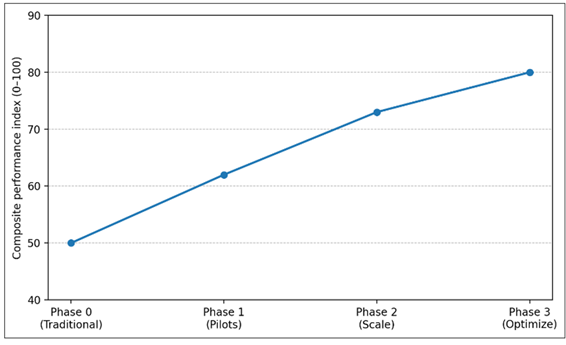
Figure 6 Relationship
Between Phased AI Adoption and Composite Performance Outcomes in Craft
Industries
The manageability of AI adoption is also a critical point that manifests in a progressive way. As shown in Figure 6, the improvement in performance associated with the use of composite is gradual in pilot implementations and the scaled deployment, and then steady in optimization stages. This trend emphasizes the need to adopt the strategies of gradual and learning-based adoption with the assistance of governance and feedback mechanisms. The impulsive or unplanned implementation of AI can thus be dysfunctional to craft settings where reliance, adaptability to skill, and readiness of an institution are developed over time.
8. Conclusion
This paper explored how to use management methods to develop artificial intelligence into the traditional craft industries, and how the implementation of AI in the field is more a management, ethical, and governance issue than a technological problem. The paper has shown that AI could be used as a facilitating infrastructure reinforcing craft ecosystems when it is oriented towards cultural values, agency of artisans, and sustainability goals by integrating knowledge at the strategic, operational, and policy levels. The suggested conceptual framework represented the way traditional craft foundations, AI capabilities, and strategic management engage to deliver sustainable effects. The strategic management model also emphasized the roles of alignment, organizational preparedness, human-AI cooperation and ethical governance in the mediation of AI adoption. On the operational level, the analysis revealed that AI-assisted procurement, production planning, quality assurance, logistics, and sustainability management is capable of decreasing the long-term inefficiencies without imposing uniformity in the industrial sphere. Significantly, the results supported the fact that phased and collaborative contexts of adoption are more appropriate than top-down and quick-tech implementation. Governance came out as an essential factor in the responsible integration of AI. There should be clear systems of protecting intellectual property, the ownership of data, representation of cultures and distribution of benefits to avoid cultural exploitation and equitable distribution of value. The discussion also showed that in case the governance structures are incorporated with operational feedback measures, the AI-induced performance gains can be long-term.
CONFLICT OF INTERESTS
None.
ACKNOWLEDGMENTS
None.
REFERENCES
Aboada, A., Daneshpajouh, N., Toledo, and De Vass, T. (2023). Artificial Intelligence-Enabled Project Management: A Systematic Literature Review. Applied Sciences, 13(9), 5014. https://doi.org/10.3390/app13095014
Auth, J., Jöhnk, J., and Wiecha, D. A. (2021, September). A Conceptual Framework for Applying Artificial Intelligence in Project Management. In Proceedings of the IEEE 23rd Conference on Business Informatics (CBI) (161–170). IEEE. https://doi.org/10.1109/CBI52690.2021.00027
Du, D., Si, M., Ahmad, M., and Gu, X. (2024). Advancing Environmental Sustainability: A Study on Energy and Resource Efficiency Through Technological Innovation in China. International Journal of Environmental Research, 18, 92. https://doi.org/10.1007/s41742-024-00645-y
Gil, J., Torres, M., and González-Crespo, R. (2021). The Application of Artificial Intelligence in Project Management Research: A Review. International Journal of Interactive Multimedia and Artificial Intelligence, 6(1), 54–66. https://doi.org/10.9781/ijimai.2020.12.003
Gaikwad, R. R., and Damodaran, D. (2024). The Rise of Predictive Analytics in Management Accounting: From Descriptive to Prescriptive. ShodhAI: Journal of Artificial Intelligence, 1 (1), 159–167. https://doi.org/10.29121/shodhai.v1.i1.2024.54
Hariyani, D., and Mishra, S. (2023). A Descriptive Statistical Analysis of Enablers for Integrated Sustainable Green-Lean-Six Sigma-Agile Manufacturing Systems in Indian Manufacturing Industries. Benchmarking: An International Journal, 31(3), 824–865. https://doi.org/10.1108/BIJ-06-2022-0344
Karadimas, G., Pagone, E., and Salonitis, K. (2025). Comparative Life Cycle Assessment of Swarf Cleaning Methods for Sustainable Manufacturing. Procedia CIRP, 134, 1005–1010. https://doi.org/10.1016/j.procir.2025.02.240
Kombaya Touckia, N., Hamani, N., and Kermad, L. (2022). Digital Twin Framework for Reconfigurable Manufacturing Systems (RMSs): Design and Simulation. International Journal of Advanced Manufacturing Technology, 120, 5431–5450. https://doi.org/10.1007/s00170-022-09118-y
Misra, N. N., et al. (2022). IoT, Big Data, and Artificial Intelligence in Agriculture and Food Industry. IEEE Internet of Things Journal, 9(9), 6305–6324. https://doi.org/10.1109/JIOT.2020.2998584
Napoleone, A., Bruzzone, A., Andersen, A. L., and Brunoe, T. D. (2022). Fostering the Reuse of Manufacturing Resources for Resilient and Sustainable Supply Chains. Sustainability, 14(9), 5890. https://doi.org/10.3390/su14105890
Pansare, R., Yadav, G., Garza-Reyes, J. A., and Nagare, M. R. (2023). Assessment of Sustainable Development Goals Through Industry 4.0 and Reconfigurable Manufacturing System Practices. Journal of Manufacturing Technology Management, 34(2), 383–413. https://doi.org/10.1108/JMTM-05-2022-0206
Polonevych, O. V., et al. (2020). Artificial Intelligence Applications for Project Management. Connectivity, 146, 054855. https://doi.org/10.31673/2412-9070.2020.054855
Prifti, V. (2022). Optimizing Project Management Using Artificial Intelligence. European Journal of Formal Sciences and Engineering, 5(1), 30–38. https://doi.org/10.26417/667hri67
Ullah, S., Kukreti, M., Sami, A., and Shaukat, M. R. (2025). Leveraging Technological Readiness and Green Dynamic Capability to Enhance Sustainability Performance in Manufacturing Firms. Journal of Manufacturing Technology Management, 36(4), 714–730. https://doi.org/10.1108/JMTM-05-2024-0268
Ullah, S., Mehmood, T., and Ahmad, T. (2023). Green Intellectual Capital and Green HRM Enabling Organizations Go Green: Mediating Role of Green Innovation. International Journal of Innovation Science, 15(2), 245–259. https://doi.org/10.1108/IJIS-12-2021-0222
Vavrík, V., Fusko, M., Bučková, M., Gašo, M., Furmannová, B., and Štaffenová, K. (2022). Designing of Machine Backups in Reconfigurable Manufacturing Systems. Applied Sciences, 12(5), 2338. https://doi.org/10.3390/app12052338
Yazdani, M. A., Khezri, A., and Benyoucef, L. (2022). Process and Production Planning for Sustainable Reconfigurable Manufacturing Systems (SRMSs): Multi-Objective Exact and Heuristic-Based Approaches. International Journal of Advanced Manufacturing Technology, 119, 4519–4540. https://doi.org/10.1007/s00170-021-08409-0
Zheng, T., Ardolino, A. B. M., and Perona, M. (2021). The Applications of Industry 4.0 Technologies in Manufacturing Context: A Systematic Literature Review. International Journal of Production Research, 59(6), 1922–1954. https://doi.org/10.1080/00207543.2020.1824085
Zidi, S., Kermad, L., Hamani, N., and Zidi, H. (2023). Reconfigurable Supply Chain Selection: Literature Review, Research Roadmap, and New Trends. Applied Sciences, 13(7), 4561. https://doi.org/10.3390/app13074561
|
|
 This work is licensed under a: Creative Commons Attribution 4.0 International License
© ShodhKosh 2026. All Rights Reserved.