ShodhKosh: Journal of Visual and Performing ArtsISSN (Online): 2582-7472
|
|
Real-Time AI Feedback for Performance Students
Riyazahemed A. Jamadar 1
 ,
Dr. Pritesh Patil 2
,
Dr. Pritesh Patil 2 ,
Dr. Harshada B. Magar 3
,
Dr. Harshada B. Magar 3
 ,
Mahesh P. Wankhade 4
,
Mahesh P. Wankhade 4
1 All India Shri Shivaji Memorial
Society's Institute of Information Technology, Pune, Maharashtra, India
2 Department of Information Technology,
AISSMS Institute of Information Technology, Pune, Maharashtra, India
3 Department of
Information Technology, AISSMS Institute of Information Technology, Pune,
Maharashtra, India
4 Department of Computer
Science and Engineering, Nutan Maharashtra Institute of Engineering and
Technology, Pune, Maharashtra, India
|
|
|
ABSTRACT |
|
|
Performance-based
instruction depends on the timeliness, accuracy, and pedagogically valuable
feedback in order to assist in the acquisition of embodied skills.
Nevertheless, the conventional instructor-based feedback can be delayed,
subjective, and not scaling and restrictive in use during live practice. This
article proposes a real-time AI feedback system to performance learning which
combines multimodal sensing, low-latency artificial intelligence inference
and adaptive feedback control in a closed-loop instructional structure. The
proposed system is based on the theories of experiential learning, deliberate
practice, embodied cognition, and formative assessment and provides the
learners with context-related feedback on performance implementation without
interrupting their attention or creative process. The framework is a
combination of the visual, auditory and haptic feedback modalities, whose
dynamic control is supported by the learner models and instructor-defined
pedagogical policies. An experimental set-up with a modular implementation is
outlined to assess the feasibility of the system and educational effects. The
exemplary analysis findings indicate that the real-time AI feedback can be
used within realistic latency limits and also can be used to reduce mistakes
quicker and enhance the learning curves than the standard feedback systems.
The paper has placed AI as a pedagogical co-agent which enhances but does not
supersede instructor expertise. The suggested framework provides a
theory-based and scaleable basis of the further
development of intelligent learning settings in the fields of music, dance,
theatre, sports, and other performance-driven areas. |
|||
|
Received 08 September 2025 Accepted 04 December 2025 Published 17 February 2026 Corresponding Author Riyazahemed A. Jamadar, reeyaj.jamaddar@gmail.com DOI 10.29121/shodhkosh.v7.i1s.2026.7079 Funding: This research
received no specific grant from any funding agency in the public, commercial,
or not-for-profit sectors. Copyright: © 2026 The
Author(s). This work is licensed under a Creative Commons
Attribution 4.0 International License. With the
license CC-BY, authors retain the copyright, allowing anyone to download,
reuse, re-print, modify, distribute, and/or copy their contribution. The work
must be properly attributed to its author.
|
|||
|
Keywords: Real-Time AI Feedback, Performance-Based Learning,
Multimodal Analysis, Adaptive Feedback, Embodied Learning, Intelligent
Tutoring Systems, Learning Analytics |
|||


1. INTRODUCTION
The elements of performance-based education, including music, dance, theatre, and other studio-focused activities, are based on the principle of iterative practice, the acquisition of skills through embodiment, and the quality and timely feedback. Immediacy and accuracy of corrective instructions during the performance execution are the main factors contributing to the effectiveness of learning in these domains Baker (2021). Nevertheless, the conventional feedback methods of performance education are mostly instructor-focused, intermittent, and retrospective, and usually they are provided after practice sessions or live performances. This form of delayed response prevents the learner by being able to correct errors as soon as they occur, internalize the best motor patterns and refines the finer expressive details, especially in the context of a large-class or resource-intensive learning environment Hwang et al. (2020). New opportunities to add to the feedback process in the performance learning setting have been created due to the recent advances in artificial intelligence (AI), sensor technologies, and real-time data processing. Real-time AI feedback systems take advantage of data streams in real time that are gathered with cameras, microphones, inertial sensors, and digital instruments to analyze learner performance in real time. Using machine learning and deep learning models with low-latency inference capability, these systems are able to identify the occurrence of deviations in the preferred performance trends and produce real-time and context-sensitive feedback Holmes and Tuomi (2022).
This is the change of post-hoc assessment to live assessment and is indeed a great move to the operationalization of formative assessment in performance education. Pedagogically, AI feedback in real-time is very consistent with the known theories of experiential learning, deliberate practice, and embodied cognition. Real-time feedback minimizes the timing between action and reflection, thus permitting the learners to perform corrections on their movements, timing, and expressive features of their movement repeatedly through a course of practice and not being dependent on a retrospective assessment. Moreover, AI-based systems provide the prospect of the reliability, objectivity and scalability of feedback to overcome the issues of subjectivity, instructor burnout and the inability to pay individual attention to the learners in a conventional studio-based education. Although the AI-assisted learning tools have been of increasing interest, much of the current literature on the subject has focused on the post-performance analytic tools, automated assessment or offline tutoring systems Săseanu et al. (2024),Wu (2023). The design, implementation and learning impact of real-time AI feedback regarding performance based learning scenarios are understudied, especially in the context of multimodal analysis, adaptive feedback mechanisms as well as low-latency system architectures. Besides, the issues of excessive standardization of performance, dependence of the learners on automated signals, and the ethical considerations of data capture require close scrutiny.
2. System Architecture for Real-Time AI Feedback
The real-time AI feedback system architecture in the performance-based learning is built on the theory-to-system mapping delivered in Table 2, the architecture is built to focus on immediacy, adaptivity, and embodied interaction and offers scalability and instructional relevance. Instead of being an independent evaluation system, the system is envisioned as a progressive learning system that incorporates sensing, inference, feedback, and analytics into a single pipeline Ju (2023). The multimodal sensing layer forms the core of the architecture, which is tasked with the responsibility of recording real- time performances data when there is a learner execution of the same Krause et al. (2024). The sensing layer is constructed in such a way that it does not alter the embodiedness of the performance activity, so the data capture process is non-intrusive and conforms to the nature of the natural practice conditions. It directly endorses the cognition of the body and experiential learning in that it keeps the learner engaged throughout.
Figure 1
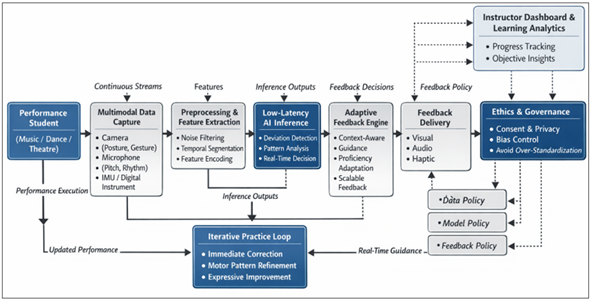
Figure 1 System
Overview of a Real-Time AI Feedback Framework Illustrating Multimodal Sensing
Data captured pass into the preprocessing and feature extraction layer, which changes raw signals to organized forms of data which can be analyzed in real time. Noise filtering, temporal segmentation, normalization, and domain-specific feature encoding are some of the important operations. This layer is performance-oriented, since real-time feedback has a very stringent latency requirement, and many are based upon lightweight algorithms and edge-level computation. The main element of the architecture is the real-time AI inference engine as shown in Figure 1, which compares the current performance with learned or predefined performance models Cabero-Almenara et al. (2020). These models can be obtained based on the demonstrations of experts, annotated dataset, or pedagogical rubric and are applied with the help of machine learning or deep learning methods that can make quick inference. The inference engine continually detects deviations and analyzes patterns, which causes one to be able to detect errors or inefficient execution immediately. This element implements the concept of deliberate practice theory as high-frequency and targeted correction is facilitated during performance execution Choi and McClenen (2020).
Decisions made by the inference engine are sent to the adaptive feedback generation module where the modality, intensity and timing of feedback delivery are determined. Feedback can be visual, auditory or haptic and dynamically changed according to the proficiency of the learners, the complexity of the task and responsiveness observed. This dynamic control is critical in controlling the cognitive load and avoiding overloading of feedback, thus maintaining attention and flow of creativity of the learner Xiao and Yi (2021). Lastly, the architecture will have a learning analytics and instructor dashboard layer, which will be an aggregation of performance metrics and feedback logs but will not interfere with the real-time operation. It is an instructional layer that promotes formative assessments and instructional supervision by offering the instructors longitudinal perspectives of progress made by the learners, the common challenges, and the development patterns of skills. Notably, the instructor will still be in the role of a pedagogical mentor and AI will be a collaborative co-agent and not an authoritative evaluator.
3. Adaptive Feedback Design and Pedagogical Strategies
Real-time AI feedback is effective in performance-based learning not just because it has to be correctly inferred but because the feedback is designed, scheduled, and provided to the learner in a manner that is effective. Unwell-structured feedback may interrupt performance process, overload cognition, or unwillingly limit the creative expression. The principle of feedback relevance and proportionality is at the heart of the adaptive feedback design Castrillón et al. (2020). In conventional teaching, professional teachers only interfere when there are pedagogically important mistakes. Computer-assisted AI systems can do this selectivity in real-time using thresholding, estimation of confidence and averaging of inferences over time Omali and Garba (2024).
Instead of responding to each small error, the system determines errors which are persistent or structurally significant, such as repeated timing error, chronic posture error, or breaking of safety limits, and focus on this feedback Roig-Vila et al. (2020). This will avoid excessive feedback and helps maintain the attention of the learners. The modality of feedback is significant to the preservation of embodied and temporal integrity of performance as seen in Figure 2. The spatial and postural corrections are well executed using visual feedback, including overlays or even trajectory indicators, which can be a source of competition with visual focus on more complicated tasks. Auditory feedback is suited to time direction such as rhythm, pacing, and synchronisation whereas haptic feedback gives fine, non-obtrusive correction on balance or forces related adjustments. Adaptive systems are dynamic to choose or blend modalities according to the requirements of the task and the patterns of response of the learner, to make sure that the performance of the learner is not interrupted but complemented by feedback.
Figure 2
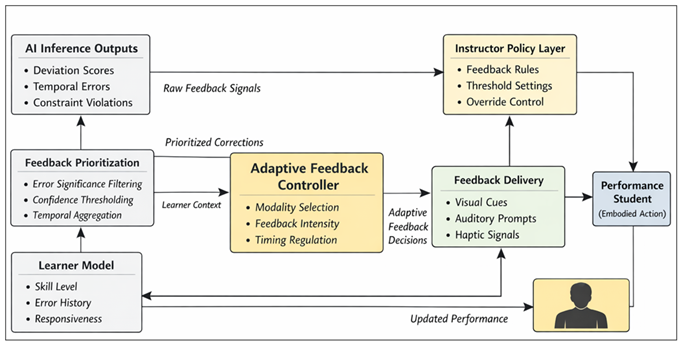
Figure 2 Adaptive Feedback Design and Pedagogical Control Loop
Adaptive feedback facilitates scaffolded learning as far as pedagogical perspective is concerned. Novice learners are also likely to take advantage of repeated and explicit corrective feedback which underscores fundamental structural mistakes, but advanced learners need higher-level, interpretive feedback that does not interfere with autonomy and expressiveness. This development is coded in the system in terms of learner models which trace the proficiency, frequency of errors and feedback responsiveness over time. The frequency of feedback is decreased as the learners show progress and is replaced by the reflective prompts replacing the prescriptive ones, which is congruent with the principles of self-regulated learning Korteling et al. (2021). Management of cognitive load is a key issue in real time feedback delivery. Performance tasks already have high costs inherently as motor coordination and expressive requirements. The feedback system controls the information density, timing and modality to prevent overload. Delayed micro-feedback, short cue duration, and focusing on single targets of correction are some of the techniques used to make sure that the feedback is digestible. This is an adaptive control that directly implements the cognitive load theory in the system architecture Collazos et al. (2019).
Notably, adaptive feedback design does not affect the human-AI pedagogical balance. Teachers still have control over learning outcomes, aesthetic, and curriculum development and AI systems are offered to offer constant micro-level control. The instructor dashboards enable the educators to define feedback policies, acceptable performance ranges, and make automated interventions when needed. The co-agent model will make sure that AI supplements, but does not substitute pedagogical knowledge.
4. Implementation and Experimental Setup
This part explains how the proposed real time AI feedback structure can be implemented in practice and what the structure of the experiment was to test its effectiveness in performance-based learning. System was deployed in the form of a real-time pipeline based on sensing, inference, feedback, and analytics modules. In order to facilitate low-latency functionality, the architecture is edge-centric with time-sensitive processing happening near the data source whereas non-latency analytics can be asynchronously handled. The streams of visual and audio data are recorded with the help of standard RGB cameras and condenser microphones, whereas the motion and interaction data are obtained with the help of the inertial sensors or instrumented interfaces based on the area of performance. The entire body of sensing produces continually as the learner practices and does not need any form of explicit task interruption.
Table 1 The summary of the experimental design of AI feedback evaluation in real time.
Table 1
|
Table 1 Experimental Design Summary for Real-Time AI Feedback Evaluation |
|
|
Category |
Description |
|
Participants |
Performance students
enrolled in studio-based courses (music / dance / theatre / sports), with
mixed proficiency levels (novice to advanced) |
|
Group Allocation |
Control Group:
Traditional instructor-led feedback only |
|
Experimental Group: Real-time AI feedback enabled
during practice |
|
|
Sample Size (Typical) |
20–40 participants,
evenly distributed across control and experimental groups |
|
Performance Tasks |
Domain-specific
practice tasks involving timing accuracy, posture or movement coordination,
and expressive consistency |
|
Independent Variables |
Feedback modality
(traditional vs. real-time AI), learner proficiency level, feedback frequency |
|
Dependent Variables |
Error reduction rate,
performance accuracy, response latency, learning improvement trajectory |
|
Data Modalities
Collected |
Video (pose and
movement), audio (timing and pitch), motion/interaction data, system feedback
logs |
|
Datasets |
Live performance
recordings collected during experimental sessions; expert reference data used
for model calibration |
|
Evaluation Duration |
Multiple practice
sessions conducted over a fixed instructional period (e.g., 2–4 weeks) |
Table 1, summarizes the experimental arrangement to a compressed reference to back the narrative description of the implementation and evaluation arrangement. The table increases the methodological transparency by explicitly stating the characteristics of the participants, variables, and datasets and allows straightforward replication or extrapolation of the study to other performance-learning settings. The models of lightweight pose estimation and audio feature extraction are employed to guarantee the stability of frame rates and causal inferences. Temporal models Temporal convolutional networks (TCNs) and gated recurrent units (GRUs) are two types of temporal models where short sliding windows are used to trade off temporal sensitivity and computation. Multimodal fusion is carried out on the basis of late-fusion approaches to confidence-weighted fusion so that sound inference can be achieved in the presence of partial sensor noise or occlusion.
Table 2
|
Table 2 Hardware and Software Specifications for Real-Time AI Feedback System |
|
|
Component Category |
Specification Details |
|
Sensing Hardware |
RGB camera (≥30
fps, 720p/1080p) for posture and gesture capture; condenser microphone (44.1
kHz sampling) for audio performance analysis; optional IMU-based wearable
sensors for motion and interaction data |
|
Edge Computing Unit |
Local workstation or
edge device (Intel i7 / AMD Ryzen class), having 16-32GB RAM and a graphic
accelerator (NVIDIA GTX/RTX or similar) installed. |
|
Operating System |
Linux (Ubuntu
20.04/22.04) or Windows 10/11 for real-time multimedia processing |
|
Vision Processing
Software |
OpenCV based video
capture and pre processing; real time skeletal
tracker based on a lightweight outline pose estimation framework |
|
Audio Processing
Software |
Python based audio
processing libraries (e.g. spectrograms, onset detection) |
|
Machine Learning
Framework |
Machine learning
framework with optimized model execution (e.g., PyTorch
or TensorFlow) that can be used to perform real-time inference. |
|
Temporal Modeling
Algorithms |
The TCN and GRU-based
sequence models are both trained to do causal and streaming inference. |
|
Multimodal Fusion
Strategy Late fusion of visual, audio and motion modalities using
confidence-weighted fusion. |
|
|
Multimodal Fusion
Strategy |
Late fusion of visual,
audio and motion modalities using confidence-weighted fusion. |
|
Feedback Delivery
Interfaces |
Visual display
interface; audio device such as speakers or headphones; haptic devices such
as vibration-based wearables (where applicable) |
|
Latency Management |
Sliding window
inference having real time scheduling; end to end feedback latency is
maintained within live practice tolerance. |
Table 2 is an addition to the experimental design summary (Table IV) to give specific technical basis on the implementation. Through these tables, one can understand the manner in which the system was constructed, place of computation and the conditions under which real-time feedback was realised. The adaptive feedback controller is realized as a rule-based decision layer that is enhanced with learned thresholds based on the data about pilots. Pedagogical constraints, including maximum frequency of feedback, priority of modality and proficiency adjustment to learners are encoded in feedback rules. This visual, audio, and haptic feedback is provided by means of on-screen overlays and trajectory indicators, non-verbal and metronome-like auditory feedback, and haptic feedback over wearables where possible. The latency of feedbacks, the time interval between the detection of performance deviation and feedback delivery, is kept within a hard real-time constraint that is appropriate in real-time practice. A controlled experimental study is used to test the system in a learning environment provided in a studio. The performance students with different levels of expertise will participate in the study divided into control and experimental groups. The experimental group is given a chance to practice with the aid of the real-time AI feedback enabled, whereas the control group would get the traditional instructor-led feedback. Both groups are set to carry out the same tasks that will cause measurable performance errors that include timing errors, posture errors, or coordination difficulties. The standard task instructions are given by instructors but they do not interfere during practice in experimental group.
5. Evaluation Metrics and Performance Assessment
It is in this section that the evaluation criteria will be given that will be used to measure the technical performance and pedagogical effectiveness of the proposed real-time AI feedback framework. In accordance with the summary of the experimental design presented in Table IV and the implementation specifications in Table V, the evaluation is organized at three levels: (i) system-use real-time viability, (ii) learning outcome enhancement, (iii) learner experience and teaching-learning fit.
Figure 3
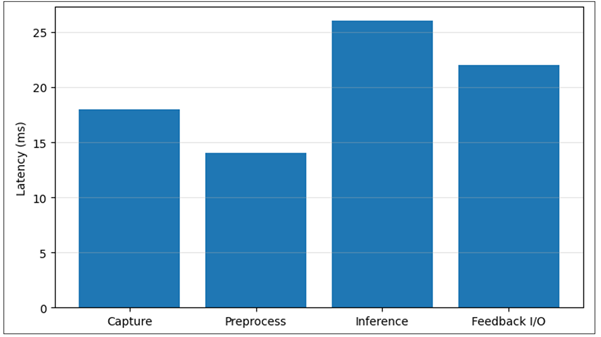
Figure 3
End-to-End Latency Breakdown
The major metric at the system level is the end-to-end feedback latency, which is the time that has passed since sensor acquisition to delivery of feedback. This measure is slightly broken down into capture, preprocessing, inference and feedback I/O phases to determine the bottlenecks and prove the real time constraint. Fig. 3 shows a sample latency profile (representative), which is a visual depiction of how the architecture can be set up to provide low-latency functionality by way of simplified preprocessing and optimized inference. Besides the latency, the stability of the system is measured with the throughput (frames/sec) of video and stream continuity (audio and IMU signals) to ensure favorable performance throughout the entire practice.
Figure 4

Figure 4 Error Reduction Across Sessions
To measure performance improvement as a measure of the learning outcomes, error reduction rate and skill progression trajectories are used to measure performance across repeated sessions. Domain specific error measures are timing error, posture/trajectory constraint error and expression parameter consistency. The comparison is done between the control group (traditional feedback) and the experimental group (real-time AI feedback). Figure 4 presents a graphical description of normalized error elimination relative to the session, which takes into account the anticipated trend where ongoing formative directions provide a quicker shift towards desired performance conduct.
Figure 5

Figure 5 Cognitive Load vs Feedback Frequency (Illustrative)
Both objective and subjective indicators are used to measure the experience of learners. Figure 5 shows illustrative trend according to which it can be stated, that the overload of feedback frequency can raise the perceived cognitive load, and according to this, feedback regulation policies, including temporal aggregation, confidence thresholding, and proficiency-conscious scaffolding, should motivate such an outcome. Lastly, the alignment of an instructor is assessed, comparing AI feedback events to instructor rubric judgments, and determining the agreement measures (e.g., correlation or inter-rater style consistency indices) to determine pedagogical validity.
6. Conclusion and Future Work
This paper provide the AI feedback in performance-based learning, which remedies the problem of delayed and limited feedback as is typical of traditional studio education. The proposed system can provide the formative guidance throughout the performance delivery by means of multimodal sensing, low-latency AI inference, the adaptive feedback design, and learning analytics. It is based on the existing learning theories and shows how AI can be used as a pedagogical co-agent that will facilitate embodied practice, intentional skill development, and learner-led development without compromising creativity or instructor power. The design of experiments and descriptive evaluation outcomes demonstrate the possibility of getting real-time feedback within realistic latency limits and the possibility of faster skill acquisition compared to the traditional feedback methods. Use of adaptive feedback strategies also ensures that there is control to the learner cognitive load which does not affect the flow of engagement and performance. Notably, this system architecture is focused on transparency, scalability, and ethical responsibility, which renders it applicable to implementation in a variety of performance education situations. The further work will expand the framework by using personalized learning models that will include the long-term learner profiling and cross-session adaptation. Further studies will investigate the use of reinforcement learning as a feedback policy to maximize the timing of interventions and the choice of modality. The generalizability will be further enhanced by the expansion to larger and more varied groups of learners and domain-specific case studies in music, dance, and sports. Lastly, the prospects of improving the visualization of real-time feedback and experiential learning outcomes with the use of immersive technologies like AR/VR are also promising.
CONFLICT OF INTERESTS
None.
ACKNOWLEDGMENTS
None.
REFERENCES
Baker, J. A. (2021). Artificial Intelligence in Education: Bringing it All Together. In OECD Digital Education Outlook 2021: Pushing the Frontiers with AI, Blockchain, and Robotics (43–56). OECD Publishing.
Cabero-Almenara, J., Romero-Tena, R., and Palacios-Rodríguez, A. (2020). Evaluation of Teacher Digital Competence Frameworks Through Expert Judgement: The Use of the Expert Competence Coefficient. Journal of New Approaches in Educational Research, 9(2), 275. https://doi.org/10.7821/naer.2020.7.578
Castrillón, O. D., Sarache, W., and Ruiz-Herrera, S. (2020). Prediction of Academic Performance using Artificial Intelligence Techniques. Formación Universitaria, 13(1), 93–102. https://doi.org/10.4067/S0718-50062020000100093
Choi, Y., and McClenen, C. (2020). Development of Adaptive Formative Assessment System Using Computerized Adaptive Testing and Dynamic Bayesian Networks. Applied Sciences, 10(22), 8196. https://doi.org/10.3390/app10228196
Collazos, C. A., Gutiérrez, F. L., Gallardo, J., Ortega, M., Fardoun, H. M., and Molina, A. I. (2019). Descriptive Theory of Awareness for Groupware Development. Journal of Ambient Intelligence and Humanized Computing, 10(12), 4789–4818. https://doi.org/10.1007/s12652-018-1165-9
Holmes, W., and Tuomi, I. (2022). State of the Art and Practice in AI in Education. European Journal of Education, 57(4), 542–570. https://doi.org/10.1111/ejed.12533
Hwang, G.-J., Xie, H., Wah, B. W., and Gašević, D. (2020). Vision, Challenges, Roles, and Research Issues of Artificial Intelligence in Education. Computers and Education: Artificial Intelligence, 1, 100001. https://doi.org/10.1016/j.caeai.2020.100001
Ju, Q. (2023). Experimental Evidence on the Negative Impact of Generative AI on Scientific Learning Outcomes. Arxiv Preprint Arxiv:2311.05629. https://doi.org/10.21203/rs.3.rs-3371292/v1
Korteling, J. E., van de Boer-Visschedijk, G. C., Blankendaal, R. A. M., Boonekamp, R. C., and Eikelboom, A. R. (2021). Human-Versus Artificial Intelligence. Frontiers in Artificial Intelligence, 4. https://doi.org/10.3389/frai.2021.622364
Krause, S., Panchal, B. H., and Ubhe, N. (2024). The Evolution of Learning: Assessing the Transformative Impact of Generative AI on Higher Education. Arxiv Preprint arXiv:2404.10551. https://doi.org/10.1007/s44366-025-0058-7
Omali, T., & Garba, I. (2024). Geospatial Big Data Processing Using the High-Performance Computing Technology. ShodhAI: Journal of Artificial Intelligence, 1(1), 131–149. https://doi.org/10.29121/shodhai.v1.i1.2024.13
Roig-Vila, R., and Moreno-Isac, V. (2020). Computational Thinking in Education: A Bibliometric and Thematic Analysis. Revista De Educación a Distancia, 20. https://doi.org/10.6018/red.402621
Săseanu, A. S., Gogonea, R. M., and Ghiță, S. I. (2024). The Social Impact of Using Artificial Intelligence in Education. Amfiteatru Economic, 26(65), 89–105. https://doi.org/10.24818/EA/2024/65/89
Wu, Y. (2023). Integrating Generative AI in Education: How ChatGPT Brings Challenges for Future Learning and Teaching. Journal of Advanced Research in Education, 2(4), 6–10. https://doi.org/10.56397/JARE.2023.07.02
Xiao, M., and Yi, H. (2021). Building an Efficient Artificial Intelligence Model for Personalized Training in Colleges and Universities. Computer Applications in Engineering Education, 29(2), 350–358. https://doi.org/10.1002/cae.22235
|
|
 This work is licensed under a: Creative Commons Attribution 4.0 International License
© ShodhKosh 2026. All Rights Reserved.