ShodhKosh: Journal of Visual and Performing ArtsISSN (Online): 2582-7472
|
|
The Role of Generative Algorithms in Abstract Sculpture Creation
Amit Wamanrao Bankar 1 , Kiran Ingale 2
 ,
Shailena Verma 3
,
Shailena Verma 3 , Ashwini Dnyaneshwar Bhapkar 4
 , Pooja Srishti 5
 ,
Shanthi R. 6
,
Shanthi R. 6
1 Department
of Mechanical Engineering, Suryodaya College of Engineering and Technology,
Nagpur, Maharashtra, India
2 Department
of E and TC Engineering, Vishwakarma Institute of Technology, Pune,
Maharashtra, 411037, India
3 Basic Science and Department of Humanities (Department of
Electronics and Telecommunication Engineering), Shri Shankaracharya Institute
of Professional Management and Technology, Raipur, Chhattisgarh, India
4 Department of Computer Engineering, Bharati Vidyapeeth's College of
Engineering, Lavale, Maharashtra, India
5 Assistant Professor, School of Business Management, Noida
International University, Greater Noida, 203201, India
6 Assistant Professor and HOD, Meenakshi College of Arts and Science,
Meenakshi Academy of Higher Education and Research, Chennai, Tamil Nadu,
600080, India
|
|
|
ABSTRACT |
|
|
Increasingly,
the effects of computational exploration of form, structure and materiality
are being felt even in the realms of contemporary abstract sculpture due to
the availability of generative algorithms that allow exploration of form,
structure and materiality to levels previously impossible in the realm of
manual sculptural practice. In this paper, the authors explore the
contribution of generative algorithms to the creation of abstract sculptures,
and discuss how rule-based, evolutionary, learning-based, and hybrid
computational methods assist in the creation of complex and emergent
sculptural objects. The paper gives a coherent approach to the generative
pipeline, including algorithmic form generation, computational
representation, human-algorithm co-creation, and digital fabrication. To
facilitate the systematic analysis and comparison, a common evaluation
methodology is proposed that integrates aesthetic evaluation, assessment of
novelty and diversity, structural feasibility, preparedness of fabrication,
performance of materials, as well as usefulness of the process. The paper
also contends on the implications of educational and studio practices, which
explore system-based learning by integrating interdisciplinary practices
alongside the importance of learning, which revolves around exploration, in
sculpture learning. The problem of authorship, interpretability, bias in the
dataset, and sustainability are addressed critically, and the directions of
further research are described. In sum, the paper frames generative
algorithms as collaborative generators of expressive and conceptual range of
abstract sculpture with the primary emphasis on the human artistic will. |
|||
|
Received 08 September 2025 Accepted 04 December 2025 Published 17 February 2026 Corresponding Author Amit
Wamanrao Bankar, amitb9275@gmail.com DOI 10.29121/shodhkosh.v7.i1s.2026.7078 Funding: This research
received no specific grant from any funding agency in the public, commercial,
or not-for-profit sectors. Copyright: © 2026 The
Author(s). This work is licensed under a Creative Commons
Attribution 4.0 International License. With the
license CC-BY, authors retain the copyright, allowing anyone to download,
reuse, re-print, modify, distribute, and/or copy their contribution. The work
must be properly attributed to its author.
|
|||
|
Keywords: Generative Algorithms, Abstract Sculpture,
Computational Creativity, Human -Algorithm Co-Creation, Digital Fabrication,
Generative Art, Evaluation Framework |
|||



1. INTRODUCTION
The abstract sculpture is traditionally used as the means of discovering the form, space, material, perception beyond the representational limitations. Abstract sculpture is based on modernist art trends of the twentieth century through its focus on conceptual expression, reductionism with geometric forms, and experimental work with materials. Historically, the invention of these works depended more on the intuition of the sculptor, the manual ability and the physical interaction with the materials through the repetition. Nevertheless, the fast development of computational technologies has initiated some new paradigms of form generation, which essentially redefines the practice of sculpture. Of such, generative algorithms have become an effective toolkit to create complex, intuitively non-intuitive, and emergent abstract forms, which are beyond the scope of human imagination itself Goodfellow et al. (2025). Computational procedures that generate forms, autonomously or semi-autonomously, are called generative algorithms, and are based on some mathematical models, stochastic processes, or learning data representations. Rule-based systems, evolutionary computation, and deep generative models are some of the techniques that allow exploring a large range of design space by varying and optimizing Leong and Zhang (2025). These algorithms are used in the context of abstract sculpture to support the creation of complex geometries and organic forms and dynamic spatial associations that would be hard or impossible to imagine by hand. Consequently, both art, computation, and engineering are becoming convergent in sculpture as illustrated below in Figure 1. It is also the redefinition of the role of the artist through the incorporation of the generative algorithms in the processes of sculpting. Instead of performing the purely formal task of a form-maker, the sculptor takes the responsibility of a system designer, curator, and evaluator, setting limitations and influencing algorithmic action and choosing the results according to aesthetic and conceptual will Shao et al. (2024). The change predicts a paradigm of human algorithm co-creation, in which the creative authority between the computational systems and the human judgment is shared. This practice continues to complicate traditional conceptions of authorship, originality and artistic control and poses significant theoretical and ethical issues in the practice of contemporary art Leong and Zhan (2025).
Figure 1
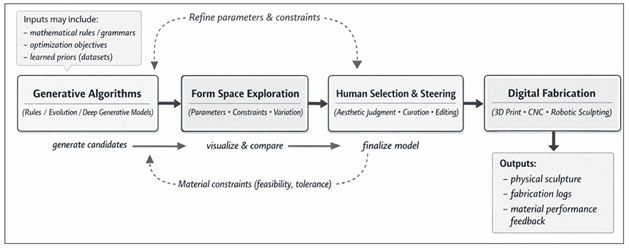
Figure 1 Conceptual Pipeline for Generative Abstract Sculpture Creation
These algorithms search a high dimensional form space with a variety of abstract geometries generated by varying parameters and recomputing. The human selection and intervention phase is the artist-in-the-loop in which aesthetic judgment and conceptual intent and constraint guiding choice, refinement or recombination of generated forms are involved Lou (2023). Lastly, the chosen digital models are converted to physical objects using digital fabrication methods like additive manufacturing, robotic sculpture or CNC milling which allows physical objects to embody computational abstraction. The paper fills these gaps by analyzing the place of generative algorithms in the creation of abstract sculptures in a systematic way, including algorithmic conceptualizations, human-AI interface, digital manufacture, and assessive models Sheikh et al. (2023). The main value of the work is that it introduces the connection between computational approaches and the sculptural discussion as it provides an organized view that is not only able to promote artistic work but can also be used in cross-disciplinary studies.
2. Theoretical Foundations of Generative Art and Abstract Sculpture
Generative art and abstract sculpture come together theoretically in the intersection of common interests in form, autonomy, process, and emergence. Since the beginning of the twentieth century, abstract sculpture has ceased to follow mimetic depiction and has engaged in the exploration of geometry, rhythm, materiality, and space Simone et al. (2021). This trend prefigured process and concept, as opposed to depiction, which provided fertile soil in the post-computational methods to come. Generative art on the other hand, has its roots in systems theory, mathematics and algorithmic logic whereby works of art are created by processes using rules which can produce more than one result. In the case of sculpture, these traditions converge upon the concept that form can emerge out of controlled procedures and not out of manual authorship Aldoseri et al. (2024). The key conceptual component of generative art theory is the concept of procedural autonomy, where the artist sets up a system, which can be a set of rules, constraints, learning systems and so forth, and lets it run to some extent by itself. The initial forms of generative practice used deterministic rules and randomness to bring variation and place an emphasis on emergence as a value of aestheticism. In abstract sculpture, related concepts have been used in the past such as modular construction, repetition, and serial variation Santaella (2023). These practices are formalized in generative algorithms, where abstraction can be studied as a space of possibilities to be navigated and not in a form that is arrived at.
Figure 2
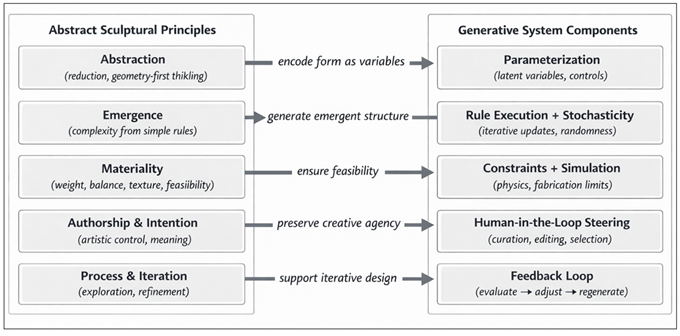
Figure 2 Mapping Abstract Sculptural Principles to Generative System Components
Another theoretical aspect is authorship and originality. Generative abstract sculpture also assigns authorship to the design of the generative system as well as the final object. This re-evaluation is echoed in the current art thinking that is becoming more and more open to the realms of process, interactivity and systems as artistic expression Relmasira et al. (2023). The abstract sculptural object turns into a material record of a computational process that is still going on instead of a unique, static object represented below in Figure 2. Lastly, theoretical backgrounds are applied to pedagogy and interdisciplinarity. Our generative learning techniques are consistent with the constructivist approach to learning, where a person is encouraged to experiment, iterate, and evaluate critically. Locating the abstract sculpture in the context of computational and systems-based processes, generative algorithms offer a conceptual system of help between artistic intuition and formalized thinking. Such theoretical foundation is necessary not only to comprehend the way that generative sculptures are created, but also to realize why this kind of practice is a significant shift in the modern discourse of sculptures Albar (2024).
3. Generative Algorithms for Sculptural Form Synthesis
The computational core of modern abstract sculpture generation is made up of generative algorithms which allow systematic discovery of rich form space through programmable logic, adaptive processes and learned representations. In contrast to classical methods of sculpture, in which a form is created by simply manipulating material physically, generative methods externalize form-making to algorithmic systems that can create large families of variations Caetano et al. (2020). This change is to enable abstraction to be viewed as an ongoing space of potential morphologies, ruled by rules, parameters and constraints. In this paradigm, sculptural synthesis is a generative process of navigation and generative shaping as opposed to a generative construction of geometry. One of the earliest and conceptually parallel systems to abstract generation of sculptures is the rule-based and grammar-driven ones De et al. (2022). Formal logic has been represented in recursive production rules in techniques like shape grammars and Lindenmayer systems, and has been used to generate modular, hierarchical, and frequently highly structured geometries. These systems are especially effective in sculptural work to create rhythmic repetition, branching forms and Hanotia and Satsangi (2025) space growth patterns akin to architectural abstraction or biomorphic forms Ali (2020). Their deterministic character enables an exact control of formal results thus are useful in pedagogical use where the connection between rule definition and the geometry obtained should be clear and understandable.
Figure 3

Figure 3 Different
Algorithm Classes Integrate within A Hybrid System
The generative sculpture algorithms proposed by Stochastic and evolutionary algorithms bring the element of randomness, adaptation, and selection to these algorithms by evolving a population of forms by mutating and crossbreeding them and by evaluating their fitness. This methodology is compatible with the focus on emergence and non-linear exploration of abstract sculpture, and allows all the unexpected geometries to be used, maximizing the properties of balance, stability, and spatial distribution as shown below in Figure 3. In this respect, the artist sets fitness standards and leads the process of selection, perpetuating a human-algorithmic process of co-creation. Sculptural synthesis can be extended to high-dimensional latent spaces based on the learning-based generative models Generative Adversarial Networks and diffusion models, which allow sculptural synthesis to interpolate and hybridize between fluid and organic forms. Nonetheless, they do not allow much interpretability, which requires latent navigation/constraint-based refinement tools Yu (2023). Parametric, evolutionary, and learning-based approaches are merged in hybrid generative systems to find a balance between control and emergence to place generative algorithms as auxiliaries to art practice as opposed to substitutes.
4. Computational Representation and Geometry Processing
The quality of generative algorithms in abstract sculpture heavily relies on the computation of sculptural form. Computational representation provides an interface between algorithmic reasoning and physical implementation, and has an effect on the expressiveness, structural consistency, and manufacturability. Abstract sculpture unlike two dimensional generative art has to have representations that facilitate volumetric logic, spatial continuity, and material translation and so geometry processing becomes a fundamental part of the generative pipeline. The mesh based representations are simple to use because of the compatibility with modeling and fabrication tools, giving excellent control of the surface curvature and details with improve ability of surfaces through the use of vertices, edges and faces. Meshes however have topological problems like self-intersections, non-manifold geometry that need to be cleaned up and validated prior to fabrication. An alternative to grid representations is voxel-based and volumetric representations, which are focused on mass and solidity, allow Boolean operations, growable forms, and internal representations. These representations are compatible with additive manufacturing naturally and have only a limit of the resolution which, unless augmented by more computer power, can diminish fine detail.
Figure 4
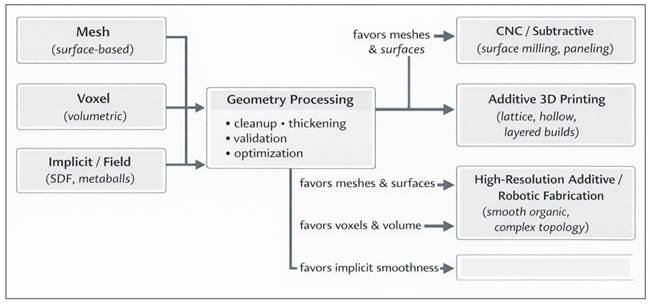
Figure 4 Workflow
Linking Computational Representation Choices to Fabrication Outcomes in
Generative Abstract Sculpture
Workflow diagrams Software architecture Representations Empirical research Latent representations Enhancing models Computational aesthetics In Silico aesthetics Generative art Generative art Editing Systems Generative art Heuristic techniques Generative art Architecture Generative art Sketches Generative art Synthesis Generative art animation Generative art control Generative art quantification Generative art control Generative art fabrication Generative art modeling Generative art synthesis Generative art reconfiguration Generative art arcading Generative art we.
The diagram also shows how various geometric representations have a direct effect of influencing downstream fabrication processes and material realization. Mesh-based representations are conducive to surface-driven abstraction, and are very much applicable to CNC milling and surface-based 3D printing, but demand some careful validation of topology as shown below in Figure 4. Voxel representations put more emphasis on mass and internal structure (volumetric) and are inherently aligned with the methods of additive manufacturing and the lattice-based sculptures. Field-based representations and implicit representations allow free-flowing and organic morphologies and continuity of topology, and are especially useful in irregular complex sculptures produced by high-resolution additive or robotic processes. Geometry processing provides a mediating interface between computational form of abstraction and fabrication-ready artifacts through imposing constraints of scale, thickness and structure.
Signed distance functions and meatballs are implicit and field-based representations that have become increasingly popular in recent generative systems of sculpture, because of their mathematical beauty and topological versatility. These images make form a continuous scalar field as opposed to literal surfaces and permit organic transitions, smooth blending and topology-preservation deformation. In the case of abstract sculpture, implicit modeling aids in the modeling of fluid morphologies and non-linear spatial transformations which are not easily modeled using traditional meshes. Such techniques of geometry processing as iso-surface extraction then translate these fields into models ready to be fabricated. In all paradigms of representation, geometry processing is very crucial in imposing constraints on aspects of scale, balance, structural integrity, and material behavior. Smoothing, decimation, thickening and stress-aware optimization are some examples of the operations that keep the generative products loyal to the sculptural intent without compromising the physical and fabrication criteria. In this way, the concept of computational representation is not only a technical but a conceptual option, it determines how the concepts of abstraction, materiality and process are coded in the generative sculpture systems.
5. Human–Algorithm Co-Creation in Abstract Sculpture
The introduction of generative algorithms to abstract sculpture revolutionarily changes the creative experience of a humanity-only activity, of making forms, into a form of cooperation between the intent and the agency of computation. Instead of substituting the sculptor, algorithmic systems are creative partners which lengthen perceptual range, speed of exploration, and non-intuitive formal possibilities. This paradigm of co-creation between humans and algorithms places the artist as a participant in the entire generative pipeline, meaning, designing systems, guiding outputs, and managing outputs, but leaves algorithms to work independently within set limits. The first level of co-creation is the one in which the sculptor creates the generative structure by setting out rules, parameters, datasets, or optimization goals. Artistic intent is coded into these design choices and the space of possible forms is determined in advance of the production of any geometry. In the generation of forms, interactive interfaces and visualization tools allow the artists to explore variations, compare alternatives and interfere in real time. The generative space is easily accessible to high dimensions using a set of parameter sliders, evolutionary selection algorithms and latent-space navigation to allow visual access to the computational abstraction of high-dimensional generative spaces without necessarily using low-level programming at all steps.
Figure 5

Figure 5 Unified Evaluation Framework for Generative Abstract Sculpture
The phase of selecting and refining is the most critical when human judgment should be involved. Algorithms can be used to generate a high number of candidate forms, but do not put any contextual comprehension to cultural meaning, intent symbolic meaning, and experiential aesthetics. The sculptors are thus viewed as curators and they sieve the output of algorithms using subjective elements like balance, tension, rhythm, and emotional resonance as shown below in Figure 5. Table 1 is a summary of the prevailing forms of human interaction in most of the major classes of generative algorithms applied to abstract sculpture, as the role of the sculptor has transformed, as system designer and system curator. This is a selective process that converts raw generative output into sculptural propositions that are in line with the artistic vision. In evolutionary systems, these types of feedback can be represented as fitness evaluation, but in learning based systems they can be represented as manual curation and retraining.
Table 1
|
Table 1 Modes of Human Interaction Across Generative Algorithm Classes in Abstract Sculpture |
|||
|
Algorithm Class |
Primary Role of the
Sculptor |
Mode of Interaction |
Typical Sculptural
Outcomes |
|
Rule-Based / Grammar
Systems |
System designer and
formal controller |
Definition of rules,
constraints, recursion depth, and parameter tuning |
Structured
abstraction, modular repetition, geometric clarity, predictable variation |
|
Evolutionary
Algorithms |
Curator and selective
evaluator |
Fitness selection,
mutation control, population steering, iterative refinement |
Emergent morphologies,
non-linear forms, optimized balance and spatial distribution |
|
Learning-Based
Generative Models (GANs, VAEs, Diffusion) |
Latent space navigator
and conceptual editor |
Dataset curation,
latent traversal, output filtering, retraining cycles |
Fluid, organic
abstraction, stylistic interpolation, high formal novelty |
|
Hybrid Generative
Systems |
Meta-designer and
process orchestrator |
Coordinated control of
rules, evolution, and learning components with feedback loops |
Balanced synthesis of
control and emergence, fabrication-aware abstraction |
|
Fabrication-Integrated
Generative Systems |
Material-aware
co-creator |
Constraint injection
from fabrication tests, scale adjustment, structural correction |
Material-sensitive
forms, structurally viable abstractions, embodied computation |
Co-creation also brings about the feedback of physical creation and algorithmic development. The concept of material constraints, structural failures, and fabrication artifacts that are seen in the prototyping process, contribute to future modification of generative parameters and constraints. This recycling of interaction makes the sculptural practice embodied so as to hold the computational abstraction to material reality. The resultant work process is a combination of intuition and computation with material experimentation as one creative process. Theoretically, the concept of human-algorithm co-creation threatens the other traditional ideas of authorship and originality. The creative agency is spread out system design, algorithmic execution, and human evaluation and the role of the sculptor is redefined as both a creator and meta-designer. This collaborative model, in abstract sculpture, does not only widen formal possibilities, but also creates a modern day paradigm of how to conceive creativity as an emerging quality of human-machines interaction.
6. Digital Fabrication and Material Translation
A digital fabrication is the point of critical transition of generative abstract sculpture between computational possibility and physical reality. Although generative algorithms can be used to create complex and non-intuitive forms and shapes, the artistic and experiential worth of these ideas is achievable only through material embodiment. Digital fabrication technology e.g. additive manufacturing, CNC machining and robotic sculpting acts as intermediaries between abstract computational geometry and the material sculptural objects. This is not only a technical process of translation, but also a fundamental distortion of form, scale, texture and perception, which will ultimately affect the final aesthetic and conceptual effect of the sculpture. With its ability to produce complex geometries, internal space, and organic structures, additive manufacturing, and more specifically three-dimensional printing, has become a prevailing fabrication technique of generative sculptures. Layer-by-layer production is compatible with the voxel based and implicit representations, and allows the generation of lattice structures, porous volumes and topological transitions that are smooth, and challenging to make in subtractive methods. Additive processes in abstract sculpture aid experimentation with materials at varying scales, both in small types of maquettes to conceptually validate a project and in large-scale installations built out of modular prints. Nevertheless, print resolution, material strength and volume limitations require meticulous incorporation of print parameters that are fabrication conscious during the generative design phase.
Table 2
|
Table 2 Mapping Digital Fabrication Methods to Geometric Representations and Materials in Generative Abstract Sculpture |
|||
|
Fabrication Method |
Preferred Geometric
Representation |
Compatible Materials |
Sculptural Affordances |
|
Additive Manufacturing
(3D Printing) |
Voxel-based, Implicit
/ Field-based |
Polymers, resins,
composites, metals (powder-based) |
Complex internal
structures, porous volumes, organic morphologies, high formal freedom |
|
CNC Milling
(Subtractive Fabrication) |
Mesh-based, Surface
models |
Wood, stone, metal,
foam |
Surface precision,
material expressiveness, structural solidity, scale continuity |
|
Robotic Additive
Fabrication |
Implicit /
Field-based, Hybrid representations |
Clay, concrete,
polymers, recycled composites |
Large-scale
abstraction, continuous deposition, spatial fluidity |
|
Robotic Subtractive
Fabrication |
Mesh-based with
segmented surfaces |
Stone, wood, metal
blocks |
Expressive tool marks,
controlled material removal, gestural abstraction |
|
Hybrid Fabrication
(Additive + Subtractive) |
Hybrid (Voxel + Mesh +
Implicit) |
Multi-material
composites, metal–polymer systems |
Fine detail with
structural refinement, fabrication-aware abstraction |
Table 2 abstracts the correlation between digital fabrication processes, geometrical representation and choice of materials and how representational choices affect the sculpture and material implementation in terms of affordances. Subtractive methods of fabrication are still very relevant to abstract sculpture, especially where one is dealing with traditional materials, like stone, wood, or metal. These processes prefer surface-based representations and need a clear understanding of tool paths, accessibility and strategies of removing material. Generative algorithms need to be thus modified to generate geometries that can be fabricated by subtractive logic, typically by simplifying surfaces or segmenting them, or penalizing them. The issues of material translation also include the reflexion of surface finish, texture, weight distribution and a durability that determine the perception and experience of abstract forms. Digital fabrication therefore provides the space of intersection of algorithmic abstraction, the judgment of humans and material reality.
7. Evaluation Metrics for Generative Abstract Sculpture
There is a fundamental difficulty of evaluating generative abstract sculpture because the quality of art is a subjective measure and the behavior of an algorithmic system is emergent. Sculptural works cannot be evaluated by only using functional performance or numerical optimization as is the case with conventional engineering artifacts. Rather, in generative sculpture it is necessary to incorporate aesthetic assessment, constructive viability, originality and conceptual integration to combine qualitative evaluation with selective quantitative measurements. It is necessary to create such hybrid evaluation systems to test generative systems, compare algorithm strategies, and promote iterative improvement. The aesthetic criticism still plays the key role in abstract sculpture and is generally based on the professional evaluation, peer review, and the evaluation by the curatores. The most frequently used criteria include balance, spatial tension, rhythm, proportional harmony, and perceptual complexity, which are used by sculptors and other art professionals to choose or optimize generative outputs. Aesthetic assessment in human-algorithm co-creation processes is frequently interactive, artists browsing through great quantities of algorithmically produced forms through a series of visual and conceptual resonances. These ratings may be as subjective as they wish them to be, but may be organized using scoring rubrics or through a pairwise comparison to enhance consistency between repetitions.
Figure 6
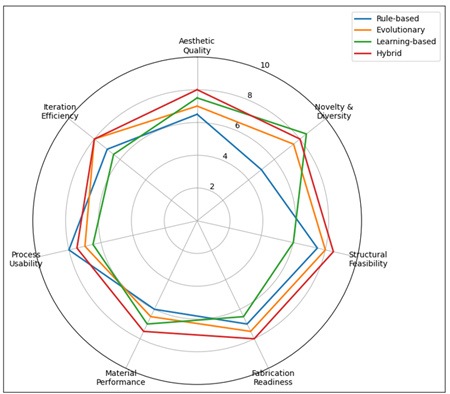
Figure 6 Comparative Evaluation of Generative Algorithm Classes Using Multi-Criteria Metrics
The radar chart (shown in Figure 6) is used in
summarizing the comparative performance of rule-based, evolutionary,
learning-based, and hybrid generative algorithms on major dimensions of
evaluation, that is, aesthetic quality, novelty, structural feasibility,
fabrication readiness, and process usability. This visualization emphasizes the
even-handed nature of the performance of hybrid systems as well as the
trade-offs of control, novelty, and feasibility between classes of algorithms.
In addition to aesthetic judgment, new metrics such as novelty and diversity
develop on the basis of computational creativity research can provide
quantitative information about generative performance. Diversity of
populations, form variance, and distance of latent or parameter space are some
of the measures used to determine whether a system is searching a large design
space or is prematurely terminating. Such measures are especially useful in
abstract sculpture, in which evolutionary and learning-based algorithms are
assessed, where too much convergence may restrict the creative space. The
metrics of novelty, though, should be taken with reservations, because when the
formal deviation is high it is not always an indication of an artistic value.
Figure 7
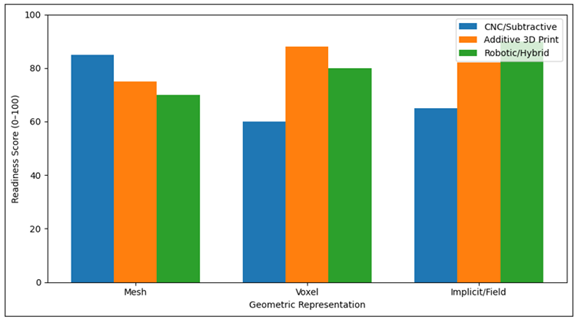
Figure 7 Fabrication Readiness of Geometric Representations Across Fabrication Methods
This bar chart is in the form of a grouped bar chart as shown in Figure 7 comparing fabrication readiness scores of mesh, voxel and implicit representations of CNC machining, additive manufacturing and robotic fabrication. The findings demonstrate the direct relationship of the choice of representation with manufacturability and material compatibility in the workflow of generative abstract sculpture creation. The generative sculptures have to meet requirements of stability, material strength and manufacturability constraints. Numerical measures like minimum wall thickness, angles of overhang, centrally mass positioning, and stress field give objective measures as to whether algorithmic forms can be physically produced.
Figure 8
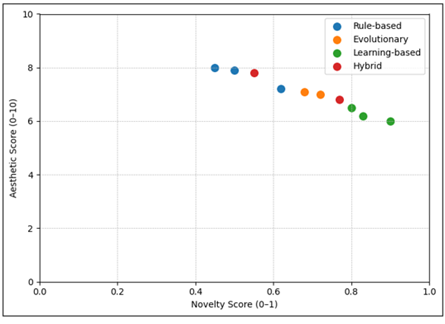
Figure 8 Relationship
Between Novelty and Aesthetic Quality in Generated Abstract Sculptures
This scatter plot as shown in Figure 8, visualizes the trade-off between novelty and aesthetic quality of individual generated sculptures, with the points clustering by algorithm class. The distribution displays the clustering behavior and indicates that increased novelty does not necessarily increase the liking and that multi-criteria assessment is necessary. The metrics are particularly relevant within workflows whereby a fabrication feedback mechanism is considered a part of generative loops and allows rejecting or altering infeasible designs early in the design process.
8. Conclusion
Generative algorithms have become a powerful tool in modern abstract sculpture, extending sculptural practice past the use of manual form-making methods to a situation where computer-based exploration and human-machine collaboration are used. This enables artists to work within the space of complex forms and to explore new abstractions not easily accessible in traditional methods alone as these systems make it possible to engage in generation, evolutionary adaptation and learning-driven synthesis. This paper has emphasized the role of generative algorithms in conjunction with the right geometric model, digital fabrication method, and the presence of a human in the loop in developing a unified pipeline between computational abstraction and material actualization. The suggested unified assessment system is also an indication that the success of generative sculpture hinges on the existence of a balance between aesthetic evaluation, structural viability, material behavior, and process utilization based on the feedback and repetition. Comprehensively, generative algorithms do not substitute the role of the sculptor, but instead reinvent it, making the artist a designer of a system, a curator and a critical viewer. As a long term and interdisciplinary way of progressing abstract sculpture both in research and education, generative approaches provide a sustainable and ethical course of action.
CONFLICT OF INTERESTS
None.
ACKNOWLEDGMENTS
None.
REFERENCES
Albar Mansoa, P. J. (2024). Artificial Intelligence for Image Generation in Art: How Does it Impact the Future of Fine Art Students? Encuentros, 20, 145–164.
Aldoseri, A., Al-Khalifa, K. N., and Hamouda, A. M. (2024). AI-Powered Innovation in Digital Transformation: Key Pillars and Industry Impact. Sustainability, 16(4), 1790. https://doi.org/10.3390/su16051790
Ali, M. (2020). The Human Intelligence vs. Artificial Intelligence: Issues and Challenges in Computer Assisted Language Learning. International Journal of English Linguistics, 8(5), 259. https://doi.org/10.5539/ijel.v8n5p259
Caetano, L., Santos, L., and Leitão, A. M. (2020). Computational Design in Architecture: Defining Parametric, Generative, and Algorithmic Design. Frontiers of Architectural Research, 9(2), 287–300. https://doi.org/10.1016/j.foar.2019.12.008
De Crescenzio, F., Fantini, M., and Asllani, E. (2022). Generative Design of 3D-Printed Hands-Free Door Handles for Reduction of Contagion Risk in Public Buildings. International Journal of Interactive Design and Manufacturing, 16, 253–261. https://doi.org/10.1007/s12008-021-00825-6
Goodfellow, J., Pouget-Abadie, M., Mirza, B., Xu, D., Warde-Farley, D., Ozair, S., Courville, A., and Bengio, Y. (2025). Generative Adversarial Networks. Communications of the ACM, 63(11), 139–144. https://doi.org/10.1145/3422622
Hanotia, T., and Satsangi, P. (2025). Professional Opportunities IN Influencer Marketing and Financial Content CreatioN ShodhAI: Journal of Artificial Intelligence, 1(1), https://doi.org/10.29121/ShodhVichar.v1.i1.2025.58
Leong, W. Y. (2025, January 29–February 1). AI-Powered Color Restoration of Faded Historical Painting. In Proceedings of the 10th International Conference on Digital Arts, Media and Technology (DAMT) and the 8th ECTI Northern Section Conference on Electrical, Electronics, Computer and Telecommunications Engineering (NCON) (pp. 623–627). Nan, Thailand. https://doi.org/10.1109/ECTIDAMTNCON64748.2025.10961986
Leong, W. Y., and Zhang, J. B. (2025). AI on Academic Integrity and Plagiarism Detection. ASM Science Journal, 20, 75. https://doi.org/10.32802/asmscj.2025.1918
Leong, W. Y., and Zhang, J. B. (2025). Ethical Design of AI for Education and Learning Systems. ASM Science Journal, 20, 1–9. https://doi.org/10.32802/asmscj.2025.1917
Lou, Y. Q. (2023). Human Creativity in the AIGC Era. Journal of Design Economics and Innovation, 9, 541–552. https://doi.org/10.1016/j.sheji.2024.02.002
Relmasira, S. C., Lai, Y. C., and Donaldson, J. P. (2023). Fostering AI Literacy in Elementary Steam Education in the Age of Generative AI. Sustainability, 15(18), 13595. https://doi.org/10.3390/su151813595
Santaella, L. (2023). Is Artificial Intelligence Intelligent? São Paulo, Brazil: Almedina.
Shao, L. J., Chen, B. S., Zhang, Z. Q., Zhang, Z., and Chen, X. R. (2024). Artificial Intelligence Generated Content (AIGC) in Medicine: A Narrative Review. Mathematical Biosciences and Engineering, 21(2), 1672–1711. https://doi.org/10.3934/mbe.2024073
Sheikh, H., Prins, C., and Schrijvers, E. (2023). Artificial Intelligence: Definition and Background. In Mission AI: Research for Policy (pp. 25–37). Cham, Switzerland: Springer. https://doi.org/10.1007/978-3-031-21448-6_2
Simone, C., Cerquetti, M., and La Sala, A. (2021). Museums in the Infosphere: Reshaping Value Creation. Museum Management and Curatorship, 36(4), 322–341. https://doi.org/10.1080/09647775.2021.1914140
Yu, H.-C. (2023). The Impact of Artificial Intelligence Images Application on Creative Performance of Elementary School Senior Students in Art Courses (Master’s Thesis). National Ilan University, Yilan, Taiwan.
|
|
 This work is licensed under a: Creative Commons Attribution 4.0 International License
© ShodhKosh 2026. All Rights Reserved.