ShodhKosh: Journal of Visual and Performing ArtsISSN (Online): 2582-7472
|
|
Parametric Modeling and AI in Modern Sculpture Education
Dr. J. P. Bhosale 1 , Dipti Ganesh Korwar 2
 ,
Shweta Goyal 3
,
Shweta Goyal 3 , Neha 4
 ,
Manoj Kumar Singh 5
,
Manoj Kumar Singh 5 , Kiran Shyam Khandare 6
1 Professor and Head, Research Centre in
Commerce and Management, Gramonnati Mandal's Art's
Commerce and Science College, Narayangaon, Pune,
Maharashtra, India
2 Department of Engineering, Science and
Humanities, Vishwakarma Institute of Technology, Pune, Maharashtra, 411037,
India
3 Department of Electrical Engineering, Graphic Era Deemed to be
University, Dehradun, Uttarakhand, India
4 Assistant Professor, School of Business Management, Noida
International University, Greater Noida, 203201, India
5 Department of Computer Science and Engineering, Shri Shankaracharya
Institute of Professional Management and Technology, Raipur, Chhattisgarh,
India
6 Assistant Professor, Department of Computer Technology, Yeshwantrao Chavan College of Engineering, Nagpur, India
|
|
|
ABSTRACT |
|
|
The use of
parametric modeling and artificial intelligence (AI) is quickly transforming
the current education of sculpture by bringing in computational practices
that create expansions of formal inquiry, material cognition, and design
practice that reflects. In this paper, the authors explore how parametric
modeling and AI-driven approaches can be taken into consideration in the
field of contemporary sculpture lessons and to place these technologies as
the complementary, but not substitutive, tools of human artistic authority.
The paper follows the history of computer-assisted sculptural work, analyzes
the most important parametric and AI algorithms to create forms and suggests
a hybridized parametric-AI design pipeline, which can be applied to the
studio learning setting. Structured evaluation metrics, where creativity,
formal complexity, and technical performance are related, are used to analyze
experimental sculptural prototypes, with the help of visual analytics. The
paper addresses pedagogical issues, authorship, and the technological
restrictions that are connected with AI-aided
sculpture education. Placing parametric modeling and AI into a cognitive and
creative collaboration in the sculptural practice, this work adds a
systematic instructive approach in training future sculptors to work in
digitally enhanced and interdisciplinary creative contexts. |
|||
|
Received 17 September 2025 Accepted 21 December
2025 Published 17 February 2026 Corresponding Author Dr. J. P.
Bhosale, drbhosalejp@gmail.com DOI 10.29121/shodhkosh.v7.i1s.2026.7077 Funding: This research
received no specific grant from any funding agency in the public, commercial,
or not-for-profit sectors. Copyright: © 2026 The
Author(s). This work is licensed under a Creative Commons
Attribution 4.0 International License. With the
license CC-BY, authors retain the copyright, allowing anyone to download,
reuse, re-print, modify, distribute, and/or copy their contribution. The work
must be properly attributed to its author.
|
|||
|
Keywords: Parametric Modeling, Artificial Intelligence,
Sculpture Education, Computational Creativity, Human–Machine Co-Creation,
Generative Design, Digital Fabrication |
|||



1. INTRODUCTION
The revolution in the field of modern sculpture education is based on the developments in the sphere of computational design and artificial intelligence (AI). Sculpture is traditionally based on the craftsmanship of the hand, intuition of material and experimentation with the touch, sculpture pedagogy has historically focused on physical contact with form, mass and space. Although these foundations are still crucial, the growing sophistication of the modern artistic representation and fabrication technology has widened the boundaries of the sculptural practice into the domain of the exact manual procedure Chen et al. (2023). Profitability of sculptors Sculptors are now provided with a new way of thinking with parametric modeling and AI-based design systems that allow them to create, assess, and refine rich forms that would not be possible without conventional methods. Parametric modeling is a form of sculptural geometry that defines sculptural geometry through rule-based creation, whereby sculptural geometry is defined by adjustable parameters, constraints, and relationships, as opposed to fixed shapes Rahimi et al. (2022). Such a change of object to process design is believed to guide students towards a more constructive attitude to sculpture as a dynamic system and promotes learning more about geometry, structure and material behavior. Manipulation of parameters allows large design spaces to be explored by learners, form variation to be studied, and sensitivity to the effect of small changes on global sculptural outcomes to be developed. Parametric thinking encourages exploratory learning, algorithmic thinking and trial and error in the education world, which are all becoming more and more valuable in the practice of contemporary art and design Yu and Hu (2025).
Figure 1
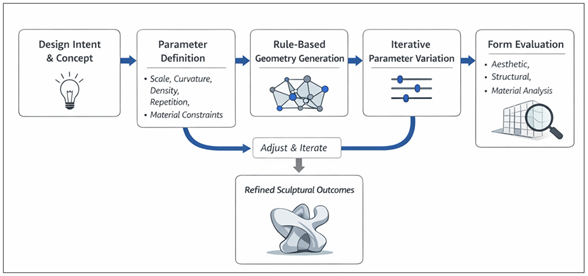
Figure 1 Evolution of sculptural pedagogy from manual craftsmanship to parametric modeling and AI-assisted co-creation.
This number shows how sculpture education has been evolving gradually towards the replacement of traditional poly-manual artisanism by computational and AI-guided processes. The manual phase puts focus on the tactile abilities, material intuition, and direct interaction with the tool of the hand, as the basic pedagogy of sculpture. The parametric phase brings in the geometrical rules and the variable control, which allows exploring the form, structural reasoning and material restraints systematically with the help of computational representation as shown above in Figure 1. The stage with AI assistance encompasses this paradigm with conceptual support based on data-driven intelligent, generative algorithms, and optimization approaches to creative exploration and informed decisions Cetinic and She (2022). A combination of the stages brings out a change of object-based making to process-based and co-creative workflows, whereby human artistic agency is complemented, but not replaced, by computational systems Song et al. (2022)
The paper examines the application of parametric modeling and AI in current sculpture studies through the lens of technology. It considers the history of computational development of sculptural practice, the main parametric and AI methods of interest in the establishment of forms, and how to design hybrid workflows that can be applied in an educational context. Through experimental sculptural prototypes and the human-machine interaction dynamics, the research project is expected to show how the use of computational intelligence can be used to improve sculptural learning without reducing artistic freedom. Finally, the article will be relevant to current debate on how new technologies can be effectively incorporated into art education to equip future sculptors with the digitally enhanced creative space.
2. Parametric Modeling Techniques for Sculptural Form Exploration
Parametric modeling has become a revolutionary paradigm within the contemporary sculpture education, and it essentially redefines the concept of sculptural form as it is being conceived, explored, and developed Ramesh et al. (2022). In contrast to traditional digital modeling methods where emphasis is made on building fixed geometries of models, parametric modeling is modeled by the direct definition and description of variables, constraints, and rules of relations that determine the form creation. In this paradigm, objects of sculptures are seen as dynamic systems that can generate a broad spectrum of variations of forms based on one logic instead of being just the final result.
Table 1
|
Table 1 Parametric Modeling Techniques and Associated Learning Outcomes in Sculpture Education |
|||
|
Parametric
Technique |
Technical
Description |
Learning
Focus |
Key
Learning Outcomes |
|
Parameter-Based
Scaling & Proportion Control Al Darayseh
(2023) |
Adjustable
numerical variables controlling size and ratios |
Spatial
reasoning |
Improved
understanding of proportion and scale relationships |
|
Rule-Based
Geometry Construction Chen et al. (2023) |
Encoding
form logic through explicit rules |
Algorithmic
thinking |
Ability
to translate artistic intent into computational logic |
|
Procedural
Surface Generation Chiu et al. (2022) |
Mathematical
generation of complex surfaces |
Form
abstraction |
Exploration
of non-linear and emergent sculptural forms |
|
Iterative
Parameter Variation Hill and West (2020) |
Real-time
modification of parameters |
Reflective
experimentation |
Development
of iterative design and hypothesis testing skills |
This change has a strong pedagogical implication, in that it helps to promote the idea of sculpture as an exploratory and process-based discipline instead of an outcome-oriented craft. Technically, parametric modeling is based on algorithmic descriptions of geometry where parameters, including scale, curvature, density, repetition and material constraints, may be set in real time. Various techniques, such as rule-based geometry construction, procedural surface generation, modular aggregation and constraint-driven deformation present students with a chance to explore complex and non-linear forms that would not be easy to create using manual modeling. The systematic manipulation of the values of the parameters allows the learners to explore the impact local variations have on the global behaviour of the sculpture, thus, forming a more profound knowledge of the relationships of geometry, logic of structure, and coherence of the composition. Parametric learning aids reflective and iterative learning in a pedagogical perspective. It is also desired that students should come up with hypotheses, tune parameters, test emergent forms and to optimize design logic through repeated round trips of experimentation Lin et al. (2023). This goes hand in hand with the constructivist theories of learning and the knowledge is constructed in an active manner through exploration and feedback. Besides that, parametric workflows also enable the visibility of the creative process, where the design intent is directly coded in the computational rules that can be reviewed and criticized and edited. It results in a more transparent peer instruction, instructor commentary and critical dialogue within the studio instructional environments Zhu et al. (2022). The applicability of the parametric modeling to learning is also explicable in the sense of how the various methodologies of individuals can be transformed to learning outcomes. The parametric modeling methods are correlated in Table 1 along the pedagogical focus and the learning advantages and it is observed that parametric workflows may be applied both as technical methods of form generation and as learning frameworks.
3. Hybrid Parametric–AI Design Pipeline
Combining parametric modeling and artificial intelligence results in a hybrid design pipeline which is a combination of deterministic control with adaptive intelligence. This pipeline as a conceptual model in sculpture art training suggests a stylized but adaptable empennage where parametric machine to architectural space constitutes a system of product coherence, whereas AI techniques work discontinuously inside and outside this space to aid exploration, judgment, and development. Instead of viewing parametric modeling and AI as distinct phases of the process, the hybrid pipeline adjacent to one another presents them as complementary entities in one creative process Zhou et al. (2024). Design intent is generally parameterised and encoded into constraints, rule-based relationships and parameters which make up the pipeline starting with conceptual framing and parametric definition; in which students describe design intent and encode it into parameters. This step makes sure that artistic vision, geometric reasoning, materiality and fabrication limits are clearly demonstrated Ranieri et al. (2021). The parametric modeling therefore offers transparency and control that permits the learner to interpret the way of form coming out of encoded decisions. The result of this phase is not some singular form of sculptural creation, but a well-organized design space that can produce numerous possibilities.
Figure 2

Figure 2 Hybrid Parametric AI Pipeline Design
The AI techniques are thereafter presented as a layer of exploration and augmentation. Based on parametric variations, precedence sculptures or material-performance simulations, AI models acquire patterns and relationships that are not necessarily obvious to the designer. Generative algorithms may suggest new configurations, and optimization methods can assess forms by existing criteria e.g. structural stability, material efficiency, or aesthetic balance as shown above in Figure 2. It is important to note that AI does not replace parametric logic, only runs it to a larger degree in exploratory mode, and there is conceptual coherence. The key feature of the hybrid pipeline is a human-parametric system feedback loop with AI that is anchored in an iterative loop Sun (2024). This process enhances the reflective practice and critical decision-making, and this is what makes the creative agency always subordinate to the human designer. The pipeline thus helps in the balancing of predictability and emergence in such a way that the students are able to manage the uncertainty and at the same time, the students feel to be in control.
4. Algorithmic Control, Constraints, and Material Intelligence
Preservation of artistic coherence and material viability are finding their way to algorithms and constraint control as sculptural design work processes are increasingly being integrated in parametric modeling and artificial intelligence. Systematic control in the contemporary education of sculpture is the mechanical control over the construction of forms through coded principles, parameters and limits of decisions. Such processes help the student to navigate through complex design space with deliberate intentionality and ensure that conceptual, structural and material objectives are aligned to computational exploration. The impact of limitations is significant in the generation of the outcomes of the algorithmic sculpture. The constraints are actually viewed as generative forces which drive the form to meaningful and both reachable solutions rather than as restricted. In parametric systems, the constraints can either be in the form of geometric limits, proportional limits, symmetry or fabrication limits as shown in Figure 3. In a well-thought-out combination of these constraints, students are invited to participate in sculpture as a compromise between freedom and control promoting disciplined creativity. More logically, AI-assisted systems go even further and learn pattern of constraints based on data and make form proposals dynamically meet predetermined requirements, including stability, balance or spatial continuity. Material intelligence is a relevant enhancement of algorithmic control in hybrid sculptural processes. Material intelligence means the incorporation directly into models of computational models of material behavior, including strength, flexibility, weight, and fabrication response. In learning institutions, this allows the students to foresee the way digital forms will react when converted to real objects. The material properties can be represented as the parameters in parametric models, and AI systems can use previous data in fabrication or the results of simulations to forecast the material behavior. This unification is what divides the digital abstraction and the physical manifestation and establishes the applicability of material thought into computational sculpture Chi et al. (2025).
Figure 3
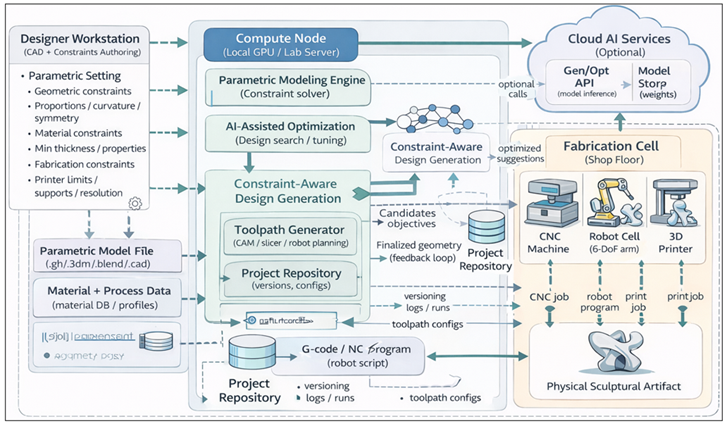
Figure 3
Fabrication-oriented
diagram showing constraint propagation from design to production
Responsible and ethical design practices are also aided with the help of algorithmic control. Design logic and constraints, by ensuring the latter are clear, motivate students to be critical about the decisions processes, included in algorithms. This is especially crucial in the context of AI-assisted processes where non-transparent or biased systems can contribute to the outcomes adversely. Educating the students about questioning the assumptions of the algorithms, setting the constraints, and curating outputs supports the authorship and accountability in the human-machine co-creation. Altogether, algorithmic control, constraint-based modeling, and material intelligence constitute an integrated system according to which hybrid parametric-AI sculpture is based on pragmatic, educational, and ethical concerns. Through the experience of working with these elements, students are able to gain a holistic perspective into how computational systems mediate form, material and meaning. This basis does not only help to advance the sculptural learning outcomes but also train students to high-level digitally mediated fabrication and assessment processes that are analyzed in the subsequent sections.
5. Evaluation Metrics for Experimental Sculptural Prototypes
A systematic evaluation of experimental sculptural prototypes created as a result of hybrid parametric-AI workflow requires a systematized set of evaluation measures. Such measures associate quality of creativity, formal complexity and technical performance, such that evaluation is not limited to judgment by aesthetics but reflects the complexity of learning multifaceted in an education in computational sculpture. The metrics proposed are appropriate to evaluate in studios, to review the work of peers, and to analyze the work in academic terms, and these metrics are oriented toward the artistic and engineering-informed interpretations. Metrics that are based on creativity are assessed based on the level of originality, expressive purpose, and conceptual integrity displayed in prototypes. These criteria consider the effectiveness with which the students can use the parametric variation and AI-generated suggestions to proceed beyond the predictable or conventional forms. Instead of being the reward of novelty, creativity metrics encourage purposeful divergence, in which innovation is explicitly linked to a defined concept of design. Complexity measures are a set of measurements that represent the structural and geometrical complexity of sculptural shapes. The nature of parametric and AI-driven workflows tends to create very complex geometries, but the concept of complexity is not simply assessed by visual density, but by the fact of meaningful arrangement of the form.
Table 2
|
Table 2 Evaluation Metrics Linking Sculptural Prototypes to Learning Dimensions |
|||
|
Evaluation
Dimension |
Metric |
Description |
Indicative
Evidence |
|
Creativity |
Conceptual
Originality |
Degree
of innovation relative to precedents and parametric baseline |
Novel
form strategies, distinct visual language |
|
Expressive
Intent Alignment |
Coherence
between concept statement and final form |
Concept–form
correspondence |
|
|
Human–AI
Synthesis Quality |
Effectiveness
of integrating AI suggestions with human judgment |
Selective
adoption or refinement of AI outputs |
|
|
Complexity |
Geometric
Richness |
Level
of meaningful geometric variation |
Multi-scale
features, non-linear surfaces |
|
Parameter
Interaction Depth |
Number
and interaction of active parameters |
Interdependent
parameter relationships |
|
|
Structural
Hierarchy |
Organization
of form across scales |
Clear
primary, secondary, and tertiary elements |
|
|
Technical
Performance |
Structural
Stability |
Ability
of prototype to maintain integrity |
Load-bearing
behavior, absence of failure |
|
Material
Efficiency |
Optimal
use of material relative to form |
Reduced
waste, lightweight structures |
|
|
Fabrication
Accuracy |
Fidelity
between digital model and physical output |
Dimensional
accuracy, tolerance compliance |
|
|
Surface
Quality |
Quality
of finish post-fabrication |
Smoothness,
resolution, minimal artifacts |
|
This category of metrics measures hierarchical structure, depth of parameter interaction and order/emerging balance. These measures promote critical, not constructive, involvement of the students in computational complexity, instead of that being used as a goal. Technical performance measures deal with the practicability and quality of translation of the digital model to the physical object. They are material efficiency, structure stability and precision of fabrics and surfaces. Table 2 illustrating the evacuation framework relates experimental sculptural prototypes to three primary areas of learning that are creativity, complexity and technical performance. With the help of such measures, not only the aesthetic success of the sculptural work, but the depth of computational thinking and material knowledge of the students may be assessed by the instructors and researchers. It is a multidimensional evaluation process that can make objective comparisons between projects, and allows the interpretive flexibility necessary to evaluate artistic projects.
6. Performance and Creativity Analysis
In contrast to the conventional evaluation of sculptures, where in many cases the evaluation is mostly dependent on the aesthetic judgment subjectivity of the observer, the computationally oriented sculptural practice requires a more systematic and explicit approach to evaluation. In this regard, the performance and creativity analysis aims at the degree to which students are able to convert a computational exploration into coherent, expressive, and fabrically viable forms of sculpture. Creativity analysis focuses on the connection between conceptual purpose and formalization. The prototypes are judged according to the originality of their shape, the intelligibility of a concept behind it, and the extent to which the parametric variation and AI-suggestions add value to the creative results. Instead of valuing complexity as in itself, evaluation values intentional innovation, which encompasses cases in which students selectively adopt, alter or avoid algorithmically generated forms in order to support conceptual coherence. This is done to have human agency control and to have AI as an augmentative creative power and not as dominating one.
Figure 4

Figure 4
Performance and
Creativity Evaluation of Sculptural Prototypes
Technical performance analysis helps in closing the gap between the digital design and actual physical realization. The tests on prototypes are conducted to assess their structural stability, fabrication accuracy, material efficiency and surface quality. Differences between simulated results and fabricated results are considered as diagnostic results of learning, and not a failure. Their willingness to react to such discrepancies is evaluated in terms of parameter adjustment, constraint refinement or design refinement. This supports material intelligence development and design-for-fabrication mentality in the learning of computational sculpture. In general, the analysis of performance and creativity proves that hybrid parametric-AI processes can be assessed strictly without getting artistic practice to quantitative metrics. This model of evaluation contributes to the greater goal of incorporating state-of-the-art computational approaches into sculpture education without sacrificing the critical, expressive and human-based roots of sculpture education.
7. Conclusion and Future Technological Directions
The proposed paper has discussed how parametric modeling and artificial intelligence can be incorporated into modern sculpture education, and put computational systems in the role of facilitating creative exploration, not replacing artistic agency. Through the historical analysis of the shift in traditional pedagogy to hybrid parametric-AI processes, the research has shown that modern sculptural education is more and more focusing on process-related thought, algorithmic regulation, and thoughtful human-machine interactions. The analysis of experimental sculptural prototypes demonstrated that the hybrid workflows may be strictly evaluated in terms of creativity, complexity, and technical performance without transforming artistic practice into the strictly quantitative metrics of its metrics. The use of transparency and reflective learning was facilitated by structured evaluation metrics and supported by visual analytics, and interpretive flexibility was maintained. More importantly, the results support once again, the fact that authorship, conceptual intent and ethical responsibility are all well-established within the human designer and that AI acts as a dialogic and augmentative creative partner. Educationally, the union of the parametric and AI-based methods brings about interdisciplinary competency through the use of a combination of artistic sensitivity and computational literacy and material intelligence. These are becoming essential capabilities among sculptors who are working in mediated and fabrication-focused creative spaces, which are digitally mediated. The robotic fabrication, extended reality (XR), and digital twin frameworks are some of the emerging technologies promising future developments in sculpture education.
CONFLICT OF INTERESTS
None.
ACKNOWLEDGMENTS
None.
REFERENCES
Al Darayseh, A. (2023). Acceptance of Artificial Intelligence in Teaching Science: Science Teachers’ Perspective. Computers and Education: Artificial Intelligence, 4, 100132. https://doi.org/10.1016/j.caeai.2023.100132
Cetinic, E., and She, J. (2022). Understanding and Creating Art with AI: Review and Outlook. ACM Transactions on Multimedia Computing, Communications, and Applications, 18(1), Article 22. https://doi.org/10.1145/3475799
Chen, X., Xie, H., Li, Z., Zhang, D., Cheng, G., Wang, F. L., Dai, H. N., and Li, Q. (2023). Leveraging Deep Learning for Automatic Literature Screening in Intelligent Bibliometrics. International Journal of Machine Learning and Cybernetics, 14(6), 1483–1525. https://doi.org/10.1007/s13042-022-01710-8
Chen, Y., Wang, L., Liu, X., and Wang, H. (2023). Artificial Intelligence-Empowered Art Education: A Cycle-Consistency Network-Based Model for Creating the Fusion Works of Tibetan Painting Styles. Sustainability, 15(8), 6692. https://doi.org/10.3390/su15086692
Chi, Y. N., Chi, O., and Ngo, C. (2025). Exploring Public Views on Oceanic and Shoreline Ecosystem Threats Through Machine Learning. ShodhAI: Journal of Artificial Intelligence, 2(1), 10–26. https://doi.org/10.29121/shodhai.v2.i1.2025.27
Chiu, M. C., Hwang, G. J., Hsia, L. H., and Shyu, F. M. (2022). Artificial Intelligence-Supported Art Education: A Deep Learning-Based System for Promoting University Students’ Artwork Appreciation and Painting Outcomes. Interactive Learning Environments, 1–19. https://doi.org/10.1080/10494820.2022.2100426
Hill, J., and West, H. (2020). Improving the Student Learning Experience Through Dialogic Feed-Forward Assessment. Assessment and Evaluation in Higher Education, 45(1), 82–97. https://doi.org/10.1080/02602938.2019.1608908
Lin, H. C., Hwang, G. J., Chou, K. R., and Tsai, C. K. (2023). Fostering Complex Professional Skills with Interactive Simulation Technology: A Virtual Reality-Based Flipped Learning Approach. British Journal of Educational Technology, 54(2), 622–641. https://doi.org/10.1111/bjet.13268
Rahimi, F. B., Boyd, J. E., Levy, R. M., and Eiserman, J. (2022). New Media and Space: An Empirical Study of Learning and Enjoyment Through Museum Hybrid Space. IEEE Transactions on Visualization and Computer Graphics, 28(8), 3013–3021. https://doi.org/10.1109/TVCG.2020.3043324
Ramesh, A., Dhariwal, P., Nichol, A., Chu, C., and Chen, M. (2022). Hierarchical Text-Conditional Image Generation with CLIP Latents (arXiv:2204.06125). arXiv.
Ranieri, M., Raffaghelli, J. E., and Bruni, I. (2021). Game-Based Student Response System: Revisiting its Potentials and Criticalities in Large-Size Classes. Active Learning in Higher Education, 22(2), 129–142. https://doi.org/10.1177/1469787418812667
Song, J., Li, P., Fang, Q., Xia, H., and Guo, R. (2022). Data Augmentation by an Additional Self-Supervised Cyclegan-Based Method for Shadowed Pavement Detection. Sustainability, 14(21), 14304. https://doi.org/10.3390/su142114304
Sun, M. Y. (2024). Ancient Transportation Methods Demonstrated the Remarkable Creativity of the Chinese People. Popular Science, Z1, 52–55.
Yu, Y., and Hu, W. (2025). Three-Dimensional Modeling and AI-Assisted Contextual Narratives in Digital Heritage Education: Course for Enhancing Design Skill, Cultural Awareness, and User Experience. Heritage, 8(7), 280. Https://Doi.Org/10.3390/Heritage8070280
Zhou, W., Hu, X., Que, Y., and Wei, W. (2024). Immersive Interface Design for Cultural Heritage Learning Experience: An Exploration with Multimodal Learning Analytics. In Proceedings of the 2024 IEEE International Conference on Advanced Learning Technologies (ICALT) ( 269–271). IEEE. https://doi.org/10.1109/ICALT61570.2024.00084
Zhu, D., Deng, S., Wang, W., Cheng, G., Wei, M., Wang, F. L., and Xie, H. (2022). HDRD-Net: High-Resolution Detail-Recovering Image Deraining Network. Multimedia Tools and Applications, 81(30), 42889–42906. https://doi.org/10.1007/s11042-022-13489-5
|
|
 This work is licensed under a: Creative Commons Attribution 4.0 International License
© ShodhKosh 2026. All Rights Reserved.