ShodhKosh: Journal of Visual and Performing ArtsISSN (Online): 2582-7472
|
|
Digital Twins in Sculpture Studios: Enhancing Learning
Dharmesh Dhabliya 1 , Dr. Uday Chandrakant Patkar 2
 , Pooja Yadav 3
 , Ketan Kishor Tonpe 4
 , Yatin Gandhi 5, Rajashri CK 6
1 Vishwakarma
Institute of Technology, Pune, Maharashtra, India
2 Department
of Computer Engineering, Bharati Vidyapeeth's College of Engineering, Lavale,
Pune, Maharashtra, India
3 Assistant
Professor, School of Business Management, Noida International University,
Greater Noida 203201, India
4 Department
of Mechanical Engineering, Suryodaya College of Engineering and Technology,
Nagpur, Maharashtra, India
5 Competent
Softwares, Pune, Maharashtra, India
6 Assistant
Professor, Meenakshi College of Arts and Science, Meenakshi Academy of Higher
Education and Research, Chennai, Tamil Nadu 600079, India
|
|
|
ABSTRACT |
|
|
The expanding
penetration of computational technologies into the studio-based education has
provided new possibilities to improve learning in long-standing traditionally
material-centered fields like sculpture. The current paper examines the
application of digital twin technology as a facilitating model of hybrid
physical-digital sculptural pedagogy. The concept of a digital twin-powered
sculpture studio is envisioned as a closed-loop system connecting the actual
making conditions with the virtual simulation in real-time and the feedback
directed towards learners. The suggested framework combines sensing
infrastructure, physics-based and parametric simulation, the analytics which
is supported by the artificial intelligence and the interactive visualization
interfaces to facilitate the iterative exploration, predictive reasoning, and
reflective practice. It describes a modular system architecture, which is the
interaction between physical studio components, digital twin computation and
learning analytics layers. The pedagogical assimilation of the system holds
major sculptural learning goals of material learning, structural reasoning,
and creative problem solving to measurable assurance measures. The viability
and didactic value of the method has been shown in a case study carried out
in an undergraduate sculpture studio. The empirical results show that
students using the digital twin did more virtual cycles before they started
doing physical ones, which led to a decrease in physical rework, smaller
prediction-execution gap, better resource use in materials, and high-quality
sculptural work. The results indicate that digital twins can be used to
supplement, and not substitute embodied sculptural practice, by visualizing
the otherwise invisible phenomena and enabling evidence-based creative design
decisions. The research will add a validated theoretical framework, a system
architecture to be implemented and empirical evidence of the pedagogical
usefulness of digital twins in creative education. Potential further implications
involve immersive visualization and AI-assisted personalization and
inter-domain interdisciplinary implementation in the field of studio-based
learning. |
|||
|
Received 08 September 2025 Accepted 04 December 2025 Published 17 February 2026 Corresponding Author Dharmesh
Dhabliya, dharmesh.dhabliya@viit.ac.in DOI 10.29121/shodhkosh.v7.i1s.2026.7076 Funding: This research
received no specific grant from any funding agency in the public, commercial,
or not-for-profit sectors. Copyright: © 2026 The
Author(s). This work is licensed under a Creative Commons
Attribution 4.0 International License. With the
license CC-BY, authors retain the copyright, allowing anyone to download,
reuse, re-print, modify, distribute, and/or copy their contribution. The work
must be properly attributed to its author.
|
|||
|
Keywords: Digital Twins, Sculpture Education, Studio-Based
Learning, Virtual–Physical Feedback Loop, Computational Creativity, Learning
Analytics, Parametric Modeling, AI-Assisted Pedagogy |
|||



1. INTRODUCTION
The accelerated adoption of digital technologies in creative learning has dramatically transformed the studio-based educational environment, especially in those fields where people usually interact with material and practice. The field of sculpture is taught through a combination of tactile inquiry, spatial thinking, and making, and is becoming ever more shaped by the use of computational technology of parametric modeling and digital fabrication and artificial intelligence Jover and Sempere (2025). It is in the context of this changing environment that the digital twin technology has presented itself as a prospective paradigm of improving learning through the production of dynamic virtual versions of physical studios, tools, materials, and creative processes. Digital twins were originally created to help with the optimization of engineering and industry, but they are currently becoming more applicable in educational settings where complicated interactions between physical and mental processes should be clarified and improved Dayoub et al. (2024). Traditional sculpture studios are limited in a number of pedagogical and operational ways. Cost of materials, safety considerations, permanent fabrication mistakes and limited access to the studio facilities tend to constrain the amount of experimentation that the learners can do. Additionally, most important phenomena like internal stress distribution, balance behaviour or material deformation are mostly not visible in physical making and conceptual comprehension is therefore reliant on long-term experience Buhalis et al. (2023). Such difficulties are also intensified in modern sculpture education, which is becoming more computational, fabricative at scale, and interdisciplinary in its team work. This has led to an increased desire to have learning environments that encourage experimentation, visualization and reflection without deeming the embodied practice of sculpture.
Figure 1
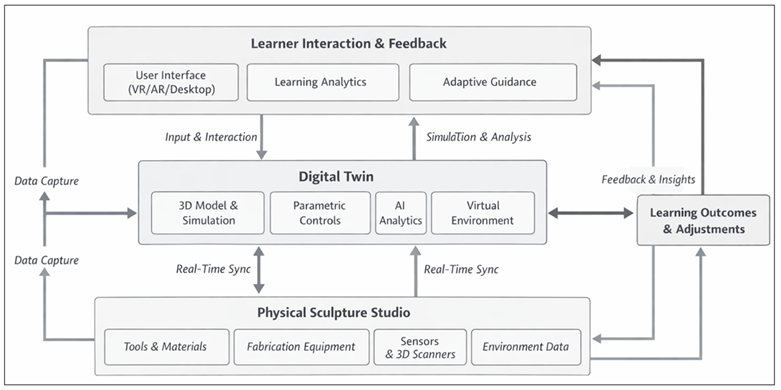
Figure 1 Digital Twin–Based Closed-Loop Framework for
Sculpture Studio Learning
Fig. 1 shows the conceptual architecture of the proposed state-of-the-art sculpture studio based on digital twins. The structural architecture consists of three closely bound layers: physical studio layer, digital twin layer as well as the learner interaction and feedback layer Cruz Franco et al. (2022). The physical studio includes the conventional sculptural tools, materials, fabrication tools, and space arrangement supplemented with sensing technologies that include 3D scanners, motion capture systems, and material/environment sensors as shown in Figure 1. These elements keep on producing information about the development of sculptural forms, use of tools, and behavior of materials. This information is sent to the digital twin layer where it keeps a high-fidelity virtual copy of the studio surroundings as well as the form of the sculpture that is changing Wu et al. (2024). In contrast to statical models in digital form, the digital twin is connected with the real studio and can be updated in real-time and explore the scenarios. The interaction and feedback layer is the part of a digital twin that can be accessed by the learner via interactive interfaces, like the workstations, tablets, or immersive AR/VR systems. The students play with the sculptural parameters, visualize the obscure physical processes and experiment with alternative design approaches in the virtual world. Feedbacks provided by interaction information and system analytics can be used to support reflective learning, teacher instruction and adaptive pedagogical interventions Hashash et al. (2022). This feedback is recapitulated in the digital and physical layers to create a closed-loop learning system, which improves experimentation, comprehension, and creative decision-making.
2. Conceptual Framework of a Digital Twin–Enabled Sculpture Studio
The idea behind a digital twin-based sculpture studio is rooted in the fusion of the physical making space with smart virtual space to facilitate experiential, reflective, and information-based learning. In contrast to the traditional digital modeling tools, which do not require a physical practice, a digital twin creates an unprecedented, two-way communication between the real studio and the virtual one Jagatheesaperumal et al. (2023). According to this framework, the digital twin is not just a visualization tool, but a proactive pedagogical interlude, which connects action on the material, computational analysis and cognition of a learner in a closed-loop system. The physical sculpture studio is the basis of the structure which includes traditional tools, raw materials, fabrication equipment, spatial arrangements, and environmental conditions. Sculptural practices practiced in this area include carving, assembling, casting, or hybrid digital fabrication, which create rich streams of data by means of sensing, such as 3D scanners, motion tracking, force/vibration sensors and environmental monitors Niccolucci and Felicetti (2025). These data streams are able to record the changing geometry of the sculpture and the contextual issues that impact artistic and structural performance. Physical making thus is not just in the proposed framework a manifestation of expressiveness, but can also serve as a generator of quantifiable learning responses Zhang et al. (2024).
Figure 2
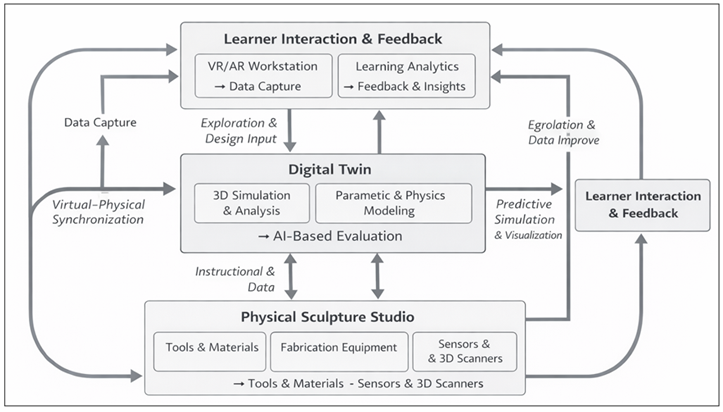
Figure 2 Integrating Physical Sculptural Practice, Digital Twin Simulation, And Adaptive Learner Feedback.
The main part of the framework is the layer of the digital twin. It has a synchronized virtual representation of the sculpture, tools and the studio context by combining geometric models, parametric definition as well as physics based simulations. This layer allows the learner to experiment with what-if conditions, like changing proportions, redistributing mass or changing material parameters, without the physical hazard or expense of doing so Luther et al. (2023). Notably, the digital twin assists predictive reasoning by visualizing previously invisible phenomena as shown in Figure 2, such as internal stress, the balance steadiness or deformation predispositions. The virtual model has been developed by real time synchronization that the physical artifact develops and the creative process remains authentic and the depth of analysis is broadened. The learner interaction and feedback layer interfaces the digital twin and gives the learner access to it using either desktop interfaces, tablets, or immersive AR/VR systems. In this layer, learners will control the parameters of the sculptures, examine the results of simulations, and compare the virtual results with the physical ones Vilalta-Perdomo et al. (2022). The system has learning analytics that detect patterns of interaction, the frequency of the iterations and the pathways of the decision made, which allow instructors or AI-driven feedback systems to provide adaptive guidance. This feedback is reintroduced in the digital twin and the physical studio process to form the learning loop Wang et al. (2024).
3. System Architecture and Implementation
The proposed digital twin-enabled sculpture studio has a system architecture that is developed to fulfill real-time synchronization among the physical practice of sculpture, virtual simulation, and learner-centered feedback. The architecture is a modular and scaled architecture comprising of hardware sensing, digital modeling and simulation core and interactive learning interfaces. Such a composite design will make sure that the physical studio work is faithfully represented in the digital space and allow predictive analysis and adaptive pedagogical assistance. Sensing and capture technologies have been deployed at the physical layer in the sculpture studio to track the artifact development and contextual factors Adel (2023). These consist of 3D scanners to acquire geometric, motion and force sensors to trace the interaction between the tool and the material, and environmental sensors to monitor the environment parameters (temperature, humidity and vibration). Fabrication tools of various types, including manual tools or additive manufacturing systems and CNC, are a source of data as well as a medium of creation. The information produced at this layer is time stamped and is preprocessed and consistent before being relayed to the digital twin Greco et al. (2020).
Figure 3

Figure 3 Digital Twin Sculpture Studio Architecture
The computational core of digital twin is the main part of the system. It incorporates 3D geometric representations and parametric as well as physics-based simulation engines that can be used to assess structural stability, equipoise, deformation, and material behavior as seen in Figure 3. The sculptural characteristics, including scale, mass distribution, and curvature can be modified in a dynamic manner using parametric controls, where simulation modules are used to anticipate the effects of these modifications before physical implementation Pepe et al. (2020). The twin is also expanded with more AI-based analytics modules that process patterns in the behavior of learners, detect anomalies in the process of fabrication, and produce performance indicators of interest to the learning outcomes. Real-time synchronization schemes, make sure that all updates made in the physical studio are automatically making the virtual model better and that the correct decisions made virtually can be converted back into physical actions. The interaction and visualization layer will give communication with the digital twin to the desktop workstations, tablets, or immersive AR/VR interfaces. These interfaces enable learners to test the results of simulations, make comparisons between the virtual prediction and the physical results and refine their sculptures designs in cycles Ramos Sánchez et al. (2022). The interaction records and metrics of the systems are logged to assist in learning analytics and teacher monitoring. Feedback created at this level by automated recommendation or instructor may be reprocessed into the digital twin, and where necessary, used to modify the physical studio workflow.
4. Learning Methodology and Pedagogical Integration
The digital twin-enabled sculpture studio is based on the learning methodology that aims to align the elements of the system with well-defined learning outcomes as well as allow the formative and summative evaluation of the learning process in the context of the studio-based pedagogue. The methodology combines the aspects of the experiential learning, reflective practice, and data-informed instruction by embedding digital twin technologies into the learning workflow in the form of the interrelation between the physical studio, the core of the digital twin, and the mechanisms of feedback to the learners. At the initial level, embodied learning is supported at the physical sculpture studio via the physical interaction with tools, materials, and fabrication equipment. This tier deals with fundamental learning goals regarding the material knowledge, spatial skills, and skills of interaction between tools and materials. The information obtained through sensors and 3D scanners allows the learner to view how the sculptural shape changes over the years, supporting the understanding of the process and understanding the evolution of the design. Such physical activities will be at the core of learning at the same time as conceptual clarity is improved by their digital augmentation. The core of the digital twin is a crucial pedagogical concept that allows associating physical activities with computational predictive models. With the aid of 3D simulation, parametric controls, and physics based analysis, learners are able to experiment with other sculptural structures and predict the structural behavior before they are physically realized. This ability provides greater learning goals like analytical skills, design validation and creative problem-solving. The AI-based analytics are another extension of the role of the digital twin to detect the patterns of how learners interact and how effectively the process is run, contributing to metacognition and continual enhancement.
Table 1
|
Table 1 Mapping of Digital Twin System Components to Learning Objectives and Assessment Metrics |
|||
|
System
Component |
Pedagogical
Function |
Learning
Objectives Addressed |
Assessment
Metrics |
|
Physical
Sculpture Studio |
Embodied
making and material engagement |
Material
understanding; spatial reasoning |
Artifact
quality; structural stability |
|
Sensors
& 3D Scanners |
Capture
geometric and process data |
Process
comprehension; form awareness |
Geometry
deviation; consistency |
|
Digital
Twin Core |
Predictive
exploration and analysis |
Structural
reasoning; design validation |
Simulation–execution
alignment |
|
Parametric
Controls |
Iterative
design exploration |
Creative
problem-solving |
Iteration
count; exploration depth |
|
AI
Analytics Module |
Behavior
and process analysis |
Metacognitive
awareness |
Error
reduction rate |
|
Visualization
Interfaces |
Interactive
comparison and review |
Visual–spatial
cognition |
Time-on-task;
interaction frequency |
|
Learning
Analytics & Feedback Engine |
Adaptive
guidance and reflection |
Self-regulated
learning |
Feedback
uptake; reflection logs |
|
Instructor
Dashboard |
Formative
monitoring |
Guided
progression |
Intervention
frequency |
Visualization and interaction interfaces, such as desktop and immersive AR/VR, are used to help learners become engaged. These interfaces allow making comparisons between predicted results in the simulation and the real results in the physical world so as to encourage visual-spatial cognition and reflective learning. Logs of interaction and system analytics are inputted into an engine of learning analytics and feedback that offers adaptive feedback to the learners and actionable insights to the instructors. This process will allow formative assessment in time and apply self-regulated learning without interfering with studio practice. The correspondence of the system components, learning objectives, and assessment strategies has been summarized in Table 1 that shows how each technological component facilitates pedagogical objectives and quantifiable learning outcomes. Outcome-based measurement of sculptural artifacts based on expert rubrics is a complement or supplement to process-oriented measures of assessment like iteration depth, prediction accuracy, and quality of reflection. Such a combined method of assessment maintains the qualitative richness of the studio assessment approach and brings quantitative rigor.
5. Case Study: Digital Twin Deployment in a Sculpture Studio
The given section is a case study exemplifying the application of the given digital twin-based sculpture studio in real life and its effect on the learning outcomes. The study was done in an undergraduate sculpture unit on form and structural exploration to prove the given framework in relation to its pedagogical efficiency, involvement of learners and its studio practicability. The atelier integrated both conventional sculptural materials and equipment with computerized resources of fabrication and sensing infrastructures, such as 3D scanners, motion sensors. The processing of the data was done on an edge device and the digital twin which consisted of the geometric models, the parametric controls and physics-based simulations ran on a specific compute node. Students used the system through the desktop workstations, and optional AR visualization was used to analyze space. One of the tasks required the students to design and make a free standing sculpture with a restriction in terms of balance, material used and steadiness. The workflow was iterative with the first step being physical prototyping with a synchronized data capture and the subsequent step being virtual simulation and parametric refinement via the digital twin. The simulation provided insights that would be used to make physical adjustments and create a continuous virtual-physical feedback loop.
Table 2
|
Table 2 Sample Case Study Data from Digital Twin–Enabled Sculpture Studio |
|||||
|
Student
ID |
Number
of Virtual Iterations |
Physical
Rework Attempts |
Prediction–Execution
Deviation (%) |
Material
Waste Reduction (%) |
Final
Artifact Score (0–10) |
|
S1 |
7 |
2 |
6.5 |
28 |
8.6 |
|
S2 |
5 |
3 |
9.2 |
22 |
7.9 |
|
S3 |
9 |
1 |
4.8 |
35 |
9.1 |
|
S4 |
6 |
2 |
7.1 |
26 |
8.4 |
|
S5 |
8 |
1 |
5.3 |
32 |
9 |
Table 2, summarize the exemplary data of the deployment of the digital twin sculpture studio. Multiple virtual replications were done to physical fabrication resulting in less rework attempts and less deviation of the predicted and actual forms. Reduced material waste and higher final artifact scores assert that decisions suing simulation resulted in increased structural accuracy and quality of the sculpture. Interactions between learners and the digital twin were also logged with the metrics of iteration count, simulation frequency, and deviation between prediction and realisation being recorded. Dashboard analytics were applied by instructors to monitor the progress and step in when structural problems were observed repeatedly or exploration was limited. In qualitative observation it was observed that there was more systematic experimentation than traditional studios that students tried various virtual alternatives before executing material. The evaluation of final artifacts by experts working on the structural integrity, conceptual correctness, and craftsmanship and process-oriented measures were combined. Students were less wasteful of materials and fewer errors were made in fabrication than their predecessors. Reflections also indicated that there was better insight in the balance, load distribution, and material behavior. Generally, the case study has validated the technical and pedagogical usefulness of digital twins in sculpture education, as they are useful in learning more and working in the studio more effectively.
6. Discussion
The results of the case study prove that a digital twin can be successfully implemented into a sculpture studio, and it might actually improve learning activities and creative results. The reduction in physical rework activities, less prediction-execution deviation, and better quality of the artifacts are observed, which altogether indicate that simulation-driven decision-making can assist in the efficient and reflective sculptural practice. These findings are consistent with the larger body of the educational literature that underlines the importance of the experiential learning environment with enhanced by real-time feedback and computational visualization. Pedagogically, the greater number of virtual reiterations before actual performance signifies the move towards intentional experimentation, one of the principal attributes of quality studio learning. The digital twin will help lower the cognitive and material cost of trial and error by allowing learners to experiment by hypothesis testing online to explore the form, balance, and material behavior more in-depth. The result is consistent with the previous research in design and Tiwari et al. (2025) engineering education where digital twins and simulation software have been provided to stimulate analytical thinking and iterative improvement without reducing hands-on interactions.
Figure 4
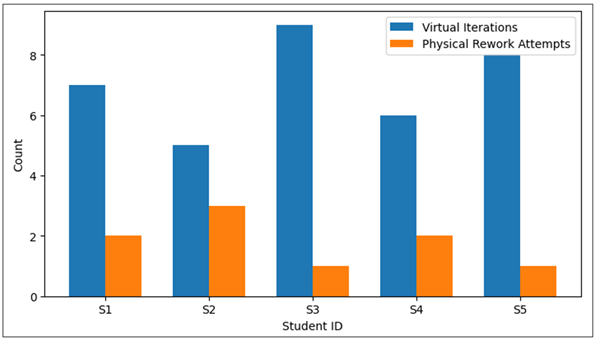
Figure 4 Relationship Between Virtual Design Iterations and Physical Rework Attempts.
The fact that prediction-execution deviation between the participants was relatively small implies that the digital twin was highly fidel to physical sculptural processes. Such technical robustness is essential to the adoption of simulations in education, where poor simulation may damage the confidence of learners in the results and also compromise the teaching worth. The findings substantiate the current study on physics-based modeling and parametric systems as shown in Figure 4 which highlights that transparent and explainable simulations do not replace the creative intuition but augment the conceptual knowledge. This trade-off between calculative precision and aesthetic expressiveness is especially important as far as sculpture education is concerned.
Figure 5
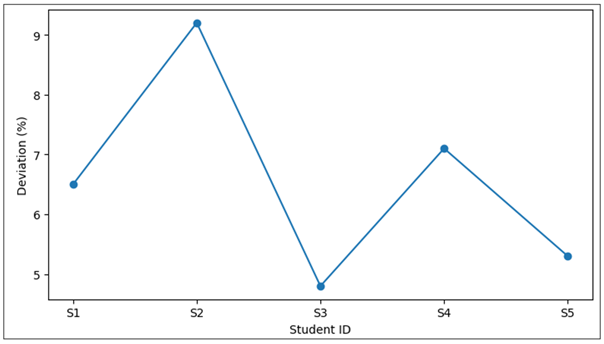
Figure 5 Prediction–Execution Deviation Observed Across Learners Using the Digital Twin System.
The decrease in the amount of material wastes moving into the final artifact and a positive correlation with the quality of the latter reflect the sustainability concerns of the digital twins-supported studios. The existing literature on digital fabrication and sustainable design education emphasizes the need to keep the number of resources to a minimum and keep the standards of creativity as shown in Figure 5. The case study implies that digital twins can put these principles into operation by making the learners oriented towards informed material use, which would ultimately make the creative pedagogy aligned with the sustainability concerns that are becoming more and more relevant in the modern art and design education.
Figure 6

Figure 6 Material Waste Reduction and Final Artifact Quality
Scores in the Case Study Cohort
Even though these positive results were achieved, the results should be interpreted in the view of some limitations. The test sample was relatively small and the implementation was in a controlled studio setting. Also, the level of engagement could have been affected by the familiarity of the learner with digital tools as shown in Figure 6. The future research should hence focus on longitudinal adoption in different institutional contexts and to understand the impact of different degrees of technical proficiency on learning pathways.
7. Limitations
Although the outcomes the digital twin-powered sculpture studio proved to be encouraging, there are a few limitations that are to be considered. One, a relatively small cohort conducted in a controlled studio setting was used to conduct the case study, which can restrict the extrapolation of the results to a wide range of institutional settings and population of learners. The variations in studio infrastructure, style of teaching and access to digital resources may affect the adoption as well as the outcome of learning.
Second, digital twin framework effectiveness is partially reliant on sensing and simulation components reliability and accuracy. False data acquisition, synchronization lag or simplified material models can impact on the prediction fidelity and trust in the system by learners. Although the existing use proved the reasonable correspondence of the virtual and the physical results, there is still a necessity of improving it to fit a greater variety of materials and sculpture techniques.
Third, all participants were not familiar with digital tools, which could present engagement and performance differences. Despite the system being designed to help the novice users due to intuitive interfaces and feedback, it still has an initial learning curve that requires attention at the expense of creative exploration in the short run. Lastly, the research paid much attention to short-term learning performance; the long-term effects on artistic growth, originality of creativity, and studio culture should be examined in more detail.
8. Conclusion
The study presents the idea of digital twins as a novel paradigm of enhancing the learning process in the studio in the field of art education. The suggested methodology will be based on the old paradigm of sculptural pedagogy with the addition of real-time data capture, virtual simulation, and feedback that could be offered to the learner without interrupting the process of interacting with the material and the degree to which the creative expression could take place. The digital twins are proved to be not only the means of visualisation, but the intermediaries of the pedagogy between embodied making and the wisdom of the computer. The article contributes a conceptual model of closed loop, a system architecture implementation and empirical research of a case study in a studio. The evidence leans towards the fact that workflows driven by digital twins reduce corporeal rework, make congruency in prediction execution, material intensity, facilitative reflective learning. These findings reveal how digital twins may promote deeper conceptual understanding, learners agency and long term studio activities. The proposed structure can be applied to other non-sculpture training hybrid pedagogies of architecture, design and performative arts. The implementation of immersive interfaces, AI-assisted personalization and robotic generation will be probable to increase digital twin empowered creative learning settings in the future.
CONFLICT OF INTERESTS
None.
ACKNOWLEDGMENTS
None.
REFERENCES
Adel, A. (2023). Unlocking the Future: Fostering Human–Machine Collaboration and Driving Intelligent Automation Through Industry 5.0 in Smart Cities. Smart Cities, 6(5), 2742–2782. https://doi.org/10.3390/smartcities6050124
Buhalis, D., Lin, M. S., and Leung, D. (2023). Metaverse as a Driver for Customer Experience and Value Co-Creation: Implications for Hospitality and Tourism Management and Marketing. International Journal of Contemporary Hospitality Management, 35(2), 701–716. https://doi.org/10.1108/IJCHM-05-2022-0631
Cruz Franco, P. A., Rueda Márquez de la Plata, A., and Gómez Bernal, E. (2022). Protocols for the Graphic and Constructive Diffusion of Digital Twins of the Architectural Heritage that Guarantee Universal Accessibility through AR and VR. Applied Sciences, 12(17), 8785. https://doi.org/10.3390/app12178785
Dayoub, B., Yang, P., Omran, S., Zhang, Q., and Dayoub, A. (2024). Digital Silk Roads: Leveraging the Metaverse for Cultural Tourism within the Belt and Road Initiative Framework. Electronics, 13(12), 2306. https://doi.org/10.3390/electronics13122306
Greco, A., Caterino, M., Fera, M., and Gerbino, S. (2020). Digital Twin for Monitoring Ergonomics During Manufacturing Production. Applied Sciences, 10(21), 7758. https://doi.org/10.3390/app10217758
Hashash, O., Chaccour, C., Saad, W., Sakaguchi, K., and Yu, T. (2022). Towards a Decentralized Metaverse: Synchronized Orchestration of Digital Twins and Sub-Metaverses. arXiv.
Jagatheesaperumal, S. K., Yang, Z., Yang, Q., Huang, C., Xu, W., Shikh-Bahaei, M., and Zhang, Z. (2023). Semantic-Aware Digital Twin for Metaverse: A Comprehensive Review. IEEE Wireless Communications, 30(2), 38–46. https://doi.org/10.1109/MWC.003.2200616
Jover, V., and Sempere, S. (2025). Creating Digital Twins to Celebrate Commemorative Events in the Metaverse. Computers, 14(7), 273. https://doi.org/10.3390/computers14070273
Luther, W., Baloian, N., Biella, D., and Sacher, D. (2023). Digital Twins and Enabling Technologies in Museums and Cultural Heritage: An Overview. Sensors, 23(3), 1583. https://doi.org/10.3390/s23031583
Niccolucci, F., and Felicetti, A. (2025). Digital Twins and the Stendhal Syndrome. Computers, 14(4), 136. https://doi.org/10.3390/computers14040136
Pepe, M., Costantino, D., and Restuccia Garofalo, A. (2020). An Efficient Pipeline to Obtain 3D Models for HBIM and Structural Analysis Purposes from 3D Point Clouds. Applied Sciences, 10(4), 1235. https://doi.org/10.3390/app10041235
Tiwari, A., Shukla, K., and Modi, K. (2025). Digital Forgery in the Age of Misinformation: Using Techniques for Reliable Image Manipulation Detection and Assessing their Societal Impact. Journal of Digital Security and Forensics, 2(2), 76–87. https://doi.org/10.29121/digisecforensics.v2.i2.2025.68
Ramos Sánchez, J. A., Cruz Franco, P. A., and Rueda Márquez de la Plata, A. (2022). Achieving Universal Accessibility Through Remote Virtualization and Digitization of Complex Archaeological Features: A Graphic and Constructive Study of the Columbarios of Mérida. Remote Sensing, 14(14), 3319. https://doi.org/10.3390/rs14143319
Vilalta-Perdomo, E., Michel-Villarreal, R., and Thierry-Aguilera, R. (2022). Integrating Industry 4.0 in Higher Education using Challenge-Based Learning: An Intervention in Operations Management. Education Sciences, 12(10), 663. https://doi.org/10.3390/educsci12100663
Wang, H., Yang, Z., Zhang, Q., Sun, Q., and Lim, E. (2024). A Digital Twin Platform Integrating Process Parameter Simulation Solution for Intelligent Manufacturing. Electronics, 13(4), 802. https://doi.org/10.3390/electronics13040802
Wu, R., Gao, L., Lee, H., Xu, J., and Pan, Y. (2024). A Study of the Key Factors Influencing Young Users’ Continued use of the Digital Twin-Enhanced Metaverse Museum. Electronics, 13(12), 2303. https://doi.org/10.3390/electronics13122303
Zhang, J., Zhu, J., Tu, W., Wang, M., Yang, Y., Qian, F., and Xu, Y. (2024). The Effectiveness of a Digital Twin Learning System in Assisting Engineering Education Courses: A Case of Landscape Architecture. Applied Sciences, 14(15), 6484. https://doi.org/10.3390/app14156484
|
|
 This work is licensed under a: Creative Commons Attribution 4.0 International License
© ShodhKosh 2026. All Rights Reserved.