ShodhKosh: Journal of Visual and Performing ArtsISSN (Online): 2582-7472
|
|
Empirical Research on Exploring the Impact and Effectiveness of Instagram Driven Content Marketing Strategies in Rajasthan's Healthcare Industry
Pallavi Mathur 1 ,
Dr. Tanushri Mukherjee 2
,
Dr. Tanushri Mukherjee 2 , Dr.
Neha Bhagat 3, Rohan Shivendra
Singh 4, Dr. Yogesh Keskar 5,
, Dr.
Neha Bhagat 3, Rohan Shivendra
Singh 4, Dr. Yogesh Keskar 5,
Dr. Nisha Singh 6
1 Research Scholar, Amity School of Communication (ASCO), Amity
University, Rajasthan, India
2 Associate Professor, Amity School of Communication, Amity
University, Rajasthan, India
3 Assistant Professor, Maharaja Agrasen Institute of
Management Studies, India
4 Research Scholar, Amity School of Communication, Amity
University, Rajasthan, India
5 Associate Professor, Amity School of Architecture and
Planning, Amity University, Rajasthan, India
6 Associate Professor, Maharaja Agrasen Institute of
Management Studies, India
|
|
|
ABSTRACT |
|
|
The present
fast-paced digital transformation has significantly impacted on marketing
strategies, amongst all sectors, including the healthcare industry. The
Instagram platform, with its unique features such as visual appeal,
engagement capabilities, and large user base, has developed as a significant
and effective medium for content marketing among all other social media
platforms. The research aims to examine the impact and effectiveness of
Instagram-based content marketing strategies in the healthcare industry of
Rajasthan. The primary focus of the Research is on studying the impact of
this digital strategy on patient engagement, brand perception, and healthcare
decision-making. The research centered on studying the responses of 200
participants, which included patients, healthcare practitioners, and social
media users of Rajasthan. The study examines the influence of various types
of Instagram content, including live sessions, expert Q&A, patient
testimonials, and educational posts, on public understanding and trust about
the various aspects of healthcare services. The findings exhibit that
rigorously developed and engaging Instagram marketing strategies increase
patient trust, healthcare accessibility, and reinforce industry image, thus
strengthening enhanced engagement and informed healthcare decisions. The
study offers valuable insights in the field of digital healthcare marketing
by giving empirical insights into the effectiveness of social media,
especially Instagram based content marketing strategies in the direction of
imparting patient-oriented communication. |
|||
|
Received 05 September 2025 Accepted 01 December 2025 Published 17 February 2026 Corresponding Author Dr.
Tanushri Mukherjee, mukherjeetanushri4@gmail.com
DOI 10.29121/shodhkosh.v7.i1s.2026.7051 Funding: This research
received no specific grant from any funding agency in the public, commercial,
or not-for-profit sectors. Copyright: © 2026 The
Author(s). This work is licensed under a Creative Commons
Attribution 4.0 International License. With the
license CC-BY, authors retain the copyright, allowing anyone to download,
reuse, re-print, modify, distribute, and/or copy their contribution. The work
must be properly attributed to its author.
|
|||
|
Keywords: Brand Perception, Digital Healthcare Marketing,
Health-Care Decisions, Instagram Marketing Strategies, Patient-Oriented
Communication, Patient Engagement, Patient Trust, Rajasthan Healthcare
Industry, Social Media, Visual Appeal |
|||



1. INTRODUCTION
The present era is characterized by growing popularity of digital platforms being widely used for gathering information and knowledge besides entertainment and recreation. In the realm of exponential growth of digital platforms, the growing effectiveness of social media marketing tools and their engaging strategies in varied sectors cannot be ignored. Healthcare industry which has always relied on the traditional word of mouth strategy and institutional reputation from long time back, has also incorporated digital strategies and techniques to communicate effectively with patients in real time in a more appealing and engaging manner. Instagram has secured notable popularity among various social media platforms due to its visual focus, user friendliness, and interactive features, making it a highly effective and suitable medium for content marketing in the healthcare industry. Content marketing and traditional advertising are very different from each other, with content marketing focusing on making engaging and informative content that promotes businesses in a more captivating manner. The field also includes the dissemination of medical information, patient success stories, expert examination, health and wellness advice, and interesting debates in the healthcare industry, which instills knowledge, trustworthiness and confidence amongst the patients and viewers at large. Instagram has emerged as an effective platform in this area by curating and implementing various content formats, including posts, segments, stories, and IGTV. Healthcare industries are using Instagram to increase communication between medical professionals and patients, thereby improving public health awareness and encouraging active health practices.
The study has been conducted in Rajasthan, a state with a dynamic healthcare environment, including the application of contemporary and traditional health practices, and a noticeable difference between rural and urban areas regarding the healthcare perception and awareness amongst the patients. The application of internet being used as a crucial tool for education and engagement in Rajasthan has been a big challenge. The research examines the effectiveness of Instagram, which includes its content marketing strategies being employed by the healthcare industry in Rajasthan to educate, inform and engage their audience.
The research gathers data from 200 participants by using empirical methodology. It includes Healthcare professionals, patients and social media consumers to examine their views, behaviour, and trust in healthcare content of Instagram. The study evaluates the effect of various content strategies of Instagram, which include patient reviews, live health-related expert talks, experts' Q&A meetings, etc on patient perception about healthcare industry and healthcare information.
The research findings generate vital information which can help the healthcare industry professionals to enhance their digital marketing strategies. The study insights highlight that by identifying efficient content formats and engagement tactics, the healthcare industry can increase its social media presence, improve patient education and encourage better health outcomes. The results of the study will help medical institutions and healthcare marketers who want to implement data-driven digital communication strategies.
2. Literature Review
Social media platforms are emerging as significant medium for patient engagement and education. According to a study by Ramasubramanian et al. (2021), Instagram is a popular platform for healthcare communication stating that 88.1% of posts about strokes are factually correct. The research exhibits that healthcare professional’s participation is limited in content creation, which suggests a potential chance for more professional engagement to raise the quality and reliability of information that is accessible to the public.
The efficiency of Instagram as a health education tool has been evaluated in various contexts. The study examines the quality of Instagram content, which is linked to health- related education for the Azerbaijani community to increase patient knowledge and comprehension of health issues using modern platforms. The results exhibit that Instagram has become an important tool for health education, provided that the content is properly evaluated for relevance and quality.
Using Instagram for healthcare marketing presents different challenges. According to a recent study performed by Dr Jerry Chidester, 85% of plastic surgeons reported a decrease in exposure, with 68% claiming censorship on social media platforms such as Meta and TikTok. This restriction, occasionally, applies to content material, including before-and-after pics of remedies that have been marked or prohibited due to nudity or sexually explicit language. Healthcare practitioners who prefer to apply Instagram for advertising and marketing may additionally confront giant boundaries that restrict the spread and engagement of educational and promotional content.
The most recent studies by Anisa et al. (2024) indicate that in promoting healthcare, the role of social media as a digital marketing tool is increasing rapidly. The research by making a quantitative study of 372 respondents, evaluates the effectiveness of Instagram in promoting health seminars. The study reveals that Instagram-based content like its substantially enhanced user engagement, awareness and positive opinion about health seminars. appealing visual content, interactive sessions, and frequent messaging are the important factors driving the effectiveness of the digital platform. This research exhibited how Instagram may provide a strategic platform for the healthcare providers to interact with audiences, give information and increase active involvement in health-related activities.
In a study of Indian users, Vasani et al. (2024) discover the effect of social media platforms on the spread of health-related information and personal empowerment. The paper reveals the current research on digital health communication and the reliability of online sources, exhibiting that digital platforms like YouTube and Instagram have changed access to health content. A statistical analysis and survey highlight the relationship between user demographics (such as gender) and reliance on social media for health-related decisions. The writer situates their work in the context of broader discussions of digital effect and information habits and presents an empirical understanding of how health-related information is driven by trust and tool usage patterns in the modern communication environment.
Kurniasari (2024) analyzed how Instagram marketing communication tactics influenced the brand awareness of RSIA Bunda Jakarta, a healthcare institution in Indonesia. The study by applying a qualitative and descriptive approach, combines research on soial media and marketing communication to discuss the role of digital platforms in modern times. The study illustrates how Instagram content has changed according to the new generation, which is Gen Z and female consumers. Interactive educational content and tactics timing uploads can increase interaction and reliability, eventually reinforcing brand visibility.
The article by Trivedi and Pal (2022) focusses on social media marketing tactics, mainly concentrating on Instagram and displays how businesses enhance their presence and survive in a competitive world. The researcher reviews existing studies on how different social media marketing activities, such as timing of posts, word of mouth engagement, and content tactics, affect consumer interaction and business endurance. The research by combining literature on digital promotion and user outreach patterns, illustrates Instagram’s role as a main platform for customer connection and brand promotion. This review matches the broader findings that efficient social media marketing provides consistent business performance, specifically for small and medium enterprises.
3. Research Objectives
· To assess how Instagram-based Content Marketing Strategies and Campaigns influence Rajasthan based consumers' views about healthcare services and healthcare providers.
· To analyse the influence of appealing Visual and Interactive Instagram Content on Patient Engagement and Trust in Healthcare Providers.
· To examine demographic variations (Gender and Age) concerning consumers' response to healthcare marketing strategies on Instagram.
4. Research Methodology
A cross-sectional study was conducted to evaluate the impact and effectiveness of Instagram- based content marketing strategies in the healthcare sector of Rajasthan. The research undertakes the collection of data from a different range of respondents across diverse gender and age groups in a short period, thus exploring change in the consumer attitudes and perspectives. The main objective of the investigation was to analyses the impact of Instagram content on the decision-making process of the patients and their engagement with healthcare professionals.
The sample size consists of 200 respondents of Rajasthan representing diverse age groups, occupation and educational background. The study employs stratified random sampling method to ensure that a variety of demographic groups, including patients and their relatives, are represented. The method decreases bias and improves understanding about the engagement level of various demographic groups regarding healthcare content on Instagram.
Standardized questionnaires were administered online to collect data, facilitating widespread distribution and ensuring an effective data collection strategy. The research comprised of Survey Method entailing 12 closed-ended questions to examine respondents' opinion about healthcare content posted on Instagram, their beliefs in healthcare providers based on their online presence, and the effect of social media marketing strategies on their healthcare choices.
4.1. HYPOTHESIS
Following is the hypothesis of the study:
H₀: There is no significant difference based on demographic factors (Gender and Age) in consumers’ trust levels regarding the type of healthcare content consumed on Instagram
H1: There is a significant difference based on demographic factors (Gender and Age) in consumers’ trust levels regarding the type of healthcare content consumed on Instagram.
The Research methodology ensured that the study provides empirical interpretation regarding the impact of Instagram health content on consumer engagement, trust, and decision-making about healthcare services in Rajasthan.
5. Data Analysis and Interpretation
1) Personal
Information
Table 1
|
Table 1 Demographic Analysis |
|||||
|
Demographic Parameter |
Category |
Frequency |
Percent |
Valid Percent |
Cumulative Percent |
|
Age |
18-25 |
68 |
34.00% |
34.00% |
34.00% |
|
26-35 |
96 |
48.00% |
48.00% |
82.00% |
|
|
36-45 |
28 |
14.00% |
14.00% |
96.00% |
|
|
Above 45 |
8 |
4.00% |
4.00% |
100.00% |
|
|
Total |
200 |
100.00% |
100.00% |
100.00% |
|
|
Gender |
Female |
104 |
52.00% |
52.00% |
52.00% |
|
Male |
96 |
48.00% |
48.00% |
100.00% |
|
|
Total |
200 |
100.00% |
100.00% |
100.00% |
|
|
Geographical Location |
Rural |
58 |
29.00% |
29.00% |
29.00% |
|
Urban |
142 |
71.00% |
71.00% |
100.00% |
|
|
Total |
200 |
100.00% |
100.00% |
100.00% |
|
Interpretation:
Table 1 exhibits that most of the respondents belonged to the age group of 26–35 years, which holds for 48% of the respondents. The second biggest age group is aged 18– 25, which holds up 34% of the respondents. With the majority of women (52%), the gender-based distribution is almost balanced. There is a considerable urban presence in the data, since a substantial majority (71%) is from urban areas.
2) Instagram
Health Content Usage and Perception
Are you aware that Instagram is used by healthcare providers to share health-related content?
Table 2
|
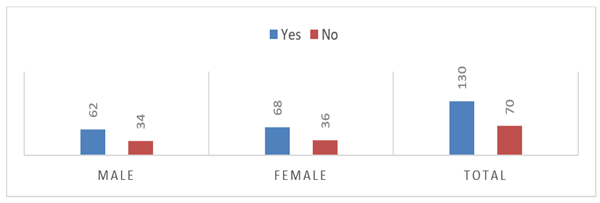
Table 2 Awareness about Instagram being used as a Content Marketing Strategy in Healthcare based on Gender |
|||
|
Gender |
Yes |
No |
Total |
|
Male |
62 |
34 |
96 |
|
Female |
68 |
36 |
104 |
|
Total |
130 |
70 |
200 |
|
Chi-Square Tests |
|
|
|
|
|
|
|
Value |
df |
Asymptotic Significance (2-sided) |
Exact Sig. (2-sided) |
Exact Sig. (1-sided) |
|
“Pearson
Chi-Square |
0.014 |
1 |
0.906 |
|
|
|
Continuity Corrections |
0 |
1 |
0.989 |
|
|
|
Likelihood
Ratio |
0.014 |
1 |
0.906 |
|
|
|
Fisher's Exact Test |
|
|
|
0.906 |
0.453 |
|
Linear-by-Linear Association |
0.014 |
1 |
0.906 |
|
|
|
N of Valid Cases” |
200 |
|
|
|
|
Interpretation:
In the above chi-square test, it’s clearly visible that there is no significant difference between gender and awareness of the Instagram platform as a healthcare content marketing (p = 0.906). Gender does not affect an individual's understanding of how healthcare professionals use Instagram to disseminate health-related information. The Fisher's Exact Test and other statistical tests exhibit that the differences in awareness between both genders are due to by chance rather than a significant trend.
Table 3
|
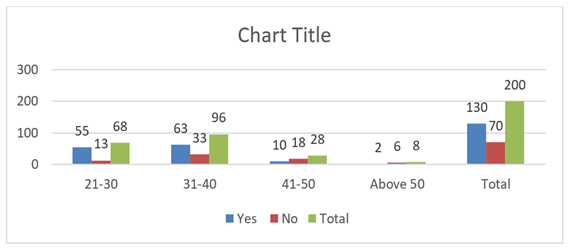
Table 3 Awareness about Instagram being used as a Content Marketing Strategy in Healthcare based on Age |
|||
|
Age |
Yes |
No |
Total |
|
21-30 |
55 |
13 |
68 |
|
31-40 |
63 |
33 |
96 |
|
41-50 |
10 |
18 |
28 |
|
Above 50 |
2 |
6 |
8 |
|
Total |
130 |
70 |
200 |
|
Gender |
Yes |
No |
Total |
|
Male |
46 |
50 |
96 |
|
Female |
44 |
60 |
104 |
|
Total |
90 |
110 |
200 |
|
Test |
Value |
df |
Asymp. Sig. (2-sided) |
|
Pearson Chi-Square |
23.74 |
3 |
0 |
|
Likelihood Ratio |
23.01 |
3 |
0 |
|
Linear-by-Linear Association |
18.92 |
1 |
0 |
|
N of Valid Cases |
200 |
Interpretation
Table 2.2 suggests that the p-value is less than 0.05, which shows that there is a statistically significant difference between both variables, that is, age and awareness of Instagram usage as a content marketing strategy in healthcare. Studies suggest that awareness levels vary substantially among different age groups. Respondents aged between 21 and 40 years show higher awareness, whereas in the group aged 41 years and above, awareness is comparatively low.
5) Have you come across Instagram Pages of Healthcare Providers?
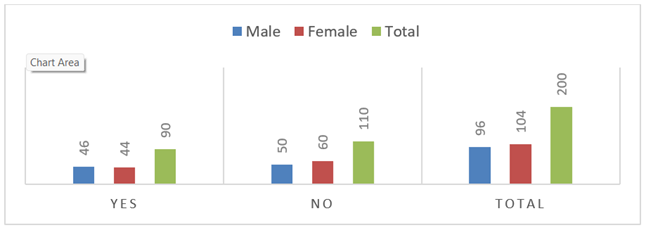
Table 4
|
Table 4 Awareness about Instagram Pages of Healthcare Providers’ Channels based on Gender |
|||||
|
Chi-Square Tests |
|||||
|
Value |
Df |
Asymptotic Significance (2-sided) |
Exact Sig. (2- sided) |
Exact Sig. (1- sided) |
|
|
Pearson Chi-Square |
0.563 |
1 |
0.453 |
||
|
Continuity Corrections |
0.39 |
1 |
0.532 |
||
|
Fisher's Exact Test |
0.453 |
0.366 |
|||
|
Linear-by-Linear Association |
0.56 |
1 |
0.454 |
||
|
Likelihood Ratio |
0.564 |
1 |
0.453 |
||
|
N of Valid Cases |
200 |
||||
Interpretation
The above chi-square test clearly demonstrates that there is no significant difference between gender and exposure to Instagram pages of healthcare professionals (p = 0.453). This shows that both genders have an equal probability of seeing such pages, and any observed differences are attributable to chance rather than a trend. Fisher’s Exact Test confirm findings, showing no significant relation between gender and exposure to healthcare-related Instagram content.
Table 5
|
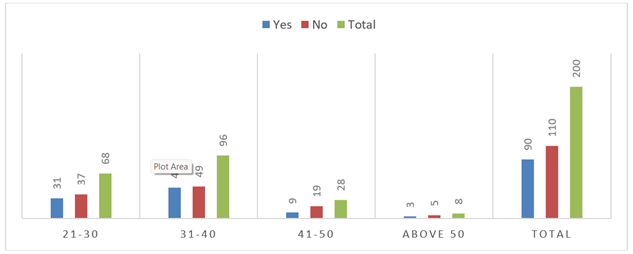
Table 5 Awareness about Instagram Pages of Healthcare Providers Channels based on Age |
|||
|
Age |
Yes |
No |
Total |
|
21-30 |
31 |
37 |
68 |
|
31-40 |
47 |
49 |
96 |
|
41-50 |
9 |
19 |
28 |
|
Above 50 |
3 |
5 |
8 |
|
Total |
90 |
110 |
200 |
|
Chi-Square Test |
|||
|
Test |
ValueChi-Square |
Df |
Asymp. Sig. (2-sided) |
|
Pearson Chi-Square |
2.67 |
3 |
0.445 |
|
Likelihood Ratio |
2.61 |
3 |
0.456 |
|
Linear-by-Linear Association |
1.92 |
1 |
0.166 |
|
N of Valid Cases |
200 |
||
Interpretation:
According to Table 3.2, the p-value (0.445) is greater than 0.05. This shows that there is no statistically significant difference between age and awareness of Instagram pages of healthcare providers. Awareness levels among different age groups seem low.
6) How often do you engage with Health-Related Content on Instagram?
Table 6
|
Table 6 Frequency of Engagement with Health-Related Content on Instagram based on Gender |
|||||||
|
Gender |
Never |
Rarely |
Occasionally |
Monthly |
Weekly |
Daily |
Total |
|
Male |
6 |
20 |
42 |
8 |
12 |
8 |
96 |
|
Female |
16 |
24 |
24 |
6 |
26 |
8 |
104 |
|
Total |
22 |
44 |
66 |
14 |
38 |
16 |
200 |
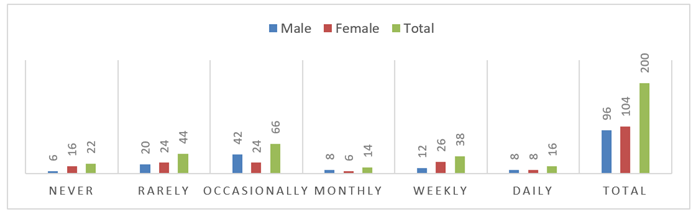
|
df |
Asymptotic Significance (2-sided) |
||
|
Pearson
Chi-Square |
14.97 |
5 |
.0.010 |
|
Linear-by-Linear Association |
.3.86 |
1 |
0.049 |
|
Likelihood
Ratio |
15.28 |
5 |
0.009 |
|
N of Valid Cases |
200 |
Interpretation:
In the above chi-square test, it clearly exhibits that there is a statistically significant difference between gender and consistency of engagement on Instagram with health-related content (p = 0.010). This shows that engagement patterns differ meaningfully between male and female respondents, which shows systematics gender based meaningful patterns rather than random variation.
Table 7
|
Table 7 Frequency of Engagement with Health-Related Content on Instagram based on Age |
|||||||
|
Age |
Never |
Rarely |
Occasionally |
Monthly |
Weekly |
Daily |
Total |
|
21-30 |
10 |
14 |
20 |
3 |
20 |
1 |
68 |
|
31-40 |
6 |
20 |
42 |
8 |
12 |
8 |
96 |
|
41-50 |
4 |
8 |
3 |
2 |
5 |
6 |
28 |
|
Above 50 |
2 |
2 |
1 |
1 |
1 |
1 |
8 |
|
Total |
22 |
44 |
66 |
14 |
38 |
16 |
200 |
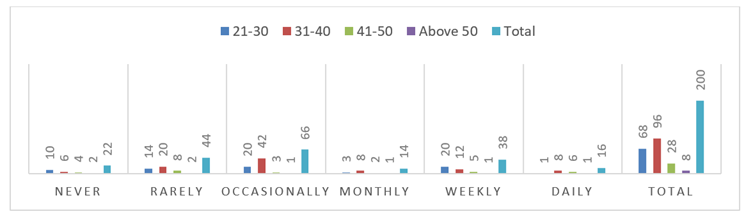
|
Chi-square
Test |
|||
|
Test |
Value |
Df |
Asymp. Sig. (2-sided) |
|
Pearson Chi-Square |
31.69 |
15 |
0.007 |
|
Likelihood Ratio |
33.02 |
15 |
0.004 |
|
Linear-by-Linear Association |
6.48 |
1 |
0.011 |
|
N of Valid Cases |
200 |
||
In Table 4.2, this clearly shows that the pattern of engagement is different among various age categories. The younger age group from 21 to 40 years was continuously involved, as compared to the older age categories. The chi-square table shows the p-value is less than 0.05, i.e. 0.007, which means there is a statistically significant difference between the variables
7) How frequently do you watch Instagram Reels, IGTV videos, or Stories for medical information
Table 8
|
Table 8 Consistency of Watching Instagram Reels, IGTV Videos, or Stories for Medical Information Based on Gender |
|||||||
|
Gender |
Never |
Rarely |
Occasionally |
Sometimes |
Frequently |
Always |
Total |
|
Male |
6 |
22 |
38 |
24 |
4 |
2 |
96 |
|
Female |
14 |
34 |
22 |
24 |
6 |
4 |
104 |
|
Total |
20 |
56 |
60 |
48 |
10 |
6 |
200 |
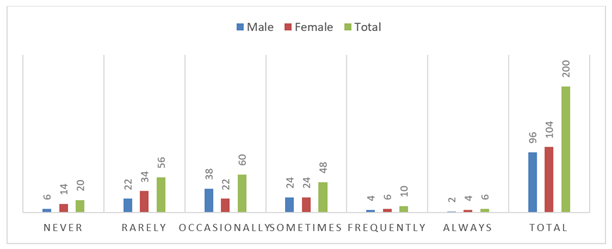
|
Chi-Square Tests |
|||
|
|
Value |
Df |
Asymptotic
Significance (2-sided) |
|
Pearson
Chi-Square |
16.97 |
5 |
.0.005 |
|
Linear-by-Linear Association |
3.68 |
1 |
0.055 |
|
Likelihood
Ratio |
17.4 |
5 |
.0.004 |
|
N of Valid Cases |
200 |
|
|
Interpretation:
According to the Chi-Square Test, there is a significant difference between gender and consistency of viewing medical information on Instagram Reels, IGTV videos, and Stories. The test findings (p = 0.005) exhibit that engagement patterns differ meaningfully between male and female respondents, and observed variations are probably meaningful trends rather than due to chance
Table 9
|
Table 9 Consistency of Watching Instagram Reels, IGTV Videos, or Stories for Medical Information based on Age |
|||||||
|
Age |
Never |
Rarely |
Occasionally |
Sometimes |
Frequently |
Always |
Total |
|
21-30 |
5 |
20 |
16 |
20 |
5 |
2 |
68 |
|
31-40 |
10 |
30 |
31 |
23 |
1 |
1 |
96 |
|
41-50 |
4 |
5 |
11 |
3 |
3` |
2 |
28 |
|
Above 50 |
1 |
1 |
2 |
2 |
1 |
1 |
8 |
|
Total |
20 |
56 |
60 |
48 |
10 |
6 |
200 |
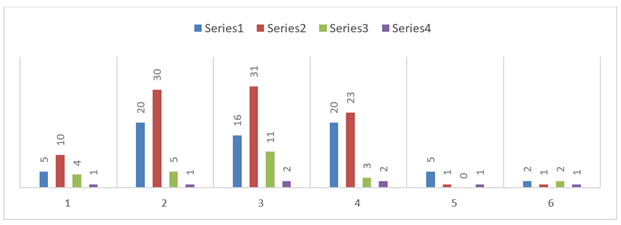
|
Chi-square Test |
|||
|
Test |
Value |
Df |
Asymp. Sig. (2-sided) |
|
Pearson
Chi-Square |
18.42 |
15 |
0.24 |
|
Likelihood Ratio |
19.03 |
15 |
0.213 |
|
Linear-by-Linear
Association |
1.84 |
1 |
0.175 |
|
N of Valid Cases |
200 |
||
Interpretation
According to Table 5.2, the p-value (0.240) is greater than 0.05. The chi-square test indicates there is no statistically significant difference between age and the consistency of watching Instagram Reels, IGTV videos, or Stories for medical information, shows, and that the viewing pattern remains broadly similar among various age groups
8) Do you think Health-Related Content on Instagram provides accurate and reliable information?
Table 10
|
Table 10 Dissemination of Accurate and Reliable Health Content Information Through Instagram Based on Gender |
||||
|
Gender |
Yes |
No |
May be |
Total |
|
Male |
16 |
22 |
58 |
96 |
|
Female |
26 |
12 |
66 |
104 |
|
Total |
42 |
34 |
124 |
200 |
|
Chi-Square Tests |
|||
|
|
Value |
Df |
Asymptotic Significance (2-sided) |
|
Pearson
Chi-Square |
8.69 |
2 |
0.011 |
|
Linear-by-Linear Association |
3.05 |
1 |
0.081 |
|
Likelihood
Ratio |
9.14 |
2 |
0.01 |
|
N of Valid Cases |
200 |
|
|
Interpretation:
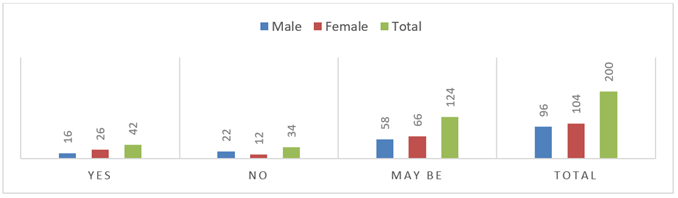
According to the above table 6.1, the chi-square test shows a significant difference between gender and accuracy in health-related content on Instagram (p = 0.011). Female respondents opted for content as accurate, whereas male respondents mostly observed the “No” and “Maybe” categories. whereas a lesser fraction shows firm agreement or disagreement with its reliability. This exhibits that trust in Instagram's health content is mostly unclear, and gender has a significant effect on these attitudes.
Therefore, the study Hypothesis which states that “There is a significant difference based on demographic factor (Gender and Age) in consumers’ trust levels regarding the type of healthcare content consumed on Instagram” stands proved in regard to gender as male and female respondents differ significantly in their perception regarding the dissemination of accurate and reliable health content information through Instagram reflecting their trust level regarding such content.
Based on the research findings, therefore, the Null Hypothesis Ho which states, “There is no significant difference based on demographic factors (Gender and Age) in consumers’ trust levels regarding the type of healthcare content consumed on Instagram” stands disapproved.
Table 11
|
Table 11 Dissemination of
Accurate and Reliable Health Content Information Through Instagram Based on
Age |
||||
|
Age |
Yes |
No |
May be |
Total |
|
21-30 |
20 |
13 |
35 |
68 |
|
31-40 |
15 |
12 |
69 |
96 |
|
41-50 |
5 |
6 |
17 |
28 |
|
Above 50 |
2 |
3 |
3 |
8 |
|
Total |
42 |
34 |
124 |
200 |
|
Chi-square Test |
|||
|
Test |
Value |
df |
Asymp. Sig. (2-sided) |
|
Pearson Chi-Square |
10.94 |
6 |
0.09 |
|
Likelihood Ratio |
11.21 |
6 |
0.082 |
|
Linear-by-Linear Association |
2.47 |
1 |
0.116 |
|
N of Valid Cases |
200 |
||
Interpretation
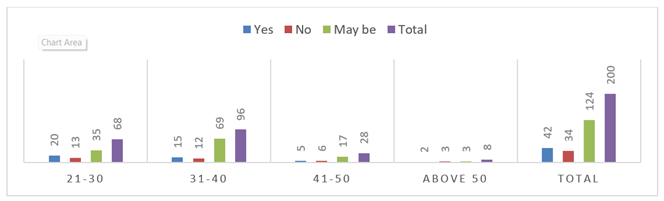
According to Table 6.2, it is clearly mentioned that the p-value is greater than 0.05, i.e. 0.090. This suggests there is no statistically significant difference between variables. Which means respondents among various age categories normally share similar perceptions regarding the reliability of health-related content on Instagram.
Therefore, the study Hypothesis which states that “There is a significant difference based on demographic factor (Gender and Age) in consumers’ trust levels regarding the type of healthcare content consumed on Instagram” stands disapproved in regard to age as almost all respondents across all age groups either express their highest opinion for “ May be” option followed by “ Yes” option regarding the dissemination of accurate and reliable health content information through Instagram.
Based on the research findings, therefore, the Null Hypothesis Ho which states, “There is no significant difference based on demographic factors (Gender and Age) in consumers’ trust levels regarding the type of healthcare content consumed on Instagram” stands proved.
3) Content
Marketing Strategies in Healthcare and Patient Perception
9) What is the frequency of your use of online platforms for health-related information?
Table 12
|
Table 12 Frequency of using Online Platforms for Health-Related Information Based on Gender |
||||
|
Gender |
Rarely |
Occasionally |
Frequently |
Total |
|
Male |
28 |
42 |
26 |
96 |
|
Female |
48 |
22 |
34 |
104 |
|
Total |
76 |
64 |
60 |
200 |
|
Chi-Square Tests |
|||
|
|
Value |
Df |
Asymptotic Significance (2-sided) |
|
Pearson
Chi-Square |
6.140a |
2 |
0.046 |
|
Linear-by-Linear Association |
0.475 |
1 |
0.491 |
|
Likelihood
Ratio |
6.126 |
2 |
0.054 |
|
N of Valid Cases |
200 |
|
|
Interpretation:
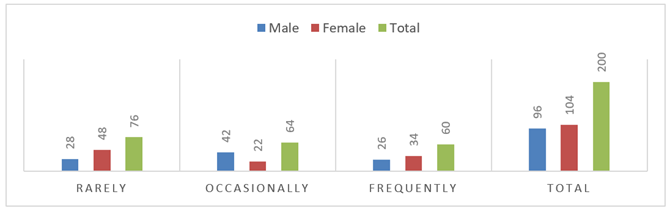
According to Table 7.1. The Chi-Square test shows a significant difference in usage patterns between males and females (χ² = 6.140, p = 0.046). This exhibits the effect of gender on consumer engagement with healthcare online information. The healthcare industry must modify its Instagram content strategies to increase female engagement and employ customized initiatives to enhance male engagement, as women are more likely to engage with healthcare digital resources.
Table 13
|
Table 13 Frequency of using Online Platforms for Health-Related Information Based on Age |
||||
|
Age |
Rarely |
Occasionally |
Frequently |
Total |
|
21-30 |
27 |
23 |
18 |
68 |
|
31-40 |
35 |
31 |
30 |
96 |
|
41-50 |
10 |
8 |
10 |
28 |
|
Above 50 |
4 |
2 |
2 |
8 |
|
Total |
76 |
64 |
60 |
200 |
|
Chi- Square Test |
|||
|
Test |
Value |
Df |
Asymp. Sig. (2-sided) |
|
Pearson Chi-Square |
1.46 |
6 |
0.962 |
|
Likelihood Ratio |
1.47 |
6 |
0.961 |
|
Linear-by-Linear Association |
0.02 |
1 |
0.887 |
|
N of Valid Cases |
200 |
|
|
Interpretation
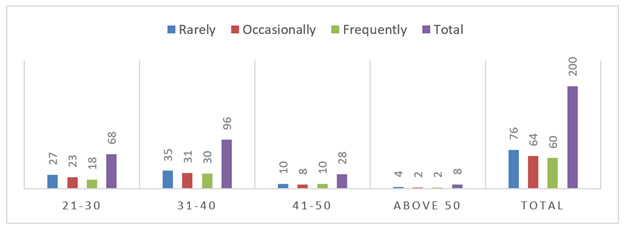
Table 7.2 shows that the p-value is greater than 0.05, i.e. 0.962, which shows no statistically significant difference between variables. Study highlights that respondents among different age groups exhibited equal usage trends, study reveals that age does not noticeably influence online health–related information–seeking habits.
10) Have you ever examined health-related content, including articles, videos, reels, or infographics, published by healthcare providers on Instagram?
Table 14
|
Table 14 Examination of Health-Related Material published by Healthcare Providers on Instagram based on Gender |
|||
|
Gender |
Yes |
No |
Total |
|
Male |
56 |
40 |
96 |
|
Female |
50 |
54 |
104 |
|
Total |
106 |
94 |
200 |
|
Chi-Square Tests |
|||||
|
|
Value |
df |
Asymptotic Significance (2-sided) |
Exact Sig. (2- sided) |
Exact Sig. (1- sided) |
|
Pearson
Chi-Square |
1.045a |
1 |
0.305 |
|
|
|
Linear-by-Linear
Association |
1.044 |
1 |
0.307 |
|
|
|
Likelihood
Ratio |
1.065 |
1 |
0.304 |
|
|
|
Continuity Correction |
0.683 |
1 |
0.409 |
|
|
|
Fisher's
Exact Test |
|
|
|
0.324 |
0.204 |
|
N of Valid Cases |
200 |
|
|
|
|
Interpretation:
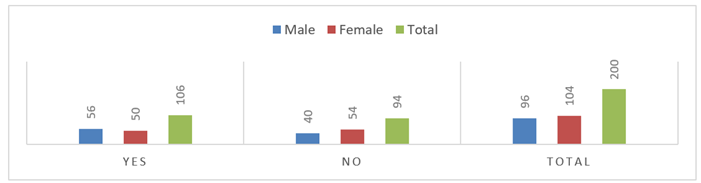
According to Table 8.1, the data analysis shows that there are 56 males and 50 females who are accessing health-related content on Instagram. Females (54) marked lower levels of engagement with this content when compared to males its slightly higher. There were no significant differences in content usage by gender, as shown by the Chi-Square test (p = 0.307). This suggests that gender has no significant impact on users' opinions of healthcare-related information shared by healthcare providers on Instagram.
Table 15
|
Table 15 Examination of Health-Related Material published by Healthcare Providers on Instagram based on Age |
|||
|
Age |
Yes |
No |
Total |
|
21-30 |
36 |
32 |
68 |
|
31-40 |
50 |
46 |
96 |
|
41-50 |
15 |
13 |
28 |
|
Above 50 |
5 |
3 |
8 |
|
Total |
106 |
94 |
200 |
|
Chi Square Test |
|||
|
Test |
Value |
Df |
Asymp. Sig.
(2-sided) |
|
Pearson
Chi-Square |
0.33 |
3 |
0.955 |
|
Likelihood Ratio |
0.33 |
3 |
0.955 |
|
Linear-by-Linear
Association |
0.01 |
1 |
0.921 |
|
N of Valid Cases |
200 |
||
Interpretation
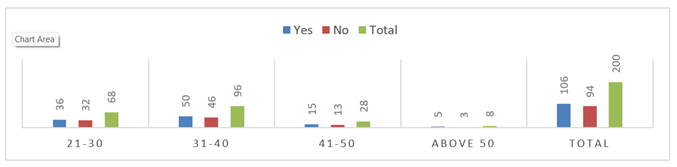
Table 8.2 indicate the p-value (0.955) is greater than 0.05, so there is no statistically differences in between age and examining health-related material given by healthcare providers. Respondents among various age groups exhibits similar examination habits.
11)Which Instagram Content Marketing Strategy do you consider to be the most informative and effective?
Table 16
|
Table 16 Most Preferred Instagram Content Marketing Strategy for Disseminating Health Information Based on Gender |
|||||||
|
Gender |
Patient success
stories |
Fitness and wellness tips from experts |
Live Q&A sessions with doctors |
Infographics and
articles |
Total |
||
|
Male |
16 |
30 |
14 |
36 |
96 |
||
|
Female |
22 |
28 |
8 |
46 |
104 |
||
|
Total |
38 |
58 |
22 |
82 |
200 |
||
|
Chi-Square Tests |
|||
|
|
Value |
Df |
Asymptotic Significance (2-sided) |
|
Pearson
Chi-Square |
1.779 |
3 |
0.602 |
|
Linear-by-Linear Association |
0.008 |
1 |
0.903 |
|
Likelihood
Ratio |
1.709 |
3 |
0.617 |
|
N of Valid Cases |
200 |
|
|
Interpretation:
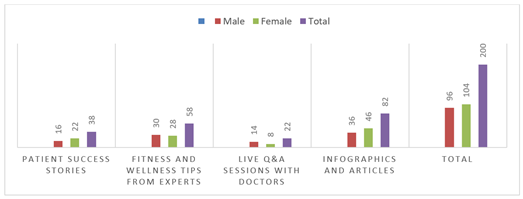
Table 9.1 shows that the use of infographics and articles on health issues are most informative and successful Instagram content marketing technique, with a little predilection for females over males. The second most popular choice is professional exercise and wellness assistance, with almost equal choices for both genders. Patient success stories and live Q&A sessions significantly reduced engagement, especially among females. The Chi-Square test suggests there is no significant difference in content choice based on gender (p = 0.620). It appears that men and women have similar preferences when it comes to Instagram posts related to health.
Table 17
|
Table 17 Most Preferred Instagram Content Marketing Strategy for Disseminating Health Information Based on Gender |
|||||||
|
Age |
Patient success
stories |
Fitness and wellness tips from experts |
Live Q&A sessions with doctors |
Infographics and
articles |
Total |
||
|
21-30 |
15 |
20 |
8 |
25 |
68 |
||
|
31-40 |
17 |
30 |
11 |
38 |
96 |
||
|
41-50 |
5 |
6 |
2 |
15 |
28 |
||
|
Above 50 |
1 |
2 |
1 |
4 |
8 |
||
|
Total |
38 |
58 |
22 |
82 |
200 |
||
|
Chi-Square Test |
|||
|
Test |
Value |
df |
Asymp. Sig. (2-sided) |
|
Pearson Chi-Square |
3.417 |
9 |
0.946 |
|
Likelihood Ratio |
3.438 |
9 |
0.944 |
|
Linear-by-Linear Association |
0.12 |
1 |
0.729 |
|
N of Valid Cases |
200 |
||
Interpretation
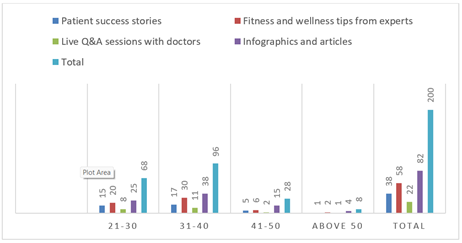
In Table 9.2, the p-value is 0.946, which is greater than 0.05; this shows no statistically significant difference between age and preferred strategies for Instagram content marketing for disseminating health information. Respondents among different age categories show similar preferences, showcasing that age does not considerably affect the choice of Instagram content formats.
12) Does the implementation of Content Marketing Strategies of Instagram enhance perception about Healthcare Providers?
Table 18
|
Table 18 Impact of Content Marketing Strategies of Instagram on Enhancing Perception About Healthcare Providers Based on Gender |
|||||
|
Gender |
Never |
Not Sure |
Moderately |
Significantly |
Total |
|
Male |
14 |
24 |
38 |
20 |
96 |
|
Female |
18 |
28 |
40 |
18 |
104 |
|
Total |
32 |
52 |
78 |
38 |
200 |
|
Chi-Square Tests |
|||
|
|
Value |
df |
Asymptotic Significance (2-sided) |
|
Pearson
Chi-Square |
0.323 |
3 |
0.965 |
|
Linear-by-Linear Association |
0.313 |
1 |
0.567 |
|
Likelihood
Ratio |
0.323 |
3 |
0.965 |
Interpretation:
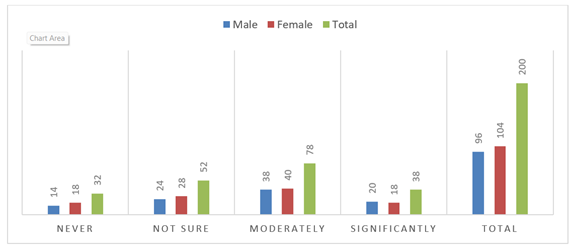
The results suggest that the majority of respondents, irrespective of their gender, believe that Instagram content marketing strategies are either marginally or significantly beneficial to their perception of healthcare providers. A small number of respondents express uncertainty or believe that these strategies are ineffective. The results of the Chi-Square test show that the gender-based perceptions are not significantly different (p = 0.965). This suggests that Instagram content marketing influences men's and women's views about healthcare providers in a comparable way.
Table 19
|
Table 19 Impact of Content Marketing Strategies of Instagram on Enhancing Perception About Healthcare Providers based on Age |
|||||
|
Age |
Never |
Not Sure |
Moderately |
Significantly |
Total |
|
21-30 |
10 |
20 |
23 |
15 |
68 |
|
31-40 |
14 |
25 |
37 |
20 |
96 |
|
41-50 |
7 |
6 |
13 |
2 |
28 |
|
Above 50 |
1 |
1 |
5 |
1 |
8 |
|
Total |
32 |
52 |
78 |
38 |
200 |
|
Chi-Square Test |
|||
|
Test |
Value |
df |
Asymp. Sig. (2-sided) |
|
Pearson Chi-Square |
7.52 |
9 |
0.58 |
|
Likelihood Ratio |
7.61 |
9 |
0.572 |
|
Linear-by-Linear Association |
0.84 |
1 |
0.359 |
|
N of Valid Cases |
200 |
||
Interpretation
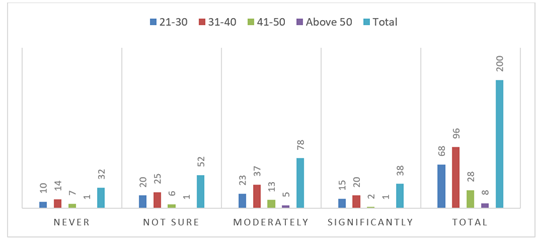
Table 10.2 shows that there is no significant difference visible between the variables, because the p-value is greater than 0.05, i.e. 0.58. The study reveals that the respondents among different age categories observed the same type of subjective impact.
6. Conclusion and Future Scope
The research provides significant inputs related to how patients’ opinions of healthcare practitioners are affected by Instagram-based content marketing strategies and tactics. Collectively, the study reveals that Instagram is useful for healthcare communication, mainly for younger and middle-aged audiences. Age and gender-based responses highlight more engagement depth, credibility, and perceived effectiveness than mere exposure. Despite awareness being widespread, healthcare providers need to adopt demographic-based sensitive content strategies— employing engaging formats for younger users, credibility-focused messaging for doubtful segments, and using inclusive communication approaches to maximize impact across the group.
The research indicates that younger individuals, between the ages of 21 and 40, illustrate a higher level of engagement with older health content than their older respondents. Gender differences in online engagement were noted, with females more frequently using online platforms for consuming healthcare information compared to males. The usage of content, preferences, and opinions of healthcare providers shows no significant differences based on gender. The research suggests the significance of healthcare providers making digital content that is both effective and visually appealing.
The study, besides showcasing various advantages, also had considerable limitations. The research has frequently ignored other social media platforms, such as Facebook, Twitter, and YouTube, which are also important in the field of healthcare communication as content marketing tactics. The research especially focusses on a specific demographic sample, specifically individuals from urban areas and hence it results in the exclusion of understanding from rural populations with various degrees of digital engagement. Moreover, the challenge of developing determinism, despite the use of statistical tests to determine importance, limits the ability to reach a particular conclusion regarding patient’s opinion about content marketing tactics.
In order to have a better understanding of content marketing engagement, future research may look at how various digital media platforms react to different content marketing tactics. The understanding of the effectiveness of social media marketing among a various of socioeconomic classes may be developed by incorporating rural respondents and other demographic groups into the research. The effect of regular contact to digital health content on patient opinion over time may be assessed through longitudinal studies.
CONFLICT OF INTERESTS
None.
ACKNOWLEDGMENTS
None.
REFERENCES
Anisa, N., Ariana, P. M., and Ramadhani, A. (2024). Digital Marketing Strategy Through Social Media: Analysis of the Effectiveness of Health Seminar Promotion on the Instagram Account @Indonesianmedicalcenter. Jurnal Komunikasi: Malaysian Journal of Communication, 40(4). https://doi.org/10.17576/jkmjc-2024-4004-26
Chidester, J. (2023, October 20). 68% of Plastic Surgeons Surveyed Say They've Been Censored by Meta. Allure.
Constantinescu-Dobra, A. (2014). Content Marketing in Dentists' Websites: An Empirical Comparative Study Between Romania and the UK. In S. Vlad and R. Ciupa (Eds.), International Conference on Advancements of Medicine and Health Care Through Technology (p. 22). Springer. https://doi.org/10.1007/978-3-319-07653-9_22
Elmortada, A., Mokhlis, C.-E., Mokhlis, A., and Elfezazi, S. (2020). Innovations in HR management: A Content Analysis Approach. Marketing and Management of Innovations, 1, 182–191. https://doi.org/10.21272/mmi.2020.1-14
Graefen, B., Hasanli, S., Jabrayilov, A., Alakbarova, G., Tahmazi, K., Gurbanova, J., and Fazal, N. (2023). Instagram as a Health Education Tool: Evaluating the Efficacy and Quality of Medical Content on Instagram in Azerbaijan. Cold Spring Harbor Laboratory. https://doi.org/10.1101/2023.12.03.23299316
Kurniasari, D. R. (2024). The Marketing Communication Strategy of RSIA Bunda Jakarta Through Instagram Social Media to Enhance Brand Awareness. Riwayat: Educational Journal of History and Humanities, 7(1), 90–110. https://doi.org/10.24815/jr.v7i1.36625
Prudnikov, Y., and Nazarenko, A. (2021). The Role of Content Marketing in the Promotion of Medical Goods and Services. Health Economics and Management Review, 2(1), 23–29. https://doi.org/10.21272/hem.2021.1-02
Ramasubramanian, V., et al. (2021). Multifaceted Role of Social Media in Healthcare: Opportunities, Challenges, and the Way Forward. Journal of Medicine and Life, 14(3), 347–354.
Trivedi, P., and Pal, R. (2022). A Research Paper on Strategies that Businesses Use to Survive Through Social Media Marketing with Reference to Instagram. Towards Excellence, 14(2). https://doi.org/10.37867/TE1402141
Vasani, S., Pravin, P., Bhupatkar, S., and Abdulkareem, A. M. (2024). The Digital Medic: Assessing the Role of Social Media in Empowering Individuals with Health Knowledge and Choices. Journal of Information and Knowledge, 61(2), 71–76. https://doi.org/10.17821/srels/2024/v61i2/171256
|
|
 This work is licensed under a: Creative Commons Attribution 4.0 International License
© ShodhKosh 2026. All Rights Reserved.