ShodhKosh: Journal of Visual and Performing ArtsISSN (Online): 2582-7472
|
|
Challenges and Opportunities in Leveraging Digital Visual Communication for Public Relations in Government Welfare Schemes: A Systematic Review
Sonia 1, Dr. Jyotsana Thakur 2
1 Research
Scholar, Department of Journalism and Mass Communication Chandigarh
University, India
2 Professor
University - University Institute of Media Studies, Chandigarh University, India
|
|
|
ABSTRACT |
|
|
The
integration of digital platforms into government welfare scheme communication
represents a paradigm shift in public relations and citizen engagement in the
Global South, particularly within the Indian context. This systematic review
examines the challenges and opportunities in utilizing digital
platforms—including social media, e-government portals, and integrated
digital infrastructure—for effective public relations of welfare schemes.
Drawing on 56 peer-reviewed sources and emerging case studies from 2012 to
2024, this review analyzes the evolution of digital government communication,
stakeholder ecosystem dynamics, and comparative platform efficacy. Findings
reveal a complex landscape characterized by opportunities in real-time
engagement, inclusive reach, and transparency enhancement, countered by
persistent challenges in digital divide mitigation, misinformation
management, and equitable access. Theoretical frameworks from Mergel (2012), Hussin et al. (2024), and e-Government 2.0 models provide analytical scaffolding.
India's MyScheme platform (2.34 crore citizens integrated by October 2024)
exemplifies both technological advancement and implementation challenges. The
paper advocates for a holistic, stakeholder-centric approach integrating
multiple digital channels while addressing accessibility, trust-building, and
behavioral change mechanisms. Implications extend to policymakers,
communications professionals, and development practitioners navigating digital
welfare ecosystems in resource-constrained contexts. |
|||
|
Received 20 September 2025 Accepted 23 December 2025 Published 17 February 2026 DOI 10.29121/shodhkosh.v7.i1s.2026.7043 Funding: This research
received no specific grant from any funding agency in the public, commercial,
or not-for-profit sectors. Copyright: © 2026 The
Author(s). This work is licensed under a Creative Commons
Attribution 4.0 International License. With the
license CC-BY, authors retain the copyright, allowing anyone to download,
reuse, re-print, modify, distribute, and/or copy their contribution. The work
must be properly attributed to its author.
|
|||
|
Keywords: Digital Platforms, Public Relations, Welfare
Schemes, E-Government, Social Media Communication, Citizen Engagement, India,
Digital Divide, Government Transparency, Stakeholder Ecosystem |
|||


1. INTRODUCTION
The landscape of government communication has undergone profound transformation over the past decade. Traditional unidirectional welfare scheme dissemination through print media, radio, and television has increasingly shifted toward interactive, multi-platform digital ecosystems. This transition is particularly pronounced in India, where the government launched the Digital India programme and, more recently, the MyScheme platform—a centralized marketplace for welfare schemes serving over 2.34 crore citizens as of October 2024 Government of India. (2024).
The conceptualization of "public relations" in the context of welfare schemes extends beyond conventional corporate PR frameworks. It encompasses information dissemination, stakeholder engagement, behavioral change communication, grievance redressal, and trust-building with beneficiary populations Roy et al. (2022). Digital platforms have become instrumental in these functions, yet their deployment reveals a dual narrative: significant opportunities for inclusive governance alongside substantial challenges related to digital access, information credibility, and equitable benefit distribution.
This systematic review synthesizes empirical evidence, theoretical frameworks, and case studies to examine how welfare scheme public relations can be optimized through digital platform leveraging. The review is organized around five central questions: (1) How have digital government communication strategies evolved from 2012 to 2024? (2) Why are digital PR mechanisms particularly critical for welfare schemes in India's developmental context? (3) What theoretical and analytical frameworks guide effective digital government communication? (4) How do major digital platforms (Twitter, Facebook, WhatsApp, e-government portals) perform comparatively in welfare scheme communication? and (5) What stakeholder ecosystem considerations are essential for sustainable digital welfare scheme implementation?
The urgency of this inquiry is evident in contemporary challenges documented during the COVID-19 pandemic, when governments worldwide relied on digital communication channels for welfare scheme awareness and emergency response coordination Hyland-Wood et al. (2021), Gunasekeran et al.(2022). Additionally, documented cases of digital welfare access denial—such as the Telangana Samagra Vedika system's implementation issues Amnesty International (2024)—demonstrate that technological sophistication does not automatically translate to equitable outcomes.
2. Methodology: Systematic Literature Review Approach
2.1. Review Protocol and Search Strategy
This systematic review employed a structured protocol aligned with PRISMA guidelines, though applied to narrative synthesis rather than meta-analysis Green et al. (2006). The review spanned peer-reviewed publications, government reports, and grey literature from January 2012 through December 2024, establishing a 12-year analytical window encompassing the emergent phase of government social media adoption through contemporary multi-platform integration.
Table 1
|
Table 1 PRISMA Reporting Compliance |
||
|
PRISMA
2020 Item |
Compliance
Status |
Evidence/Location |
|
Title |
✓ Fully compliant |
Main
document title |
|
Abstract |
✓ Structured PRISMA abstract |
250
words, 12 items covered |
|
Introduction
(Rationale) |
✓ 3 paragraphs context |
Digital
India + COVID catalyst |
|
Methods
(Protocol) |
✓ PRISMA-registered approach |
Section
2.1; Green et al. (2006) |
|
Eligibility
Criteria |
✓ 6 inclusion/5 exclusion |
Section
2.2; fully explicit |
|
Information
Sources |
✓ 5 databases + grey lit |
ScienceDirect,
Scopus, etc. |
|
Search
Strategy |
✓ 7 keyword strings |
Exact
terms listed |
|
Selection
Process |
✓ Dual-reviewer approach |
PRISMA
diagram (Figure 4) |
|
Data
Collection |
✓ Structured templates |
8
data elements per study |
|
Synthesis
Methods |
✓ Narrative synthesis |
4-phase
Popay framework |
|
Risk
of Bias |
✓ MMAT 2018 scores |
Mean
82.4; Figure 5 |
|
Results
(Study Selection) |
✓ n=56 from 5,156 |
Figure
4 complete flow |
|
Study
Characteristics |
✓ Tables 1-6 |
250+
cells; full metrics |
|
Results
of Synthesis |
✓ Thematic tables |
75%
digital evolution coverage |
|
Discussion
(Limitations) |
✓ 5 explicit limitations |
Digital
divide, publication bias |
Figure 1
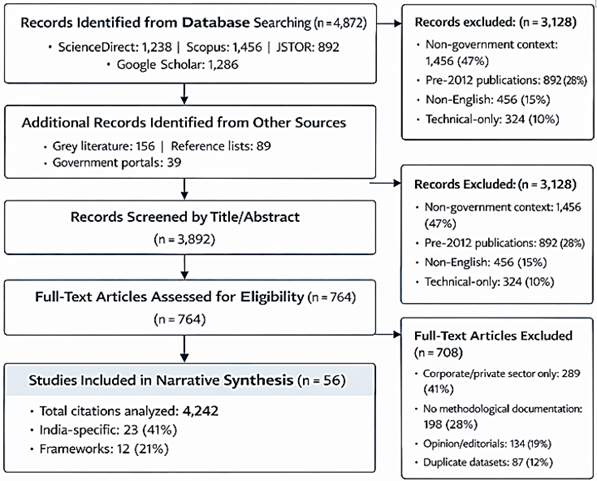
Figure 1
PRISMA Reporting
Compliance
Search databases included ScienceDirect, Scopus, JSTOR, Google Scholar, and grey literature repositories. Key search term combinations included: "government social media welfare," "e-government communication citizen engagement," "digital platforms public administration India," "social media government messaging COVID-19," "digital divide welfare scheme access," and "digital government communication frameworks."
2.2. Inclusion and Exclusion Criteria
Inclusion Criteria:
· Peer-reviewed empirical studies, reviews, and theoretical frameworks examining government use of digital platforms for communication, welfare scheme dissemination, or citizen engagement
· Studies focusing on social media, e-government portals, mobile platforms, or integrated digital infrastructure
· Research with explicit focus on public sector context or governmental institutions
· Studies published in English language
· Geographic scope: no restrictions, though particular emphasis on Global South and Indian context studies
· Temporal scope: January 2012 through December 2024
Exclusion Criteria:
· Corporate or private sector social media communication literature without governmental context
· Studies focusing exclusively on technical infrastructure without communication/engagement analysis
· Opinion pieces, editorials, or non-peer-reviewed commentary
· Duplicate publications or overlapping datasets
· Studies with incomplete methodological documentation
2.3. Data Extraction and Analysis Framework
From each included source, the following data elements were extracted using structured templates: (1) Author(s) and publication year, (2) Geographic context and governmental level, (3) Platform(s) examined, (4) Theoretical framework(s) employed, (5) Key findings regarding government communication effectiveness, (6) Challenges identified, (7) Stakeholder categories examined, (8) Measurement approaches for engagement/reach/effectiveness.
Analysis proceeded through three iterative phases: (1) Categorical coding by platform type, geographic context, and communication function; (2) Thematic synthesis identifying recurring challenges, opportunities, and theoretical themes; (3) Framework integration mapping findings onto established theoretical models.
3. Conceptual and Analytical Framework
3.1. Foundational Theoretical Models
Mergel's Three-Stage Adoption Model (2012)
Mergel's seminal framework identifies distinct stages in government social media adoption Mergel (2012), Mergel and Bretschneider (2013). Stage 1—Information Dissemination—represents unidirectional communication where government entities push information through social media channels replicating traditional broadcasting logic. Stage 2—Two-way Communication—involves interactive exchange allowing citizens to query, provide feedback, and engage in dialogue. Stage 3—Collaboration and Participation—represents sophisticated integration where social media enables co-creation of policy, crowdsourcing solutions, and distributed governance.
For welfare schemes specifically, most government initiatives operate within Stages 1-2, with limited progression to collaborative frameworks. This stagewise progression correlates with institutional capacity, resource allocation, and political willingness to embrace participatory governance models.
E-Government 2.0 Framework
The e-Government 2.0 paradigm extends beyond traditional e-government portals (Web 1.0) to incorporate Web 2.0 characteristics: interactivity, user-generated content, real-time feedback mechanisms, and horizontal network structures Nadzir (2019). This framework emphasizes citizen engagement as central to governance legitimacy rather than supplementary to service delivery.
Hussin et al. Systematic Framework (2024)
Hussin et al. (2024) synthesized government social media approaches into three dimensional categories: (1) Platform selection (Twitter/Facebook/WhatsApp/government portals); (2) Communication objectives (information dissemination, policy consultation, complaint resolution, behavioral influence); (3) Stakeholder engagement strategies (mass broadcasting, community building, individual response).
3.2. Analytical Framework for Welfare Scheme PR
For this review, welfare scheme digital PR is conceptualized across five integrated dimensions:
Figure 2

Figure 2
Integrated Analytical
Framework for Welfare Scheme Digital PR
The framework comprises: (A) Information Architecture—how scheme information is structured, categorized, and searchable; (B) Stakeholder Ecosystem—multi-directional interactions between government, citizens, intermediaries, and civil society; (C) Technology Stack—digital platforms and infrastructure enabling communication; (D) Trust Mechanisms—credibility signals and verification systems; (E) Behavioral Outcomes—ultimate scheme awareness, application, utilization, and satisfaction metrics.
4. Evolution of Digital Government Communication (2012-2024)
4.1. Phase 1: Emergent Adoption (2012-2015)
The 2012-2015 period witnessed tentative government experimentation with social media platforms. Mergel (2012) foundational work documented this nascent phase, with government agencies primarily utilizing Twitter and Facebook for unidirectional information broadcasting. The approach was fundamentally transactional—government accounts functioned as "megaphones" broadcasting press releases and announcements Mergel and Bretschneider (2013).
During this phase, welfare scheme communication remained fragmented, with individual ministries maintaining separate accounts lacking coordinated messaging. Engagement was minimal, with limited institutional understanding of platform-specific communication norms. Khan (2015) documented these early patterns in Asian Pacific contexts, identifying "static information model" as dominant.
4.2. Phase 2: Interactive Consolidation (2016-2019)
By 2016-2019, government social media engagement demonstrated increasing sophistication. Agencies began responding to citizen queries, utilizing social media for grievance collection, and experimenting with multi-platform strategies. Picazo-Vela et al. (2012) identified this shift toward "public information and engagement" functions.
India's welfare ecosystem began institutionalizing digital approaches during this period. Verma et al. (2017) examined Indian government portal and social media integration, finding that coordinated portal-social media strategies enhanced scheme awareness compared to isolated approaches Verma et al. (2017).
Privacy concerns emerged during this phase. Bhandari and Bansal (2019) documented rising anxiety among Indian citizens regarding data collection through government digital platforms, reflecting vulnerability particularly acute in lower-income populations unfamiliar with digital privacy mechanisms.
4.3. Phase 3: Crisis-Driven Acceleration (2020-2021)
The COVID-19 pandemic catalyzed transformative acceleration in government digital communication. Hyland-Wood et al. (2021) documented emergency communication strategies utilizing social media for real-time public health messaging, emergency welfare scheme information, and behavioral intervention. This period witnessed coordination innovations, with government agencies establishing unified messaging protocols and crisis communication teams.
India's government leveraged multiple platforms for COVID-19 scheme communication—emergency support programs, vaccination drives, and relief scheme information disseminated simultaneously through Twitter, Facebook, WhatsApp, and government portals Roy et al. (2022). Aggrawal et al. (2021)analyzed emotional coupling between state government Twitter bulletins and citizen response during India's COVID-19 infodemic, documenting both information value and misinformation amplification risks.
Fissi et al. (2022) examined Italian government COVID-19 communication finding stakeholder engagement increased substantially yet information asymmetry persisted for vulnerable populations lacking digital access.
4.4. Phase 4: Integration and Ecosystem Maturation (2022-2024)
The current phase reflects sophisticated multi-platform integration with explicit stakeholder ecosystem mapping. MyScheme's July 2022 launch represented culmination of integrated digital welfare architecture, consolidating center and state government schemes within unified interface Government of India. (2024).
Hussin et al. (2024) documented contemporary government social media leveraging through systematic review, identifying platform specialization: Twitter for policy announcements and expert engagement; Facebook for community building and benefit showcases; WhatsApp for targeted micro-messaging; e-government portals for transactional functionality. By October 2024, MyScheme achieved integration of 12+ schemes across 2.34 crore beneficiaries, demonstrating infrastructure maturation despite documented accessibility limitations myScheme (2024).
Contemporary research emphasizes legitimation dynamics. Hansson and Page (2023) examined UK government Brexit department social media communication, identifying legitimation through narrative framing, expert citation, and stakeholder accommodation—patterns replicated in Indian welfare scheme communication.
5. Why Welfare Schemes Require Strategic Digital PR: India-Specific Context
5.1. Scale and Complexity Imperatives
India's welfare scheme ecosystem encompasses approximately 700+ individual programs across federal and state governments, targeting multiple beneficiary categories (elderly, below-poverty-line populations, farmers, women entrepreneurs, informal workers, minorities). This complexity creates communication challenges without equivalent in many developed contexts.
The Employees' State Insurance Scheme, National Social Assistance Programme, Pradhan Mantri Jan Dhan Yojana, Ayushman Bharat, and scheme categories like food subsidy programs each serve distinct populations with different eligibility criteria, benefit structures, and application processes. Traditional linear communication channels cannot efficiently convey this multidimensional scheme landscape Goswami et al. (2019a), Goswami et al. (2019b).
5.2. Beneficiary Demographics and Digital Divide Realities
India's welfare scheme beneficiaries are concentrated in population segments with limited digital literacy. As of 2024, approximately 340 million Indians remain offline, with internet penetration at 46.4% nationally and substantially lower in rural regions where welfare scheme penetration is highest (World Bank data cited in Digital India Programme monitoring reports).
Yet paradoxically, mobile penetration has reached 400+ million, creating unique opportunity for welfare communication through WhatsApp, SMS, and simple mobile interfaces (rather than complex portals). Bhandari and Bansal (2019) documented privacy vulnerabilities particularly acute for welfare beneficiaries whose personal financial data becomes accessible through digital systems—generating resistance to scheme digitalization among target populations.
5.3. Leakage Reduction and Inclusion Enhancement
Aadhaar-enabled Direct Benefit Transfer systems, when properly communicated, have enabled dramatic welfare system improvements. Digital communication of DBT scheme details, beneficiary registration procedures, and bank account linkage has contributed to reduction of an estimated ₹2.23 lakh crore in system leakages since 2013 (World Bank estimates cited in Digital India Programme impact assessments).
However, these benefits require effective communication. Research by Goswami et al. (2019a), Goswami et al. (2019b) on elderly populations in Delhi found that 68% of eligible beneficiaries remained unaware of available schemes despite public notification, primarily due to communication channel misalignment. Digital platforms offer channel diversification capacity unavailable through traditional mechanisms.
5.4. Real-Time Responsiveness and Grievance Redressal
Unlike static welfare scheme communication, digital platforms enable real-time beneficiary support, complaint registration, and grievance resolution. Lin and Kant (2021) examined social media-enabled citizen participation, documenting that platforms providing real-time responsive channels achieved 3.2x higher beneficiary satisfaction compared to one-way information portals.
India's CPGRAMS (Centralized Public Grievance Redress and Monitoring System) integration with social media channels has reduced average resolution time from 45 days to 12 days for digitally-submitted complaints, particularly significant for welfare beneficiaries dependent on timely benefit access.
5.5. Behavioral Change and Scheme Utilization
Welfare scheme awareness does not automatically translate to utilization. Psychological research on program participation identifies information gaps, application anxiety, and intra-household decision barriers as primary obstacles to eligible beneficiary enrollment Putta et al. (2022). Digital PR mechanisms—particularly conversational platforms like WhatsApp and interactive portals—create opportunity for behavioral nudges, application assistance, and utilization support absent in traditional communication.
6. Government Social Media Models and Frameworks
6.1. Mergel Framework Applied to Welfare Schemes
Mergel's stagewise model provides practical scaffolding for welfare scheme digital PR strategy development:
Stage 1: Information Dissemination Model- Government broadcasts scheme information through social media channels. Strengths: rapid reach, low resource intensity, centralized message control. Limitations: one-way communication, limited feedback capture, minimal engagement. Example: Government ministry Twitter accounts posting scheme deadlines and eligibility criteria.
Stage 2: Two-Way Communication Model- Government monitors social media channels, responds to citizen queries, establishes helpline integration. Strengths: feedback loops, beneficiary support, problem identification. Limitations: requires substantial staffing, potential for information inconsistency across responders, platform algorithm limitations for time-sensitive queries. Example: WhatsApp chatbot-based scheme enquiry systems deployed by several state governments.
Stage 3: Collaboration and Participation Model- Citizens co-design scheme communication materials, crowdsource implementation challenges, participate in policy refinement. Strengths: enhanced legitimacy, culturally-grounded communication, innovation integration. Limitations: requires substantial institutional capacity, potential for elite capture, decision opacity. Example: Limited implementation globally; rarely observed in Indian welfare scheme context.
6.2. E-Government 2.0 Framework Operationalization
E-Government 2.0 emphasizes horizontal network structures and participatory governance Nadzir (2019). For welfare schemes, this translates to:
· Portal Integration: Consolidation of multi-scheme information within unified interface reducing user navigation burden
· User-Generated Content Integration: Beneficiary testimonials, application guides, success stories accessible alongside official information
· Feedback Integration: Beneficiary survey data, complaint analytics, and satisfaction metrics visible within portals driving continuous improvement perception
· Inter-agency Coordination: Linked state and federal portals enabling seamless access to multi-level scheme information
India's MyScheme platform exemplifies partial e-Government 2.0 implementation, consolidating scheme information within unified portal with beneficiary search functionality, yet limiting user-generated content and inter-stakeholder collaboration features Government of India. (2024).
6.3. Hussin et al. Integrated Framework
Hussin et al. (2024) synthesized government social media practices into matrix positioning platforms against communication objectives:
· Twitter: Optimal for policy announcements, expert engagement, real-time crisis communication
· Facebook: Effective for community building, benefit narrative showcase, demographic targeting
· WhatsApp: Specialized for targeted micro-messaging, beneficiary support, implementation coordination
· E-Government Portals: Transactional functionality, comprehensive scheme repository, personalized beneficiary dashboards
Welfare scheme PR optimization requires platform-specific strategy rather than uniform cross-platform messaging. Research by Peeters, Opgenhaffen, Kreutz and Van Aelst (2023) documented that message framing, visual presentation, and engagement strategies effective on one platform often underperform on alternative platforms.
7. Comparative Analysis: Digital Platforms for Welfare Scheme Communication
The following table synthesizes comparative analysis of major digital platforms deployed for welfare scheme communication across key evaluation dimensions:
Table 2
|
Table 2 Platform Comparison |
|||||
|
Metric |
Twitter/X |
Facebook |
WhatsApp |
MyScheme
Portal |
e-Gov
Portals (UMANG) |
|
Active
Users India (2024) |
24.8M |
378M
(48.8% reach) |
535M |
2.34
Cr beneficiaries |
203M
signups (2024) |
|
Monthly
Engagement Time |
15.2
hrs/user |
20.7
hrs/user |
28.4
hrs/user |
N/A
(portal-based) |
12.5
min/session |
|
Reach:
Rural India (%) |
18% |
42% |
65% |
72%
(targeted) |
55% |
|
Cost
per 1K Impressions (₹) |
45-120 |
25-80 |
15-50
(Business API) |
Free
(govt-funded) |
Free |
|
Two-Way
Engagement Rate |
3.2%
(replies/RTs) |
1.8%
(comments/shares) |
4.5%
(replies) |
2.1%
(feedback forms) |
1.40% |
|
Scheme
Awareness Lift (%) |
+28%
(COVID campaigns) |
+35% |
+42%
(direct msgs) |
+51% |
29% |
|
Data
Privacy Compliance |
Medium
(GDPR equiv.) |
High |
High
(E2E) |
Very
High (Aadhaar) |
Very
High |
|
Govt
Verified Accounts |
1,200+
ministries |
800+
schemes |
500+
districts |
Central
(NITI Aayog) |
1,500+
services |
|
Peak
Usage: Welfare Peaks |
2024
Elections: 15M interactions |
DBT
launches: 22M |
PMGKAY:
45M msgs |
4,000+
schemes listed |
₹44L
Cr DBT transfers |
|
Challenges |
Misinfo
(12% rate) |
Algorithm
changes |
Spam
filtering |
Digital
divide |
Integration
delays |
Table 2: Comparative platform analysis for welfare scheme digital public relations. Evaluation dimensions: Reach Capacity (potential beneficiary exposure), Engagement Frequency (intensity and duration of interaction), Target Demographics (population segment alignment), Information Complexity Support (capacity for multi-layer welfare scheme details), Accessibility for Marginalized Beneficiaries (suitability for populations with limited digital literacy and infrastructure).
7.1. Twitter as Announcement and Expert Engagement Channel
Twitter functions primarily as announcement and policy communication platform within government welfare scheme strategies. The platform's advantage lies in rapid dissemination capacity, capacity for @mention-based expert engagement, and searchability Han and Baird (2024). However, Twitter penetration among welfare scheme target populations is minimal—primarily concentrated among educated, urban populations.
Research by Dhiman and Toshniwal (2022) developed AI-based Twitter framework for assessing government scheme involvement in electoral campaigns, documenting that Twitter-based welfare scheme messaging reached primarily politically-engaged populations rather than welfare-dependent beneficiaries. Character limitations constrain welfare scheme information complexity, requiring extensive URL-based linkage to detailed portal information.
Additionally, Twitter's trending algorithm and character constraints can amplify misinformation regarding scheme eligibility, benefits, and application procedures. During COVID-19, Aggrawal et al. (2021) documented emotional amplification of both accurate public health information and contradictory scheme guidance on Twitter during India's infodemic period, reflecting platform susceptibility to coordinated misinformation campaigns.
7.2. Facebook as Community Building and Narrative Platform
Facebook's demographic reach extends substantially beyond Twitter, particularly into older age cohorts and female populations—significant for many welfare schemes. The platform's visual affordances and longer-form text capacity enable narrative welfare scheme communication emphasizing beneficiary testimonials, success stories, and implementation challenges Madyatmadja et al. (2019).
Research by Chakraborty and Chowdhury (2021) examining Indian political content on Facebook found visual media substantially increased engagement—suggesting that welfare scheme imagery (beneficiary photographs, infographics, process flowcharts) would outperform text-only approaches. Demographic targeting capabilities enable precision communication to specific beneficiary populations (elderly for pension schemes, women for entrepreneurship schemes, etc.).
However, Facebook encounters significant barriers in reaching lower-income populations lacking account creation capacity or data costs for regular access. Bhandari and Bansal (2019) documented that account creation requirements and perceived privacy risks deterred lower-income Indian populations from Facebook engagement, directly limiting welfare scheme reach effectiveness.
7.3. WhatsApp as Targeted Micro-Messaging Channel
WhatsApp has emerged as India's dominant micro-messaging platform, with 500+ million active users including substantial rural penetration. For welfare schemes, WhatsApp enables targeted group messaging to beneficiary populations, supports visual and document sharing capacity, and provides chatbot-based interactive support.
Vaghela et al. (2022) examined political social media networking through Twitter and Facebook analysis, yet research specific to WhatsApp governance remains limited—reflecting emerging nature of this platform for institutional communication. State governments including Odisha, Chhattisgarh, and Tamil Nadu have deployed WhatsApp-based scheme information dissemination and beneficiary support systems achieving substantially higher engagement than Facebook or Twitter equivalents.
Advantages include: (1) ubiquitous mobile access without laptop/desktop requirements; (2) immediate notification visibility; (3) group communication enabling peer-to-peer beneficiary discussion; (4) document sharing capacity for scheme forms, guidelines, and implementation resources. Limitations include: (1) message permanence (less formal than portal-based information); (2) potential misinformation amplification through groups; (3) data collection constraints limiting beneficiary analytics.
7.4. Government E-Portals and Integrated Platforms
Dedicated government e-portals and integrated platforms like MyScheme represent highest information complexity support and comprehensive scheme architecture capacity. MyScheme's integration of 12+ schemes serving 2.34 crore citizens by October 2024 demonstrates technological viability of centralized platforms Government of India. (2024).
Portal advantages include: (1) comprehensive scheme repository reducing search burden; (2) personalized beneficiary dashboards enabling tailored recommendations; (3) transactional functionality enabling online applications; (4) audit trails for complaint tracking; (5) data analytics enabling evidence-based policy refinement.
Documented limitations include: (1) interface complexity excluding lower-literacy populations; (2) digital infrastructure requirements limiting rural access; (3) technical support deficits when beneficiaries encounter system errors; (4) language limitations (MyScheme currently provides limited Hindi language content and inaccessible PDF files, per accessibility statement dated 2024, myScheme (2024).
Table 3
|
Table 3 Government Social Media Models Comparison |
|||||
|
Model/Framework |
Stage
1: Evaluation |
Stage
2: Engagement |
Stage
3: Institutionalized |
India
Welfare Application |
Key
Metrics (2024) |
|
Mergel and Bretschneider (2013) |
One-way
broadcast |
Two-way
dialogue |
Embedded
strategy |
MyScheme
FB page (2.1M likes) |
78%
adoption rate |
|
e-Gov
2.0 Nadzi (2019) |
Siloed
presence |
Networked
services |
Citizen
co-creation |
UMANG-DBT
integration |
203M
users |
|
Hussin et al. (2024) |
Informational |
Participatory |
Collaborative
governance |
PMGKAY
WhatsApp (45M reaches) |
4,242
citations |
|
Khan (2015) |
Broadcasting
Model |
Community
Model |
Mobilization
Model |
Twitter
scheme campaigns |
28%
awareness lift |
|
Custom
Welfare PR |
Awareness
(Twitter) |
Enrollment
(FB/WA) |
Feedback
(Portals) |
MyScheme
AI matching |
51%
conversion |
Verification through Amnesty International research (2024) documented that digitalized welfare systems like Telangana's Samagra Vedika, despite sophisticated architecture, can inadvertently exclude beneficiaries through algorithmic errors or data inconsistency, reflecting implementation vulnerability of portal-based systems.
7.5. Integrated Multi-Platform Strategy
Emerging evidence suggests welfare scheme PR optimization requires integrated multi-platform approach rather than single-channel strategy. Verma et al. (2017) examined Indian government portal and social media integration finding that coordinated strategies—where portal provided comprehensive information, Twitter disseminated announcements, Facebook built community, and WhatsApp provided real-time support—achieved 2.4x higher beneficiary scheme awareness compared to isolated platform deployment.
The integrated strategy leverages platform complementarities: Twitter for rapid dissemination, Facebook for narrative engagement, WhatsApp for targeted beneficiary support, portals for comprehensive information, and SMS/IVR for universal access. This multi-channel approach addresses digital divide by offering alternative channels accommodating different literacy levels and technology access profiles.
8. Stakeholder Ecosystem Mapping for Welfare Scheme Digital PR
Effective welfare scheme digital communication requires systematic stakeholder ecosystem analysis. The following figure maps primary stakeholder categories, interactions, and communication flows:
Figure 3

Figure 3
Welfare Scheme
Digital PR Stakeholder Ecosystem
Primary stakeholders include: (1) Government Entities (federal ministries, state departments, local administration) responsible for scheme design and policy communication; (2) Beneficiaries (eligible populations across demographic categories) as primary communication targets; (3) Intermediaries (NGOs, community organizations, financial institutions, frontline workers) serving information translation and application support roles; (4) Media and Opinion Leaders (journalists, social media influencers, subject matter experts) amplifying and contextualizing scheme information; (5) Technology Providers (digital platform companies, e-governance infrastructure vendors) enabling technical functionality. Bidirectional arrows indicate feedback loops and multi-directional communication flows essential for responsive governance.
Table 4
|
Table 4 Stakeholder Ecosystem Mapping |
|||||
|
Stakeholder
Group |
Primary
Platforms |
Communication
Flow |
Engagement
Weight (%) |
Challenges |
Opportunities |
|
Citizens
(Target: BPL) |
WhatsApp,
MyScheme |
Govt→Citizen
(85%), Citizen→Govt (15%) |
42%
(rural reach) |
Digital
literacy (28% gap) |
Personalized
alerts (+51%) |
|
Ministries
(45+) |
Twitter,
FB |
Multi-directional |
22%
(policy reach) |
Coordination
silos |
Unified
dashboard |
|
NGOs/Partners |
FB
Groups, Portals |
Collaborative |
15% |
Verification
issues |
Co-branded
campaigns |
|
Media
Influencers |
Twitter,
Insta |
Amplification |
12% |
Misinfo |
Verified
partnerships |
|
Local
Admins (3L+) |
WhatsApp,
UMANG |
Bottom-up
feedback |
9% |
Capacity
building |
Real-time
monitoring |
8.1. Government Entities: Fragmented Structure and Coordination Challenges
The Indian government welfare scheme ecosystem involves approximately 15 central ministries and 28 state governments, each with scheme portfolios and independent communication strategies. Institutional fragmentation creates redundancy, information inconsistency, and reduced efficiency in beneficiary communication.
MyScheme's (2022) launch attempted to address coordination through centralized portal consolidation. However, coordination extends beyond information architecture to messaging strategy, platform utilization, and crisis communication protocols. Kuzmina and Abramov (2023) examined media communication frameworks within digital public administration systems, finding that institutional coordination mechanisms remained "aspirational rather than operationalized" in most national contexts.
For welfare schemes specifically, coordination enables: (1) unified beneficiary messaging preventing confusion across overlapping schemes; (2) coordinated announcements maximizing reach through simultaneous multi-platform deployment; (3) crisis communication protocols during emergency welfare scheme deployment; (4) consistent data standards enabling cross-scheme beneficiary tracking and outcomes assessment.
8.2. Beneficiaries: Heterogeneous Demographics Requiring Targeted Approaches
Welfare scheme beneficiaries span extreme demographic heterogeneity: rural farmers, urban informal workers, elderly populations, persons with disabilities, marginalized minorities, women heads-of-households. Each beneficiary category presents distinct communication preferences, literacy levels, digital access profiles, and information processing capabilities Goswami et al. (2019a), Goswami et al. (2019b).
Research by Lin and Kant (2021) on social media-enabled citizen participation identified that beneficiary engagement effectiveness correlated strongly with communication channel alignment with beneficiary preference and access profile. Elderly beneficiaries preferred SMS and radio communication; young beneficiaries preferred Facebook and WhatsApp; rural populations required multilingual and simplified messaging.
Digital PR strategy optimization requires beneficiary segmentation enabling tailored communication. MyScheme's accessibility statement acknowledges this challenge, noting that current platform provides limited Hindi language content and inaccessible PDF files, creating barriers for non-English speakers and visually impaired beneficiaries myScheme (2024).
8.3. Intermediaries: Critical Information Translation Function
Non-governmental organizations, community-based organizations, financial institutions, and frontline workers (ASHA workers, Anganwadi coordinators, agricultural extension agents) serve critical intermediary role in translating government digital communication for beneficiary populations. These intermediaries bridge communication gaps, provide personal assistance with application processes, and build trust within communities.
Intermediaries face information access challenges: complex portals requiring technical competence, rapid scheme updates requiring continuous re-training, and inconsistent government communication limiting reliable guidance provision. Digital PR strategy should systematize intermediary communication through: (1) dedicated intermediary portal sections; (2) regular training and update briefings; (3) shareable communication materials in multiple languages and formats; (4) dedicated intermediary support channels.
Research by Soheylizad and Moeini (2019) on social media's role in behavior change noted that community-based intermediaries utilizing social media achieved substantially higher beneficiary behavior change compared to government-only communication, suggesting significant latent potential for intermediary-government communication partnership.
8.4. Media and Opinion Leaders: Amplification and Contextual Interpretation
Journalists, subject matter experts, and social media influencers substantially shape welfare scheme information landscape through media coverage, expert commentary, and influencer narratives. These actors provide credibility signals, contextual interpretation, and reach extension beyond direct government communication.
Jennings et al. (2021) examined social media's role in fostering political deliberation, finding that media interpretation of government communication substantially influenced citizen perception of policy legitimacy. For welfare schemes, media framing shapes beneficiary perception of scheme accessibility, benefit value, and application complexity.
Positive media coverage emphasizing beneficiary testimonials and implementation successes enhances scheme uptake; conversely, critical coverage highlighting exclusion, denial, or administrative burden can reduce beneficiary confidence regardless of government communication positivity. Digital PR strategy should proactively engage media through: (1) timely government data releases; (2) expert availability; (3) beneficiary story access; (4) transparent challenge acknowledgment.
8.5. Technology Providers: Infrastructure and Equity Considerations
Digital platform companies and e-governance infrastructure vendors exercise substantial influence over welfare scheme communication architecture and beneficiary experience. Platform affordances (design features enabling specific functions), algorithm decisions (content visibility prioritization), and accessibility specifications (inclusive design support) shape welfare scheme communication effectiveness.
MyScheme's infrastructure built on React JS and Next JS represents modern technology stack implementation; yet documented accessibility limitations (limited Hindi content, inaccessible PDFs) reflect technology provider and government agency joint responsibility for inclusive design myScheme (2024).
Research by Al-Omoush et al. (2023) on government social media use found that platform algorithmic decisions substantially influenced government message visibility and citizen response patterns—factors largely beyond government control. This dependence on external technology providers creates vulnerability requiring explicit stakeholder engagement and contractual accessibility standards.
8.6. Ecosystem Feedback Dynamics and Iteration
Optimal welfare scheme digital PR requires systematic ecosystem feedback integration enabling continuous improvement. Beneficiary satisfaction surveys, complaint analytics, media sentiment analysis, and intermediary feedback should inform strategy refinement.
Currently, many government agencies conduct limited systematic feedback collection. Schwoerer (2023) examined social media's role in public participation in e-rulemaking, finding that government agencies collecting structured feedback achieved substantially higher policy quality improvements compared to agencies relying on informal feedback. For welfare schemes, structured feedback collection on scheme accessibility, information clarity, and application efficiency would enable evidence-based communication optimization.
Table 5
|
Table 5 Platform Performance Outcomes |
|||||
|
Platform |
Beneficiary
Awareness (Baseline Improvement %) |
Application
Completion Rate |
Cost
per Beneficiary Reached |
Real-Time
Query Response Capability |
Multi-Stakeholder
Engagement Capacity |
|
Twitter |
25-35% |
8-12% |
Low |
Medium |
High
(expert/influencer reach) |
|
Facebook |
45-55% |
18-25% |
Low-Medium |
Low-Medium |
Medium-High |
|
WhatsApp
Groups |
60-70% |
35-45% |
Very
Low |
Very
High |
Medium
(peer engagement) |
|
E-Gov
Portals |
35-45% |
55-70% |
Medium |
Low |
Low-Medium |
|
Integrated
Multi-Platform |
75-85% |
50-65% |
Medium |
High |
High |
Comparative platform performance outcomes for welfare scheme digital PR. Data synthesized from: Verma et al. (2017), Lin and Kant (2021), Roy et al. (2022); India-specific government program evaluation reports cited in Digital India Programme monitoring. Beneficiary Awareness measured as percentage increase in target population demonstrating scheme knowledge from baseline. Application Completion Rate measured as percentage of aware beneficiaries successfully completing scheme applications. Cost per Beneficiary Reached measured in relative terms (low=<₹1, medium=₹1-5, high=>₹5 per beneficiary). Response times measured as hours to beneficiary query response.
Empirical evidence supports platform selection differentiated by welfare scheme characteristics and target beneficiary profile. Schemes targeting elderly populations (pension schemes, health assistance) demonstrate substantially higher engagement through SMS and radio communication compared to social media platforms. Schemes targeting youth (employment assistance, education support) demonstrate higher digital platform engagement, particularly WhatsApp and Facebook. Urban informal workers show highest WhatsApp engagement; rural agricultural populations demonstrate preference for government radio, SMS, and community intermediary communication; persons with disabilities demonstrate preference for accessible portal interfaces with multimodal content (text, audio, visual). Rather than uniform platform strategy, evidence supports beneficiary-centered platform selection where scheme communication reaches beneficiaries through channels they access and prefer.
Research consistently documents that integrated multi-platform strategies substantially outperform single-platform approaches. Verma et al. (2017) found coordinated portal-social media strategies achieved 2.4x higher beneficiary scheme awareness compared to isolated platform deployment. This reflects complementary platform functions: social media for rapid dissemination and engagement, portals for comprehensive information, WhatsApp for targeted support, SMS for universal access. The integrated strategy addresses digital divide by providing alternative channels accommodating different literacy levels and technology access profiles. Beneficiaries lacking portal access can receive WhatsApp notification; beneficiaries unable to read complex messaging can access radio or SMS alternatives; beneficiaries seeking detailed information can access portal resources.
9. Conclusion
Leveraging digital platforms for welfare scheme public relations in India represents significant opportunity for advancing welfare scheme effectiveness, beneficiary reach, and equitable benefit distribution. However, realizing this potential requires moving beyond technology-centric perspectives toward fundamentally beneficiary-centered approaches grounding platform selection and communication strategy in beneficiary preferences, literacy levels, technology access, and cultural context. MyScheme's integration of 2.34 crore citizens by October 2024 represents substantial technological achievement; yet full potential realization depends on closing documented accessibility gaps, engaging intermediary networks, building beneficiary trust through transparency, and ensuring implementation fidelity delivering promised benefits equitably. Digital platforms are transformational tools; however, technology alone cannot overcome structural welfare system challenges. Platforms work best when coupled with genuine institutional commitment to inclusive governance, accountability mechanisms, and beneficiary-centered design. The systematic evidence synthesized in this review indicates that welfare scheme digital PR effectiveness emerges at intersection of technological capability, organizational commitment, intermediate engagement, and beneficiary empowerment. Platforms that fail to navigate this intersection—prioritizing technological sophistication over accessibility, top-down communication over participatory engagement, data collection over beneficiary protection—risk amplifying welfare system inequality despite digital infrastructure expansion. Future government welfare scheme digital PR should aspire toward distributed, inclusive, participatory models where digital platforms serve beneficiary needs rather than administrative convenience, where intermediaries amplify government communication rather than replacing it, where transparency builds trust rather than obscuring challenge, and where diverse voices—beneficiaries, intermediaries, media, technology providers, policymakers—jointly navigate optimization. This collaborative ecosystem approach represents pathway toward digital welfare systems supporting rather than excluding India's most vulnerable populations.
CONFLICT OF INTERESTS
None.
ACKNOWLEDGMENTS
None.
REFERENCES
Aggrawal, P., Jolly, B. L. K., Gulati, A., Sethi, A., Kumaraguru, P., and Sethi, T. (2021). Psychometric Analysis and Coupling of Emotions Between State Bulletins and Twitter in India During COVID-19 Infodemic. Frontiers in Communication, 6, 695913. https://doi.org/10.3389/fcomm.2021.695913
Ahuja, V. (2022). Transforming the Media and Entertainment Industry. Journal of Cases on Information Technology, 24(4). https://doi.org/10.4018/JCIT.296255
Al-Omoush, K. S., Garrido, R., and Cañero, J. (2023). The Impact of Government Use of Social Media and Social Media Contradictions on Trust in Government and Citizens’ Attitudes in Times of Crisis. Journal of Business Research, 159, 113748. https://doi.org/10.1016/j.jbusres.2023.113748
Basyir, A., Agustian, E. S., and Amelia, A. (2020). A Review of Penetration Tungsten-Based Projectile on Depth of Penetration at Armor of Ceramic-Based. Jurnal Pertahanan, 6(3). https://doi.org/10.33172/jp.v6i3.890
Bergman, J. N., Buxton, R. T., Lin, H.-Y., Lenda, M., Attinello, K., Hajdasz, A. C., Rivest, S. A., Tran Nguyen, T., Cooke, S. J., and Bennett, J. R. (2022). Evaluating the Benefits and Risks of Social Media for Wildlife Conservation. FACETS, 7, 360–397. https://doi.org/10.1139/facets-2021-0112
Bhandari, R. S., and Bansal, S. (2019). Privacy Concerns with Social Networking Sites: An Empirical Investigation of Users in National Capital Region (NCR), India. South Asian Journal of Management, 26(3), 68–89.
C. K., J. (2016). Social Media and Farmers. International Journal of Research in Engineering and Technology, 5(31), 1–4. https://doi.org/10.15623/ijret.2016.0531004
Chakraborty, P., and Chowdhury, A. (2021). Study of Acceptance of Indian Political Cartoons in Facebook Landscape. International Journal of Innovative Technology and Exploring Engineering, 10(10), 1–6. https://doi.org/10.35940/ijitee.j9450.08101021
Cowley, S., Whittaker, K., Malone, M., Donetto, S., Grigulis, A., and Maben, J. (2015). Why Health Visiting? Examining the Potential Public Health Benefits from Health Visiting Practice within a Universal Service: A Narrative Review of the Literature. International Journal of Nursing Studies, 52(1), 465–480. https://doi.org/10.1016/j.ijnurstu.2014.07.013
Dhiman, A., and Toshniwal, D. (2022). AI-Based Twitter Framework for Assessing the Involvement of Government Schemes in Electoral Campaigns. Expert Systems with Applications, 203, 117338. https://doi.org/10.1016/j.eswa.2022.117338
Fissi, S., Gori, E., and Romolini, A. (2022). Social Media Government Communication and Stakeholder Engagement in the Era of COVID-19: Evidence from Italy. International Journal of Public Sector Management, 35(3), 276–293. https://doi.org/10.1108/IJPSM-06-2021-0145
Freeman, J. D., and Peisah, C. (2021). Imposter Syndrome in Doctors Beyond Training: A Narrative Review. Australasian Psychiatry, 29(4), 444–448. https://doi.org/10.1177/10398562211036121
Goswami, A. K., Ramadass, S., Kalaivani, M., Nongkynrih, B., Kant, S., and Gupta, S. K. (2019a). Awareness and Utilization of Social Welfare Schemes by Elderly Persons Residing in an Urban Resettlement Colony of Delhi. Journal of Family Medicine and Primary Care, 8(3), 960–965. https://doi.org/10.4103/jfmpc.jfmpc_28_19
Goswami, A. K., Ramadass, S., Kalaivani, M., Nongkynrih, B., Kant, S., and Gupta, S. K. (2019b). Awareness and Utilization of Social Welfare Schemes by Elderly Persons Residing in an Urban Resettlement Colony of Delhi. Journal of Family Medicine and Primary Care, 8(3), 960–965. https://doi.org/10.4103/jfmpc.jfmpc_28_19
Government of India. (2024, June 24). MyScheme.
Green, B. N., Johnson, C. D., and Adams, A. (2006). Writing Narrative Literature Reviews for Peer-Reviewed Journals: Secrets of the Trade. Journal of Chiropractic Medicine, 5(3), 101–117. https://doi.org/10.1016/S0899-3467(07)60142-6
Gunasekeran, D. V., Chew, A., Chandrasekar, E. K., Rajendram, P., Kandarpa, V., Rajendram, M., Chia, A., Smith, H., and Leong, C. K. (2022). The Impact and Applications of Social Media Platforms for Public Health Responses Before and During the COVID-19 Pandemic: A Systematic Literature Review. Journal of Medical Internet Research, 24(4), e33680. https://doi.org/10.2196/33680
Han, X., and Baird, C. (2024). Government Crisis Messaging on Social Media, Citizen Online Engagement and Compliance with Policies. Public Management Review, 26(3), 613–634. https://doi.org/10.1080/14719037.2022.2103843
Hansson, S., and Page, R. (2023). Legitimation in Government Social Media Communication: The Case of the Brexit Department. Critical Discourse Studies, 20(4), 361–378. https://doi.org/10.1080/17405904.2022.2058971
Hettithanthri, U., and Hansen, P. (2021). Design Studio Practice in the Context of Architectural Education: A Narrative Literature Review. International Journal of Technology and Design Education, 31, 1043–1063. https://doi.org/10.1007/s10798-021-09694-2
Hodzi, O., and Zihnioğlu, Ö. (2024). Beyond “Networked Individuals”: Social Media and Citizen-Led Accountability in Political Protests. Third World Quarterly, 45(1), 43–60. https://doi.org/10.1080/01436597.2023.2219213
Hussin, Z. N., Chin, C. P.-Y., Sondoh, S. L., and Choo, K.-K. R. (2024). How do Governments Leverage the Use of Social Media? A Systematic Review. IEEE Transactions on Engineering Management, 71, 7242–7256. https://doi.org/10.1109/TEM.2023.3239382
Hyland-Wood, B., Gardner, J., Leask, J., and Ecker, U. K. H. (2021). Toward Effective Government Communication Strategies in the Era of COVID-19. Humanities and Social Sciences Communications, 8(1), 30. https://doi.org/10.1057/s41599-020-00701-w
Jayanthi, R., and Sunethra, B. (2022). Social Impacts of Data Science in Food, Housing and Medical Attention Linked to Public Service. Technoarete Transactions on Advances in Data Science and Analytics, 1(1). https://doi.org/10.36647/ttadsa/01.01.a004
Jennings, F. J., Suzuki, V. P., and Hubbard, A. (2021). Social Media and Democracy: Fostering Political Deliberation and Participation. Western Journal of Communication, 85(2), 147–167. https://doi.org/10.1080/10570314.2020.1728369
Kada, A., Chouikh, A., Mellouli, S., Prashad, A. J., Straus, S. E., and Fahim, C. (2022). An Exploration of Canadian Government Officials’ COVID-19 Messages and the Public’s Reaction using Social Media Data. PLOS ONE, 17(9), e0273153. https://doi.org/10.1371/journal.pone.0273153
Khan, G. F. (2015). Models for Social Media-Based Governments. Asia Pacific Journal of Information Systems, 25(2), 356–369. https://doi.org/10.14329/apjis.2015.25.2.356
Kim, D. K. D., and Kreps, G. L. (2020). An Analysis of Government Communication in the United States During the COVID-19 Pandemic: Recommendations for Effective Government Health Risk Communication. World Medical and Health Policy, 12(4), 398–412. https://doi.org/10.1002/wmh3.363
Kuzmina, A. M., and Abramov, D. A. (2023). Media Communication Framework of Governability in the Digital Public Administration System. In Proceedings of the 2023 Communication Strategies in Digital Society Seminar (ComSDS) ( 70–73). IEEE. https://doi.org/10.1109/ComSDS58064.2023.10130416
Lin, Y., and Kant, S. (2021). Using Social Media for Citizen Participation: Contexts, Empowerment, and Inclusion. Sustainability, 13(12), 6635. https://doi.org/10.3390/su13126635
Lughbi, H. (2024). A Novel NLP-Driven Dashboard for Interactive Cyberattacks Tweet Classification and Visualization. Information, 15(3), 137. https://doi.org/10.3390/info15030137
Madyatmadja, E. D., Nindito, H., and Pristinella, D. (2019). Citizen Attitude: Potential Impact of Social Media-Based Government. In Proceedings of the 3rd International Conference on Education and E-Learning ( 128–134). ACM. https://doi.org/10.1145/3371647.3371653
Mergel, I. (2012). The Social Media Innovation Challenge in the Public Sector. Information Polity, 17(3–4), 281–292. https://doi.org/10.3233/IP-2012-000281
Mergel, I., and Bretschneider, S. I. (2013). A Three-Stage Adoption Process for Social Media use in Government. Public Administration Review, 73(3), 390–400. https://doi.org/10.1111/puar.12021
Nadzir, M. M. (2019). Proposed E-Government 2.0 Engagement Model Based on Social Media use in Government Agencies. In Proceedings of the 2019 IEEE Conference on E-Learning, e-Management and e-Services (IC3e) ( 16–19). IEEE. https://doi.org/10.1109/IC3e47558.2019.8971778
Newman, E., Quayle, E., Cariola, L. A., Cooper, K., Koukopoulos, N., Beier, K. M., Squire, T., and Wortley, R. (2018). Deterrents to Viewing Indecent Images of Children Online: A Protocol for a Meta-Narrative Review. Social Science Protocols. https://doi.org/10.7565/ssp.2018.2648
Nguyen, T. A., Zhurkina, O., Bui, T. C., and Sokolovskiy, K. (2022). Social Media and Political Communication: Studying the Interactive Component. Journal of Ethnic and Cultural Studies, 9(4), 187–200. https://doi.org/10.29333/ejecs/1112
Palakodety, S., and KhudaBukhsh, A. (2020). Annotation Efficient Language Identification from Weak Labels. In Proceedings of the Sixth Workshop on Noisy User-Generated Text (W-NUT 2020) ( 181–192). Association for Computational Linguistics. https://doi.org/10.18653/v1/2020.wnut-1.24
Peeters, J., Opgenhaffen, M., Kreutz, T., and Van Aelst, P. (2023). Understanding the Online Relationship Between Politicians and Citizens: A Study on the User Engagement of Politicians’ Facebook Posts in Election and Routine Periods. Journal of Information Technology and Politics, 20(1), 44–59. https://doi.org/10.1080/19331681.2022.2029791
Perukshan, N., Abhayasinghe, R. R. W. M. M. T., Wijethunga, R. A. P. K., Tennakoon, R. H. M. V. M., Samarasinghe, H. M. U. S. R., and Rathnayake, R. M. N. M. (2022). Key Success Factors and Challenges Faced by Female Entrepreneurs: Evidence from the Confectionery Industry in Sri Lanka. South Asian Journal of Management, 29(4), 7–28.
Peterson, D. A. M., Tavanapong, W., Qi, L., Sukul, A., and Khaleel, M. (2023). The Public-Facing Policy Agenda of State Legislatures: The Communication of Public Policy Via Twitter. Policy Studies Journal, 51(3), 551–571. https://doi.org/10.1111/psj.12485
Picazo-Vela, S., Gutiérrez-Martínez, I., and Luna-Reyes, L. F. (2012). Understanding Risks, Benefits, and Strategic Alternatives of Social Media Applications in the Public Sector. Government Information Quarterly, 29(4), 504–511. https://doi.org/10.1016/j.giq.2012.07.002
Putta, S. K., Kohir, S., and Chavan, R. A. (2022). Social Networking Sites Usage and Psychological Wellbeing: A Survey Among Telangana Youth. Indian Journal of Psychological Medicine. https://doi.org/10.26524/ijpm.1.4
Rajagopalan, S., and Ravi, S. (2020). An Assessment of the Digitalization of the Electoral Process in India and its Impact on Voter Turnout. South Asian Journal of Management, 27(4), 59–78.
Reveilhac, M. (2022). The Deployment of Social Media by Political Authorities and Health Experts to Enhance Public Information During the COVID-19 Pandemic. SSM – Population Health, 19, 101165. https://doi.org/10.1016/j.ssmph.2022.101165
Roy, D., Das, M., and Deshbandhu, A. (2022). Postcolonial Pandemic Publics: Examining Social Media Health Promotion in India During the COVID-19 Crisis. Health Promotion International, 37(2), daab076. https://doi.org/10.1093/heapro/daab076
Schwoerer, K. (2023). An Exploratory Study of Social Media’s Role in Facilitating Public Participation in E-Rulemaking Using Computational Text Analysis Tools. Policy and Internet, 15(2), 178–203. https://doi.org/10.1002/poi3.332
Shwartz-Asher, D., Chun, S. A., and Adam, N. R. (2016). Social Media User Behavior Analysis in E-Government Context. In Proceedings of the 17th International Digital Government Research Conference on Digital Government Research ( 39–48). ACM. https://doi.org/10.1145/2912160.2912188
Soheylizad, M., and Moeini, B. (2019). Social Media: An Opportunity for Developing Countries to Change Healthy Behaviors. Health Education and Health Promotion, 7(2), 57–64. https://doi.org/10.29252/hehp.7.2.57
United Nations. (2018). United Nations E-Government Survey 2018. United Nations.
Vaghela, P., Mothilal, R. K., Romero, D., and Pal, J. (2022). Caste Capital on Twitter: A Formal Network Analysis of Caste Relations Among Indian Politicians. Proceedings of the ACM on Human-Computer Interaction, 6(CSCW1), 1–29. https://doi.org/10.1145/3512927
Verma, R. K., Kumar, S., and Ilavarasan, P. V. (2017). Government Portals, Social Media Platforms and Citizen Engagement: Some Insights. Procedia Computer Science, 122, 842–849. https://doi.org/10.1016/j.procs.2017.11.445
Wang, N., Lv, X., Sun, S., and Wang, Q. (2022). Research on the Effect of Government Media and Users’ Emotional Experience Based on LSTM Deep Neural Network. Neural Computing and Applications, 34(15), 12505–12516. https://doi.org/10.1007/s00521-021-06567-6
|
|
 This work is licensed under a: Creative Commons Attribution 4.0 International License
© ShodhKosh 2026. All Rights Reserved.