ShodhKosh: Journal of Visual and Performing ArtsISSN (Online): 2582-7472
|
|
Performative Power and Visual Discourse: A Media Study of High-Profile Interviews and Gendered Narratives
Yogeeta Sharma 1 , Dr. Vijay Kumar 2

1 Research
Scholar, Galgotias University, Uttar Pradesh, India
2 Professor,
Galgotias University, Uttar Pradesh, India
|
|
|
ABSTRACT |
|
|
This study
explores high-profile media interviews as performative spaces where power and
gender are visually and discursively constructed. Drawing on visual discourse
analysis and qualitative examination of interview narratives, the paper
investigates how framing, body language, questioning strategies, and visual
cues shape gendered power relations. The analysis demonstrates that
interviews function as staged performances in which authority is negotiated
through both verbal and non-verbal communication. By examining the
intersection of media aesthetics and discourse, the study highlights the role
of visual representation in reinforcing or challenging dominant gender
narratives. The paper contributes to visual and media studies by
foregrounding interviews as cultural performances that mediate power,
identity, and representation. |
|||
|
Received 05 September 2025 Accepted 01 December 2025 Published 17 February 2026 Corresponding Author Yogeeta
Sharma, sharmayogeeta07@gmail.com DOI 10.29121/shodhkosh.v7.i1s.2026.7015 Funding: This research
received no specific grant from any funding agency in the public, commercial,
or not-for-profit sectors. Copyright: © 2026 The
Author(s). This work is licensed under a Creative Commons
Attribution 4.0 International License. With the
license CC-BY, authors retain the copyright, allowing anyone to download,
reuse, re-print, modify, distribute, and/or copy their contribution. The work
must be properly attributed to its author.
|
|||
|
Keywords: Digital Media, Power Dynamics, Critical Discourse
Analysis, Mass Communication, Interview Language, Gender Discourse, Print
Media |
|||


1. INTRODUCTION
Media plays a huge role in influencing the perception of society through critical discourse analysis. However, when it comes to the gender discourse, the role of media is still controversial and somehow being blamed for perpetuating gender inequality among the masses Arfan (2022). These gender stereotypes and the demarcated segregation led to the preference for the creation of specific gender-appropriate and biased content. This biasedness is not limited to the creation of media content but is also reflected in various other modes within all social and economic classes Banerjee (2021).
According to Guccione (2022) media’s projection of the image of high-profile personalities, with a linguistic pattern, influences the belief system of society. Moreover, as per dominance and linguistic theory, there is no direct link between language and gender. However, language, power dynamics, and Singh and Thakur (2025) social interceptions are interlinked. Hence, the Media’s linguistic pattern in the interview of high-profile people is a passive representation of the power dynamics of society. It has been observed that the framing of language by media houses during interviews varies depending on gender and power structure. This linguistic diversity is more prominent in the interviews of celebrities which varies from being gender-specific to gender-sensitive patterns rather than gender-neutral perspectives. Media’s power dynamics discourse in these interviews is based on semantic–capitalist ideology within the realm of gender discourse.
However, in the long run, the passive semantic ideology is impacting society Ida et al. (2023). Women have historically been underrepresented in leadership positions, and many continue to face significant barriers to entry and advancement Konnelly (2020). Furthermore, this passive objectification leads to the stabilization and affirmation of a patriarchal culture where success cannot be taken as a means for civilized development. Hence, media plays a pivotal role in shaping society in both the long and short terms. Consequently, a more responsible attitude is expected and mandatory from their side.
The objective of this paper is to analyze the role of media and journalists in a discourse of power while interviewing high-profile people. The research paper has used qualitative data to analyze its objective and the conclusion has been drawn that there is an imperative need for the media to recognize their role in the creation of a gender-balanced society. Linguistics plays an influential role in establishing or demolishing an image in a stereotypical society which would have its own long and short-term repercussions in the context of gender discourse.
2. Literature Review
2.1. Media Ideology
The advancement of the modern era has provided media with tools and access to create various ideologies Ida et al. (2023). The continuous criticism of media for favoring semiotic constructs for women has created self-ethics to review their content. However, the passive semiotic ideology is still prevalent in media, as a reflection of society. According to Konnelly (2020), semiotics could be referred to as the set of doctrines that is embedded logically and naturally in the belief system. Hence the passive semiotic belief is not an unconscious reflection of the world. On the contrary, it defines cultural ideology, shared belief, and social identity as a fundamental existence condition.
According to Konnelly (2020), the analysis of discourse helps to understand its impact on social changes. Furthermore, discourse is a complex and multifaceted phenomenon, with various levels of language use and structures Mowri and Bailey (2023). As can be seen in the selection of alternative ways to convey a particular message, which contributes to the construction of specific themes within the discourse. In the case of media, its communication analysis, based on its impact on various groups, could be bifurcated into text and talks.
According to Rasool (2014), recurring themes and phrases in media talks play a crucial role in shaping discourse. However, it is important to note that such choices are not neutral, but rather carry social and ideological implications, as they reflect the opinions and beliefs of specific groups while silencing or discrediting those of others Stella (2020). Specifically, in the context of feminist discourse and mass media, the use of certain themes and phrases can reinforce or challenge dominant ideologies and power structures.
3. Conversion of Discourse to Power Dynamics
According to Wagner et al. (2019) Gender perspective, it is imperative to examine how language use and structures contribute to the perpetuation or subversion of gendered power dynamics by media houses. Stella (2020) stated that it requires careful attention to the social and historical contexts in which discourse is produced, as well as the various ways in which different groups may interpret and respond to it. Sharma and Kumar (2022) emphasized the in-depth exploration within lines to reveal subtle philosophies that aren’t directly articulated in the text. Such exploration can help understand the nuanced use of language, stressing a cohesive schema of text evaluation that enables scholars to derive meaning from diverse angles. This aligns with the overarching idea that understanding the role of discourse in shaping social attitudes and beliefs is essential for promoting social justice and equality, especially when considering gender discourse and the hegemonic influence of mass media. Overall, understanding the role of discourse in shaping social attitudes and beliefs is essential for promoting social justice and equality, particularly in the context of gender discourse and the hegemonic influence of mass media.
Rasool (2014) argued that any kind of discourse, not natural, reflected in any form, whether conversational or textual form, leads to the creation of a power struggle. Mowri and Bailey (2023) stated that language is an important tool to exercise power. Konnelly (2020) further argued that the media and journalists have the power over information, video, prints, and publications. These controls give them the power to select, frame, and decide the extent and type of content to be presented to their receptors.
4. Gender Customised Interview Language of Media and Its Impact on Society
The media’s framing of language is very much gender specific. Furthermore, it conveys a passive message of mediocrity and reliance with an emotionally frail attitude that needs grants and support to flourish over time. Ida et al. (2023) argue that the language of the media interviews is gender discriminative with a forceful approach to navigate these questions towards family and children as their main interest in activities. These stereotypes are more ideological with a structural set of beliefs on traditional attitudes and patriarchal culture.
The second aspect of this discourse arises from objectification based on gender, where certain sensational sexism questions are customized for women to create controversy. The media channels are more of portraying a capitalist and patriarchal definition of femineity Arfan (2022). They imply suggestive ideology and linguistic culture as the passive mode to sell their content by fabricating sexist questions to the women professionals. The consumerism culture to sell the product requires the content of mass demand. However, the constant ethical criticism led to the adoption of passive linguistic ideology to objectify women professionals and marginalize their social and economic roles.
The linguistic language framing of media personnel is more based on the AIDA model, which is attention, interest, desire, and action Arfan (2022), Banerjee (2021). The media personnel requires the attention of its viewers, who are subordinate to deep-rooted patriarchal system conveyors. The attention creates interest and desire for the product and finally consumers to action to watch or read the content Guccione (2022). Hence this passive objectification and controversy creation is helping the media to sell their content.
5. Data analysis and Findings
To Appraise and evaluate the role of media and the journalist in creating a gender discourse, within the dominant ideology, the interview precept of some high-profile people has been contemplated. While performing the data analysis the framing of the questions by media personnel has been categorized and studied accordingly. The questions that are directly gender derogatory have been framed in Appendix 1. It has been founded that most of these questions have been asked by Video media journalists to create intentional controversy. However, their impact on the viewer’s perception of their role model is a matter of further research.
Appendix 2 Interview questions interpretation that female interviewees in all popular interviews have more gender-related questions as compared to male interviewees. Lastly, Appendix 3 analyzes the framing of questions by media personnel on the same topic to male and female professionals from the same field.
The findings Interpret that the framing of the questions by the journalist is more based on the regulatory theory where the male must witness more promotional orientation questions while the female counterparts’ questions are more prevention-oriented. As per the regulatory theory, the promotional-oriented questions are about advancement and achievement. while the prevention orientation questions are more concerned with responsibilities and vigilance. Hence, it has been observed that questions framed to men are futuristic and orientation is more towards their achievements and plans. However, in the case of women, the questions are more framed toward their family and their current positions. The framing of questions by media depicts the power dynamic and socio-cultural perceptions and image projection of high-profile people based on gender discourse.
Furthermore, in the conducted analysis, Figure 1 presents a word cloud to visually represent the frequency and distribution of terms within the questions posed to high-profile female personalities during interviews. The findings reveal a pronounced emphasis on topics related to family planning and marital life. This pattern may reflect an underlying bias in the line of questioning, wherein subjects traditionally associated with women’s private lives are disproportionately foregrounded. Such a focus can be interpreted as indicative of broader societal and media trends that often compartmentalize women’s experiences and roles, potentially marginalizing their professional achievements and public personas.
Figure 1

Figure 1 Word Cloud for Questions Asked to Female Personalities
Figure 2
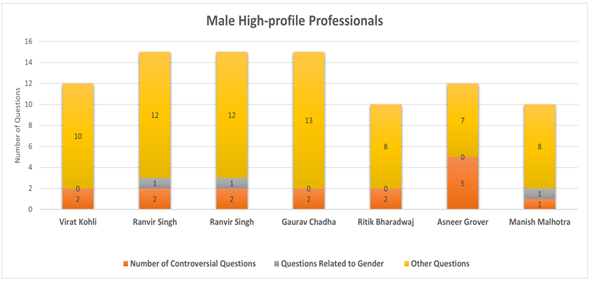
Figure 2
Comparison of
Interview Transcripts for High Profile Male Personalities
6. Appendix
Appendix - 1
Figure 3

Figure 3 Comparison of Interview Transcripts for High Profile Female Personalities
Table 1
|
Table 1 Active Gender Discourse (Sexism) Questions Framed by Media |
|||
|
Name of Women
Professional |
Profession |
Media Person
Questions |
Interview Details |
|
Mitali Raj |
Cricket |
Who is your favorite male cricketer? |
Press conference |
|
Deepika Padukone |
Actor |
Has your husband been the producer of
the movie? |
Press conference for the movie Chapak
with Deepika Padukone as producer |
|
Vineeta Singh |
Business Personal |
These Females only go for cosmetic
brand business: How cliche?´ |
IIT madras coordinator questions
entrepreneurs list for awards |
|
Sania Mirza |
Tennis Player |
What about motherhood and starting a
family? |
Rajdeep Sar Desai in CNN-IBN Interview |
|
Katrina Kaif |
Actor |
Can you dance for us? |
Indian Today conclave – Karan Thapar |
|
Smriti Irani |
Politician |
How a TV actor could be the education
minister of India? |
Karan Thapar |
|
Dutee Chand |
Sprinter |
Are you a man? |
She must prove that her testosterone
level is below 5 nanomoles hence she is a female sportsperson, not a male. |
|
Ameeni Dutt |
Startup |
When women start a business
it is for the hobby ? |
Shark tank |
|
Sunny Leone |
Actor |
Many Married women see you as a threat
to their husband? |
Media Interview CNN -IBN |
|
Ami Sata |
Entrepreneur |
How it is to be a female CEO? |
Media Interview |
|
Swati Kulkarni |
Co-founder CEO, Elda Health |
Is your husband partner of your
business? |
Media Personal Asked in entrepreneur
submit. |
Appendix - 2
Table 2
|
Table 2 Comparison of Interview Transcripts of High Professionals Based on Gender: Male High Profile Professionals |
|||||
|
Name & Occupation |
Total Questions |
Controversial
Questions |
Gender-Specific
Questions |
Genre of Questions |
Source Detail |
|
Virat Kohli (Cricketer) |
12 |
2 |
0 |
Conflict with BCCI over the selection |
Text |
|
Ranvir Singh (Actor) |
15 |
2 |
1 |
Another actor played the role |
Tele |
|
Ranvir Singh (Actor) |
15 |
2 |
1 |
Body showing photoshoot |
Tele |
|
Gaurav Chadha (politician) |
15 |
2 |
0 |
Politics |
Tele |
|
Ritik Bharadwaj (television actor) |
10 |
2 |
0 |
Entertainment |
Text |
|
Asneer Grover (Entrepreneur) |
12 |
5 |
0 |
Business |
Tele |
|
Manish Malhotra (fashion designer) |
10 |
1 |
1 |
Male Fashion model ethics |
Text |
Table 3
|
Table 3 Comparison of Interview Transcripts of High Professionals Based on Gender: Female High-Profile Professionals |
|||||
|
Name & Occupation |
Total Questions |
Controversial Questions |
Gender-Specific Questions |
Genre of Questions |
Source Detail |
|
Mithali Raj |
20 |
5 |
4 |
Women Harassment, Women cricketer lees pay |
CNN-IBN |
|
Deepika Padukone |
15 |
8 |
5 |
Body, dressing, childbirth |
India-Today |
|
Atishi K (Politician) |
10 |
4 |
2 |
Family responsibility,
support |
NDTV |
|
Shweta Tiwari (Television
actor) |
20 |
5 |
4 |
Marriage, body shaming of
daughter 1 |
Pink- Villa |
|
Vineeta Singh (Entrepreneur) |
10 |
2 |
2 |
Women only choose the
cosmetic industry |
Barbershop (YouTube channel) |
|
Masab Gupta (Fashion Designer) |
10 |
5 |
3 |
Ethnicity, mother, marriage |
YouTube interview |
Appendix - 3
Table 4
|
Table 4 Active and Passive Discourse in Framing the Interview Question Based on Gender: Active Discourse |
|||
|
Profession Topic |
|
Male |
Female |
|
Sportsperson Family life
balance |
|
Your wife and children must
be happy with your achievement. |
How has your family
supported your dream? |
|
Actor Movie |
|
What is your next project? |
Which star movie are you
part of? |
|
Politician Career |
|
How will you and your party
deal with the incumbency? |
How are you balancing family
and politics altogether? |
|
Businessperson |
Young entrepreneur |
Everyone is predicting you
as a young and promising entrepreneur. |
You are a young, but inexperienced
enthusiast in the field. |
|
Media Person |
Controversy |
He is an arrogant though
impressively competent person. |
She needs to develop
networking and business concepts to be successful. |
Table 5
|
Table 5 Active and Passive Discourse in Framing the Interview Question Based on Gender: Passive Discourse |
|||
|
Topic |
Male |
Female |
Profession |
|
Business |
Profitability |
How
do you think you will increase your customer base? |
What
is your active customer retention ratio at present? |
|
Startups |
Sales |
What
is your plan to increase its valuation? |
In
how much time your company will achieve the break even point? |
|
Movie
Producer |
Movie
revenue |
Do
you think that the Hindi movie market is growing? |
Isn’t
it a risk-taking venture compared to other businesses? |
|
Sportsperson |
Professional Milestone |
What
are the major targets you want to achieve this year? |
What
is the future of women’s sports in the country? |
|
Fashion
designer |
Brand
name |
What
is your vision to create your brand name? |
Are
you looking to create sustainable clothing and employment for tribal women? |
|
New
Entrepreneur |
Management |
Tell
us something about yourself. |
Is
this your family business or how much of the product is your in-house
production? |
CONFLICT OF INTERESTS
None.
ACKNOWLEDGMENTS
None.
REFERENCES
Arfan, A. (2022). The Female Journalist Leadership and Gender Mainstreaming in Jamberita.com Media in Jambi. HUMANISMA: Journal of Gender Studies, 6(1), 115–126. https://doi.org/10.30983/humanisme.v6i1.4947
Banerjee, K. (2021). Refashioning India: Gender, Media, and a Transformed Public Discourse, Maitrayee Chaudhuri (2017). Studies in South Asian Film and Media, 12(1), 97–99. https://doi.org/10.1386/safm_00041_5
Guccione, C. (2022). Migration Discourse and the New Socially Constructed Meanings of the English Lingua Franca. European Scientific Journal, ESJ, 18(18), 33–49. https://doi.org/10.19044/esj.2022.v18n18p33
Ida, R., Ilahiati, N. K., and Saud, M. (2023). Media Discourse on Islamic Women Jihadists in Indonesia: Islamic Radicalism Post-Arab Spring. Feminist Media Studies, 23(8), 4302–4317. https://doi.org/10.1080/14680777.2023.2171083
Konnelly, L. (2020). “The Woman in the Background”: Gendered Nouns in CNN and FOX Media Discourse. Journal of English Linguistics, 48(3), 233–257. https://doi.org/10.1177/0075424220938937
Mowri, S., and Bailey, A. (2023). Framing Safety of Women in Public Transport: A Media Discourse Analysis of Sexual Harassment Cases in Bangladesh. Media, Culture and Society, 45(2), 266–284. https://doi.org/10.1177/01634437221111913
Rasool, S. (2014). Media Discourse and Gender: Issues of Reconstruction of Gender Ideologies in Pakistani Television Advertisements. Pakistan Journal of Gender Studies, 8(1), 197–218. https://doi.org/10.46568/pjgs.v8i1.344
Roy, A., Kennelly, J., Rowley, H., and Larkins, C. (2020). A Critical Discussion of the Use of Film in Participatory Research Projects with Homeless Young People: An Analysis Based on Case Examples from England and Canada. Qualitative Research, 21(6), 957–974. https://doi.org/10.1177/1468794120965374
Sharma, Y., and Kumar, V. (2022). Spoken Discourse Analysis for Feminist Interviews: Movement Towards a Gender Equality Era? Specialusis Ugdymas, 2(43), 2665–2675.
Singh, M., and Thakur, Meenakshi. (2025). Lines That Sell: The Artistic Integrity Of Caricature And Cartoons In Visual Branding Through A Fine Arts Lens ShodhShreejan: Journal of Creative Research Insights, 2(1),45-56. https://doi.org/10.29121/shodhshreejan.v2.i1.2025.24
Stella, M. (2020). Text-Mining Forma Mentis Networks Reconstruct Public Perception of the STEM Gender Gap in Social Media. PeerJ Computer Science, 6, e295. https://doi.org/10.7717/peerj-cs.295
Wagner, A., Trimble, L., and Sampert, S. (2019). One Smart Politician: Gendered Media Discourses of Political Leadership in Canada. Canadian Journal of Political Science/Revue canadienne de science politique, 52(1), 141–162. https://doi.org/10.1017/S0008423918000471
|
|
 This work is licensed under a: Creative Commons Attribution 4.0 International License
© ShodhKosh 2026. All Rights Reserved.