ShodhKosh: Journal of Visual and Performing ArtsISSN (Online): 2582-7472
|
|
Global Resonances: Mapping World Music Influences in Contemporary Indian Classical and Folk Fusion
Dr. Ramandeep Kaur 1 , Abhijeet Deshpande
2
, Abhijeet Deshpande
2 , Debasis Chakraborty 3, Pooja Yadav 4
 , Damodaran B. 5
 , Yogesh Nagargoje 6
1 Assistant
Professor Music, Department of Performing Arts, Guru Kashi University Talwandi
Sabo, Bathinda, Punjab, India
2 Assistant
Professor, Department of Mechanical Engineering, Vishwakarma Institute of
Technology, Pune, Maharashtra, 411037, India
3 Department of Visual and
Performing Arts, Mangalayatan University Aligarh,
India
4 Assistant Professor,
School of Business Management, Noida International University, Greater Noida
203201, India
5 Associate Professor,
Meenakshi College of Arts and Science, Meenakshi Academy of Higher Education
and Research, Chennai, Tamil Nadu 600115, India
6 CMO, Researcher Connect
Innovations and Impact Private Limited, India
|
|
|
ABSTRACT |
|
|
The modern Indian classical and folk fusion music has
become an important musical trend shaped by the increased globalization, the
digital spreading, and the transnational artistic interaction. Although these
fusion practices are commonly loosely grouped into the term of a world music,
the available literature rarely constructs systemic frameworks to examine the
manner in which particular global musical influences interact with the Indian
musical systems both structurally and aesthetically. This gap is filled in
this paper when the author presents the concept of global resonances as an
analytical tool to evaluate mutual relations of Indian classical and folk
traditions and global musical idioms. Based on interdisciplinary
interpretations of ethnomusicology, cultural studies, and globalization
theory, the paper offers a Global Resonance Mapping theory in order to
classify and evaluate the musical influences in the world in various
dimensions, such as rhythm, harmony, instrumentation, vocal aesthetics, form,
and production practices. The research design is a qualitative and
mixed-methods study that examines a purposely chosen collection of modern
fusion work that covers in the styles of classical-rooted, folk-rooted and
global-genre-led. Comparative case study is built up and applied to develop a
structured taxonomy of global influences, showing the unique patterns of
integration and accommodation between fusion orientations. The results prove
that worldly impact in Indian fusion music is not one-dimensional or one-way
but instead follows selective and context-dependent mechanisms that keep the
balances between the traditions of the culture and innovations. The paper
also suggests that fusion practices help to create a dynamic redefinition of
authenticity as a negotiated and changing object. This paper builds
analytical insights into Indian fusion music by providing a systematic
mapping of global resonances and the transferable framework of the analysis
of cross-cultural musical interactions in the globalized environment. |
|||
|
Received 10 September 2025 Accepted 06 December
2025 Published 17 February 2026 Corresponding Author Debasis
Chakraborty, debasis.chakroborty@mangalayatan.edu.in DOI 10.29121/shodhkosh.v7.i1s.2026.7004 Funding: This research
received no specific grant from any funding agency in the public, commercial,
or not-for-profit sectors. Copyright: © 2026 The
Author(s). This work is licensed under a Creative Commons
Attribution 4.0 International License. With the
license CC-BY, authors retain the copyright, allowing anyone to download,
reuse, re-print, modify, distribute, and/or copy their contribution. The work
must be properly attributed to its author.
|
|||
|
Keywords: Indian Classical Music, Indian Folk Music, Music
Fusion, World Music, Globalization, Hybridity, Cross-Cultural Influence,
Musical Hybridity |
|||



1. INTRODUCTION
Music has always
served as a living cultural warehouse, which is being absorbed, changed and
rearticulated on both geographical and temporal frontiers. In the modern age,
the process of globalization, the spread of digital technologies, and artistic
cooperation across the borders has radically changed the sphere of music
creation and consumption on the global scale. The traditions of Indian
classical and folk music, traditionally based on the regional performance, oral
transmission, and heavily codified aesthetic systems, currently are becoming
more involved in interacting with the global musical idioms Ramesh
(2023). The result of this interaction has been a
rich and multifaceted landscape of fusion where melodic structures based on the
raga, rhythmic cycles based on taala, and folk motives of indigenous origins
coexist with other influences of jazz, rock, electronic dance music (EDM), and
other Western systems of harmony. The soundscape as it is created is not just a
matter of experimenting with style, but of more fundamental negotiation and
artistic rediscovery of culture.
Figure 1
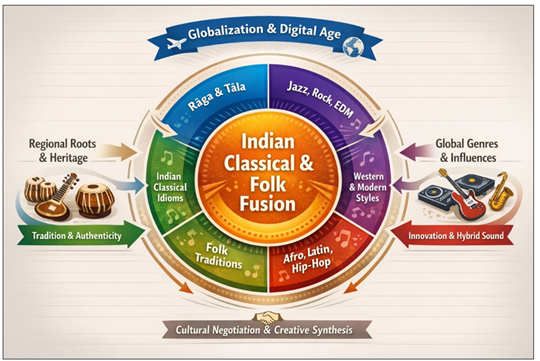
Figure 1 Global Fusion of Indian Music
Modern Indian
traditional or folk fusion exists at the crossroad between tradition and
innovation. On the one hand, it attracts the legitimacy of the canonical
systems, including Hindustani and Carnatic music, and various regional folk
traditions who entrap the local histories, rites and social identities Saini
(2025). Conversely, it is proactive in reacting to
the worldwide music trends which are enabled by global festivals, streaming
sites, diasporic societies and cooperative networks. This ambivalent stance has
helped Indian musicians to cross the traditional genre boundaries without
losing the identifiable cultural attributes. In this regard, fusion does not
refer to a homogeneous or linear phenomenon; to the contrary, it is a continuum
of practices between the inclusion of global timbre into classical models and
extreme reiterations whereby global genres emerge as the dominant forces behind
structural and production aesthetics.
Although the
Indian classical and folk fusion are gaining popularity and exposure in the
world stages, scholarly interests in this phenomenon are still poorly
fragmented. The available literature tends to concentrate either on particular
musicians, specific genres, or general discourses of world music and does not
provide any systematic frameworks of how particular influences of the world
interrelate with the Indian music systems. In addition, the issue of
authenticity, cultural appropriation and commercialization often eclipse the
critical analysis of the music and leave gaps in the knowledge of how the
cross-cultural impact actually is received and converted Dhand
(2023). It is quite evident that an integrative
method is required, transcending descriptive explanations with an analytic
attempt to follow patterns of influence within melody, rhythm, instrumentation,
form, and production.
It is on this
backdrop that the current research presents the term of global resonances as an
analytical construct to theoretically analyze the
contemporary Indian classical and folk fusion. The word resonance is adopted
carefully to stress the idea of a reciprocal interaction and not unidirectional
influence since the aesthetic meanings of the music belonging to global and
Indian worlds are vibrating together to create new meanings. The work is also
proposed to make a systematic mapping of these resonances by determining
recurrent influence patterns, classifying different forms of musical borrowing
and adaptation, and placing them into larger socio-cultural and technological
frameworks. In this way, the paper aims at making a contribution in the form of
a systematic taxonomy and mapping framework which in turn can serve the
purposes of both the qualitative musicological research and the future data
analysis.
The aims of the
research are 4-fold: (i) to situate current Indian
classical and folk fusion within the global musical flows, (ii) to determine
and categorize the prevailing world influences on contemporary fusion
practices, (iii) to evaluate the ways these influences are reflected on the various
musical levels and (iv) to critically comment on how they affect cultural
identity, authenticity and artistic agency.
2. Background and Related Work
The idea of musical fusion has traditionally held a
tenuous status in musicology, cultural studies and ethnomusicology. In its
simplest definition, fusion means being conscious of combining aspects of two
or more musical traditions, creating hybrid forms that break traditional genre
lines. The fusion in the Indian context has been present in a soft form in the
past through the intercultural exchange of different cultures on the trade
routes and the patronage systems at the courts Chathuranga
and Ekanayaka (2025). Nevertheless, the
modern Indian classics and folk fusion is a qualitatively new phenomenon,
influenced by the further development of globalization, digital mediation, and
distribution of musical capital throughout the world Fusion
Music in Contemporary India: Exploring Cross-Cultural Collaborations (2022). To comprehend this
change, it is crucial to take a critical look at how the fusion, the world
music, the Indian classical systems and folk traditions have been theorized and
analyzed in literature.
The concept of world music, commonly applied to
non-Western or hybrid music in the international market, has caused a lot of
controversy. Although it has assisted in achieving visibility to various
musical traditions, scholars believe it also subjects reductive labels that
render the cultural specificity more difficult to challenge and creates unequal
power relations between the Global North and the South. In this context, Indian
fusion music is often sold as exotic or spiritual, despite the use of western harmonic
progressions, electronic production, or global rhythmic idioms Paonam (2025). These groupings are
more inclined to give preference to consumption oriented
discourses against the analytical interpretation of the musical structure, thus
restricting the academic knowledge of the embedding of global influences in the
practices of Indian music.
The very codified melodic and rhythmic systems that define
Indian classical music traditions include raa and
tala. These systems do not just exist as technical constructs only but as an
aesthetic and philosophical ground on which improvisation, performance ethics,
and the perception of the listener depend Ginting
et al. (2024). Most of the previous
research on fusion between Indian classical music usually dwells on the
maintenance or dilution of these frameworks when they are combined with Western
music genres like jazz or rock. Although this line of investigation is worthy it
often subjects the global influence as an outward pressure on a fixed tradition
as opposed to Indian classical music of being an adaptive and historically
progressive system that can assimilate new concepts without its fundamental
identity Joshi
(2023).
The problem of folk music tradition in India can be even
more complicated to analyze because of the vast
regional diversity and close connection with local social backgrounds. Folk
genres are interred in folk life, rituals, working, and oral traditions, and
frequently they are not easily codified Kapuria and Duggal (2024). Available works about
Indian folk fusion also emphasize the folk motifs as the emblem of authenticity
and grass-root identity in modern music. These studies, however, are more
inclined to lyrical themes and sociological narration rather than to musical
analysis, and they leave the gaps to grasp the interaction of the global
rhythmic patterns, instrumentation, and production aesthetics with local folk
organizations at the sonic level Narayanan
(2024).
Studies addressing the impact of global music in the
fusion of Indian music often focus on the contribution of diaspora groups,
international festivals, and the Internet Ramesh
(2023). According to
scholars, Indian musicians working in transnational spaces tend to embrace
global genres as both a strategy of global response to global markets and
audience as well as a stylistic choice. Jazz improvisation, electronic
sequencing, hip-hop grooves, and Western harmonic language are usually
mentioned as the streams of influence that are predominant Impact
of Globalization on Traditional Folk Performing Arts of Assam (2022). However, the majority of current researches consider these
factors separately, which does not provide a comparative framework, allowing to
trace a multitude of influence routes at the same time and consider the mutual
exchange of Indian and global music traditions Akhtar
(2024).
Another weakness of literature is how it addresses the
issue of authenticity and cultural ownership. Cultural appropriation,
commercialization and preservation of tradition have spawned valuable critical
discussions, yet too often they have prevailed over empirical examination of
musical form. Consequently, fusion music is often judged based on normative
principles and not analytical principles. Relatively little has been done to
systematically appraise the properly negotiated authenticity of the level of musical
structure, such as the adaptation of raga phrases to the global harmonic
environment or the re-creation of folk rhythms using electronic looping.
3. Theoretical Framework
The theoretical
framework of this study is the interdisciplinary concept that incorporates the
ideas of ethnomusicology, cultural studies, and the globalization theory to analyze the dynamics of debate that surround the modern
Indian classical and folk fusion. Instead of viewing fusion as a shallow
melding of styles, the framework represents it as a negotiation process that
continues over time where musical forms, cultural identities and power
relations interplay. It uses the concept of global resonances to anticipate
continuity, reciprocity and change and enables the analysis to transcend a
simplistic dichotomy of tradition/modernity or local/global.
Figure 2
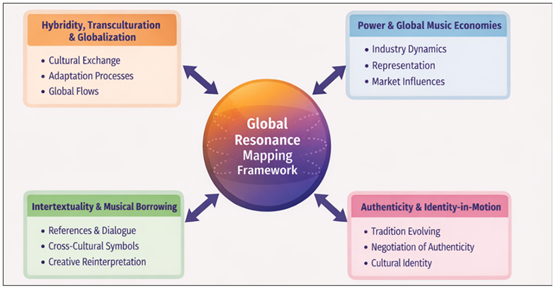
Figure 2 Theoretical Framework for Indian Classical-Folk Fusion Analysis
3.1. Hybridity,
Transculturation, and Globalization in Music
Hybridity serves as a foundational concept for understanding fusion music, emphasizing the creation of new cultural forms through interaction rather than mere coexistence of distinct traditions. In the context of Indian classical and folk fusion, hybridity manifests through the reconfiguration of melodic, rhythmic, and formal elements drawn from multiple musical systems. Transculturation further refines this understanding by highlighting how cultural exchange involves processes of adaptation, reinterpretation, and resistance. Globalization accelerates these processes by enabling rapid circulation of sounds, technologies, and aesthetics, thereby creating conditions in which Indian musicians simultaneously engage with local traditions and global musical languages. This perspective acknowledges fusion as a historically situated response to global flows rather than an aberration from tradition.
3.2. Intertextuality
and Musical Borrowing
Intertextuality
is one of the tools that aid in an examination of the construction of musical
meanings by making reference to other musical texts. Intertextuality can be
found in a fusion situation where raga phrases invoke classical traditions,
folk themes indicate regionality, or jazz chords and electronic tones refer to
international styles. In this model, musical borrowing is never considered to
be imitative but as a dialogic practice whereby borrowed items are given new
meanings by other structural and cultural environments. This method enables the
research to track how certain musical gestures like rhythmic grooves, chord
progressions or timbral decisions are operating as a mark of influence as well
as points of creative revitalization.
3.3. Authenticity,
Identity, and Tradition-in-Motion
Among the most
debated notions when it comes to the fusion music, authenticity stands. This
study takes an active view of tradition instead of perception of authenticity
as a rigid commitment to the past rules as a historical tradition. Indian
traditional and folk cultures have continually developed based on pedagogical
traditions, regional diversity, and historical interactions. Within fusion
practices, authenticity is achieved by negotiating between maintaining the main
tenets of creative practice such as improvisational ethos or narrative
functionality whilst permitting variability in form and instrumentation. In
this respect, identity is practised and re-articulated in music, both in its
rootedness at the local and its belonging to the global. This framework does
not make normative judgments, but it looks at how authenticity is made and
expressed through sound by musicians themselves.
3.4. Power,
Representation, and Global Music Economies
Unequal power
relations in the global music industries influence the production and
circulation of fusion music. The record labels, streaming services, music
festivals, and media discourses shape the visibility of fusion forms and how
they are packaged to the viewers. In this sub section, musical analysis is
placed in the wider political-economic framework, considering that global
forces are not neutral but are meditated by market logic and representative
practices. The core of interpreting the phenomenon of dominance and marginality
of certain global genres and the ways Indian musicians maneuver
around these limitations to exercise creative agency is the understanding of
such dynamics.
3.5. The
Proposed Global Resonance Mapping Framework
It is based on the above theoretical bases that this study
suggests a Global Resonance Mapping framework that can be effectively used to analyze world music influence in the Indian classical and
folk fusion in modern times. The framework theorizes fusion as a network of
resonant interaction on a multiplicity of dimensions: melodic systems, rhythmic
structures, instrumentation, formal organization, and aesthetics of production.
The influences are represented as bidirectional flows and not linear transfers,
so that the convergence points can be determined where global and Indian
factors will mutually change each other. This framework acts as a bridge
between theory and empirical analysis as it provides an analytical framework
through which the development of the taxonomy and case studies in the following
sections will be provided alongside the possibility to compare various fusion
practices in a systematic manner.
4. Research Methodology
This research takes a multi-layered and systematic
approach research approach that aims at capturing the cultural, musical, and
contextual intricacy of the contemporary Indian classical and folk fusion
music. Since the research problem is exploratory and interpretive, the
mixed-methods approach with a predominant quantitative aspect is used. It is
the combination of musicological study and contextual and comparative study
that makes sure that global influences are studied not just as abstract ideas
but as phenomena that can be heard, felt and placed in a certain cultural
setting.
4.1. Research Design
The study is conducted according to a qualitative and exploratory design, with the usage of structured methods of analysis. The main focus is on the interpretive analysis of music content, with the accompaniment by the comparative and descriptive ones. The design is suitable in the investigation of fusion practices that are heterogeneous and contextual in nature. The study does not involve trying pre-tested hypotheses; instead, it seeks to determine patterns, categories, and relationship that can be discovered out of the musical material. Where applicable, the scanty quantitative indicators are added in order to facilitate clarity in analysis, without diminishing musical connotation.
4.2. Corpus Selection
and Sampling Strategy
To build a representative set of contemporary Indian
classical and folk fusion works, a purposive sampling strategy will be used to
achieve a representative corpus. It contains studio recordings, live
performances, and selected digital releases that were created in the past 20
years. Selection criteria will be based in terms of diversity in approach
(classical-led, folk-led and global-genre-led fusion), national / international
regional representation, national or international visibility and demonstration
of overt global influence. The corpus will ensure that there is a good mixture
of well-established artists and emerging practitioners so that there is no
over-representation of commercially dominant narrative.
4.3. Data Sources
Various data sources are used so as to guarantee analytical triangulation. Audio records and video recording of performance are the primary data out of which musicological documentation is formed. Such secondary data as artist interviews, album liner notes, concert program descriptions, critical reviews and media coverage are used. The use of digital platforms like streaming platforms and social media channels also gets analyzed to determine the patterns of dissemination and reception by the audience. All these sources offer some understanding of both the socio-cultural and sonic aspects of fusion practices.
4.4. Analytical
Procedures
The study is
performed in a multi-level systematic framework of analyzing
musical content in complementary dimensions. The musicalological
approach is concerned with the melodic structure, rhythmic construction,
structure and improvisational tactics, and especially the way the Indian folk
melodic idioms are in contact with the world harmonic or modal structure. The
analysis of timbre and instrumentation focuses on the usage of the indigenous
and global instruments, their functions, and re-contextualization of indigenous
instruments in the fusion environment.
Formal and
structural analysis examines the intersection of the global song forms, loop
structures or jazz structures with traditional Indian performance logics. The
analysis of production and sound aesthetics takes into account the studio
techniques, digital processing, and mixing decisions as the parts of global
influence. Where it is suitable, descriptive audio may be given (as tempo
range, rhythmic density, etc.) to aid the comparative observations, without
computational reductionism being prioritized.
4.5. Coding
Scheme and Comparative Framework
A coding scheme
is created by comparing recurring categories of influence identified in the
preliminary analysis to facilitate systematic comparison. Codings
are done in the dimensions of rhythm, harmony, instrumentation, form and
aesthetics of production. Such organized methodology enables the patterns of
international impact to be compared among works and fusion types. To illustrate
the convergences and divergences, cross-case comparison matrices are utilized
as the empirical basis of the taxonomy and resonance maps developed later.
4.6. Reliability,
Validity, and Reflexivity
Reliability in
analysis is met by having people listen repeatedly, cross-reference various
sources of information, and consistency in meaning of the codes. Triangulation
is used to enhance validity, with the combination of musical analysis,
contextual documentation, and critical discourse. Reflexivity is directly noted
and that the interpretation is influenced by positioning in culture and school
of thought. Instead of purporting being objective, the study focuses on
transparency in making analytical decisions and interpretive arguments.
4.7. Ethical
Considerations and Limitations
The ethical aspect involves a respectful presentation of
the musical practices, correct credits to the performers and the communities
and also sensitivity to the controversies of cultural ownership. The critique
does not make evaluative judgments that give one of the forms of fusion
precedence over the other. Methodological weaknesses are subjectivity of the
music analysis done qualitatively, selectivity of the corpus, and possible
platform bias in favor of artists that are digitally
visible. These constraints have been recognized as an effort to put the
findings into perspective and not to devalue them. The combination of this
methodological framework offers a very solid base to map global resonances in
contemporary Indian classical and folk fusion, which offers analytical
profundity, cultural sensitivity as well as conceptual coherence in the
following sections.
5. Taxonomy of Global Influences in Indian
Classical–Folk Fusion
In this section,
I will introduce a systematic taxonomy of musical influences in the world that
I have witnessed in Indian classical and folk fusion today. Based on the
theoretical framework and methodology mentioned above, taxonomy is developed to
categorize systematically the way elements of global music relate to impacts on
Indian traditions through various levels of sonic and structural interactions.
The taxonomy does not treat fusion as a homogenous category but identifies the
dimensions of influence that are unique to each practices
of fusion, showing the heterogeneity of fusion practices and the mechanisms
that particular global resonances are being described.
5.1. Rhythmic
Influences and Groove Structures
Rhythm is also
one of the most salient localities of world-ly
influence in the Indian fusion music. Afro-diasporic rhythmic patterns, Latin
grooves, funk backbeats and hip-hop-inspired loops often overlap with the
Indian tala systems and folk rhythmic cycles. Traditional cyclic time
structures are often still conceptualized and just rephrased in a global groove
aesthetics, like steady meter, syncopation, or loop-based repetition Ramesh
(2023). The interaction results in hybrid
rhythmical structures balancing improvisational flexibility and the
predictability needed to coordinate a group and electronic production.
5.2. Harmonic
and Modal Influences
Harmonic
influence is a big breakage of the traditional Indian classical practice where
the focus of the Indian classical tradition was on melodic development rather
than the chordal development. Fusion compositions usually incorporate Western
harmonic models, such as triadic progressions, sustained jazz harmonies, and
modal exchange, and melody material produced by raga. Harmony is used in
certain instances as a supportive background, and in other instances it plays
an active role in determining melodic decisions and improvisational directions Impact
of Globalization on Traditional Folk Performing Arts of Assam (2022). It is the part of the taxonomy that captures
the selective adoption and adaptation of harmonic thinking to produce new
modal-harmonic hybrids that question the traditional differences among
melody-driven systems, harmony-driven systems and hybrid systems.
5.3. Instrumentation
and Timbre
The global
influences are also well-presented in the development of instrumental palettes
of fusion music. The local instruments like the sitar, sarangi, flute or local
folk instruments are now being accompanied with electric guitars, synthesizers,
bass guitars, drum machines and digital controllers. In addition to
coexistence, fusion activities frequently resettle functional roles, e.g.,
Indian melodic instruments can take up riff-based roles or textural roles,
whereas global instruments can talk to each other improvisational. Timbre then
becomes one of the primary indicators of global resonance the mark of
hybridity, which is often more of a psychological indicator in the sound
texture than the melodic content Akhtar
(2024).
5.4. Vocal
Aesthetics and Performance Practices
The identity formation of the fusion music through vocal expression displays subtle negotiations between Indian classical ornamentation, folk narrative approaches, and world vocality. Gamaka, meend, and microtonal inflection are combined with such global practices as breathy phrasing, layer effects in chorals and effects in the studio. Language selection and lyrical presentation also indicate the influence of the global society, as multilingual texts and adherence to the stylistic models of the popular and global art forms are also represented. This classification underscores the contribution of vocal performance as a place of identity formation, as the mediating variable between tradition, innovation, and accessibility to the audience Khan (2025).
5.5. Structural
and Formal Influences
Another
imperative aspect of global influence is formal organization. The classical
Indian performance forms like the slow revelation of a raga or the repetitive
folk song structures are often re-structured in terms of a world song
structure, like versechorus structure, breakdowns,
and drops. The insistence on repetition and build-up that electrical music
places on the perception of time frequently redefines the concept of time in
fusion music Anjum
and Riaz (2024). It is in this subsection that the impacts
of structural borrowing on narrative flow and listener action can be absorbed
and their outcomes, neither all traditional nor all global.
5.6. Production
Aesthetics and Technological Mediation
The modern fusion is strongly influenced by the global production practice and technologies. It is in many fusion works that digital recording, sampling, looping, and sound designing are involved, which not only impact sonic quality but also influence the way of thinking in composition. The aesthetics of production, imitated after genres of the world - refined mixing, spatial effects, rhythmic quantization - collide with the natural textures of the acoustic instruments. The given category highlights the importance of technology as the agent that promotes the global resonance and takes an active part in developing fusion aesthetics.
Table 1
|
Table 1 Comparative Analysis of Fusion Approaches in Contemporary Indian Classical and Folk Music |
|||
|
Analytical Dimension |
Classical-Rooted Fusion |
Folk-Rooted Fusion |
Global-Genre-Led Fusion |
|
Primary Musical Anchor |
Hindustani / Carnatic rāga–tāla framework |
Regional folk melody and narrative traditions |
Global genres (jazz, rock, EDM, hip-hop) |
|
Role of Global Influence |
Supportive and contextual |
Enhancing reach and texture |
Structurally dominant |
|
Rhythmic Integration |
Cyclical tāla
retained with subtle global groove overlay |
Folk rhythms blended with steady global beats |
Global groove frameworks; Indian cycles adapted |
|
Harmonic Usage |
Minimal, often drone-based or modal |
Limited chordal support |
Extensive harmonic progressions and jazz harmony |
|
Instrumentation Strategy |
Classical instruments in lead roles; global
instruments supportive |
Folk instruments central; global instruments
amplify |
Global instruments lead; Indian instruments color |
|
Vocal Aesthetics |
Classical ornamentation and improvisation
emphasized |
Narrative-driven, regionally styled vocals |
Hybrid vocal delivery with global phrasing |
|
Formal Structure |
Alap–development logic preserved |
Song-based folk structures |
Verse–chorus, loop, or drop-based forms |
|
Production Aesthetics |
Minimal processing; acoustic focus |
Moderate studio enhancement |
Highly processed, electronic-heavy production |
|
Audience Orientation |
Connoisseur and classical listeners |
Community-based and regional audiences |
Global and cross-cultural audiences |
|
Authenticity Strategy |
Lineage and aesthetic continuity |
Cultural rootedness and storytelling |
Innovation and hybrid identity |
6. Conclusion
This paper aimed to explore South Park Indian classical and folk fusion in terms of global resonances and the goal of transcending the description of fusion to the analysis of how the influences of the world music are negotiated, absorbed, and transformed. Placing fusion in the context of other discussions on the same issues of hybridity, globalization and authenticity, the paper has shown that the present day fusion practices are not a weakening of tradition nor a blind imitation of global form. Rather, they are a process of dynamic interaction of the Indian musical systems with the world musical languages where the systems still have their own cultural identities. The suggested Global Resonance Mapping framework is one of the major contributions of this piece of work. The framework allows a detailed examination of fusion practices in a way that brings musical complexity as well as cultural analysis by classifying the global influences into rhythmic, harmonic, instrumental, vocal, structural, and production dimensions. The taxonomy formulated in Section 5 points out that the global influence is not evenly distributed among all types of fusion; it also selectively appears according to the purpose of the artist, cultural background, and target audience. This observation disputes the homogenized accounts of the world music but reinforces the plurality of the fusion strategies that may act in the Indian musical space. The comparative case study analysis also supports this claim by illustrating how the various orientations of fusion, which include classical-rooted, folk-rooted and global-genre-led, meet the global influences differently. The classical based fusion is more conservative with continuity and lineage, it incorporates the global elements with reservations in order to maintain the original aesthetic tenets. Folk-based fusion places an emphasis on the regional identity and narrative role with the help of global instruments which increase the visibility and sonic scope. Global-genre-led fusion foregrounds, in contrast, feature stylistic experimentation, which places Indian musical elements as a malleable resource in global genre contexts. A combination of these models helps to understand that fusion can be better described as a continuum of practices, as opposed to a single stylistic category.
CONFLICT OF INTERESTS
None.
ACKNOWLEDGMENTS
None.
REFERENCES
Akhtar, R. (2024, December). A Vernacular Historiography
of the Punjabi Poetic Genre of the Kāfī: A Review of Shah Hussain, Bulleh Shah and Piro Preman’s works. Journal of Research in Humanities.
Anjum, N., and Riaz, A. R. (2024,
December). Reading Punjabi Sufi Poetry as Performance: Reviewing
the Musical Renditions of the Kāfī.
Asian-European Music Research
Journal.
Chathuranga, M., and
Ekanayaka, M. (2025, May). An Analytical
Study on the Influence and Reinterpretation of Indian
Folk Art in Contemporary Artistic
Expression. Journal of Novel Research in Innovation
and Development, 3(5), a391–a401.
Dhand, S. (2023, January). The Growing Influence of Fusion Music in Indian Classical
Music. International Journal of Information Movement,
7(6), 61–66.
Fusion Music in Contemporary India: Exploring Cross-Cultural Collaborations. (2022). International Journal of Innovative Research in Creative Technology, 8(2), 1–6.
Ginting, D., et al. (2024). The Effects of Digital Storytelling on the Retention and Transferability of Student Knowledge. SAGE Open, 14(3), 21582440241271267. https://doi.org/10.1177/21582440241271267
Impact of Globalization
on Traditional Folk Performing
Arts of Assam. (2022, June). International Journal
of Creative Research Thoughts,
10(6), a699–a705.
Joshi, S. M. (2023). Fusion Music: A Modern Trend in Music. Scholarly Research Journal for Humanity Science and English Language, 11(58), 14079–14085.
Kapuria, R., and Duggal, V. (Eds.). (2024). Punjab sounds: In and Beyond the Region. Routledge. https://doi.org/10.4324/9781003406983
Khan, I. (2025). Rhythmic Ecstasy:
The Synthesis of Folk and Sufi Music in Punjab.
Pustak Mahal.
Narayanan, V. (2024, October). The Sufi and the Sufiana Kalam: Bridging the Folk and the Classical in North Indian Music. Journal of Indian Classical Music, 5(2).
Paonam, V. (2025, January). The Homogenization of Indian Culture: A Post-Liberalization, Post-Traditional Paradigm Shift in Urban Agglomerates. International Journal of Advanced Research, 13(1), 841–848. https://doi.org/10.21474/IJAR01/16123
Ramesh, S. (2023, May). Harmonic Confluences: Indian Music Maestros’ Enduring Impact on Global Sounds. Journal of Humanities, Music and Dance, 3(3). https://doi.org/10.55529/jhmd.33.50.52
Ramesh, S. (2023, September). Eternal Elegance: The Resplendent Beauty and Global Impact of Indian Classical music. Journal of Humanities, Music and Dance, 3(5), 22–26. https://doi.org/10.55529/jhmd.35.22.26
Saini, P. (2025, March). Music in the Hybrid Period: Transformative Phases and Cross-Cultural Collaborations. Journal of Global Values, 16(SI03), 104–110. https://doi.org/10.31995/jgv.2025.v16iSI03.011
|
|
 This work is licensed under a: Creative Commons Attribution 4.0 International License
© ShodhKosh 2026. All Rights Reserved.