ShodhKosh: Journal of Visual and Performing ArtsISSN (Online): 2582-7472
|
|
Visual Politics in the Digital Age: Social Media as a Tool for Political Image Building
Anshul Garg 1 ,
Dr. Chanchal Sachdeva Suri 2
,
Dr. Chanchal Sachdeva Suri 2
1 Research
Scholar, University Institute of Media Studies, Chandigarh University, Chandigarh,
India
2 Professor,
University
Institute of Media Studies, Chandigarh University, Chandigarh, India
|
|
|
ABSTRACT |
|
|
The rise of
social media platforms has essentially reoriented the role of political
communication by imposing such a heavy focus on the visual content as a tool
of building and supporting the political images. This study will look at how
these political players, such as individual politicians, political parties
and electoral campaigns, utilize the visual communication techniques
available in the social media to shape, sell, and reinforce their images.
Within the frame of the review of key case studies, such as the 2008 and 2012
Barack Obama campaigns, the strategic use of social media in the Narendra
Modi campaign in India and the current state of affairs in the 2024 electoral
campaigns, this paper will examine the theoretical basis of visual political
communication, the practical tactics of modern-day political leaders, and the
ethical aspects of image-making in the digital environment. The paper will
utilize Framing Theory, Agenda Setting Theory, and Visual Communication
Theory in order to relate findings against the available academic literature.
Findings have shown that visual content such as professionally created
imagery, videos, memes, and emotionally engaging graphics can have a vast
impact on how the general population views political leaders and can
determine the electoral process. Nevertheless, this visual-based politics has
significant issues of misinformation, control of the mass consciousness, and
corrosion of faith in democratic components. The research paper concludes
that although the visual social media strategies have proven to be a
fundamental instrument of political discourse in the 21 st
century, effective ethical guidelines and media literacy programs are very
important aspects of preserving democratic integrity in the digital era. |
|||
|
Received 07 November 2025 Accepted 13 December 2025 Published 10 January 2026 Corresponding Author Dr.
Chanchal Sachdeva Suri, chanchalssuri@gmail.com
DOI 10.29121/shodhkosh.v7.i1.2026.6990 Funding: This research
received no specific grant from any funding agency in the public, commercial,
or not-for-profit sectors. Copyright: © 2026 The
Author(s). This work is licensed under a Creative Commons
Attribution 4.0 International License. With the
license CC-BY, authors retain the copyright, allowing anyone to download,
reuse, re-print, modify, distribute, and/or copy their contribution. The work
must be properly attributed to its author.
|
|||
|
Keywords: Visual Politics, Social Media, Political
Communication, Image Building, Digital Campaigns, Political Branding,
Democratic Discourse, Misinformation, Political Leadership |
|||



1. INTRODUCTION
Political communication transformation can be considered as one of the most dramatic changes in the practice of the contemporary democracy. Decades ago, the political campaigns used to depend on the use of the traditional media like television, advert on newspapers to communicate to the constituent as well as the radio and through organizing public rallies to foster the image of the candidate. Yet, with the emerging digital technologies and social media platform, this communication paradigm has radically changed and provided political actors with new opportunities and challenges Srikandi et al. (2024). Social media channels such as Twitter (now X), Facebook, Instagram, Tik Tok, and YouTube have taken the center stage in political terms and almost billions of users around the world share the political content every day Statista Research Department. (2025).
It is in this digital arena that the visual aspect of political communication has taken a specific centre stage. Unlike the traditional political communication focused on speeches, policy platforms, and text messaging, the visual content used by the contemporary political campaigns, photos, videos, infographics, memes, and other images that convey political messages with a strong emotional appeal, is also prioritized Veneti et al. (2024). This trend was further increased in the 2024 European elections, where radical and far-right politicians used social media platforms such as TikTok to update their political persona with emotionally charged visual images that focused on group identity and ideology communication Novelli and Ruggiero (2025). In the meantime, in Indian politics, Prime Minister Narendra Modi has become an international model of visual political communication, with more than 108 million followers on X by October 2025–the fourth most-followed account on the planet–because of the regular use of emotionally charged, visual-focused political communication Storyboard18. (2025).
When used in the digital context, the concept of political image building denotes the tactical design and operation of a political personality's or party’s outer identity by actively distributing personally supervised visual and narrative information in the social media space Hermawan and Santoso (2025). This is not merely a matter of mere presentation of the facts concerning the candidates and policies and as such, it is a highly complex issue of visual symbol manipulation, emotional appeal, and story framing meant to create certain impressions among the electorate and elicit votes.
1.1. The Digital Politics of Communication
The shift of political communication to the sphere of digital is the watershed point in the practice of democracy. Traditionally, the political parties and candidates had a comparatively centralized control over their messages directed at people through the mechanisms of gate keeping by the old media organizations. Radio stations, television networks and newspapers decided what stories in 2016 politics were being covered, to which extent and in what frames giving media institutions already in existence considerable authority to determine political publicity. The political elites adapted to this environment by working out the communication strategies, which were most effective on broadcast media: telegenic candidates, microbites, well-planned staged events that would produce coverage of positive news Fletcher and Nielsen (2024).
This media gate keeping system has been shaken by the digital platforms. Political actors also use social media to directly address their constituents without using the traditional media. A politician is now able to tweet and access millions of followers within seconds without intermediation by the editors. Political communication has been democratized which has given rise to fresh opportunities of political involvement that enables grassroots movements and political aspirants without access to the traditional media to develop key audiences Kumar and Singh (2025). Nevertheless, the same platforms have facilitated unprecedented amounts of misinformation, manipulation, and polarization, where algorithms meme less precise results and bad actors have the ability to produce and distribute disinformation at scale Boell Foundation. (2024).
In this digital environment, visual media becomes very crucial. The algorithm of social media is based on consuming content with attractive appearance, and the social networks Instagram and Tik Tok are made on the basis of the features of sharing images and videos. It is proven that visual content is far much better in comparison with text only posts because pictures get about 94 percent more views than textual content and videos ensure that the engagement rate is four to ten times higher than that of non-dynamics posts Amra and Elma LLC. (2025). As a result, modern political campaigns are becoming more and more concerned with the visual communication strategy in which professional photography, cinematography, meme-making, and video editing are used to create the empathetic political stories that appeal to the specific segments of the population.
1.2. Aim and Implementation of the Study
This study examines the influence and formation of political image of politicians and political parties by social media sites using visual communication strategies. The analysis pays special attention to the use of visual material as photographs, videos, graphics, infographics, and memes to build, manage, and sustain political images in digital forms. Instead of covering the entire range of political communication (speeches, policy acceptance, textual messages, and other material non-visual factors), the paper will focus in particular on the main role of visual presentation and visual messaging in political perceptions and the result of elections.
This study has a temporal scope that is going to be explored between the timeframe of say 2008-2025, when Obama in an election launched the first visual political brand in a presidential campaign, and 2025 (the current research date). This period reflects the changes in social media as a platform, the development of more complex visual political tactics, and the fact that visual politics and the academic interest in visual politics as a unique branch of inquiry gained greater significance.
In the geographical scope, the study discusses political communication in various nationalities. Although the United States (Obama campaigns, 2024 presidential election) and India (the strategic political communication of Modi and the use of social media, 2024) are considered in terms of case studies, the paper also involves the comparative analysis of visual political communication in other political systems (united by Europe, 2024 European Parliament elections) and investigates several principles that could be applied in various situations and cultures.
1.3. Research Objectives
This study aims at achieving three major objectives. First, it aims at outlining how the political elites use social media to build and negotiate their image with special reference to the techniques of visual communication. What are the visual elements that politicians and campaigns give emphasis? So what are the differences in these visual techniques within the platforms and demographic target audiences? What technologic tools and professional practices are in support of visual political messaging?
Second, the study evaluates the changing application of the visual communication as a political instrument within the digital era. What have visual strategies evolved to become going by the development of the social media? What have political actors changed in visual communications based on algorithmic shifts and platform expansions and how has the expectations of their audience changed? What is the upcoming technology (such as video generation through artificial intelligence and picture editing) changing the appearance of political communication?
Third, the study explores the causation aspect of the connection between visual political communication and public perception to determine how much visual content can affect voter attitudes, voting preferences, and political turnout. Although there are methodological complications in causal inference of the effect of media, the study reviews existing evidence on the effects of visual communication on political performance.
1.4. Research Questions
This investigation addresses the following primary research questions:
1) How do politicians use social media to craft their image, and what specific visual communication strategies do they employ?
2) In what ways do visual elements on social media influence public perception of politicians and political parties?
3) How have visual political communication strategies evolved as social media platforms have developed and matured?
4) What ethical concerns arise from the use of visual manipulation and image construction in political communication?
5) How can democratic societies address challenges posed by misinformation and visual manipulation while preserving freedom of political expression?
2. Theoretical Framework
2.1. Theories of Political Communication
Understanding contemporary visual political communication requires grounding analysis within established theoretical frameworks from political communication scholarship. Three theoretical approaches prove particularly valuable for contextualizing visual politics in the digital age.
Figure 1
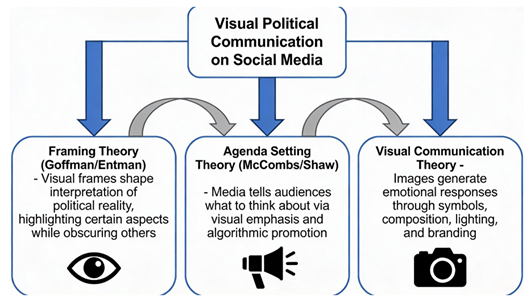
Figure 1
Theoretical
Framework
Framing Theory, The latter is an idea originally having been formulated by Erving Goffman and later elaborated by media theorists such as Robert Entman, which states that media never simply convey objective information pertaining to political realities; instead, too, they present information in specific interpretive paradigms or frames highlighting some facet of a problem and downplaying others Veneti et al. (2024). The portrayal of a political leader in a charitable gathering with a focus on personal rapport with the vulnerable groups in society sparks a very different image compared to the same leader in official government positions with a focus on the authority and power. This visual frame of the politician that is introduced largely influences the way people perceive him or her in terms of character, competence, and suitability to an office. The visual framing strategies of positivity, energy, and anti-establishment attitude were strategically deployed by the radical right-wing candidates during the 2024 European elections, who emphasized the same with their social media images, therefore, framing the choice of politics, as such, in generational terms Novelli and Ruggiero (2025).
Agenda Setting Theory, established by Maxwell McCombs and Donald Shaw is that though media does not directly dictate to audiences what to think, in effect, it does dictate to audiences what to think about Hermawan and Santoso (2025). Through frequency and prominence of coverage creating issues, media influence the public agenda thereon, i.e., the range of issues that the citizens perceive as significant. Social media networks compound this interaction by utilizing algorithmic amplification of content that is popular. When the social media posts of a particular issue by a politician were highly engaged, the posts are promoted by an algorithm and present far larger audiences with an agenda item than otherwise would be interested in reading political content. This visual process works in both directions: media campaigns actively choosing the visual effects and video materials, intended to highlight specific issues or features of their candidate, being aware that the content promoted by algorithms is the most likely to influence the opinion of the population regarding what is worth paying attention to in relation to political issues.
Social Media as Public Sphere is a more recent theory, which relies on the original concept of the public sphere by Jurgen Habermas as a space where citizens are involved in a rational-critical dialogue about issues of communal interest Grusell and Nord (2023). According to traditional public sphere theory, the internet had the potential to democratize the political communication through helping to open up political discourse and open up the gatekeeping aspects. The surface appearance of social media platforms as implementations of the ideal of the public sphere is that it offers the means in which millions of citizens can debate politics, citizens can now make direct contact with political leaders and the retarding influence of the traditional gatekeeping process ends. The reality is more complex though. Algorithms that remove human curation, filter bubbles which present users with the content that validates their prior assumptions, amplification of emotionally provoking fake news, and social media manipulation of metrics through coordinated inauthentic activity has significantly undermined the functionality of social media as a deliberative civic space Kumar and Singh (2025). The central role in this dynamic belongs to the visual content as emotionally provoking images and videos are shared much faster than nuanced and complex political reading.
2.2. Visual Communication and Branding
In addition to the general political communication theory, particular theoretical work in visual communication and political branding gives critical frameworks on the image building in digital politics.
Visual Communication Theory refers to academic literature reviewing the communication of meaning and elicitation of emotional reactions through visual symbols, pictorials, and design Veneti et al. (2024). In contrast to the textual or verbal communication, the visual one functions mostly with the help of emotional and associative channels contrary to logical reasoning. An official image of a politician with the constituents shows a sense of solidarity, reachability, democratic responsibility and needs no additional declarations to be concluded. A photograph of a politician standing at the podium focuses on the power and experience. An informal, relaxed photo implies reality and directness. By using a close visual composition, lighting, framing and editing the political campaigns create visual discourse that influence emotional reaction and political perception.
Visual branding is a concept that applies commercial theory of brand in political application. According to commercial marketing theory, a successful brand will have built unique visual identities, a logo, color scheme, typography, image styles that gain links in the minds of the consumers that are linked with the brand. Once the consumers come across the minimalist design of Apple or Nike swoosh, they feel that they instantly identify with the brand and its values. The same logic applies to the political branding: candidates and parties create their own visual identities which are aimed at providing immediate recognition and positive association. The example of this approach was the campaign led by Barack Obama in 2008 and the creation of the unique visual brand that was based on the iconic poster called Hope Adolphsen (2008). The photo shown Obama in profile, in red, beige and blue (the American color scheme), in a highly theseatrical mode that expressed idealism, dynamism, and patriotism. This visual object became a brief synonym of the overall message that the campaign was conveying regarding hope, change, and national renewal. What the image contained was impact not of making the argument of policy but that of visual communication, which created emotional appeal among audiences that mattered including youthful and first-time voters.
In modern political branding, this argument is applied to various media outlets. An example of such is the social media strategy of Modi, in which one builds a continuous aesthetic identity. The social media presents his images in a way that stresses the recurring visual components: his attitude towards austere and meditative lifestyle (yoga, meditation), his attachment to the trail of Hindu nationalism, his attachment to Indian cultural heritage, his physical mobility and energy, and his direct interaction with regular citizens Statista Research Department. (2024). The visually relevant consistency of posts, platforms, and campaign set-ups makes a unique political brand, which gives Modi a unique perception of his personality and suitability to take office to his followers.
3. The Role of Social Media in Image Building
3.1. Creating Political Personas on Social Media
The social media allows the VIP-degree of personalization of political image. The social media enables politicians to portray themselves in the entire range of personal and professional situations unlike with traditional media appearances which are to a large degree more formal and circumscribed. A politician can upload official speeches and unofficial photos of family events, videos of sports activities, a picture on religious or cultural celebrations, and unofficial remarks on what is happening around. This seeming openness and openness gives the illusion of being able to get an introduction to the true personality of the politician.
Nevertheless, this seeming authenticity covers advanced image-building. All posts, photos, and videos posted on the social media of the politician did not appear in one day without any purpose. A campaign hires social media strategists, professional photographer, videographers, and data analysts in order to maximize the content to engage and be viewed favorably Grusell and Nord (2023). Individual testimonies, emotional appeals, as well as visual presentation, are all finely tuned so as to appeal to target audiences and to further the goals of any given campaign.
Social media created political personalities have various strategic functions. They place politicians in a humanized way, forming the perception of personal relatability and accessibility that increases bondage with the constituents. They exhibit both values and personality characteristics that are considered electorally beneficial. They transmit the priorities of policy and the ideological pledges through images and discourses instead of policy discussions. More importantly, those form emotional attachment which can override rational policy consideration; voters who believe that they know a politician due to engaging with the social media can be willing to back a politician despite disagreements over a particular policy stand Hermawan and Santoso (2025).
3.2. Platforms and Tools for Political Image Construction
Modern political campaigns utilize several social media platforms, with each one having a set of strategic applications depending on the properties of a platform, the audience of these users, and the mechanics of the algorithm.
The biggest social media platform and the main location of political-related campaigns aimed at the older demographic and general audience groups is still Facebook, which has around 3.1 billion monthly active users across the world Statista Research Department. (2025). Facebook is usually utilized in the political campaigns to share longer-form content, event announcements, policy details, and also to do targeted advertising. The advanced advertising capabilities of the platform enable the campaigns to reach selected audience segments of a certain demographic, geographic, and interest with a tailored message. The visual content works significantly better than a text-based one, and campaigns aiming at high-quality photography and video as a priority.
Instagram that boasts of about 2 billion users monthly is a media that focuses more on imagery and targets the youngest age bracket, especially women. The structure of Instagram, i.e. the gallery of depictions of images with captions, predisposes this service to visual storytelling. Instagram is utilized by political campaigns to a large degree through campaign pictures of campaigns behind the scenes, personal photographs that make candidates more human, video material, and the collaboration with influencers. The types of content shared in the platform in the Stories and Reels features will enable campaigns to post temporary content and short-form videos designed to be consumed quickly.
The Twitter (X) is a platform that has around 600 million users and focuses on fast exchange of information and discussion. The text-based nature of the platform may also indicate that visual politics would be less relevant on the platform, but in reality, any text-based tweet containing captivating visual material, such as photographs, infographics, video clips, and so forth, would engage significantly more. Twitter/X emerged as a focal point in political discourse and on-the-fly campaign communications during the 2024 Indian general elections and the 2024 presidential campaign in the United States with visual content taking a key role in the trending topic creation and discourse Fletcher and Nielsen (2024).
Having about 1.6 billion people (users), TikTok prefers short-form video content and is most targeted by the Gen Z generation and younger millennials. The platform has an algorithm that increases the interactivity of the content in disregard of the number of followers to its creators, providing the possibility of fast viral traffic of videos. In the 2024 European Parliament elections, TikTok was also more actively used by political candidates to attract the younger generation by more dynamic stylistically innovative content that did not follow classic norms of political communication Novelli and Ruggiero (2025). The non-formal aesthetic of the platform as well as algorithmic mechanics have contributed to authenticity and humor being rewarded and forcing campaigns to apply less formalized visual communication styles that are more personalized.
The largest video sharing platform with around 2.5 billion users, YouTube, allows to distribute longer-form video content such as speeches, campaign ads, explaining policies, and documentary-style content about the candidates. The recommendation engine of the platform influences the content users are exposed to; high engagement campaign videos are promoted through the use of an algorithm and will shape their contribution and viewership Hermawan and Santoso (2025).
Table 1
|
Table 1 Major Social Media Platforms by Monthly Active Users and Political Utility (2025) |
|||
|
Platform |
Monthly
Active Users (Billions) |
Primary
Political Demographic |
Avg
Video Engagement Boost |
|
Facebook |
3.07 |
35+
years, events/ads |
5x |
|
YouTube |
2.50 |
Policy
videos, all ages |
8x |
|
WhatsApp |
2.00 |
Mobilization
(India) |
N/A |
|
Instagram |
2.00 |
Youth
visuals (18-34) |
6x |
|
TikTok |
1.58 |
Gen
Z memes |
10x |
|
X
(Twitter) |
0.55 |
Debates,
elites |
4x |
|
Telegram |
0.95 |
Groups,
news (EU/India) |
3x |
|
LinkedIn |
0.35 |
Policy
pros |
2x |
|
Source Wikipedia (2025), Statista Research Department. (2025), Tekrevol (2025) |
|||
Political campaigns now employ data analytics teams that measure engagement with visual content across platforms, identifying which imagery, video styles, and visual messaging strategies generate highest engagement with target audiences. This data-driven approach enables rapid iteration and optimization of visual political communication, allowing campaigns to deploy rapidly what messaging and imagery approaches prove most effective Comscore (2025).
3.3. Visual Content and Political Branding
The concrete visual material that is used in political campaigns can demonstrate how the modern political actors transfer the abstract concepts of the leadership, values, and policy into the definite visual images aimed to influence the perception and to find supporters.
One of the most important tools of visual communication in political campaigns is professional photography. The professionals used in campaigns include professional photographers who make high quality portraits and event photography that make candidates appear in appealing ways. The messages of photos are supported by lighting, composition, background and post editing. A politician who is captured in a professional environment and background would be understood to have authority and administrations. The same politician when he was photographed in a relaxing environment, with friends, warm light and friendly body language, displays accessibility and democratic responsibility. Such images are diffusing into the social media circles where they create a high level of engagement and influence the perception of the other population.
Table 2
|
Table 2 Engagement Metrics for Visual Political Content (2024-2025 Examples) |
||||
|
Campaign/Event |
Platform |
Likes
(Millions) |
Shares/RTs
(Millions) |
Platform
Avg Rate |
|
Modi
2024 Election |
X |
1.47 |
0.16 |
2.5% |
|
Trump
2024 Victory |
X |
5.2 |
1.1 |
3.1% |
|
Obama
Hope Poster |
All |
10+
historical |
Viral
grassroots |
N/A |
|
Modi
Clean India |
Instagram |
0.8 |
0.2 |
4.2% |
|
EU
2024 Right-Wing |
TikTok |
2.1 |
0.5 |
7.8% |
|
Modi
Top Tweets |
X |
8/10
top India |
High
virality |
2.8% |
|
Ardern
COVID Videos |
Facebook |
0.3 |
0.1 |
1.9% |
|
Biden
2024 Ads |
YouTube |
0.9 |
0.15 |
3.5% |
|
Modi
Yoga Day |
Insta |
1.2 |
0.3 |
5.1% |
|
Trump
Rally Clips |
X |
3.8 |
0.9 |
4.0% |
|
Source Times of India (2025), paper case studies, Wikipedia/Twitter
lists, benchmarks. |
||||
· Campaign videos are a growing significance of visual images. These types of video content are created through campaigns, including personal story videos which humanize candidates by creating narrative about their version and values, policy explanatory videos which analyze the complex policy positions into easy to understand visual stories, attack videos which berate opponents and celebrate videos which show the success of the campaign and testimonials of the constituents. The European elections 2024 saw massive backlash in terms of videos content creation, candidates creating dozens of videos to distribute them through platforms Novelli and Ruggiero (2025).
· Memes have proved to be very good visual tools of political communication. Memes are visual images that can be one with text or graphics that clip with other content in a Humorous or provocative way, whichever the case, they are rapidly spread throughout social media, have high levels of engagement, and influence the political discourse among younger people Statista Research Department. (2024). Due to this fact the political campaigns adopted the idea and developed either meme-like content to be shared or implicitly called upon their supporters to generate memes favorable to their candidates. Although it is sometimes hard to believe it until the last, memes sometimes may appear informal or low-quality in comparison to professionally created campaign materials, but their rates of spreading or engaging an audience are often higher than those of professionally created ones.
· Another category of essential types of visual content is infographics and data visualization. The visually stimulating graphics in campaigns are used to deliver the data, statistics, and policy information in very easy formats. An intricate economic policy project could be proposed in the form of an infographic where the main messages would be conveyed with the help of visual design instead of having the audience members read long descriptions of this project.
· Campaign Imagery and symbolic presentation are also applied on the bodily appearance of the candidates and how they appear during campaigns. What their candidates wear, the way they have done their hair, body language and physical behavior all send a message regarding what kind of a person they are and what kind of able competent person they are Adolphsen (2008). The stable appearance of Modi, always wearing traditional Indian formal attire (the kurth pajama) is symbolic in meaning, as it indicates that he is somehow attached to Indian culture and traditional Hinduism. Equally, it was Obama, 2008 campaign that did a good job of controlling his visual image to promote an aspect of competency, inspiration, and the post-racial identity.
4. Visual Politics Ethics and Implications
The success of visual political communication in influencing the opinion of people begs serious moral issues. This ability to represent political leaders using powerful visual styles that create an impression without occurring policy discussion makes the possibility of control and distortion of democratic discourse Veneti et al. (2024). The ethical issues revolve around a number of dimensions.
Authenticity of image and image manipulation is one of their major issues. There is also much more manipulation of images with digital technologies than was ever possible before, whether it is a slight alteration of the lighting and colour or an extensive creation of visual images. Although mild forms of image editing are considered normal in photography and videography, when there is heavy editing of a given image that distorts the truth, then the ethical issue comes into the picture. In instances where a photograph of the candidate has been over-edited to look younger, prettier or in better health conditions, the portrayal of the candidate is such that it distorts the reality to predict the attitude of the voters towards the candidate not on policy or character, but on looks. Even more serious concerns are posed by the deepfake technologies that produce fake videos of political leaders that state or do things they never stated or did, since it is more likely to be shared globally before the deceit is proven.
Another important ethical aspect is emotional manipulation. Visual aids have the ability to stir feelings of fear, hope, anger, inspiration better than written or spoken words. Political campaigns make this visual material on purpose create specific emotional appeal; an image of a politician consoling the victim of a disaster produces emotional response very different to an image of the same politician at a state dinner. Such emotional reactions can have significant effects in political judgment. In those cases, where the campaign purposefully constructs visual materials aimed at provoking emotional reactions not attached to actualized information on the competence of candidates or their policy stances, they presumably contravene the moral principles of the democratic political persuasion.
Visual misdirection is utilization of visual imagery to draw attention to issues that are strategically beneficial to the politicians and blow off attention on unsuspection elements of their records. A political figure with a disturbing economic history may overwhelm social media with pictures with the focus on their cultural or religious beliefs, thus diverting the attention of the citizens off the economic policy. Although such strategic emphasis is a common practice in campaigns, it has made me wonder about the ethical nature of such massive difference between the way candidates present themselves publicly and their track records.
5. Conclusion
In the digital era, visual communication has proven to be at the centre of political image making which has completely transformed the way political personalities build, showcase and sustain their public image. By reviewing the example of current case studies, such as the revolution of the Obama campaigns of 2008 and 2012, the unparalleled social media dominance in Indian politics in 2014 by Modi, and the dynamic nature of visual content in future electoral affairs in 2024, this study has been able to identify the tremendous impact of the visual communication on the political perception and electoral outcomes. The Framing Theory, Agenda Setting Theory, and Visual Communication Theory theoretical frames help to understand the processes of creating visual political content, which guides the social perception. Visual content does not merely educate audiences about political personalities and trends; instead, it articulates political meaning by visual representation, scales the agenda in the masses through algorithmic rewards of entertaining content, and results in emotional reaction that may far surpass what the text or policy-based communication can achieve.
The modern political campaigns have fully embraced the visual-based environment of social media and uses the tools of professional photography, cinematography, meme generation, and video editors to create impactful political stories. Data analytics teams can study the interactivity of visual content in different platforms and thus the visual political communication strategy could be tried and refined quickly. This specialization and polish of visual political communication is indicative of the structural analysis of social media whereby visually pleasurable material has been favored over any information that is textual or policy-centered. Nevertheless, the importance of visual communication to the construction of political images poses huge ethical dilemmas because of the centrality of the art hinged on creating visual communications. The visual manipulation ability, the emotional influence of the visual content that can have power regardless of the truth in the facts, the prevalence of visual misinformation via social media systems, and the possibility that deepfakes and synthetic media can create the political reality is very alarming to the state of the democratic integrity of the visually mediated political environment.
To handle these issues, complex only solutions are needed. Media literacy programs that teach citizens how to think critically about visual manipulation, how social media designs are developed, and how to offer emotional reactions rather than assess social media in a logical and critical political manner are critical. Redesign platform that puts emphasis on engagement metrics and rebalances algorithmic amplification toward visual truth and meaningful political dialogue would help decrease the transmission of visual misinformation. Opaque policies on image editing, artificial media and paid message reporting by political campaigns would enhance accountability. The regulatory systems that will define the standard of the social media communication by the political figures but allow freedom of speech are yet to be established.
Finally, visual politics in the digital era is neither an unquestionable enhancement of democracy in its exercise nor the unedulterated danger to the democratic integrity. The development of social media and visual communication has presented a unique opportunity to engage in direct communication between political leaders and constituents in ways that have never existed before, allowing the political participation of the grassroots and upsetting established media to act as a gatekeeper. At the same time, the same technologies have facilitated the manipulation, misinformation, and polarization never before seen before. Whether societies will be able to come up with governance systems and cultural practices that can ensure that the democratic promise of visual communication will be upheld without the risks it poses on the institutions of democracy being brought down to the lowest levels will determine the future of democratic politics.
CONFLICT OF INTERESTS
None.
ACKNOWLEDGMENTS
REFERENCES
Adolphsen, M. (2008). Branding in Election Campaigns: Just a Buzzword or a New Quality of Political Communication? (Master’s dissertation). London School of Economics and Political Science.
Amra and Elma LLC. (2025, March 29). Best Content Engagement Statistics 2025.
Boell Foundation. (2024, May 21). Indian Elections 2024: Social Media, Misinformation.
Comscore. (2025). Social Influencers Report India 2025. Comscore Database.
Economic Times. (2025, December 18). Most-Liked Tweets: In Top 10 Posts from India, PM Modi in top 8.
Exchange4media. (2025, June 27). PM Narendra Modi Tops Social Media Engagement Charts; What Content Creators Can Learn.
Fletcher, R., and Nielsen, R. K. (2024). Which Social Networks Did Political Parties Use Most in 2024 UK Election? Election Analysis.
Grusell, M., and Nord, L. (2023). Social Media as a Platform for Incessant Political Communication: Modi’s “Clean India” campaign. International Journal of Communication, 17, 1234–1256.
Hermawan, V., and Santoso, A. (2025). Political Communication in the Digital Era: The Role of Social Media in Image Building. Jurnal Ilmiah Multidisiplin Indonesia, 4(5), 123–140.
Kumar, R., and Singh, A. (2025). The Impact of Social Media on Voting Behaviour in the 2024 Lok Sabha Elections. The Academic Journal. https://theacademic.in/wp-content/uploads/2025/06/71.pdf
Michalsen, A. (2014). Brand Obama: How Barack Obama revolutionized political campaign marketing in the 2008 presidential election (Undergraduate thesis). Claremont McKenna College.
Novelli, E., and Ruggiero, C. (2025). Italy’s 2024 European Election Campaign on Social Media. Media and Communication. Cogitatio Press.
SPRF. (2024, May 20). Social Media as an Emerging Theatre of Political Contest: Insights from 2024 Indian Elections.
Srikandi, M. B., Widodo, T., and Sari, D. P. (2024). Social Media Politics: Analysis of Political Elite Image Construction in Multiple Country Elections. Multidisciplinary Reviews, 7(2), e2024278. https://doi.org/10.31893/multirev.2024278
Statista Research Department. (2024, August 1). Social Media Following of Narendra Modi India 2024.
Statista Research Department. (2025, March 25). Biggest Social Media Platforms by Users 2025.
Storyboard18. (2025, October 30). Narendra Modi Surpasses Justin Bieber to Become Fourth Most Followed Account on X.
Veneti, A., Jackson, D., and Willis, J. (Eds.). (2024). Visual Political Communication: Image Construction and the Fake News Challenge. Palgrave Macmillan. https://doi.org/10.1007/978-3-031-16838-9
|
|
 This work is licensed under a: Creative Commons Attribution 4.0 International License
© ShodhKosh 2026. All Rights Reserved.