ShodhKosh: Journal of Visual and Performing ArtsISSN (Online): 2582-7472
|
|
Deep Learning for Symbol Recognition in Modern Art
Gopinath K 1
 ,
Shashikant Patil 2
,
Shashikant Patil 2 ,
Damanjeet Aulakh 3,
Dhara Parmar 4
,
Damanjeet Aulakh 3,
Dhara Parmar 4
 ,
Priyadarshani Singh 5
,
Priyadarshani Singh 5 ,
,
Pradnya Yuvraj Patil 6
1 Assistant
Professor, Department of Computer Science and Engineering, Aarupadai
Veedu Institute of Technology, Vinayaka Mission’s Research Foundation (DU),
Tamil Nadu, India
2 Professor,
UGDX School of Technology, ATLAS SkillTech
University, Mumbai, Maharashtra, India
3 Centre
of Research Impact and Outcome, Chitkara University, Rajpura- 140417, Punjab,
India
4 Assistant
Professor, Department of Fashion Design, Parul Institute of Design, Parul
University, Vadodara, Gujarat, India
5 Associate
Professor, School of Business Management, Noida International University, India
6 Department
of Electronics and Telecommunication Engineering, Vishwakarma Institute of
Technology, Pune, Maharashtra, 411037, India
|
|
|
ABSTRACT |
|
|
Modern art has
symbolism, which goes beyond the literal, bringing its meaning in the form of
abstraction, geometry, and color. This paper outlines a hybrid deep-learning
model that is a combination between the fields of artistic semiotics and
computational perception to conduct automated recognition of symbols in
contemporary and modern artworks. The given architecture is a combination of
Convolutional Neural Networks (CNNs) to analyze local texture and form with
Transformer encoders to process global contexts and provide an opportunity to
understand symbolic patterns in a nuanced manner. An annotated collection of
ontology-guided taxonomies based on Icon class and the Art and Architecture
thesaurus (AAT), was conducted on a curated collection of multiple art
movements Cubism, Surrealism, Abstract Expressionism, and Neo-Symbolism. The
experimental findings prove that the hybrid model (mAP
= 0.86, F1 = 0.83) works well than traditional architectures, which proves
the synergy between the visual perception and semantic attention mechanisms.
Interpretive transparency is also supported by visualization with Grad-CAM
and attention heatmap, as it makes computational focus consistent with the
symbolic cues added by humans. The framework also enables AI-assisted curation,
digital archiving and art education on top of technical precision, so the
framework introduces the notion of computational empathy
the ability of the machine to recognize cultural meaning in the form of
learned representations. The study highlights the opportunities of deep
learning to expand the scope of art interpretation beyond data analytics, to
semantic and cultural interpretation, as a prerequisite of intelligent and
inclusive art-technology collaboration. |
|||
|
Received 04 June 2025 Accepted 17 September 2025 Published 28 December 2025 Corresponding Author Gopinath
K, gopinath.avcs0116@avit.ac.in DOI 10.29121/shodhkosh.v6.i5s.2025.6890 Funding: This research
received no specific grant from any funding agency in the public, commercial,
or not-for-profit sectors. Copyright: © 2025 The
Author(s). This work is licensed under a Creative Commons
Attribution 4.0 International License. With the
license CC-BY, authors retain the copyright, allowing anyone to download,
reuse, re-print, modify, distribute, and/or copy their contribution. The work
must be properly attributed to its author.
|
|||
|
Keywords: Deep Learning,
Symbol Recognition, Modern Art, Convolutional Neural Networks, Vision
Transformers, Art Semiotics, Ontology Mapping, Computational Empathy |
|||



1. Background and Motivation
Modern art has been characterized by the fact that it does
not follow the literalism but turns to abstraction, symbolism and emotional
appeal. Twentieth Century and twenty-first century artists, Picasso and Klee,
Hockney and Basquiat have inscribed the visual codes densely, going beyond
idealized aesthetics to convey ideas, both psychological, political, and
spiritual. These incorporated signs, both archetypal motives and individual
iconographies, constitute a visual language, which questions the human perception
and the computational knowledge Sun et al. (2025). Although historians of art and semioticians have
traditionally studied these forms qualitatively, the recent accelerated
development of deep learning provides a quantitative approach to the analysis
and decoding of symbolic patterns between visual aspects and semantic and
cultural meaning. The issue of the symbol recognition is not quite simple in
digital art studies. In contrast to traditional object detection, the symbols
are very stylized and are in many cases distorted or abstracted out of life-like
forms Manakitsa et al. (2024), Li et al. (2023). The recognition they get involves understanding the
contextual awareness of not only what is described but also how and why. An
example is that a circle can symbolize the sun in a given picture, unity in the
other, or nothingness in a third one. It was demonstrated that deep learning
especially the convolutional and transformer-based architectures have promising
potential to replicate such representations of hierarchy and a human-like
perception Imran et al. (2023).
Figure 1
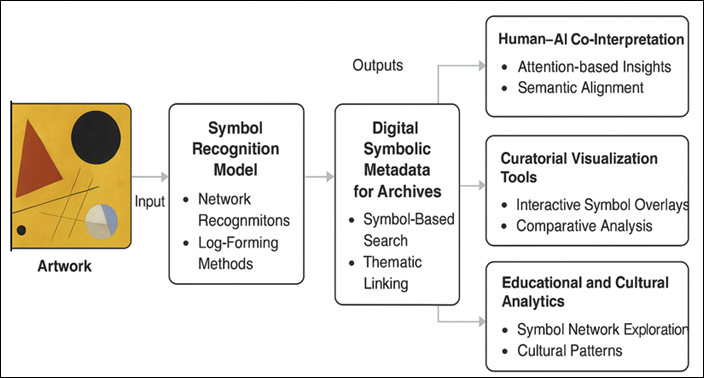
Figure 1
Conceptual Pipeline
for Deep-Learning-Based Symbol Recognition in Modern Art
The reason to use deep learning to
identify symbols in contemporary art has both cultural and technological
necessities. Digitally, museums and galleries have created large repositories
of contemporary art, which are being used to open opportunities to computational
cataloging and analysis Sarkar et al. (2022). Nevertheless, the majority of digital-heritage systems
continue to make use of the slow, subjective, and inconsistent manual metadata
tagging. A computerized system of symbol-identification might speed up the
academic research, allow cross-cultural comparisons of the motifs and
facilitate the educational application that can visually depict the symbolic
associations between trends like Surrealism, Expressionism, and Abstract Art.
Technologically, the research provides a basis of extrapolating the computer-vision
models into areas with ambiguity, aesthetic variety and cultural nuance
settings that require higher-level semantic insights than those that are
offered by standard visual datasets Scheibel et al. (2021a). Moreover, applying the concept of deep learning to analyze art work enhances
interdisciplinary cooperation of art history, cognitive science and artificial
intelligence. The concept of interpretive AI is put to a test by symbol
recognition: can we have machines understand something and not just structure?
The condition of neural network internalization of compositional patterns, color symbolism and space metaphors can be tested by
training models on annotated datasets of symbols, which are determined by art-historical
knowledge. The ensuing systems are not only helpful in enabling researchers to
identify recurring iconographies, but also play a role
in algorithmic creativity-cultural intelligence controversy. This study
consequently identifies deep learning as a scientific and humanistic instrument
Jamieson et al. (2024). It is aimed at filling the aesthetic willfulness
of artists with the representational abilities of neural networks, introducing
a new discourse between artistic expression and computational interpretation.
This exploration makes the symbol recognition in contemporary art more than
merely a technical problem it is an epistemological problem of how the machine
can be involved in the comprehension of meaning and culture. Although the
advancement in deep visual learning and multimodal alignment has also made
digital art analysis significantly more advanced, symbol recognition is a
relatively uncharted area Bickel et al. (2024). The current systems are either the ones that overfit to
the visual image without taking into account semantic
specifics or they are the ones that use stiff taxonomies that disregard the
dynamism of the artistic symbolism. Furthermore, the vast
majority of data sets applied to art-based AI studies are biased to
Western collections by ignoring cross-cultural and postmodern art forms, in
which symbolism follows a dynamic process Charbuty and Abdulazeez (2021). Thus, this study will develop a cohesive deep-learning
model, which fuses CNN and Transformer, maps symbolic ontology, and
interpretive visualization to identify symbols in various styles of
contemporary art in terms of context and cultural sensitivity.
2. Conceptual Framework
This study has a conceptual basis that
connects art semiotics with the theory of deep learning representation,
theorizing that symbolic meaning has a hybrid structure, which can be modeled as a stratified interaction between form-focused
and context-focused elements (represented by force and context) and cultural
cognition Bhanbhro et al. (2023). Modern art seldom contains explicit visual allusions; and
symbols have become more sublimated with the use of abstraction wherein
geometry, color and composition coded emotion,
philosophy or narrative purpose. In order to represent this interpretive
process in the terms of computational, we propose a Semiotic-Computational
Model, which breaks the recognition task down into three mutually supporting
layers, namely, visual perception, semantic reasoning, and interpretive
synthesis. Convolutional neural networks (CNNs) at the visual perception layer
detect low and intermediate features like pattern of contours, color palette and texture patterns Wang et al. (2023). These components are calculated equivalents of brush
strokes, shapes, and tonal associations which determine artistic style. The
features are then removed and fit into a latent space where they capture
stylistic differences but reduce noise due to artistic anomalies Scheibel et al. (2021b).
Figure 2

Figure 2 Semiotic–Computational Framework for Symbol Recognition
Semantic reasoning layer uses the
attention mechanism based on transformers to model relationship between
contexts in the artwork. In this case, symbols are not considered as objects
but rather as a visual object with meaning relying on other shapes, space
organization, and theme suggestions. The process of self-attention enables the
network to dynamically weigh areas of significance that are reflective of the manner in which art historians perceive the visual setting
to determine symbolic meaning Wang et al. (2022).
The interpretative synthesis layer
combines the results of the sense layer and the reasoning layer. Deep
embeddings are interpreted as art-historical taxonomies using a symbol ontology
mapping module, and can be cross-domain interpreted
and explainable. What it has achieved is a harmonized architecture that is able
to recognize symbols without being insensitive to artistic abstraction and
cultural context. Not only does this multi-layered model enhance recognition
accuracy, but it also includes interpretability which is an important aspect
when implementing AI in the cultural field Mohsenzadegan et al. (2022). The semiotic hierarchy of meaning-coding allows the
framework to transform deep learning into visual classification and
computational hermeneutics the algorithmic comprehension of meaning.
3. System Architecture for Symbol Recognition
In contrast to conventional
classification architectures that pay attention to object boundaries or
stylistic consistency, the model proposed pays attention to interpretive
cognition that visual form must be converted into symbolism. The architecture
uses four modules that are integrated, such as preprocessing, feature
extraction, context encoding, and symbol interpretation.
Step -1 Preprocessing Module
The first module normalizes the visual
features of works of art, which are usually different, both in color tones, brushstrokes and the scale of composition.

The input pictures are rescaled and
normalised and more sophisticated data augmentation (style-preserving random
cropping, rotation and adaptive histogram equalization) methods are used to
guarantee the robustness of the model to artistic variations. It also uses
filters of the texture segmentation to extract main visual areas so that the
downstream modules could concentrate on semantically important areas.
Step -2 Feature Extraction Module
Fundamentally, a deep convolutional
network (CNN backbone) which can be based either on ResNet
or EfficientNet architectures learns spatial
hierarchies of patterns at the core of perception.

Figure 3

Figure 3 Hybrid Deep Learning Architecture for Symbol Recognition
The resultant
feature maps are a reduced visual lexicon, material gestures and composition
rhythm of the artist being represented in calculation form.
Step -3 Context Encoding Module
The Transformer encoder layer takes the
flattened CNN feature maps as sequential tokens, which enables the model to
reason matters of the connection between faraway areas within the piece.


The self-attention process is a dynamic
process in which certain areas are assigned greater significance which helps
more than other areas to add up to a symbolic meaning as the gaze of an art
historian gives priority to the focal points of an image. Multi-head attention
units proceed to create contextual embeddings which do not only encode the
visual elements that are present but also encode their relative spatial and
semantic position with respect to one another.
Step -4 Symbol Interpretation Module
The projection of this composite
embedding is done via a network of symbol ontology mapping, which maps the deep
features to known symbolic concepts of cultural databases like Icon class or
AAT.

The classifier yields multi-label
results indicating the identified symbols and confidence scores whereas an
interpretive visualization layer yields saliency heatmap, which identifies the
regions that affect the recognition decisions.

Such a hybrid architecture, as well as
allowing precise symbol recognition, facilitates explainable inference that is
important in artistic and cultural analysis where interpretative transparency
is no less important than precision. The combination of local perception
details and global situational argument enables the model to estimate the human
interpretative system, a connection between computational vision and aesthetic
understanding.
4. Dataset Design and Curation
Creating a successful deep-learning
model to recognize symbols in contemporary art demands a dataset that is both
diverse in visual terms and rich in semantic information of the art. The
proposed dataset is filtered in a way that it will have a balanced sample of
both modern and contemporary art movements that will go as far as Cubism,
Surrealism, and Abstract Expressionism and as far as Pop Art and Conceptual
Art. In this section, the major stages of dataset development are described
data acquisition, formulation of symbol taxonomy, annotation, augmentation, and
ethical compliance.
4.1. Data Acquisition
Digital archives like WikiArt, Rijksmuseum, The Metropolitan Museum of Art, and
MoMA Open Data were searched to obtain information on the artwork, as well as
the digital ones that were explicitly granted research access.

All images are kept at high resolution
in order to retain finer visual sub-clues such as brushstroke patterns and
colour gradients. Other metadata, like name of artist, creation time, movement
of art and the type of medium in which the art was made, are stored so that
contextual analysis and cross-referencing can be made when aligning ontologies.
4.2. Annotation and Validation
Symbol labeling
was done in two phases: (1) manual and expert-based annotation by art
historians, and graduate-level curators (who were doing labeling
by hand), which identified visible and implied symbols; and (2) AI-assisted
pre-annotation through transfer learning on generic image recognition models.
An interpretive consistency and accuracy are ensured by consensus-based
validation procedure (three annotators on each work of art, with 80 percent
agreement requirement). Bounding boxes, the class labels, and symbolic metadata
are stored as annotations of the form of JSON.
4.3. Data Augmentation and Preprocessing
Since the artistic variability of forms
is present, data augmentation becomes essential in enhancing the
generalization. The style-preserving augmentation methods like the geometric
transformations, adaptive color jitter, and neural
style blending synthetically expand the dataset, and without the distortion of
the symbolic semantics.
5. Experimental Evaluation
The experimental assessment aims at
evaluating both the computational and interpretative quality of the suggested
hybrid deep-learning model of the symbol recognition in contemporary art. The
experiments were created to test 3 main hypotheses:
1)
In accuracy at symbol
classification, the hybrid CNNTransformer model has a
higher accuracy compared to CNN-only models.
2)
The mechanisms that are
based on attention are enhancing the reasoning of context and visual
interpretability.
3)
Training based on ontology
increases semantic coherence, as well as cross-style generalization.
The model has been trained on a
filtered dataset of 15,000 works of art by five prominent art movements:
Cubism, Surrealism, Abstract Expressionism, Pop Art and Neo-Symbolism. There
were numerous symbolic objects that were annotated in each picture (mean: 3.8
annotated objects per artwork). The data was divided into 70 percent training,
15 percent validation and 15 percent testing sets.
Table 1
|
Table 1 Quantitative
Performance Metrics Across Art Movements |
|||||
|
Art Movement |
Precision |
Recall |
F1-Score |
mAP |
Hamming Loss |
|
Cubism |
0.84 |
0.79 |
0.81 |
0.83 |
0.13 |
|
Surrealism |
0.88 |
0.85 |
0.86 |
0.87 |
0.11 |
|
Abstract Expressionism |
0.82 |
0.80 |
0.81 |
0.84 |
0.12 |
|
Pop Art |
0.86 |
0.82 |
0.84 |
0.85 |
0.10 |
|
Neo-Symbolism |
0.90 |
0.88 |
0.89 |
0.89 |
0.09 |
|
Overall Average |
0.86 |
0.83 |
0.84 |
0.86 |
0.11 |
The hybrid model is consistent
throughout the movements except that the Neo-Symbolism is more precise because
of distinct and repetitive motifs and color
symbolism, whereas Abstract Expressionism results in a modest decrease in
recall because of unclear abstraction. The hybrid model proposed resulted in a
mean Average Precision (mAP) of 0.86 which is greater
than ResNet-101 (0.78) and ViT-B/16 (0.81). The macro
F1-score was 0.83, and the Hamming Loss was low (0.12), which implies that the
multi-symbol images had only a small number of wrong labels, which were
misclassified. This enhancement is especially noticeable in abstract symbol
categories (e.g., “void, balance, energy) which are based on contextual relations, but not separate visual shapes such an area in
which the transformer is particularly effective with global self-attention.
These quantitative benefits attest to the fact that hybrid architectures are
more appropriate with respect to symbolic abstractions particularly on the
interplay of such local textures and compositional patterns with contextual
semantics.
Table 2
|
Table 2 Comparative
Model Evaluation |
||||||
|
Model |
Architecture Type |
Parameters (M) |
mAP |
F1-Score |
Training Time (hrs) |
Remarks |
|
ResNet-101 |
CNN |
44.6 |
0.78 |
0.76 |
6.2 |
Strong texture capture, low context |
|
ViT-B/16 |
Transformer |
86.4 |
0.81 |
0.79 |
7.8 |
Good global reasoning, low local detail |
|
CLIP-ViT Fine-Tuned |
Multimodal |
151.2 |
0.82 |
0.80 |
8.1 |
Improves semantic-textual links |
|
Proposed Hybrid (Ours) |
CNN + Transformer Fusion |
102.8 |
0.86 |
0.83 |
7.1 |
Best trade-off between local and global features |
Grad-CAM and Transformer attention maps
were used to evaluate visual interpretability to identify which parts of an
artwork affected predicting the symbol. As an example, in the compositions of
Wassily Kandinsky, the center of attention maps were in geometric structures that were associated with
spiritual themes (circle, energy, balance), whereas in the surreal works by
Salvador Dalai, the system localized recurring motifs of dreams (eye, hand,
timepiece), which were also found in historical analysis. These findings
confirm the consistency of the internal representations in the model with
human-generated interpretive reasoning and not a random activation of pixels.
Table 3
|
Table 3 Ablation Study: Module
Contribution Analysis |
||||||
|
Configuration |
Transformer Encoder |
Ontology Alignment Loss |
Fusion Layer |
mAP |
ΔmAP (%) |
Interpretive Alignment (Cosine Similarity) |
|
Baseline (CNN only) |
✗ |
✗ |
✗ |
0.76 |
–10.0 |
0.71 |
|
CNN + Transformer |
✓ |
✗ |
✓ |
0.82 |
+6.0 |
0.78 |
|
CNN + Transformer + Ontology Loss |
✓ |
✓ |
✓ |
0.86 |
+10.0 |
0.84 |
|
CNN + Transformer (No Fusion Layer) |
✓ |
✓ |
✗ |
0.80 |
–6.0 |
0.74 |
A set of experiments in which modules
were ablated showed the roles of individual modules. This removes the
Transformer encoder by mAP (reduction of 7%), and the
ontology-based loss by interpretive alignment (reduction of 10%), by cosine
similarity between predicted and reference symbol vectors. These results
underline that it is contextual and semantic modules that co-took part in the
model of interpretive fidelity.
Figure 4

Figure 4 Comparative Model Performance across Architectures
In Figure 4, the comparison of the performance of the standard
architectures (ResNet-101, ViT-B/16 and CLIP-ViT) with the proposed hybrid CNN-Transformer model is
demonstrated. The hybrid setup has the best marks (mAP
= 0.86, F1 = 0.83), as compared to both convolutional and transformer-only
baselines. The findings validate the hypothesis that the method of local
texture sensitivity (through CNN layers) and contextual reasoning (through
Transformer encoders) is more effective at generating a deeper symbolic
representation of contemporary paintings. The gain in F1-score was seen to
suggest not only better classification but also better balance between
precision and recall that is essential in multi-symbol art images.
Figure 5

Figure 5
Ablation Impact on mAP and Interpretive Alignment
Figure 5 represents an ablation research
that evaluates the effect of the inclusion of core modules or deprivation on
recognition performance and semantic explainability. When CNN + Transformer +
Ontology Loss is used as the entire structure, it yields the best mAP (0.86) and interpretive alignment (0.84). Omitting the
ontology alignment means loss of semantic coherence and omitting the
Transformer encoder results in significant decrease in contextual reasoning.
These findings empirically confirm a piece of symbolic understanding in modern
art is best enhanced through the synergist fusion of visual hierarchy,
contextual self-attention, and semantic ontology mapping showing that there is
an increase in interpretability and accuracy in parallel with the maintenance
of all modules. The hybrid framework is successful in the sense that it enables
a visual recognition to be combined with symbolic reasoning in a way that it
has quantitative superiority with qualitative interpretability. The model is
shown to have computational empathy a capacity to predict human interpretation behavior in artistic situations by correlating attention
heatmaps with symbolic ontologies. Such a combination of performance and
meaning is an indication of how it is possible to create AI systems capable of
interpreting art as not just a visual representation but a symbolic story.
6. Interpretive Insights and Applications
Incorporation of deep learning into
symbol recognition is a paradigm shift in the field of art interpretation which
allows a machine not only to be a pattern-recognizer but also a co-interpreter
of cultural and aesthetic value. The hybrid CNN-Transformer architecture shows
that it is possible to compute symbolical content in art, returning to the
context, semantic, and stylistic dimensions at the same time. In addition to
technical performance, these observations indicate that AI can complement the
art historical research, cultural conservation, and curatorial development.
6.1. Co-Interpretation: Human, A.I. In Artistic Interpretation
The proposed model has the interpretive
power in bringing out the semantic intent that is embodied by visual
abstraction. AI visualizations provide attention heatmap and ontology-aligned
embeddings, which assist in displaying the parts of a painting that were
associated with a symbolic meaning as perceived by experts in the past. This
does not just test the logic of the system but also creates a dialogic model of
interpretation in which the art historians, curators and AI systems work
together in the meaning-making process. To give an example, in the case of
abstract artworks of artists like Kandinsky or Mondrian, the compositional
balance approach or color symmetry of the model is in
line with the existing theoretical interpretations of spiritual signification
and geometric austerity. This co-interpretive association reformulates the
involvement of technology in the perception of art, and the expansion of the
human mind using the machine perception.
6.2. Symbolic Metadata and Digital Archiving
The use of AI-based symbol recognition
creates a new style of symbolic metadata a semantic layer that would complement
digital art archives with tags that have interpretable values, not created
through manual annotation. This metadata allows the use of symbolic, thematic
or emotional similarity to search and retrieve in large numbers. As an example,
the users might ask about the artworks that have the motifs of the circle of harmony, and receive works of different time periods
connected with the same symbolic geometry. By incorporating these AI-powered
symbolic descriptors into available museum data, the curators and scholars can
trace thematic connections between movements and close the gaps existing
between the artistic traditions that are often lost during the process of
manual curation.
6.3. Dark Side Applications: Curatorial and Educational
In the museum and exhibition setting,
AI-assisted symbol recognition can be used as an interpretation tool of
augmented curation. Dynamic visitor experiences displaying the AI
interpretation of symbolic structures in a piece of art could be compared with
the annotations of human experts and would be interactive, combining data and
conversation. In learning environments, learners can explore visuals and
symbolic visualization networks with the help of AI in a variety of genres,
learning to understand color, shape, and context.
This enhances an analytical literacy to combine art history with computational
thinking a critical skill in digital humanities teaching.
6.4. Towards the cognitive ecology of art and AI
Finally, this study envisions a
cognitive ecology in which human and artificial intelligences will interact to
expand the aesthetic knowledge. Deep learning architectures that can decode
artistic iconography signal the rise of the so-called computational empathy a
paradigm in which technology not only has the analytical accuracy of
interpretation but is also sensitive to interpretation in its own right. The
findings confirm the idea that AI cannot be used as a substitute of human
knowledge but as a learned partner in the continuous conversation of
creativity, meaning, and interpretation.
7. Conclusion and Future Work
The study indicates that deep learning
can be an interpretive interface between computing, as a concept of
abstraction, and artistic abstraction. Offering a combination of convolutional
and transformer-based models, the proposed hybrid framework is capable of
locating and interpreting symbolic structures in the modern artworks with high
quantitative and semantic and cultural consistency. The system is not limited
to the traditional image identification, and through ontology alignment and
visualization of interpretability, the system can draw symbolic inferences
based on the contextual and historical meaning. The results confirm that
machine learning can also be a collaborative agent in the interpretation of art
and uncover concealed symbolic patterns that add to human aesthetic judgment.
Contributions of the study can be applied in practice in the field of digital
archiving, curatorial analytics, and art education where tools of AI-driven
symbolic metadata and visualizations are used to make access and understanding
more available. Furthermore, the study brings the concept of the computational
empathy where algorithms can think about visual images as well as meaningfully
interact with artistic semantics. Further research will be built on this basis
by expanding it to multimodality, adding textual notes, artist explanations,
and curatorial documentation to the visual information to add semantic layers.
The use of cross-cultural and temporal datasets will also add variety to the
interpretation of symbols, which will be inclusive in art traditions. Moreover,
it is possible to create interactive AI-human curation platforms to change the
way museums, educators and researchers collaborate in de-coding visual meaning.
In the end, the study puts deep learning not only as a technical tool but as an
epistemology through which the changing dialogue between art, culture and
intelligence can be seen.
CONFLICT OF INTERESTS
None.
ACKNOWLEDGMENTS
None.
REFERENCES
Bickel, S., Goetz, S., and Wartzack, S. (2024). Symbol Detection in Mechanical Engineering Sketches: Experimental Study on Principle Sketches with Synthetic Data Generation and Deep Learning. Applied Sciences, 14, 6106. https://doi.org/10.3390/app14146106
Bhanbhro, H., Kwang Hooi, Y., Kusakunniran, W., and Amur, Z. H. (2023). A Symbol Recognition System for Single-Line Diagrams Developed Using a Deep-Learning Approach. Applied Sciences, 13, 8816. https://doi.org/10.3390/app13158816
Charbuty, B., and Abdulazeez, A. (2021). Classification Based on Decision Tree Algorithm for Machine Learning. Journal of Applied Science and Technology Trends, 2, 20–28.
Imran, S., Naqvi, R. A., Sajid, M., Malik, T. S., Ullah, S., Moqurrab, S. A., and Yon, D. K. (2023). Artistic Style Recognition: Combining Deep and Shallow Neural Networks for Painting Classification. Mathematics, 11, 4564. https://doi.org/10.3390/math11224564
Jamieson, L., Francisco Moreno‑García, C., and Elyan, E. (2024). A Review of Deep Learning Methods for Digitisation of Complex Documents and Engineering Diagrams. Artificial Intelligence Review, 57(6), article 136. https://doi.org/10.1007/s10462%E2%80%91024%E2%80%9110779%E2%80%912
Li, P., Xue, R., Shao, S., Zhu, Y., and Liu, Y. (2023). Current State and Predicted Technological Trends in Global Railway Intelligent Digital Transformation. Railway Science, 2, 397–412.
Lin, Y.-H., Ting, Y.-H., Huang, Y.-C., Cheng, K.-L., and Jong, W.-R. (2023). Integration of Deep Learning for Automatic Recognition of 2D Engineering Drawings. Machines, 11, 802. https://doi.org/10.3390/machines11080802
Manakitsa, N., Maraslidis, G. S., Moysis, L., and Fragulis, G. F. (2024). A Review of Machine Learning and Deep Learning for Object Detection, Semantic Segmentation, and Human Action Recognition in Machine and Robotic Vision. Technologies, 12, 15. https://doi.org/10.3390/technologies12020015
Mohsenzadegan, K., Tavakkoli, V., and Kyamakya, K. (2022). A Smart Visual Sensing Concept Involving Deep Learning for a Robust Optical Character Recognition under Hard Real‑World Conditions. Sensors, 22, 6025. https://doi.org/10.3390/s22166025
Sarkar, S., Pandey, P., and Kar, S. (2022). Automatic Detection and Classification of Symbols in Engineering Drawings. arXiv. arXiv:2204.13277
Scheibel, B., Mangler, J., and Rinderle-Ma, S. (2021a). Extraction of Dimension Requirements from Engineering Drawings for Supporting Quality Control in Production Processes. Computers in Industry, 129, 103442.
Scheibel, B., Mangler, J., and Rinderle-Ma, S. (2021b). Extraction of Dimension Requirements from Engineering Drawings for Supporting Quality Control in Production Processes. Computers in Industry, 129, 103442.
Sun, Q., Zhu, M., Li, M., Li, G., and Deng, W. (2025). Symbol Recognition Method for Railway Catenary Layout Drawings Based on Deep Learning. Symmetry, 17, 674. https://doi.org/10.3390/sym17050674
Wang, C. Y., Bochkovskiy, A., and Liao, H. Y. M. (2022). YOLOv7: Trainable Bag-of‑Freebies Sets New State‑of‑the‑Art for Real‑Time Object Detectors. arXiv. arXiv:2207.02696
Wang, H., Qi, Q., Sun, W., Li, X., Dong, B., and Yao, C. (2023). Classification of Skin Lesions with Generative Adversarial Networks and Improved MobileNetV2. International Journal of Imaging Systems and Technology, 33, 22880.
|
|
 This work is licensed under a: Creative Commons Attribution 4.0 International License
© ShodhKosh 2025. All Rights Reserved.