ShodhKosh: Journal of Visual and Performing ArtsISSN (Online): 2582-7472
|
|
Augmented Reality in Photographic Storytelling
Harsh Tomer 1
 ,
Nidhi Tewatia 2
,
Nidhi Tewatia 2 , Simranjeet Nanda 3
 ,
Abhinav Srivastav 4
,
Abhinav Srivastav 4
 ,
Avinash Somatkar 5
,
Avinash Somatkar 5 ,
,
S. Pitchumani Angayarkanni 6
1 Assistant
Professor, Department of Journalism and Mass Communication, Vivekananda Global
University, Jaipur, India
2 Assistant
Professor, School of Business Management, Noida International University, India
3 Centre
of Research Impact and Outcome, Chitkara University, Rajpura- 140417, Punjab,
India
4 Assistant
Professor, Department of Fashion Design, Parul Institute of Design, Parul
University, Vadodara, Gujarat, India
5 Department
of Mechanical Engineering Vishwakarma Institute of Technology, Pune,
Maharashtra, 411037, India
6 Professor,
Department of Computer Science and Engineering, Aarupadai Veedu Institute of
Technology, Vinayaka Mission’s Research Foundation (DU), Tamil Nadu, India
|
|
|
ABSTRACT |
|
|
AR has
transformed the visual and experiential aspect of the photography story
telling by uniting the definitions of both in one place, blending the static
visuals with the interactive spatial based stories. AR turns the viewer into
an active participant instead of the passive one, because of its capacity to
extend photography into a multisensory, three-dimensional space, and is
creating new avenues of meaning, feeling, and interaction. Embodied
interaction, spatial computing, and visual composition merge to create
AR-based photography as an art form of hybridity where action, perception,
and interest come together to create the narrative. This amalgamation does
not only add deeper aesthetic qualities but also the communicative power of
photography by reaching out to the physical and virtual. Photography has long
been a medium of remembrance and representation; AR is currently bringing it
back to the reality as a medium of participation and presence. The paper
follows this development in museum installations, interventions in the urban
storytelling, and personal memory project demonstrates how spatial narratives
will make art more democratic and create empathy and cultural continuity. The
presented structure and analysis findings emphasize the role of AR in engagement,
emotional appeal, and interpretive cognition that is backed by both
quantitative analytic data and qualitative audience feedback. Although the
technical calibration, data ethics, and cultural authenticity have been
problematic, the emergent technologies based on AI adaptivity, WebAR
platforms, and blockchain provenance have the potential to further streamline
the field. Finally, AR photographic storytelling is a meeting of artistic
vision and digital intelligence which makes photography living and responsive
as a form of narration that builds a bridge between image, space, and human
experience. |
|||
|
Received 12 June 2025 Accepted 26 September 2025 Published 28 December 2025 Corresponding Author Harsh
Tomer, harsh.tomer@vgu.ac.in DOI 10.29121/shodhkosh.v6.i5s.2025.6886 Funding: This research
received no specific grant from any funding agency in the public, commercial,
or not-for-profit sectors. Copyright: © 2025 The
Author(s). This work is licensed under a Creative Commons
Attribution 4.0 International License. With the
license CC-BY, authors retain the copyright, allowing anyone to download,
reuse, re-print, modify, distribute, and/or copy their contribution. The work
must be properly attributed to its author.
|
|||
|
Keywords: Augmented
Reality, Photographic Storytelling, Spatial Interaction, Visual Culture,
Digital Art, Interactive Photography, Audience Perception, AI-Driven Media |
|||



1. The Evolving Language of Photographic Storytelling
Photography has always been a memory,
an emotion and a story a visual medium in which the reality is remembered and
recreated. However, with the ever-increasing use of technology which is
obliterating the physical and digital divide, photographic storytelling has
entered a phase of reinvention Ryan (2015). The introduction of Augmented Reality (AR) has enhanced
the conventional photographic frame into a full-sensory and inclusive space
where pictures are no longer considered as fixed depictions but as moving and
spatially conscious ones. This change is not merely a change in technology, but
a radical re-corporation of the work of authorship, viewership, semiotics of
the photographic image itself. In the most basic terms, augmented reality is
the superposition of digital content in the form of animation, sound, text or
3D objects on actual images, generating a collage between the real and the
virtual Lee et al. (2015). In its application to photography, this blending makes
possible the narrative possibilities of images to be developed in three
dimensions. Having a smartphone or an AR headset in hand, the viewer is
transformed into an active user, experiencing the strata of visual and audio
sense as opposed to passively watching a framed scene Figueiras (2016). In this respect, AR reshapes the act of photography as
documentation in space as a story, where point of view, motion, and interaction
are used to remake the emotional and thinking process of the viewer towards the
picture.
Figure 1

Figure 1
Circular Framework Depicting How Digital
Layers
The new mode of narration is in dispute
with the ontology of the photograph. The photo has conventionally been seen as
an indexical trace a mark of an actual event or moment. In AR-based narratives,
though, the image goes beyond its evidence purpose and becomes a living
interface Galatis et al. (2016). AR photography is a way of bringing fluidity to the visual
storytelling through interactive triggers, temporal sequencing, and user-driven
exploration which allows new interpretations to change with each engagement.
The story is no longer determined by the frame of the photographer but it is
constantly rewritten by the audience. In terms of culture, the fusion of AR and
photography also rearranges the representation of memory, identity, and place Chatzopoulos et al. (2017). The augmented photographic spaces enable anchoring the
personal stories into the physical space which transforms the public spaces
into the living archives and personal photographs into the shared and immersive
experiences. The distinction between the storyteller and the audience is
blurred and the narrative ecology produced is co-creative.
2. Historical and Theoretical Foundations
The history of photographic narrative
is closely connected with the historical path of visual rhetoric and mediation
by technology. Whereas the analog darkroom culture of the 19th and 20th
centuries presented a series of darkroom practices that defined the mode of
photography, its capture, construction, and meaning, the current state of the
art of augmented reality (AR) overlays has redefined the mode of photography,
its capture and meaning construction in addition to its construction. The
materiality of the photograph film grain, and the feeling of the prints were
inherent in the analog era and were part of the authenticity. This materiality
led to the feeling of permanence and indexical truth, which anchored images as
a witness of time and space which was reliable Panou et al. (2018). The emergence of digital imaging in the 1990s has brought
photography to the era of dematerialization. Silver halides were substituted by
pixels, printing was substituted by the screens, and this enabled manipulation,
and immediate distribution. The photograph ceased to be an object of stone; it
became a moving digital fluid, which can be reproduced, edited indefinitely.
This shift erased the distinction between documentation and the act of
creation, introducing some new aesthetic paradigms where the image authenticity
was a bargain between perception and computations Dd Goh et al. (2019). To follow this change in a systematic way, Table 1 illuminates the developmental phases of photographic
narration, matching the most important technological changes with their
artistic and narrative impacts. The whole process of augmented reality
integration is the culmination of these historical changes Liestøl (2019). Based on phenomenological, semiotics, and space narrative
theories, AR erases the two-dimensional border of a photograph and places it in
real-life explorable spaces. These theories were used to get a base on how AR
is able to replace a visual story telling that is just followed by observation
into a form of participation. Table 1 below puts these frameworks into context and how they
directly relate to AR photography.
Table 1
|
Table 1 Theoretical Frameworks Influencing AR Photographic Storytelling |
|||
|
Theoretical Lens |
Key Proponents |
Core Concept |
Relevance to AR Photography |
|
Phenomenology Aliprantis and
Caridakis (2019) |
Merleau-Ponty, Husserl |
Embodied perception and lived experience |
AR engages bodily movement and spatial awareness |
|
Semiotics Tejedor-Calvo
et al. (2020) |
Roland Barthes, Umberto Eco |
Signs and meaning in image interpretation |
AR layers create polysemic narrative contexts |
|
Postmodernism Russo (2021) |
Baudrillard, Lyotard |
Fragmented, participatory narratives |
AR dissolves fixed authorship and authenticity |
|
Spatial Narrative Theory Tong et al.
(2018) |
Ryan, Jenkins |
Story unfolding through space and interaction |
AR storytelling integrates location and movement
into narrative flow |
All these theoretical approaches
explain the reason why AR storytelling cannot be limited to the sole effect of
visual enhancement it is a paradigm shift in the phenomenology of viewing. The
picture turns out to be a spatial and interactive interface as opposed to a
picture. Movement, gesture, and perception allow viewers to become participants
to recreate the story in real-time. Hence, the photographic storytelling by AR,
is not the break in the tradition but the logical continuation of the
historical development of photography in terms of the move of the application
of photography as a means of representation towards the experience of being in
the image and as the seeing towards the being in the image.
3. Proposed Design Framework for AR-Based Photographic Storytelling
Photographic storytelling using
Augmented Reality (AR) is conceptually based on a collision of the visual
semiotics, spatial computing, and interactive narrative design. In contrast to
traditional photography, in which the narrative meaning is limited by a fixed
frame, AR photography exists in a broader field of space where the viewer will
become a perceiver and an actor. The structure focuses on merging visual
levels, sensory experience, and participation by the end-user by making
photographs a dynamic experiential environment, instead of a fixed composition.
On the structural level, the AR storytelling process starts with the
visual-spatial composition of the picture that determines the contextual
anchors of augmentation.
Figure 2
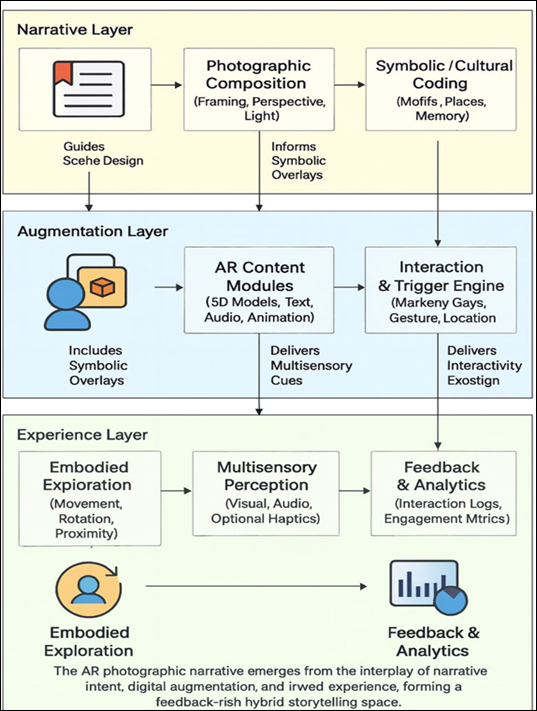
Figure 2
Workflow for AR Photographic Storytelling
Creation
Each photo is used as a canvas to
digital layertap of 3D objects, animation, ambient sound, or context texts that
improve the continuity of the story. These virtual components can be oriented
to physical coordinates through the recognition of objects and mapping the
scene to make the augmented layer reactive in respect to the viewer and their
movement. It is a form of a moving and living dialogue between the real and the
virtual produced through this spatial correspondence enabling the storytelling
to proceed in movement and perception. An important part of the framework is
multimodal fusion which combines visual, auditory and occasionally haptic
feedback to produce emotional and cognitive involvement Esser and Vliegenthart (2017). This practice is built on the theory of embodied
interaction, meaning of which is created with the help of sensual plunge and
bodily discovery. The gestures, gaze or voice input of the viewer becomes a
condition and the layers to the story are brought out or altered creating a
feedback-driven loop between the audience and the artwork. This interactivity
turns spectatorship into co-authorship, which is the viewer as a partner who is
active in determining the narrative results:
1) Narrative Layer: outlines the thematic content and
plotting that is incorporated in the photograph.
2) Augmentation Layer: realizes the visual and auditory
aspect in relation to the physical setting.
3) Experience Layer: reflects the interpretation,
movement, and emotional feeling of the user, which is returned into the logic
of adaptive stories implemented in the system.
Al the layers
depicted in diagram 2, are a continuum of physical image, digital augmentation,
and human perception becoming unified. This paradigm places AR not only as a
photographic additional feature, but as an aesthetic development of the space
of the narrative, as a part of visual art, technology, and phenomenological
experience.
4. Existing Design AR Design Technology
The scientific foundation of AR-based
photographic narrative is established based on a system of structures mainly
ARKit, ARCore, WebAR, and Unity-based toolchains, which allow spatial tracking,
surface recognition, and real-time production of graphic overlays. Practically,
the platform decision does not come down to pure technicality, but the platform
influences the manner in which a narrative can be performed, how it is made
available to the audience, and the degree to which the system can be made responsive
on the ground. ARKit and ARCore, as an example, provide powerful sensor fusion
and plane detection closely coupled with both iOS and Android systems, thus
being suitable in location-based photographic storytelling that is based on
consistent tracking and high-quality rendering. WebAR, in its turn, focuses
more on accessibility via the browser, and the lack of graphical richness in
favor of frictionless entrance, which is imperative in the case of intervention
in the public art and in the conditions of exhibitions, where some audience may
be unwilling to install the app. Unity is an orchestration platform, which
enables the artist researcher to create once and run in any of several AR
runtimes with custom shaders, particle systems, and interaction scripts
designed to fit photographic aesthetics.
Table 2
|
Table 2 AR Platforms for Photographic Storytelling |
||||
|
Platform / Stack |
Device Ecosystem |
Strengths for Photographic Storytelling |
Limitations |
Typical Use Case |
|
ARKit Wang and Zhu
(2022) |
iOS (iPhone, iPad) |
High-quality tracking, light estimation, smooth
integration with native camera and gallery |
Restricted to Apple devices |
Gallery-based AR photo essays, curated museum
experiences |
|
ARCore Boboc et al.
(2022) |
Android devices |
Broad device reach, robust plane detection,
integration with Google services |
Fragmented hardware quality, variable performance |
Urban AR street-photography narratives,
site-specific works |
|
WebAR (e.g., 8th Wall, WebXR) Gong et al.
(2022) |
Cross-platform browsers |
No app install, easy access via URL/QR, ideal for
public engagement |
Limited graphics performance, constrained access to
sensors |
Outdoor AR photo walks, quick exhibition
augmentations |
|
Unity + AR Foundation Daineko et al.
(2022) |
Multi-platform (iOS, Android, some XR headsets) |
Single project, multiple builds; advanced visual
effects, complex interaction logic |
Higher learning curve, longer build cycles |
Complex, multi-scene AR photo installations with
interactive story branching |
AR photographic storytelling design
methodology can thus be envisioned as being an iterative pipeline where
conceptual and photographic choices are made at the start of the design and the
end is interactive deployment and evaluation. It begins with the planning of
stories and images where narrative lines, visual patterns and space contexts
are established. These choices lead to directed image capture such as
consideration of parallax, depth indication and negative space that will
subsequently accommodate digital additions. During the stage of producing the
assets, 3D, textual overlays, soundscape, and subtle animations are produced or
obtained, with the stylistic unity of these elements with its underlying
photographs Daineko et al. (2023). The interaction design forms the second layer of the
approach that is critical. In this case, gesture, gaze and proximity stimuli
are stipulated to disclose narrative levels in a progressively graded manner
inviting to exploratory behaviour as opposed to one-time viewing. Prototyping
is based on on-device testing at a fast pace to create a refined interaction
threshold, realignment of the overlay and performance optimization according to
device and lighting conditions Hu et al. (2023).
5. Proposed Design Methodology for AR Photographic Storytelling Creation
The suggested design process offers a
well-organized, stage-by-stage platform, which incorporates artistic
creativity, spatial computing, and user experience design into a unity of AR
storytelling medium. It is structured around six consecutive, but repetitive
steps, which make sure that the narrative vision, as well as technological
implementation, develops simultaneously.
Step 1: Conceptualization and Figuring out of the story
This process starts with establishing
the thematic intent as well as the narrative structure of the photographic
narrative. At this point, the producer determines the emotional emphasis,
message and the required audience engagement. To visualize the way the story is
going to progress in augmented space, storyboards, and narrative flow diagrams
are created.
Figure 3

Figure 3 Process of Conceptualizing Narrative Structure and Planning Interactivity in AR Photographic Storytelling
The photos are given a narrative role
of either an entry point, transition, or an immersive anchor. Interactive
stimuli like gestures, gaze or distance are conceptually designed to determine
how the users would interact with the augmented layers. Such tools as Figma and
visual scripting block can help to move conceptual ideas into early prototypes.
At this stage, it is already known that the story is worth having aesthetic
value and interactive logic but not yet ready to be implemented technically.
Step 2: Photographic Data Capture and Contextual Data
Capture
Once conceptual planning has been done,
the next step is to capture the content of the photographic material and the
environmental metadata on which the AR experience will be based. DSLR or smart
phone cameras with depth sensors or LiDAR scanners are used to take the
high-resolution images which are needed to provide proper spatial referencing.
Figure 4
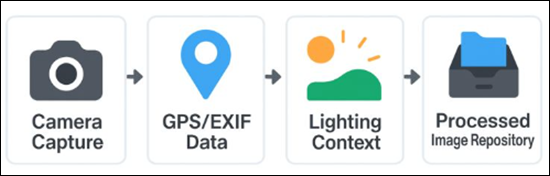
Figure 4
Workflow of
Photographic Capture Integrated with Contextual Metadata Acquisition for
Spatial Anchoring.
Coupled with the photographs, there are
a set of contextual information like GPS positions, brightness of the ambient
light, and metadata with regard to orientation. This context information is
used later to make accurate spatial registration of digital overlays. Tone,
contrast, and detail activation in the images are done using editing software
such as Adobe Photoshop or light rooms. The result of this process is a refined
visual dataset that could be augmented and also include environmental metadata
to be integrated with AR.
Step 3: AR Asset Development and
Integration
After the foundation photo material is
ready, the design stage progresses to the creation of digital additions to the
photos that now broaden the narrative abilities of the photographs. Here, the
visual narrative is supplemented with 3D models, as shown in Figure 5, animation, soundscapes as well as text layers. These
assets have been designed in accordance with the concept of narrative coherence
in which all digital pieces reinforce the original photograph and not distract
the viewer.
Figure 5
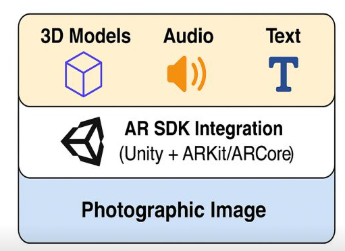
Figure 5 Integration of Digital Assets and
Interactive Overlays onto Photographic Layers for AR Storytelling
Artists create light and optimized
assets that can be rendered on mobile with the use of Blender, Maya, or
Cinema4D. These resources are then brought into Unity and connected up with
SDKs such as ARKit (iOS) or ARCore (Android), and comprise the augmented layer
that will dynamically engage with the real world photographic space. This is
where the intent of narrative is turned into spatial interactive experiences.
Those photographic and digital resources are put together in a 3D AR
representation in Unity whereby spatial orientation is realized via the SLAM
(Simultaneous Localization and Mapping) methods. The anchor in the real world
coordinates is performed by surface detection and plane tracking which puts the
anchor at the correct position in the real world.
Figure 6
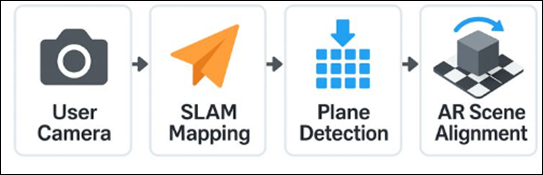
Figure 6
Scene Assembly
Process Showing Slam-Based Spatial Mapping and Real–Virtual Content Alignment
The camera angles, lighting, and motion
restrictions are predetermined by designers so that the illusion of being
immersed into the world is always constant. The interaction points of the
scene, including tap areas, motion triggers, audio hotspots, are included in
the scene, as illustrated in figure 6 the outcome of this step is the creation
of a functional AR environment, which physically and visually interacts with
the surrounding environment of the user and converts the still images into
spatial stories.
Step 5: User Interaction Design and
Testing
After assembling the scenes, the second
phase is to test and development of user interaction systems to create a system
of interaction that is intuitive and emotionally sensitive. Initial prototypes
are tested on various devices to test the tracking performance, responsiveness
and also usability. The participants will be monitored when engaging with the
AR material in order to determine the instances of disorientation, stimulation,
or aesthetic pleasure.
Figure 7
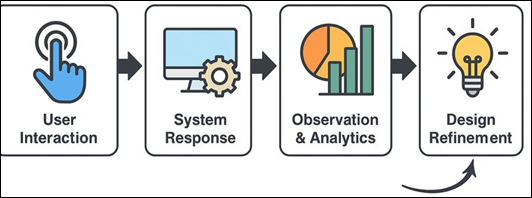
Figure 7
Iterative Loop
Representing User Testing, Data Collection, and Refinement of AR Interactions.
Quantitative data, dwell time and
trigger frequency is recorded and qualitative interviews are recorded in the
form of emotional responses and cognitive impressions. The feedback is applied,
which is symbolized by the number 7, to make the interaction design more
accurate, asset performance more productive, and the narration sequence more
understandable. This would be taken so that experience is immersive,
comfortable, and narratively consistent with diverse users and situations.
Step 6: Deployment, Evaluation, and
Iterative Refinement
The last process is the publication,
surveillance, and enhanced AR photographic experience. The final project will
be released on the platform of App Store, Google Play, or WebAR to access the
project via a browser. Embedded analytics makes a record of engagement
measures, interaction trends, and retention.
Figure 8
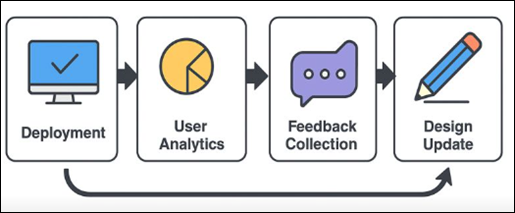
Figure 8 Continuous Evaluation and
Iterative Enhancement Cycle for Sustaining AR Photographic Storytelling
Experiences.
Surveys and observations done after
deployment provide information on the level of user satisfaction, interpretive
comprehension, and emotional richness. According to these findings, both the
artistic and technical side of the experience are optimized by the design team.
The updates can be done iteratively and can be in terms of better spatial
accuracy, better visual effects, or adaptive features that are driven by AI.
This is a cyclical process, which guarantees constant improvement of the story
telling structure and sustainability of the project in the long term as
demonstrated in Figure 8.
And last, the deployment and assessment
loop is closed, analytical modules know dwell time, hotspots interactions, and
navigation patterns and qualitative feedback is made to know the emotional
resonance and interpretive richness. The lessons of this stage are used to make
changes to the technology set up and narrative form, cementing a
research-through-design practice, in which artistic exploration and
methodological strictness are developed alongside each other. This cyclical
process is shown in Figure 4, which perceives the process of creating an AR
photographic storytelling through concept, design, implementation, and feedback
in a cyclical way.
6. Case Studies in Augmented Photographic Narratives
The real-life examples of the Augmented
Reality (AR) use in photographic storytelling show that this hybrid medium can
be used to go beyond traditional showing of images and can provide immersive,
participatory experiences. AR photography has been developed over the years
through a variety of contexts in the form of museum exhibitions, urban
interventions, in addition to personal archives as an expressive language of
spatial storytelling that marries artistic vision with computational
intelligence. In this section, we consider the exemplary case studies, which
exemplify the creative, technical, and experiential aspects of AR-based works
in photography.
Case Study-A] AR Photography
Exhibitions in Museums.
Museums are now serving as fertile
grounds to experiment with AR photography, a controlled and yet fascinating
setting where people are able to navigate through historical photographs and
digital overlay in the present day. As an example, an AR-enabled installation
could have archival images of a heritage facility alongside 3D recreations or
oral histories, which could be played as people wander through the
installation. Through the fusion of ARKit or Unity systems, curators will have
the ability to place holographic layers in space, restoring missing parts of an
architecture or showing time-lapse change of the place.
This and the visual understanding is
not just enhanced, but also creates mental empathy in the viewers who do not
simply watch the past, they enter its recreated atmosphere. Such installations
usually provide their audience analytics that reveal a statistically
significant increase in dwell time and emotional resonance scores, indicating
that AR improves the level of learning retention and aesthetic immersion.
Storytelling in the city and AR Street photography
City AR storytelling makes cities
living photographic galleries. Images on walls or computer screens are
transformed into geo-tagged narrative doors, which can be accessed by
smartphones by means of WebAR links or QR triggers. The city in itself stages out,
and in every photograph, a subtextual narrative is played out in the context of
place, time, and movement. As an example, an AR street photography experience
could enable people walking by to point their phones at an image of a long-gone
market and see an overlay in 3D, recreating the historical feel of it, with
background noises and soundbites of past traders. This site-specific narrative
design recaptures the memory of a city, bringing back photography to the
collective heritage as opposed to a lone record. The combination of
GPS-triggered overlays and photogrammetric assets suggest a more and more
narrative experience of walking, which equates to narrative advancement.
Case Study-B] Personal Memory
Narratives with the help of AR Portraiture
When it comes to personal narration, AR
portraiture can enable the viewer to save and reprocessing the memory in the
form of the interactive photographic layers. Personal photographs may be
enhanced with short video clips, voice records, or loops of animation to
recreate the emotional background with the help of such tools as ARCore and the
AR Foundation of Unity. We can use the example of a portrait that can show a
lively entry of the diary or a small secret message when a viewer comes to it.
These projects carry the ideas of the photograph as the mnemonic object to the
actual experience that combines the sense of the emotional memory and the
spatial interactivity. This form of AR storytelling is consistent with
post-phenomenological theories, in which digital media determines the
definition of human experience of memory, intimacy, and self-representation. In
order to bring together the lessons of these cases,
Table 3
|
Table 3 Summarizes the Comparative Features, Technologies, and Impacts Across these Case Studies Disussed Above |
||||
|
Case Study Context |
AR Platform / Tools |
Narrative Strategy |
Audience Interaction |
Key Impact |
|
Museum Exhibition |
ARKit + Unity |
Temporal layering, reconstruction of historical
imagery |
Spatial navigation through gallery |
Enhanced cultural immersion and interpretive
learning |
|
Urban Street Photography |
WebAR + GPS |
Geo-tagged storytelling and site-specific memory
reconstruction |
Walking-based discovery and location-triggered
activation |
Recontextualization of public space and collective
heritage |
|
Personal Memory Portraits |
ARCore + AR Foundation |
Emotional narrative layering with voice and
animation |
Gesture-based and proximity-triggered exploration |
Deepened affective connection and self-reflexive
storytelling |
The comparison shows that all three
contexts are based on embodied interaction, multisensory immersion, and
co-creative narrative design in spite of the fact that the technological
architectures vary. The institutional to personal variety of AR environments
depict the way in which photography may transform into a multidimensional
artifact to become a multidimensional ecosystem of storytelling that engages
viewers both emotionally and spatially.
7. Artistic and Cultural Implications
The fact that Augmented Reality (AR) is
integrated into the process of telling stories in photography promises to
introduce a radically new shift in the artistic and cultural paradigm of visual
expression. Combining the documentary accuracy of photography with the spatial
interactivity of AR, a new language is formed a language that questions the
concepts of authorship, time, and material space of the image. This part will
look into the artistic implications, cultural transformations as well as
ethical implication presented by this amalgamation of art and technology. AR
photographic storytelling at the artistic level reconstructs the process of
seeing. The customary photography seals a scene in a lifeless composition by
fixating the eye of the viewer on one point of view. AR destroys that fixity
and makes the viewer enter the frame to navigate in the narrative space. The
artwork is transformed into an interactive system which reacts to gesture,
closeness, and interest and it changes with each encounter. Such a spatial
immersion reestablishes a sense of agency towards the audience making
spectators co-producers of meaning. The artist thus moves out of being an
individual author, into being a narrative architect, coordinating temporal and
sensual experiences, which emerge during embodied movement of the viewer.
Figure 9
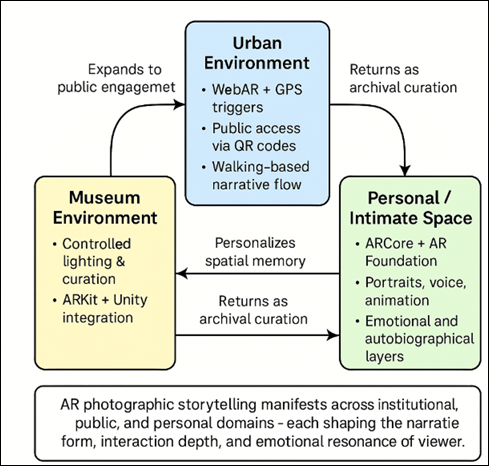
Figure 9 Audience Experience Comparison between Traditional and AR
Storytelling
In order to systematize the capture of
these transitions, Figure 9 describes the artistic changes that happen when photography
shifts to an AR-based mode of narrative. The aesthetic ontology of the
photograph is also changed as a result of the transformation. The image in
AR-based works is not just the depiction of the reality but a time interface in
which the digital and physical layers exist at the same time. This way, the
photograph is no longer tied down by its fixed position of a visual record but
rather it becomes a performative space a stage of storytelling that is changed
by being engaged in. It is similar to the postmodern idea of the open artwork
of Umberto Eco, where the interpretation and participation are finished parts
of the artistic process. In these regards, AR photography is more than
depiction, but authorship experienced, as time, space and affect are all merged
in one creative process. AR photographic storytelling removes the lines between
memory, heritage, and lived experience culturally. It brings archives back to
life in the museums where historical photographs can communicate with the real
space. It serialises the narrative in urban spaces by incorporating the local
stories into the common surroundings. At a more personal level, it converts
personal snapshots into the interactive memory capes.
8. Conclusion
The study of Augmented Reality (AR) in
photographic storytelling brings forth a paradigm change in the way the
narrative is being conceived, experienced, and remembered. Combining the
elements of photographic realism and interactive space arrangement, the AR
turns the picture into an interface of a living story, re-constructing the
borders between the viewer, the creator, and the surrounding world. The
photograph that used to serve as a static time-note turns into a multisensory
field which can change in accordance to the presence and engagement of the
viewer. Artistically, the AR storytelling places the photographer in the role
of a building designer, mixing aesthetics, movement, and visually engaging
experiences into unified experiences. With this reconfiguring, the passive
viewing act is disbanded and co-creation is established in which the audience
directs, interprets and has an emotional contribution in the narrative being
played out. Not only does such participatory storytelling renew photographic art
but it also makes it consistent with current theories of embodied perception
and experiential authorship. The implications are culturally far reaching. AR
photography makes art more accessible through entrenching visual stories in
museums, on the streets, and in personal space and transforms ordinary spaces
into platforms of memory and imagination. The medium forms the gap between
historical archives and the present culture, inviting people to recollect
together and engage in intercultural communication. However, such authority is
accompanied by a sense of responsibility that maintains ethical integrity,
transparency of data and cultural authenticity in the process of augmenting and
communicating stories. Various technological and design issues continue to exist
including variability with devices and privacy issues but more recently
emerging technologies like AI adaptivity, accessing WebAR, and blockchain
provenance are progressively conquering these obstacles.
CONFLICT OF INTERESTS
None.
ACKNOWLEDGMENTS
None.
REFERENCES
Aliprantis, J., and Caridakis, G. (2019). A Survey of Augmented Reality Applications in Cultural Heritage. International Journal of Computer Methods in Heritage Science, 3, 118–147.
Boboc, R. G., Băutu, E., Gîrbacia, F., Popovici, N., and Popovici, D. M. (2022). Augmented Reality in Cultural Heritage: An Overview of the Last Decade of Applications. Applied Sciences, 12, 9859. https://doi.org/10.3390/app12199859
Chatzopoulos, D., Bermejo, C., Huang, Z., and Hui, P. (2017). Mobile Augmented Reality Survey: From Where We Are to Where We Go. IEEE Access, 5, 6917–6950. https://doi.org/10.1109/ACCESS.2017.2695032
Daineko, Y., Alipova, B., Ipalakova, M., Bolatov, Z., and Tsoy, D. (2023). Angioplasty Surgery Simulator Development: Kazakhstani Experience. In Extended Reality. Lecture Notes in Computer Science, 14219, 466–473. https://doi.org/10.1007/978-3-031-42142-6_42
Daineko, Y., Tsoy, D., Seitnur, A., and Ipalakova, M. (2022). Development of a Mobile E-Learning Platform on Physics Using Augmented Reality Technology. International Journal of Interactive Mobile Technologies (IJIM), 16, 4–18. https://doi.org/10.3991/ijim.v16i03.31317
Dd Goh, E. S., Sunar, M. S., and Ismail, A. W. (2019). 3D Object Manipulation Techniques in Handheld Mobile Augmented Reality Interface: A Review. IEEE Access, 7, 40581–40601. https://doi.org/10.1109/ACCESS.2019.2908593
Esser, F., and Vliegenthart, R. (2017). Comparative Research Methods. In The International Encyclopedia of Communication Research Methods, 1–22. Hoboken, NJ, USA: Wiley. https://doi.org/10.1002/9781118901731.iecrm0011
Figueiras, A. R. d. P. (2016). How to Tell Stories Using Visualization: Strategies Towards Narrative Visualization (Ph.D. dissertation). Universidade Nova de Lisboa, Lisbon, Portugal. https://run.unl.pt/handle/10362/20778
Galatis, P., Gavalas, D., Kasapakis, V., Pantziou, G. E., and Zaroliagis, C. D. (2016). Mobile Augmented Reality Guides in Cultural Heritage. In Proceedings of the 8th EAI International Conference on Mobile Computing, Applications, and Services (MobiCASE’16), 11–19, Cambridge, U.K. https://doi.org/10.4108/eai.30-11-2016.2260035
Gong, Z., Wang, R., and Xia, G. (2022). Augmented Reality (AR) as a Tool for Engaging Museum Experience: A Case Study on Chinese Art Pieces. Digital, 2, 33–45. https://doi.org/10.3390/digital2020003
Hu, W., Han, H., Wang, G., Peng, T., and Yang, Z. (2023). Interactive Design and Implementation of a Digital Museum Under the Background of AR and Blockchain Technology. Applied Sciences, 13, 4714. https://doi.org/10.3390/app13114714
Lee, B., Riche, N. H., Isenberg, P., and Carpendale, S. (2015). More Than Telling a Story: Transforming Data Into Visually Shared Stories. IEEE Computer Graphics and Applications, 35, 84–90. https://doi.org/10.1109/MCG.2015.18
Liestøl, G. (2019). Augmented Reality Storytelling Narrative Design and Reconstruction of a Historical Event in Situ. International Journal of Interactive Mobile Technologies (IJIM), 13, 196. https://doi.org/10.3991/ijim.v13i12.10743
Panou, C., Ragia, L., Dimelli, D., and Mania, K. (2018). An Architecture for Mobile Outdoors Augmented Reality for Cultural Heritage. ISPRS International Journal of Geo-Information, 7, 463. https://doi.org/10.3390/ijgi7120463
Russo, M. (2021). AR in the Architecture Domain: State of the Art. Applied Sciences, 11, 6800. https://doi.org/10.3390/app11206800
Ryan, M.-L. (2015). Emotional and Strategic Conceptions of Space in Digital Narratives. In H. Koenitz, G. Ferri, M. Haahr, D. Sezen, and T. İ. Sezen (Eds.), Interactive Digital Narrative History, Theory and Practice, 106–120. New York, NY, USA; London, U.K.: Taylor and Francis. https://doi.org/10.4324/9781315683328
Tejedor-Calvo, S., Romero-Rodríguez, L. M., Moncada-Moncada, A.-J., and Alencar-Dornelles, M. (2020). Journalism That Tells the Future: Possibilities and Journalistic Scenarios for Augmented Reality. Profesional de la Información, 29, 6. https://doi.org/10.3145/epi.2020.nov.06
Tong, C., Roberts, R., Borgo, R., Walton, S., Laramee, R., Wegba, K., Lu, A., Wang, Y., Qu, H., and Luo, Q. (2018). Storytelling and Visualization: An Extended Survey. Information, 9, 65. https://doi.org/10.3390/info9030065
Wang, C., and Zhu, Y. (2022). A Survey of Museum Applied Research Based on Mobile Augmented Reality. Computational Intelligence and Neuroscience, 2022, 2926241. https://doi.org/10.1155/2022/2926241
|
|
 This work is licensed under a: Creative Commons Attribution 4.0 International License
© ShodhKosh 2025. All Rights Reserved.