ShodhKosh: Journal of Visual and Performing ArtsISSN (Online): 2582-7472
|
|
Management of Intellectual Property in AI-Generated Artworks
Dr. Tripti Sharma 1
 ,
Dr. J Jabez 2
,
Dr. J Jabez 2 ,
Dr. Varsha Agarwal 3
,
Dr. Varsha Agarwal 3
 ,
Ankit Sachdeva 4
,
Ankit Sachdeva 4 , Velvizhi K 5
 , Ashmeet Kaur 6
1 Professor,
Department of Computer Science and Engineering (Cyber Security), Noida
Institute of Engineering and Technology, Greater Noida, Uttar Pradesh, India
2 Professor,
Department of Computer Science and Engineering, Sathyabama Institute of Science
and Technology, Chennai, Tamil Nadu, India
3 Associate Professor, ISME - School of Management and Entrepreneurship,
ATLAS SkillTech University, Mumbai, Maharashtra,
India
4 Centre of Research Impact and Outcome, Chitkara University, Rajpura- 140417, Punjab, India
5 Assistant
Professor, Department of Management, Aarupadai Veedu
Institute of Technology, Vinayaka Mission’s Research Foundation (DU), Tamil Nadu,
India
6 Chitkara Centre for Research and Development, Chitkara University,
Himachal Pradesh, Solan, 174103, India
|
|
|
ABSTRACT |
|
|
The recent
rapid evolution of AI-generated artworks has provoked the essence of
creativity and raised challenging questions concerning the manner
in which intellectual property (IP) is understood, obtained, and
implemented under the circumstances of the human-machines cooperation. The
paper shall discuss the evolving character of authorship, ownership, and
creative input concerning the generative AI systems
and how the traditional mechanisms of copyright occasionally fail to work in
favor as far as the algorithmically generated material is concerned. The
questions of ambiguity in relation to human intervention in prompt-based
generation, the obscurity of the position of training data on the generation
products, and the impossibility to make a distinction between the concepts of
inspiration, derivation, and infringement on machine-generated forms are the
key ones. These concerns are compounded by ethical concerns particularly
where there is no consent in the dataset on the use of copyrighted content or
culturally sensitive content. In the paper, the new risk-reduction
strategies, including the transparency of datasets, provenance records,
watermarking systems, and hybrid licensing systems that apportion
rights by the layers of contributor of builders, users, and platforms, are
addressed. The paper will outline the legal, ethical, and technical
considerations of the issue by saying that sustainable AI art IP management
should be based on the multi-disciplinary approach that would guarantee the innovation and equitability, as well as maintain
cultural respect and safeguard the inventors. The findings indicate that
there is a need to have single global standards, consentual
data regulations and future-oriented legal definitions that are befitting to
capture the fact of the human-AI co-creation.
Together, these solutions would offer a path to an IP framework that would
assist in supporting the expanding creative frontier that is being
established by AI technologies. |
|||
|
Received 25 January 2025 Accepted 15 April 2025 Published 16 December 2025 Corresponding Author Dr.
Tripti Sharma, tripti.sharma@niet.co.in DOI 10.29121/shodhkosh.v6.i2s.2025.6742 Funding: This research
received no specific grant from any funding agency in the public, commercial,
or not-for-profit sectors. Copyright: © 2025 The
Author(s). This work is licensed under a Creative Commons
Attribution 4.0 International License. With the
license CC-BY, authors retain the copyright, allowing anyone to download,
reuse, re-print, modify, distribute, and/or copy their contribution. The work
must be properly attributed to its author.
|
|||
|
Keywords: AI-Generated Art, Copyright Law, Authorship, Data
Ethics, Dataset Governance, Licensing Frameworks, Provenance Tracking,
Platform Policy |
|||



1. INTRODUCTION
Algorithms
that can be used to generate paintings, music, animations and even intricate
multimodal compositions now effectively stand next to human artists such as unwearying apprentices with flawless memory and
unpredictable sophistication Picht (2023). With the
artists, technologists and cultural institutions experimenting with these new
creative alliances, questions of intellectual property (IP) become a background
as shadows before a new light. Is it possible to say that creativity can be
linked to something which lacks consciousness? What are the duties after the
imagination of a machine is influenced by millions of human-made work? These are the questions that the current discussion of
the world revolves around, so IP management becomes one of the most pressing
issues in the age of creativity with the help of AI Garg (2023). The growth of
generative models has erased classic lines of authorship and originality.
Although previous digital solutions were used as brushes or lenses controlled
entirely by human will, the modern AI systems, particularly those based on deep
learning, can provide semi-autonomous creative capabilities. They recombine,
restructured and rethink the information based on the mass training corpora.
This renders the resultant production familiar and new as a mosaic made out of
pieces of forgotten galleries. This quality, however, makes it harder to
legalize creative contribution, in which the past has depended on human
intellect and self-expression William et al. (2023). The
protection of AI-generated content in many jurisdictions continues to be in a
legal grey area whereby the author is not a human being
and the enforceability of any copyright is undermined.
Figure 1
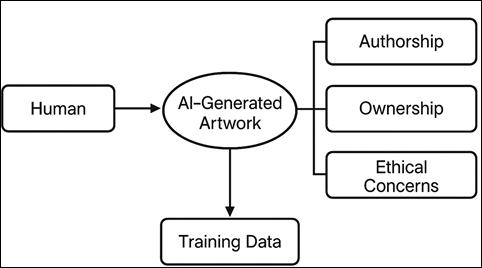
Figure 1 Human–AI IP Interaction Block Diagram Model
Combined
with legal doubts, there are ethical and practical issues that arise due to the
training of the AI systems. The datasets used to train models are frequently
scraped off the internet, which contains copyrighted artworks the creators of
which may never have given their permission to such use. It poses a conflict of
innovation and decency, with critics citing that AI systems are enjoying the
work of many artists and do not even give them credit Solbrekk (2021). In the
meantime, licenses of platform-specific terms of use, which lie between a free
open-source license and a prohibitive commercial contract, provide an
additional complexity to the matter and define the opportunities available to
users in utilizing and monetizing AI-generated content as illustrated in Figure 1. With the
growing utilization of generative AI in industries, IP management proves to be
very important in protecting creative ecosystems. Artists would like to be sure
that their work is not going to be watered down, copied, and used. Developers
need to find an answer to the question of liability. It is not easy for the
policymakers to develop innovative policies and at the same time be fair. These
conflicts of interest ensure that the issue of IP management in AI generated
art becomes a complex multi-disciplinary question that involves the
understanding of law, ethical considerations and technological knowledge Ghanghash (2022).
The
study examines the concept of the intellectual property being handled
responsibly in the time of machine-creativity. It aims to map the changing
landscape of human expression at the crossroads of algorithmic production, as
well as providing the roads to enable harmonized, prospective policy-making by analyzing the
controversies of legal frameworks, authorship, and ethics, and for new
technological solutions.
2. Conceptual and Legal Foundations
The
intellectual property of art created with AI technologies is based on a set of
fundamental ideas under which societies have conventionally organized the
definition of creativity, ownership and protection. With algorithmic creation
these pillars are calligraphy which is the same as old maps being drawn on the
new continents, the boundaries still display De Rassenfosse et al. (2023), yet the land
underneath those boundaries have changed. These are just some of the basic
principles that one has to know before investigating more intricate issues of
ownership and enforcement. The very core of the debate is the notion of
authorship, which traditionally needed human mind to create the creativity of a
piece. Most jurisdictions have made copyright doctrines based
on the fact that originality is the result of human intellectual
activity, a jolt of willfulness worked into the
ultimate product Aziz (2023). This is made
more difficult by the fact that AI systems tend to be the source of outputs
that are produced by statistical forecasting instead of by the conscious
artistic eye. Although users can create prompts or control the process of
iteration, the inner decisions made by the model are opaque, produced with the
help of layers of learned patterns Israhandi (2023). This
generates a conflict between the human hand pushing the system and the logic of
the machine doing the work, and the lawmakers have to discuss the extent to
which the human input suffices to offer protection to an artwork.
Figure 2
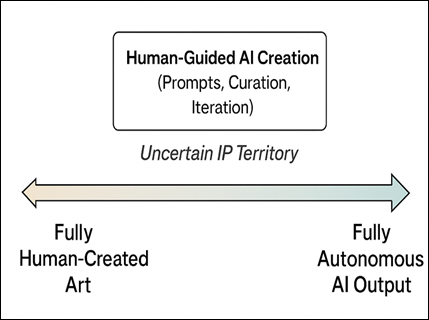
Figure 2
Human–AI Creative
Contribution Spectrum
Originality
is the second pillar which has conventionally been perceived as an
independently constructed work that exhibits low creative flair. Millions of
existing works are also fed into AI systems, and the model internalizes the
pattern as opposed to copying it Weisenberger and Edmunds (2023). However, this
distinction between inspiration and derivation is unclear when the machine is
an opaque process of learning. Courts have started to think that the
AI-generated outputs can possibly ever be meaningfully original when they are
produced in the shadow of so many hidden influences. With the changing nature
of the discussion, originality might require a redefined sense to consider the
computational creativity without the unwarranted extraction of the already
established artworks as illustrated in Figure 2.
Its
legal basis is the legal status of the AI-generated outputs. Non-human authors
are not considered as such and such works are
copyrightable in numerous countries at present. In certain jurisdictions, a
human in the loop may claim rights when his part has been creative enough,
whilst in others they may not allow claims at all when the machine has done the
expressive work Famiglietti and Ellerbach
(2023). This
disjointed international strategy makes the task of artists and businesses,
particularly the ones that operate internationally, uncertain. The legal
discussion becomes further when we look at the place of training data, which
exists in the nexus of copyright, fair use, and database rights. The question
of whether training on copyrighted content qualifies as infringement is
debatable and lawsuits as well as regulation proposals continue to seek to
define the boundaries. Others propose that training is non-expressive and
transformative and others perceive it as an unlicensed exploitation of cultural
labor.
3. Authorship, Ownership, and Creative Contribution
Whether
an AI-generated artwork can be regarded as the author of the given work is the
central matter of the intellectual property issue, creating one of the most
complicated knots in the field. Conventional authorship presupposes a human
mind, which defines the expressive decisions, a creative spark that leads the
work between the will and the end design Ning (2023). In the
AI-mediated creation, however, this spark is diffused over human instructions,
algorithmic processes and large-scale statistical inference. When a human being
enters some prompts, refines outputs, adjusts parameters, or culls variations,
his or her hand is like a constant hand on the rudder of a vessel being driven
by an unknown engine. The creative input exists, though it is not consistently
preeminent, and laws differ greatly in the extent to which human intervention
is needed before authorship is achievable. Certain jurisdictions would require
physical control of expressive elements based on data provided in Table 1, whereas, in
other jurisdictions, a conceptual direction or high-level decision making is
deemed adequate and the boundary between authorship and facilitation is
constantly shifting Bisoyi (2022).
Table 1
|
Table 1 Comparative Analysis of
Licensing Approaches |
||||
|
License Type |
Restrictiveness Level |
User Rights |
Limitations |
Typical Use Case |
|
MIT License |
Very Low |
Full reuse and modification |
No content protection |
Open-source research |
|
Apache 2.0 |
Low |
Broad use + patent grant |
Attribution required |
Academic/industrial models |
|
CC-BY |
Medium |
Reuse with attribution |
No control of derivatives |
Creative content sharing |
|
Proprietary A |
High |
Limited output rights |
Usage restrictions |
AI art platforms |
|
Proprietary B |
Very High |
Restricted commercial use |
Strict platform control |
Corporate AI systems |
The
situation of ownership is also problematic. Under the traditional copyright
models, ownership is a natural progression of authorship, whereas with AI
systems the rights chain extends further to include: the model developers, the
dataset curators, the platform providers and the final-users
who create the artwork. All these participants do not play the same role in the
end result. The architecture and training rules are designed by developers, the
training data are collected and organized by the curators, and the prompts
through which the generative engine operates are designed by the users. Who
owns the output is thus less of a question of determining who the one creator
is, and more one of comprehending the ways of joining different types of
creative work together. Other platform terms of service endeavor
to address this by assigning rights to the user on generation, whereas some
retain partial or complete rights to the outputs. This contractual layer
frequently takes the role of default authority on ownership, particularly in a
jurisdiction where AI-generated work is not considered a piece of copyrightable
content Vig (2022).
The
idea of creative contribution makes the situation even more complicated. In art
created by man, creativity is regarded not as in the final product itself but
in the decisions, revisions and interpretations that lead to the development of
the product. The value added by the user can be the richness and richness of
the prompt, or the curative loop that filters and narrows down the outputs.
Although the role of the AI is mechanical, it can include the creation of
expressive details, which the user was not necessarily imagining. This creates
some very critical questions: Is creativity calculated by intention, by process
or by aesthetic result? Is the autonomous generation behaviour of the model to
be regarded as part of creative equation, although it is not conscious? And in
case such a model accesses stylistic patterns of a vast array of human works in
training data, what about the invisible community of creators whose work passes
through the algorithm?
4. Training Data, Ethical Use, and Licensing Issues
The
basis of AI-made art has been constructed on the foundations of vast pools of
training data and this implicit substrate influences
the aesthetic behaviors of the generative models as
well as the ethical and legal controversies that have emerged around them.
Table 2
|
Table 2 Ethical Risk Matrix for AI
Training Data |
||||
|
Dataset Type |
Ethical Risk Level |
Legal Risk Level |
Primary Concern |
Example Cases |
|
Copyrighted Artwork |
High |
High |
Unauthorized scraping |
Illustrator lawsuits |
|
Cultural Heritage Data |
High |
Medium |
Misappropriation and
distortion |
Tribal motif misuse |
|
Sensitive Imagery |
Very High |
Very High |
Privacy & harm |
Faces, medical images |
|
Public Domain Data |
Low |
Low |
Minimal risk |
Historical archives |
|
Licensed Databases |
Low |
Medium |
Contractual compliance |
Commercial datasets |
Training
datasets can also be viewed as enormous libraries that are uncated
and in which images, paintings, cultural trends, and stylistic items can freely
linger. Although these datasets can be used to train AI systems to learn rich
visual structures, they are often built by mass scraping online material, most
of which is legally regulated, culturally sensitive, or created without its
presence in a machine-based learning pipeline as in data provided in Table 2. This brings a
major question, does a model have the right to learn morally or legally, of
works in which it has no right to do so? The positive viewpoint on training
tends to emphasize that it is a process of non-expressive, transformative
activity that resembles a student learning about art history, whereas many
critics view it as an industrial-level exploitation of creative work without
any attribution, consent or payment. Consequently, the dataset turns out as the
source of creativity as well as the contention of ethical controversy. Ethics
of training data go into the realms of culture as well. Indigenous motifs,
sacred symbols or traditional designs that are not owned by an individual can
be inadvertently captured by the AI systems and used across the board. When
such trends are revealed in the outputs of AI, they run a risk of becoming
unattached to the cultural identities that make them relevant and heritage
becomes a raw material to be remixed by algorithms.
Figure 3
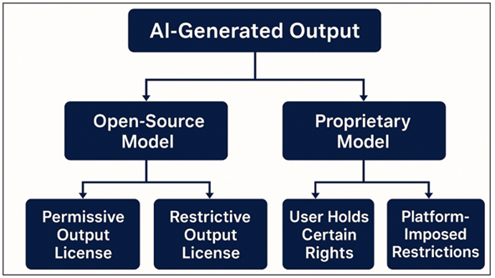
Figure 3
AI Training Data
Ethical Risk Map
Another
factor that adds to the complexity is the problem of licensing, which specifies
a manner of how users can interact legally with the AI-generated outputs.
Various models have different licensing regimes and the terms can determine
whether a work of art can be commercialized or repackaged as in Figure 3, revamped,
re-used or incorporated into other creative works. Open
source models often come with wide ranging freedoms,
but are sometimes accompanied by terms of use which limit their harmful
or deceptive use. Proprietary models on the other hand depend on platform
specifications that determine ownership, use limitations and content
limitations. Other sites allow creators to enjoy complete commercial rights to
work, whereas others demand joint ownership, or take downstream restrictions.
Since most jurisdictions do not secure AI-generated works under copyright, such
licenses can serve as an alternative legal framework, serving the role of
scaffolding that supports an incomplete legal framework until the final legal
framework can be developed.
5. IP Enforcement, Risk Management, and Emerging Solutions
Intellectual
property rights in the AI-generated artworks are one of the most complicated
frontiers in the modern creative governance. Classical enforcement is based on
the idea of detecting copying or unlicensed derivatives, but it is challenging
with the products of AI generation since they are not necessarily duplications
but can represent statistical copies. In a case where a model is creating a
piece of art that has a similarity to a safeguarded style or motif, the
similarity can be diffuse, by chance, or a result of training patterns and not
an intentional imitation. With this, enforcement will be like trying to chase a
shadow which does not exactly come into a standstill. The holders of rights
have challenges in proving substantial embodiment or showing that there is
guarded articulation in the output of the model. In the meantime, platforms
have a hard time formulating policies which would allow freedom of users and
stop the exploitation of current artists. In the absence of common standards,
enforcement turns piecemeal, moving away into courtroom combat, to
platform-specific rules which can be highly uneven in their degree of fairness
and transparency.
Figure 4

Figure 4
AI Art IP
Enforcement Lifecycle
Risk
management is becoming a major aspect as inventors
companies and organizations are trying to cross this grey terrain. Artists have
concerns about their work being consumed into datasets without their permission
such as in an unwanted distortionary stylistic parody. Those companies which
employ AI technology are concerned about how they may accidentally upload
unauthorized content which will be used to bring forward a claim of copyright
infringement, reputational harm or breach of contract. In order to reduce these
risks, new forms of best practice, focus on documentation and transparency.
Other organizations also have internal IP compliance policies, consider as high risk assets, or users verify the sources of sensitive
material. Such measures are like navigators who are distorting in uncertain
waters that provide a structure and predictability despite lawful shoreline
being far away as shown in Figure 4. There is also
the development of new technical and regulatory approaches for responsibility
and enforcement in the field. Generative models are being introduced with
watermarking technology that can be used to add identifiers to output through
invisible and cryptography marks. Registries based on blockchain also assist in
provenance as they give an immutable time and ownership record, which can be
especially handy in the context of claiming rights in a jurisdiction where
copyright laws are ambiguous. At the regulatory level, policymakers are
deliberating on frameworks concerning the transparency on training-data,
disclosure of output and liability on the part of the developers. Among the
proposals are compulsory labeling the datasets,
opt-out of artists, and standard notices about the extent of human
participation in a created work.
6. Interpretation and Analysis
The
results of the study demonstrate that there is a creative ecosystem in flux,
with the old intellectual property structures being overloaded with the burden
of new generative technologies. In every part, the results are drawn to the
same central conclusion: AI-generated art does not fit in any of the existing
legal or ethical categories since it disperses the creative workforce across
human beings, machines, data, and technologies. This distribution creates a
topography in which authorship is diffusive, ownership is negotiated and not presupposed and creativity itself extends beyond its human
resources. The discussion highlights that the capabilities that render AI art
so potent, namely, its ability to acquire patterns, recycle styles, and create
new expressions, are the same ones that lead to the development of the
fundamental conflicts regarding accountability, fairness, and protection.
Figure 5
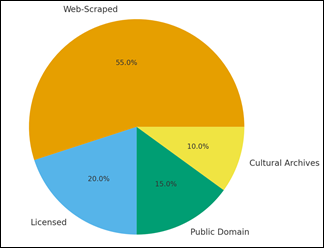
Figure 5 Proportions of Major Dataset Sources Used for
Training AI Art Generation Models
In
the Training Data Source Composition chart, it can be noted that web-scraped
content is the most significant contributor since it represents over fifty
percent of the data driving generative models as shown in Figure 5. Licensed and
open-source contents compose 35 percent of the total with culturally sensitive
archives occupying the least percentage. This imbalance raises important
ethical and legal issues because the usage of scraped content often does not
have explicit permission of original creators.
An
important consequence of this work is the fact that norms of authorship do not
readily project onto the creation mediated by machines any
more. The spectrum model that was created in the study demonstrates that
AI artworks exist on a continuum and they do not separate into a binary
opposition between "human-created" and "machine-generated."
The majority of creative outputs are in the gray
area, whereby the human will influence the generative process, but not entirely
control it. The implications of this shift to policymakers include the need to
re-evaluate the basis of copyright on human creativity or the need to recognize
the contribution of human hybridity in this case.
Figure 6
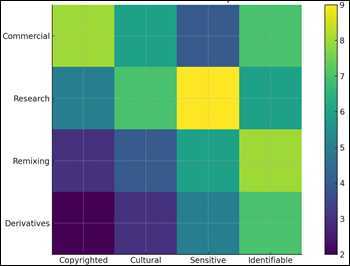
Figure 6 Heatmap Illustrating Ethical and Legal Risk Intensity Across
Dataset Types and Usage
Contexts.
The
Ethical Risk Heatmap offers a relative perspective of possible risks based on
the type of data set and its usage in the context of various applications. The
datasets with sensitive and identifiable-image pose
the highest risk scores, particularly when they are engaged in the research or
in the creation of derivatives. There are also increased dangers in commercial
and derivative uses in copyrighted and cultural content. This trend shows that
risk is not homogeneous, it is greater based on the nature of the data as well
as the purpose of its utilization. The outcome analysis further indicates that
the ethical and legal section of the AI creativity line is the training data as
shown in Figure 6. The study
indicates that models that have been trained using large datasets (unconsented)
create unanswered questions regarding impartiality, cultural sensitivity, and
economic equality. Artists whose artworks are used to train corpora in some way or another feel a sense of deprivation when AI systems
emulate stylistic elements that belong to their own or cultural identities.
This supports the necessity of greater mechanisms of transparency,
consent-based data curation and community sensitive data governance. New
technologies such as opt-out registries, dataset labeling
and culturally sensitive training practices provide promising avenues, although
they are not uniformly used as an industry practice.
Figure 7
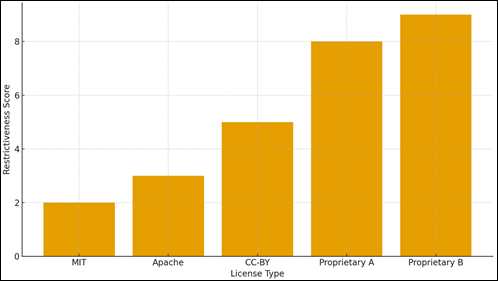
Figure 7 Comparative Restrictiveness Levels Among Open-Source and Proprietary AI
Model Licenses
The
index of the restrictiveness of the licensing has an evident gradient between
open-source licenses that have minimal restrictiveness and proprietary ones
that impose more severe restrictions on the use of output. Conversely,
proprietary structures are more restrictive, which is indicative of the
apprehensions of abuse, commercial ownership, and brand reputation. This
comparison demonstrates the significant difference in model accessibility and
user rights between the types of licensing, which will determine the
possibility to distribute AI-generated artworks and commercialize them as shown
in Figure 7. The analysis
of licensing and enforcement shows another complexity level: due to the lack of
the traditional copyright protection of the AI-generated results, the contracts
and platform licensing models have become informal IP regimes. This dominance on
a contractual basis provokes the issues of asymmetry of power where big
technological platforms possess rights, establish limits of use and determine
the terms which can dominate over the old rules of IP. The lifecycle as well as
the risk-management diagrams created in this study assist in demonstrating how
enforcement is being transferred out of the system of public law to the system
of a platform-controlled enforcement. Although these platform protocols give
short-term transparency, they could also have a negative effect on the
disintegration of global creative standards, as well as on the long-term
independence of users of their own works.
7. Conclusion and Future Directions
The
high pace of development of AI-generated works has put intellectual property
arguments in a different field of operation, exposing an apparent
incompatibility between the classic legal principles and the ambivalent
character of human-AI creativity. Generative models pose a threat to authorship
by doing what expressive tasks used to be carried out by humans. The ownership
is disputed between developers, dataset curators, platforms, and end-users who
all play a part in the creative chain. Ethical concerns are raised from the
murky practice of training data and raise concerns of consent, cultural
integrity, and the unacknowledged influence of human artists whose creations
are used to train algorithms. Simultaneously, it becomes difficult to enforce
as the courts are dealing with the issue of copying on the basis of algorithms
and not direct copying. These tensions are signs not of the failure of IP
governance, but transition. Such new solutions as watermarking, blockchain
provenance, dataset transparency, hybrid licensing schemes and platform-level
policies are promising. They still are in their developing stage, but they
present a framework on which the creativity of machines can be harmonized with
fair and responsible rights management. They also point out that in order to
deal with the IP in AI art, it is necessary to collaborate in law, technology
and culture and in creative practice.
In
the future, there are priorities that is necessary. It is necessary that the
policymakers define the legality of the outputs created with the use of AI and
redefine the concept of originality and authorship to match the modern ways of
creating. Transparent data governance which is agreeable to both the parties
should be the norm. The technical research should continue in the development
of provenance tracking tools that can be trusted. The players in the industry
may be required to adopt dynamic licensing frameworks that have a stronger
expression of joint creative contribution. The coordination will also be
required internationally to avoid a piecemeal regulation and protect uniformly
across the borders.
CONFLICT OF INTERESTS
None.
ACKNOWLEDGMENTS
None.
REFERENCES
Aziz, A. (2023). Artificial Intelligence Produced Original Work: A New Approach to Copyright Protection and Ownership. European Journal of Artificial Intelligence & Machine Learning, 2(2), 9–16.
Bisoyi, A. (2022). Ownership, Liability, Patentability, and Creativity Issues in Artificial Intelligence. Information Security Journal: A Global Perspective, 31(4), 377–386. https://doi.org/10.1080/19393555.2022.2060879
Famiglietti, P., and Ellerbach, C. L. (2023). Protecting Brands in the Age of AI. Lexology.
De Rassenfosse,
G., Jaffe, A. B., and Wasserman, M. F. (2023). AI-Generated Inventions:
Implications for the Patent System. Southern
California Law Review, 96, 101–126.
Garg, A. (2023). IPR Issues Concerning Artificial
Intelligence – Patent – India. IPR Issues Concerning Artificial
Intelligence – Patent – India.
Ghanghash, S. (2022). Intellectual
Property Rights in the Era of Artificial Intelligence: A study Reflecting Challenges in India
and International Perspective. International Journal of Multidisciplinary
Journal of Educational Research,
11(6), 72–80.
Israhandi, E. I. (2023). The Impact of Developments in Artificial
Intelligence on Copyright and Other Intellectual Property Laws.
Journal of Law and Sustainability Development,
11(11), e1965.
Ning, H. (2023). Is it Fair? Is it Competitive? Is it Human? Artificial Intelligence and the Extent to Which We can Patent AI-Assisted Inventions. Journal of Legislation, 49(2), 421–448.
Picht, P. G. (2023). AI and IP: Theory to Policy and Back Again – Policy and Research Recommendations at the Intersection of Artificial Intelligence and Intellectual Property. IIC – International Review of Intellectual Property and Competition Law, 52, 916–940. https://doi.org/10.1007/s40319-023-01344-5
Solbrekk, K. F. (2021). Three Routes to Protecting AI Systems and Their Algorithms Under IP Law: The Good, the Bad and the Ugly. Journal of Intellectual Property Law and Practice, 16(3), 247–258. https://doi.org/10.1093/jiplp/jpab033
Vig, S. (2022). Intellectual Property Rights and the Metaverse: An Indian Perspective. The Journal of World Intellectual Property, 25(3), 753–766.
Weisenberger, T., and Edmunds, N. (2023). Copyright and AI-Generated Content: Establishing Scope Requires More Than Registration. Lexology.
William, P., Agrawal, A., Rawat, N., Shrivastava, A., Srivastava, A. P., and Ashish. (2023). Enterprise Human Resource Management Model by Artificial Intelligence Digital Technology. In Proceedings of the 2023 4th International Conference on Computation, Automation and Knowledge Management (ICCAKM). IEEE, 1–6 https://doi.org/10.1109/ICCAKM58659.2023.10449624
William, P., Bani Ahmad, A. Y., Deepak, A., Gupta, R., Bajaj, K. K., and Deshmukh, R. (2023). Sustainable Implementation of Artificial Intelligence-Based Decision Support System for Irrigation Projects in the Development of Rural Settlements. International Journal of Intelligent Systems and Applications in Engineering, 12(3s), 48–56.
William, P., Panicker, A., Falah, A., Hussain, A., Shrivastava, A., and Khan, A. K. (2023). The Emergence of Artificial Intelligence and Machine Learning in Contemporary Business Management. In Proceedings of the 2023 4th International Conference on Computation, Automation and Knowledge Management (ICCAKM), IEEE, 1–6. https://doi.org/10.1109/ICCAKM58659.2023.10449493
William, P., et al. (2023). Impact of Artificial Intelligence and Cyber Security as Advanced Technologies on Bitcoin Industries. International Journal of Intelligent Systems and Applications in Engineering, 12(3s), 131–140.
|
|
 This work is licensed under a: Creative Commons Attribution 4.0 International License
© ShodhKosh 2025. All Rights Reserved.