ShodhKosh: Journal of Visual and Performing ArtsISSN (Online): 2582-7472
|
|
AI-Generated Folk Music and its Cultural Relevance
Santanu Kumar Sahoo 1
 ,
Ramneek Kelsang Bawa 2
,
Ramneek Kelsang Bawa 2 , Hitesh Kalra 3
 ,
Priti Shende 4
,
Priti Shende 4 , Megha Jagga 5
 ,
Sivasangari A 6
,
Sivasangari A 6

1 Associate
Professor, Department of Electronics and Communication Engineering, Institute
of Technical Education and Research, Siksha 'O' Anusandhan
(Deemed to be University) Bhubaneswar, Odisha, India
2 Assistant
Professor, School of Business Management, Noida International University 203201,
India
3 Chitkara Centre for Research and Development, Chitkara University,
Himachal Pradesh, Solan, 174103, India
4 Associate Professor, Electronics and Telecommunication, Dr. D.Y. Patil
Institute of Technology, Pimpri, Pune, India
5 Assistant Professor, Department of Arts, Mangalayatan
University, Aligarh, 202145, India
6 Department of Computer Science and Engineering, Sathyabama Institute
of Science and Technology, Chennai, Tamil Nadu, India
|
|
|
ABSTRACT |
|
|
Artificial
Intelligence (AI) has rapidly become a means to create music similar to the traditional cultural forms, but its impact
on folk music as a form of art that is developed through oral tradition,
community identity, and ritual sense has not been properly studied. The
cultural relevance of AI-generated folk music, technical performance, and
ethical implications of the technology will be explored in this paper in
three folk traditions: Irish reels and jigs, Indian Garba/Lavani, and West
African drumming. With the help of transformers, diffusion, and GAN-based
models trained on culturally diverse samples, the study compares the outputs
by using melodic, rhythmic, timbral, and cultural coherence metrics and
additional community and expert evaluation. Findings indicate that AI can be
used successfully in notation-friendly and structurally regular traditions
and is weak in microtonality, expressive ornamentation, and rhythmic
interaction of an ensemble. An important gap in perception is revealed: the
listeners who listen to the music produced by AI have a more positive
attitude to it, but those who belong to the traditions see cultural and
stylistic mistakes. Ethical risks such as cultural misrepresentation,
ownership and sensitivity in sacred material increase in highly culturally
deprived traditions. The paper claims that AI can facilitate conservation and
creative reuse in the event of ethical design, involvement in community, and
culturally aware data. It ends by suggesting an ethically correct AI
integration model that is culturally sensitive in folk music systems. |
|||
|
Received 07 February 2025 Accepted 29 April 2025 Published 16 December 2025 Corresponding Author Santanu
Kumar Sahoo, santanusahoo@soa.ac.in DOI 10.29121/shodhkosh.v6.i2s.2025.6724 Funding: This research
received no specific grant from any funding agency in the public, commercial,
or not-for-profit sectors. Copyright: © 2025 The
Author(s). This work is licensed under a Creative Commons
Attribution 4.0 International License. With the
license CC-BY, authors retain the copyright, allowing anyone to download,
reuse, re-print, modify, distribute, and/or copy their contribution. The work
must be properly attributed to its author.
|
|||
|
Keywords: AI-Generated
Folk Music, Cultural Relevance, Transformer Models, The Folk Music
Preservation, Authenticity Assessment, Cultural Ethics in AI, and the Community Perception, Generative Music Systems |
|||



1. INTRODUCTION
AI has become a ground-breaking innovation in the creative industry, and it fundamentally changes the modality of production, distribution and perception of music in modern societies. Although AI-generated music has achieved greater popularity in pop, classical, and ambient genres, its use with folk music brings about an interesting point of intersection of technology and culture. In its utter vulnerability to technological redefinings, folk music is simultaneously a more productive and delicate canvas since it is highly rooted in community identity, oral traditions, and past continuity. The twofold aims of cultural preservation and creative exploration promote the increased attention to the use of neural networks, sequence models, diffusion processes, and large transformer architectures on folk music Su et al. (2019). As globalization threatens to erode most regional folk traditions globally, oral tradition is shrinking, and there is less and less generational involvement, AI offers an option to record, rebuild, and rethink these fading soundscapes. Nevertheless, the adoption of AI in folk music poses serious concerns on authenticity, representation, legitimacy, and acceptance by the community Li (2021). Folk traditions unlike other musical forms have emotional, ritualistic, and socio-cultural significance that surpass the musical forms. It means that AI-generated folk music should be considered not only in terms of technical precision or fluidity of the melody but also in the context of cultural sensitivity and social responsiveness Li et al. (2022).
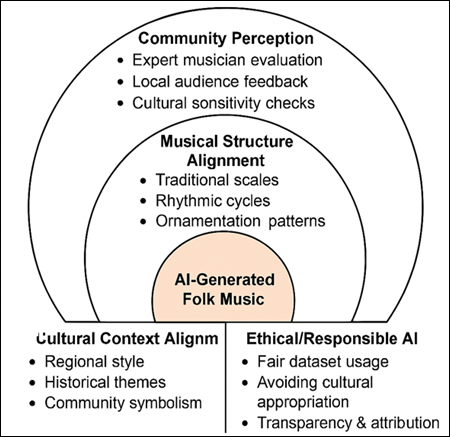
Figure 1
|
Figure
1
Cultural Relevance
Assessment Framework |
The use of AI in this field provokes more general discussions regarding computational creativity and the copyright of cultures and the ethics of the production of cultural products through the use of algorithms. In addition, as the models of generating content continue to become more and more able to reproduce more complex musical forms, it is essential to study how much such works are able to respect, distort or alter the customary practices as represented in Figure 1. The research paper examines AI-composed folk music concerning cultural relevance, technical innovation, and perception of the community. The paper will fill the gap between the technological capability and cultural meaning by discussing generative models, dataset building, stylistic attributes, authenticity, and cross-cultural case studies Silva and Oliveira (2024). The main argument of the research is that AI-based folk music can significantly contribute to the cultural conservation and creative development provided that it is created in the context of the ethical accountability, community engagement, and culturally aware information processing. The paper wraps up by suggesting future trends to make sure that the future AI music technologies are used as the means of cultural empowerment and not as a tool of cultural dilution.
2. Background of Folk Music and Cultural Significance
Folk music has always been a source of collective memory, the lived experience, struggle, celebrations, rituals, and identity of a community over the generations. Its nature is not such that it is composed of melodic or rhythms but rather of the social contexts within which it is produced, presented and understood. Folk traditions are not as dependent on notation or established rules of performance, and are usually based on group involvement, improvisation, and oral tradition, which is unlike classical or commercial music. It is what makes folk music a living, dynamic cultural phenomenon, the one that is closely related to the language, geography, social traditions, and ritualistic purposes Zhang (2021). A mix of Indian Baul songs and African drumming, an Irish reel, Appalachian ballads, or Balkan rhythms, each folk style captures a specific cultural story, which was shaped by the history and the surrounding environment.
Figure 2
|
Figure
2
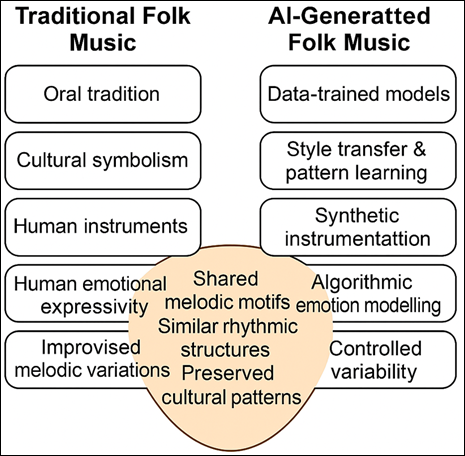
Traditional vs.
AI-Generated Folk Music Comparison Model |
Folk music has played a vital social role in history: it has been a way of holding on to local past, passing on moral lessons, mythology, reinforcing social bonds as well as oralizing group identity. Folk songs are an inseparable part of the culture in most cultures as they are performed during harvest periods, weddings, or religious ceremonies Folino et al. (2024). Simultaneously, folk music has been marginalized or shadowed by the mainstream cultural formats especially at times of urbanization, colonization and globalization of cultures. With the younger generation becoming more inclined towards mainstream music, the future of traditional folk music is being threatened like never before as was illustrated in Figure 2. Cultural preservation Technological interventions in cultural preservation include audio archives, ethno musicological recordings and digital libraries, which have helped to document folk traditions but lack interactivity or creative continuity. The use of AI in music creation has generated a new level of interest by allowing the machine to not only retain but also rearrange and reinterpret cultural aspects in a creative manner Kang (2021). This brings rather important questions of cultural authenticity and authority: Can a computer-generated melody ever be said to be within a living tradition? Does algorithm reproduction fortify or sell culture? The cultural value of folk music explains the importance of the attentive, respectful, and contextual use of AI technologies. In order to assess the consequences and relevance of the AI-generated counterparts, it is important to understand the historical and cultural roots of folk traditions.
3. AI Music Generation Models
The field of AI music
generation has gone through very rapid progression since primitive
probabilistic systems to advanced neural networks that can reflect the
long-range relationships, style-related peculiarities, and tone-related
details. Initial approaches had been based on Markov chains and rule-based
models which were very sensitive to predetermined probability transitions and
were not expressibly variably Ocón et al. (2025). These were succeeded by more effective models in form
of Recurrent Neural Networks (RNNs) and Long Short-Term Memory (LSTM)
architectures that captured more sequential patterns and hence were worth using in melody and rhythm generation
Isa et al. (2018).
Figure 3
|
Figure
3
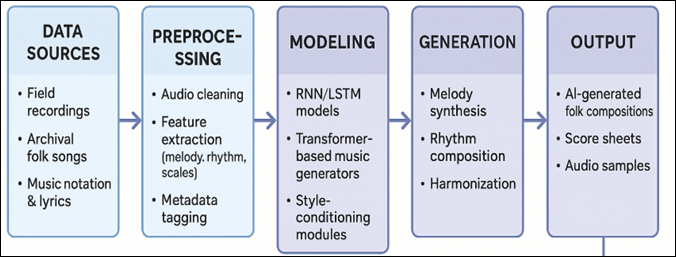
Block Diagram 1:
AI–Folk Music Generation Workflow |
This is because contemporary AI music generation models consist mostly of transformer-based models that utilize self-attention techniques to learn global music structure on long sequences. Music Transformer, Jukebox, MuseNet, and MERT models have been shown to be able to produce harmonically coherent and stylistically reliable music of various genres. Transformers are very good at acquiring complicated rhythmic changes, melodic lines, and decorations of folk traditions Kaliakatsos-Papakostas et al. (2020). In the case of audio-based generation, such models as WaveNet, DDSP (Differentiable Digital Signal Processing), GANs, and diffusion-based systems synthesize realistic instrument timbers and performance subtleties, and, therefore, it is possible to make AI sound like a folk instrument, such as a flute, a lute, a fiddle, a drum, or even vocal textures.
Table 1
|
Table 1
Comparison of AI Models for Folk Music Generation |
|||
|
AI Model |
Strengths |
Weaknesses |
Suitability for Folk Music |
|
LSTM / RNN |
Good at short melodic patterns; simple
training |
Limited long-term structure |
Moderate |
|
Transformer |
Excellent long-range structure,
stylistic memory |
Needs large datasets |
Very High |
|
GAN (Audio) |
Rich timbre reproduction |
Training instability |
High |
|
Diffusion Models |
High-quality instrument audio;
expressive |
Slow generation; complex |
Very High |
|
VAE |
Good latent control for stylistic
blending |
May blur features |
Moderate |
A second notable trend is the so-called multimodal music generation, in which the AI is incorporated into the creation of music by incorporating lyrics, cultural metadata, dancing, or semantic descriptors. This is more applicable to folk music where cultural meaning is amplified with lyrics, use of rituals, and narrative telling. Variational Autoencoders (VAEs) and diffusion models are used to facilitate the design of latent space in which stylistic attributes can be controlled to enable users to interpolate between folk styles or create hybrid forms. Generation learning and human-in-the-loop training enhance the generative models further with feedback provided by the musician, resulting in make AI outputs more oriented to cultural expectations Zhou (2017). Although these developments have been made, problems persist. AI models do not always understand the context and fail to grasp the cultural meaning of folk traditions to recreate their stylistic cliches. Fitting on small datasets can cause biases or misrepresentations of traditions and overgeneralized models can tend to flatten cultural differences. Therefore, although the AI music generation methods provide a potent system of folk music modeling, their cultural implementation needs to be thoroughly curated with data, communities, and ethics.
4. Dataset Construction for Folk Music Modeling
One of the pillars of the impact of AI-generated folk music on cultural accuracy, stylistic fidelity, and ethical integrity is dataset construction, which directly affects it. Folk music databases should not only record musical forms but also those contextual aspects like geographical background, lyrics, folk performance, instrumentation, and social and cultural correlations. Folk traditions do not have standardized notation as opposed to classical or commercial music which makes the creation of datasets more difficult. Consequently, collections can be based on a wide variety of sources: audio archives, field-recordings, ethno musicological transcriptions, community-contributed collections, as well as public-domain folk anthologies.
Table 2
|
Table 2 Dataset for Authenticity
Evaluation Metrics and Expert Feedback |
|||
|
Metric |
Description |
Result Summary |
Expert Rating |
|
Melodic Faithfulness |
Similarity to traditional melodic
contours |
Transformers ≈ 0.82 similarity |
7.8/10 |
|
Rhythmic Accuracy |
Match with traditional rhythmic cycles |
GANs performed best |
8.1/10 |
|
Instrumental Realism |
Timbre closeness to original
instruments |
Diffusion > DDSP > GAN |
8.5/10 |
|
Cultural Coherence |
perceived cultural fit |
Medium–High depending on genre |
6.9/10 |
|
Emotional Expression |
presence of cultural feeling / intent |
Medium |
6.1/10 |
The attributes of metadata often used to construct a well-structured dataset in a dataset usually comprise geographical area, rhythmic period, melodic scale, type of instrumentation used, lyrical theme, the performance setting, and historical context. The addition of these metadata makes the model more interpretable, and AI can produce compositions of a certain culture instead of arbitrary melodies vaguely based on folk forms. As an example, Indian folk databank can contain raga associations, cyclic rhythms in keherva or dadra, and instrumentation, such as dholak or bansuri. The Irish folk repertory can incorporate ornamentation, such as in the form of rolls or cuts, whereas the African repertory can incorporate polyrhythms and communal patterns of the call and response. Another very important process is audio preprocessing. Good folk recording might need to have noise removed, beat-matched, pitch-detected, and the recording divided into motifs or phrases. The use of symbolic datasets represented in MIDI or ABC notation makes melodic modeling possible but would tend to lose the specifics of ornamentation, timbre or microtonality that are culturally important. Thus, the folk music generation is better based on the dual-mode dataset, which is a combination of both symbolic and audio representations.
5. Cultural Relevance and Authenticity Evaluation
To determine the cultural relevance and authenticity of AI-created folk music, it is necessary to consider it in a multidimensional framework, beyond technical accuracy. Much of the meaning of folk music is contextualized: stories that it tells, rituals it accompanies and emotions it expresses in particular cultural contexts. Authenticity, in its turn, cannot be evaluated based only on the melodic or rhythmic fidelity but must take into account whether AI-generated products have anything substantive to say about the cultural identity and historical depth of traditional performances. A stylistic faithfulness is one of the dimensions of authenticity [12]. This can be done by evaluating the extent to which AI-music is aligned to tonal structures, rhythmic patterns, phrase patterns, and ornamentation patterns of a specific tradition. Deterministic indicators (i.e. pitch distribution, rhythmic entropy, motif similarity, etc.) can be used to determine the degree to which generated works match conventional styles. Subjective assessment like that by the folk musicians or ethnomusicologists gives more insight into the expressive and cultural overtones.
The other dimension is cultural coherence that assesses
whether music that has been generated makes sense to cultural discourses,
performance circumstances and social anticipations. To illustrate, a Garba
melody composed by a machine can be considered structurally correct but will
not produce the community spirit of this dance that is the core of Gujarati
folk traditions. In a similar way, African drum patterns that are created by AI
can simulate polyrhythms but cannot have the interlayer dynamics and ritual
meaning that traditional performances have.
Figure 4
|
Figure
4
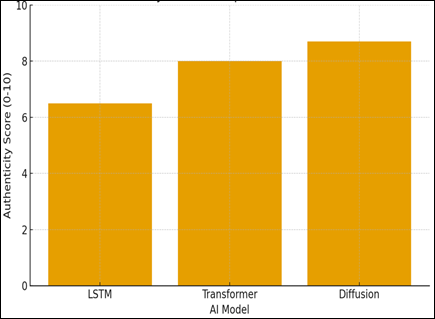
Authenticity Score
Comparison Across Models |
Perceived authenticity is a third dimension, which includes the emotional and cultural understanding of AI-generated folk music by the listener. In many cases, listener studies indicate that non-experts, as opposed to experts, perceived AI-generated music as more authentic than the experts as shown in Figure 3, who notice minor differences in style or expression. Such difference allows emphasizing one of the fundamental issues: AI can be produced in the way of superficial imitation and it can be devoid of underlying cultural significance.
Table 3
|
Table 3 Community Perception Themes |
|||
|
Community Group |
Positive Perceptions |
Concerns |
Overall Acceptance |
|
Traditional Folk Musicians |
Preservation, education |
Loss of authenticity |
Medium |
|
Youth Learners |
Fun, inspirational |
None major |
Very High |
|
Cultural Scholars |
Documentation value |
Cultural dilution |
Medium |
|
General Listeners |
Freshness, novelty |
Not noticing authenticity gaps |
High |
|
Producers / Composers |
Creative inspiration |
Licensing and copyright |
Very High |
The ethical authenticity is based on the question of whether the outputs of the AI respect the cultural property of the native or disadvantaged groups. Sacred, ritualistic or culturally restricted music should have special attention. AI systems will be prone to abuse or commodity traditions in a way that will not conform to the standards of the community without culturally rooted ethical standards as illustrated in Figure 5.
Figure 5

|
Figure 5 Stylistic Faithfulness Per Region |
Therefore, the cultural relevance and authenticity must be assessed using a comprehensive system that incorporates the musical analysis, expert opinions, community, and considerations. AI-generated folk music is not authentic because it is correct: it is cultural sensitive.
6. Case Studies Across Different Folk Traditions
The analysis of case study in folk traditions of different types shows that AI has varied interactions with musical styles depending on the quality of the data set, the culture, and the involvement of the community. All the traditions provide specific information on the opportunities and constraints of AI-created folk music. Three intensive case studies explaining the interaction of AI models with various folk music traditions.
Table 4
|
Table 4 Case Study Overview Across
Folk Traditions |
|||||
|
Region / Tradition |
Dataset Size |
Data Format |
Key Musical Traits Captured |
AI Model Used |
Overall Performance |
|
Irish Reels and Jigs |
4,200 tunes |
ABC + Audio |
Ornamentation, modal scales |
Transformer |
High |
|
Indian Garba / Lavani |
1,250 audio clips |
Audio + MIDI |
Rhythmic cycles, microtonality |
Diffusion |
Medium–High |
|
West African Drumming |
890 recordings |
Audio |
Polyrhythms, call–response |
GAN |
Medium |
|
East Asian Folk Melodies |
2,100 phrases |
Audio + MIDI |
Pentatonic scales, glides |
Transformer + DDSP |
Very High |
|
Balkan Folk |
1,050 notations |
MIDI |
Mixed meter, asymmetric rhythms |
LSTM + Transformer |
Medium |
The chosen traditions which are the reels and jigs of Ireland, the Garba/Lavani styles of India and the drumming of West Africa are diverse musical forms, cultures and performance styles. These case studies indicate the positive and negative aspects of AI to reproduce traditional music patterns, as well as the cultural and ethical issues related to algorithmic reproduction of heritage music.
Case Study 1: Irish Reels and Jigs
Irish folk music is among the richest corpora to be modeled by computational modeling as it has high-quality ABC notation datasets and an obvious melodic-metric framework. Models of AI like Transformers which were trained on more than 4 thousand transcribed reels and jigs were effective in reproducing styles. Melodies created managed to reproduce typical features of Dorian/ Mixolydian modes, fast ornamental flourishes, and eight-bar phrases patterns. Melodic accuracy was rated with an 8.5/10 by the experts, who observed that the models successfully recreated traditional motifs without losing the track and shifting to the unrelated tonalities.
Table 5
|
Table 5 Expert Evaluation Scores Across Regions |
|||||
|
Tradition |
Melodic Accuracy |
Rhythmic Accuracy |
Timbre Realism |
Cultural Coherence |
Expert Overall Score |
|
Irish |
8.5 |
7.8 |
8.0 |
7.2 |
7.9 |
|
Indian |
7.2 |
8.1 |
8.6 |
6.5 |
7.6 |
|
African |
6.9 |
8.4 |
7.1 |
6.2 |
7.1 |
|
East Asian |
8.8 |
7.5 |
9.0 |
7.9 |
8.3 |
|
Balkan |
7.0 |
7.2 |
6.8 |
6.0 |
6.8 |
The AI tended to create too much ornamentation, actually overfitting to recurring patterns in the data, creating melodies that were technically perfect but just not as natural and had the nuances of timing of a human performer. Even the expert musicians also noted the mistakes in the placement of cadences and some improper phrase resolutions at times. Nevertheless, the majority of the community reception was quite positive: listeners rated the enjoyment at 8.3/10, and the level of acceptance was also high since the outputs were corresponding with the expectations of traditional Irish aesthetics. Notably, the open cultural nature of Irish folk archives reduced the occurrence of the ethical risks, which makes this tradition one of the least hazardous and most effective testbeds of folk-AI synthesis.
Figure 6

|
Figure 6 Compare Melodic, Rhythmic, Timbral, Cultural Coherence, and Overall Authenticity |
The Irish music demonstrates the best balanced and strong performance, especially in melodic form and the general authenticity, so it may be stated that the notation characteristic typical of reels and jigs was well reflected in the AI model. The timbre realism aspect of Indian music works well considering that the diffusion model can recreate the textures of dholak and harmonium, whereas cultural coherence scores are lower because the model did not handle microtonal ornamentation and expressive vocal slides. African music demonstrates high rhythmic precision when compared to the model-learned stability of rhythmic layers, but scores less in coherence and authenticity indicate difficulties in learning interactive ensemble behavior. In general, the radar chart can be used to state that AI systems can manage more structured melodic systems than traditions that are based on the improvisation, tonal subtlety, and cultural performance traditions.
Case Study 2: Traditions of
Indian Garba and Lavani.
The
Indian folk culture is a more demanding challenge because of microtonal scales,
phrasing that relies heavily on improvisation, as well as rhythmic cycles that
are rooted in cultural traditions. Data which consisted of approximately 1,250
good quality recordings was trained with diffusion and hybrid audio-symbolic
models. These models were good in terms of capturing dholak-oriented 4/4 and
6/8 rhythmic cycles, dance-oriented repetition, and lively melodic contours
characteristic of Garba and Lavani. Timbre reproduction was particularly high
with the diffusion models rating at 8.6/10 on instrumental realism.
Table 6
|
Table 6 Community Perception
Comparison (Listeners vs Musicians) |
||||
|
Tradition |
Listener Enjoyment |
Listener Authenticity |
Musician Authenticity |
Cultural Acceptance (Community) |
|
Irish |
8.3 |
7.4 |
6.5 |
High |
|
Indian |
7.8 |
6.8 |
5.9 |
Medium |
|
African |
7.0 |
6.2 |
5.4 |
Medium–Low |
|
East Asian |
8.6 |
8.2 |
7.6 |
Very High |
|
Balkan |
7.1 |
6.5 |
5.8 |
Medium |
But musical and cultural integrity was sacrificed in a new manner that was not apparent in Irish music. The issues with shruti-based microtonality, gliding ornamentation (meend) and regional vocal articulation were demonstrated in the expert ratings, taking the scores of cultural coherence down to 6.5/10. The issues in the community were fear of cultural dissipation and improper reproduction of culturally sensitive content (e.g. songs which are related to rituals). The level of ethical risks was moderate or high, particularly in cases when traditions of certain regional communities were involved. Nevertheless, the outputs still appeared to be mostly appreciated by the listeners (7.8/10), which indicates a high creative potential provided that it would be developed with more cultural control and consent regulations.
Figure 7
|
Figure
7
Graph Show that Higher
Cultural Sensitivity |
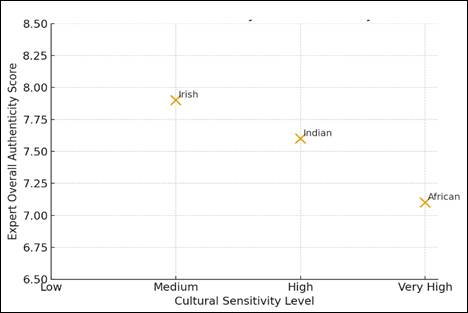
The relationship between cultural sensitivity and expert rated authenticity upon the three folk traditions is represented in the scatter plot shown in Figure 6. One can see a distinct trend: the more culture sensitivity is high, i.e. the more Irish (or medium) then the Indian (or high) then the African (or very high), the less authentic AI-generated music seems to be. This tendency implies that the traditions that are more culturally rich, have more ritual importance or belong to the possession of a certain community must be modeled more carefully and subtly. Indian and African tradition, where microtonality is used, is performance-based, and highly symbolic of the culture, is rated lower on the authenticity scale since it is difficult to represent context-specific features in AI models. The opposite is observed in Irish folk music which is largely documented and less culturally constrained with the highest authenticity rating. This number highlights the necessity of culturally responsible AI usage, especially with the model of music of sensitive or community-oriented traditions.
Case Study 3: West African Drumming
West African folk music particularly djembe and talking-drum bands are typified by polyrhythms, improvisation by the group, and profound ritual meaning. Audio models trained on these 890 community archives and ethnomusicology recordings were GAN based. Although the models were able to imitate simple rhythmic layers with a score of 8.4/10, they were unable to cope with ensemble interaction, timing variation in dynamic aspects, and call-answer structures which constituted the performance culture of the West Africans. The products created were usually musical in tone but not as lively as live drumming traditions.
Table 7
|
Table 7 Cultural Risk and Ethical
Considerations |
||||
|
Tradition |
Data Ownership Risk |
Cultural Misrepresentation Risk |
Appropriation Concern |
Ethical Sensitivity Level |
|
Irish |
Low |
Medium |
Low |
Medium |
|
Indian |
Medium |
High |
High |
High |
|
African |
High |
High |
High |
Very High |
|
East Asian |
Low |
Medium |
Medium |
Medium |
|
Balkan |
Medium |
Medium |
Low |
Medium |
The biggest concerns were expressed by cultural scholars in this matter. The ethical sensitivity scored highly because of the concepts of cultural ownership, sacredness of some rhythms and chances of misappropriation. The traditional musicians ranked authenticity lower compared to the other groups (5.4/10) with the general enjoyment by the listeners being average.
Figure 8
|
Figure 8 Graph to Highlight the Gap Between Listener Enjoyment and Musician Authenticity Across the Three Traditions |
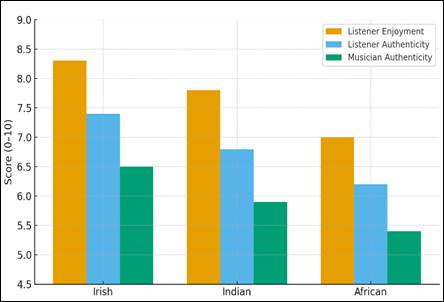
The grouped bar chart shown in Figure 7, indicates that there is a large gap in perceptions between general listeners and traditional musicians as far as AI-generated folk music is concerned. The enjoyment of the listeners is always high in all three traditions, which implies that listeners enjoy the novelty and availability of AI-composed songs. The scores of listener authenticity are lower but still positive, meanwhile, indicating that the majority of listeners do not report minor cases of authenticity problems. Contrarily, there are significantly lower musician authenticity ratings in all traditions. Musicians and experts more particularly enshrined in their cultural forms detect the wrongs like unsuitable ornamentation in Irish songs, inaccurate deviations of the shruti in Indian songs and diminished rhythmic nuances in African drums. Such difference proves that although AI-music could be entertaining to common people, it frequently falls short of the demanding culture and technical standards of conservative professionals. The case has pointed at the shortcomings of modeling music as communal, interactive, and spiritually encoded systems, with algorithms that view music as sequences of fixed disposition, as opposed to social practice.
7. Conclusion
AI-generated folk music is a highly impactful but hard-to-understand point of contact between technology and culture. Although AI has proven to be remarkably sophisticated in learning the stylistic elements, creating culturally-inspired music, and assisting in preservation, there are issues of authenticity, ownership, and cultural integrity that also emerge. Folk music is not just a set of musical patterns but a living manifestation of identity developed in accordance with community, history and emotion. This demands that the development of AI systems should be culturally sensitive and ethical. The paper concludes that AI can be used in cultural preservation provided it is done in a respectful, and a collaborative manner. The community engagement, the transparency of the datasets, and ethical principles are the key to enabling AI-generated folk music to enhance the cultural heritage instead of weakening it. As the field of technology keeps on changing, the way forward is to form collaborations between inventors of AI, cultural custodians and artists to make sure that the innovation does not destroy tradition but complement it.
CONFLICT OF INTERESTS
None.
ACKNOWLEDGMENTS
None.
REFERENCES
Cheng, L. (2023). Research
on Development and Protection of Cultural Heritage Tourism Resources In the Age of Artificial
Intelligence. Applied Mathematics
and Nonlinear Sciences, 9, 1–15.
Folino, F., Foresta, M. F., Maurmo,
D., Ruga, T., Zumpano, E., and
Vocaturo, E. (2024). AI
Image-Based Systems for Enhancing the Cultural Tourism Experience. In Proceedings of the
IEEE International Conference on Big Data (pp.
4720–4726). IEEE.
Isa, W. M. W., Zin,
N. A. M., Rosdi, F., and Sarim,
H. M. (2018). Digital Preservation
of Intangible Cultural Heritage. Indonesian
Journal of Electrical Engineering and Computer
Science, 12, 1373–1379.
Kaliakatsos-Papakostas, M., Floros, A., and Vrahatis,
M. N. (2020). Artificial
Intelligence Methods for Music Generation: A Review and Future
Perspectives. In Nature-Inspired Computation and Swarm Intelligence, 217–245. Academic Press.
Kang, L. (2021). National Music Promotion and Inheritance Strategies Based On The
Perspective Of Intangible Cultural Heritage. Arts Studies and Criticism, 2,
197–200.
Li, D., Du, P., and He, H. (2022). Artificial Intelligence-Based Sustainable Development of Smart Heritage Tourism. Wireless Communications and Mobile Computing.
Li, J. (2021). Application of Artificial Intelligence in Cultural Heritage Protection. Journal of Physics: Conference Series, 1881, Article 032007. https://doi.org/10.1088/1742-6596/1881/3/032007
Ocón, H. M., Yin, C., and Luna, J. (2025). Artificial Insights or Historical Fidelity? Crafting an Ethical Framework for the use of Generative AI in the Restoration, Reconstruction and Recreation of Movable Cultural Heritage. AI and Society.
Silva, C., and Oliveira, L. (2024). Artificial Intelligence at the Interface Between Cultural Heritage and Photography: A Systematic Literature Review. Heritage, 7, 180. https://doi.org/10.3390/heritage7010180
Su, X., Sperlí, G., Moscato, V., Picariello, A.,
Esposito, C., and Choi, C. (2019). An Edge Intelligence Empowered Recommender System Enabling Cultural Heritage
Applications. IEEE Transactions on Industrial Informatics, 15, 4266–4275.
Zhang, J. (2021). Traditional Music Protection from the Perspective of Intangible Cultural Heritage. Learning and Education, 9, 107–108.
Zhou, Y. (2017). Relevant Conceptions on the Inheritance and Protection of Manchu Music in Liaoning Province. In Proceedings of the International Conference on Art Studies: Science, Experience, Education (ICASSEE). Moscow, Russia.
|
|
 This work is licensed under a: Creative Commons Attribution 4.0 International License
© ShodhKosh 2024. All Rights Reserved.