ShodhKosh: Journal of Visual and Performing ArtsISSN (Online): 2582-7472
|
|
Integrating AR and AI for Immersive Sculpture Exhibitions
Dr. J. Vijay 1
 ,
Romil Jain 2
,
Romil Jain 2 ,
Guntaj J 3
,
Guntaj J 3 ,
Dr. Senduru Srinivasulu 4
,
Dr. Senduru Srinivasulu 4
 , Vinod Chandrakant Todkari 5
 , Dr. Pooja Srishti 6
1 Assistant
Professor Gr. II, Department of Electronics and Communication Engineering, Aarupadai Veedu Institute of Technology, Vinayaka Mission’s
Research Foundation (DU), Tamil Nadu, India
2 Chitkara
Centre for Research and Development, Chitkara University, Himachal Pradesh,
Solan, 174103, India
3 Centre of Research Impact and Outcome, Chitkara University, Rajpura-
140417, Punjab, India
4 Professor, Department of Computer Science and Engineering, Sathyabama Institute of Science and Technology, Chennai, Tamil Nadu, India
5 Department of
Mechanical Engineering, Vidya Pratishthans Kamalnayan
Bajaj Institute of Engineering and Technology, Baramati, Pune, India
6 Assistant Professor, School of Business Management, Noida International
University 203201, India
|
|
|
ABSTRACT |
|
|
The paper
addresses the issue of combining Augmented Reality (AR) and Artificial
Intelligence (AI) to create the experience of thicker and adaptive sculpture
display that will change the interactions of the audience in the digital era.
The proposed scheme outlines how AR technologies can be employed to add to
physical sculptures some dynamic and interactive depth of information and
sensory enhancement and AI will personalize these experiences to their
current preferences of use behavior. The cognitive and emotional associations
between visitors and artworks are deeper are formed with the help of the
visual augmentation of the system along with clever content adaptation. The
concept framework is based on experiential learning, aesthetic perception,
and human-computer interaction theories to provide grounds on hybrid AR-AI
exhibition environments. The research design used in the study involves a
combination of qualitative interviews, observational analysis, and
quantitative usability testing with the use of a mixed-methods research
design. To create the prototype system, there are tools, including Unity 3D, ARCore, TensorFlow, and 3D scanning technologies. It is
characterized by an AR interface that allows visualizing sculpture in
real-time, AI algorithms that examine the behavior of users, and a
feedback-based data pipeline that optimizes the system in the long run. The
metrics to be evaluated are immersion, engagement, and learning outcomes
which are assessed by user experience studies and comparison with traditional
settings of exhibits. |
|||
|
Received 28 January 2025 Accepted 19 April 2025 Published 16 December 2025 Corresponding Author Dr. J.
Vijay, vijay.ece@avit.ac.in DOI 10.29121/shodhkosh.v6.i2s.2025.6718 Funding: This research
received no specific grant from any funding agency in the public, commercial,
or not-for-profit sectors. Copyright: © 2025 The
Author(s). This work is licensed under a Creative Commons
Attribution 4.0 International License. With the
license CC-BY, authors retain the copyright, allowing anyone to download,
reuse, re-print, modify, distribute, and/or copy their contribution. The work
must be properly attributed to its author.
|
|||
|
Keywords: Augmented Reality, Artificial Intelligence, Immersive Art, Sculpture Exhibitions, User Engagement, Personalization |
|||



1. INTRODUCTION
The dynamism of digital technologies has
changed the environment of the art, culture and the human experience with the
creative expressions. Generally, Augmented Reality (AR) and Artificial
Intelligence (AI) are the two most significant technologies in transforming
artistic experiences and the museum practice. The AR is an overlay of digital
content, e.g. a picture, animation, or background information onto the physical
environment which enables the audiences to interact with artworks, not only
through the visual perception. Instead, AI gives systems the ability to process
data, identify trends, as well as dynamically generate content depending on
user preferences and behaviors. The combination of these technologies creates a unique
possibility of developing immersive, intelligent, and personal art exhibitions
especially in the field of sculpture, where spatial and tactile experiences are
the main aspect of it. Conventional sculpture displays in most cases are based
on a passive experience of viewing artwork and they
lack interactive and contextual enhancement Chang (2021). The
traditional model restricts the richness of interaction and interpretive
possibility. Nonetheless, the AR can be incorporated so that sculptures act as
interactive screens, with digital overlay being used to demonstrate the
historical background, intention of the artist, or even to repackage the art in
a three-dimensional state. Simultaneously, AI systems can use the prospect to
personalize these expanded experiences to each visitor depending on their
background, learning style, or emotional response, and create adaptive and
inclusive art experiences. As an example, AI-driven recommendation engines can
suggest some viewing points, highlight information about the interests of the
user, or change the narration based on the real-time feedback Barath et al. (2023). It is not
only that the interaction between AR and AI augments the visual and cognitive
experiences but a solution to the dilemma concerning the interwoven world of
art and technology. It enables museums and galleries to stop existing as fixed
exhibitions, becoming hybrid interactive eco systems, where the visitor is not
a spectator but an actor. Such intelligent exhibition space can record the behavior of the user such as gazing, dwell time and user
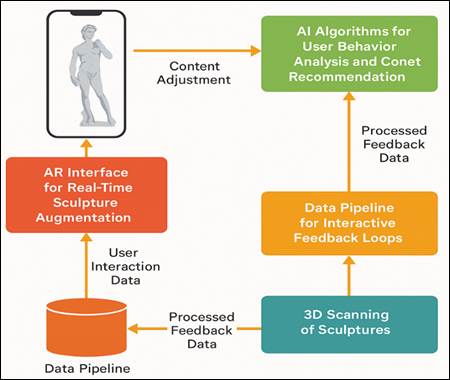
navigation to improve future displays Cheng et al. (2023). Figure 1 illustrates multilayer AR-AI system which
allows the exhibition of sculptures in an immersive way. This feedback
contributes to the iterative optimization of delivery of user experience and
content, which is done by the curators and system designers.
Figure 1
|
Figure 1 Multilayer System Architecture for AR–AI Integrated Immersive Sculpture Exhibition |
Furthermore, the combination of AR and AI is a useful factor
in education and culture propagation. Considering the example of students
studying the history of art, it is possible to use sculptures to gain multiple
benefits or layers of information, such as visualizing how the object has been
restored, the techniques applied in the creation of the artwork, or the
symbolic meaning it conveys, with the help of AI-generated narratives Wang (2022). Equally, by converting visual data into a multisensory or
text-based format, sculpture exhibitions may be made available to a wider range
of individuals, including those with physical or other sensory constraints,
through the use of AR-guided tours.
2. Related Work
The multidisciplinary approach to art, technology and the
interaction between humans has been more attentive of how digital technologies
can be involved and used to give aesthetic experiences. A number of scholars
have talked about the possibilities of Augmented Reality (AR), which can be
utilized in the context of museums and galleries to improve the engagement and
interpretation process. As it has been proved, the AR-based museum applications
can enhance the learning and satisfaction of visitors by adding contextual
information over artifacts Matthews and Gadaloff (2022). Moreover, the use of AR has created spaces of narration
into which people are actively involved in an active manner with
three-dimensional content, which leads to greater emotional and cognitive
involvement with the art object. The same trends in the cultural and creative
industry have recorded substantial advancement in Artificial Intelligence (AI)
in personalizing its technologies to users. Curatorial systems and
recommendation models that use AI can be used to interpret visitor information
to make predictions and create customized content. These developments show how
AI can overcome the challenge of the curatorial intent and personal interaction
Sovhyra (2022). New approaches to computer vision and natural language
processing also make it possible to interpret user behaviour in real time,
whether by tracking gaze, detecting sentiment or creating an adaptive
narrative, enabling each visitor to have a unique pattern of interaction.
Although the application of AR and AI in sculpture exhibition is a
comparatively underdeveloped field, their integration has been widely discussed
separately. The past attempts have generally focused on either visual
augmentation or smart recommendation, but not the combined incorporation of
both technologies Wang and Lin (2023). In Table 1, studies,
which are summarized, are mixing AR and AI to exhibitions. The combination of
AR visualization and AI-supported personalization will likely lead to
synergistic effects and contribute to the level of immersion and
interpretation.
Table 1
|
Table 1 Summary of Related Work on AR and AI
for Immersive Sculpture Exhibitions |
||||
|
Study |
Technology Focus |
Application Domain |
Methodology |
Future Scope |
|
“A Survey of Augmented Reality” |
AR Frameworks |
Mixed Reality Foundations |
Literature Review |
Early theoretical model, lacked AI integration |
|
“Interaction in Augmented Reality” |
AR Interaction Design |
Human–Computer Interaction |
Experimental Studies |
No adaptive personalization |
|
“Beyond Virtual Museums” Al‑Kfairy et al. (2024) |
AR Visualization |
Virtual Heritage |
Case Study |
Limited user analytics |
|
“AR in Art Exhibitions” |
Mobile AR Apps |
Art Galleries |
Prototype Testing |
Lack of personalization mechanisms |
|
“Personalized Museum Experiences” Alkhwaldi, A.
F. (2024) |
AI Recommendation |
Cultural Heritage |
User Study |
Limited integration with AR visualization |
|
“Immersive Technologies in Museums” |
AR / VR Systems |
Museum Interaction |
Survey and Case Analysis |
High technical setup cost |
|
“Mixed Reality for Heritage Education” Gong et al.
(2022) |
AR + 3D Reconstruction |
Education and Museums |
Experimental Design |
Focused on heritage, not sculpture art |
|
“AI-Powered Museum Curation” |
AI-driven Analytics |
Exhibition Design |
Machine Learning Implementation |
Data privacy concerns |
|
“Embodied Museography” |
Immersive Interfaces |
Interactive Art |
Conceptual Framework |
No quantitative validation |
|
“Emotion-Aware AR Systems” |
Affective AI + AR |
Art Installations |
Deep Learning + Vision Analysis |
Still in prototype phase |
|
“AI-Based Art Recommendation Systems” |
Recommendation Algorithms |
Digital Art Platforms |
Neural Network Model |
Lacked spatial immersion |
|
“Hybrid AR–AI Museum Interfaces” Sylaiou et al. (2024) |
AR + AI Hybrid |
Museum Visitor Studies |
Field Experiment |
Requires cross-device optimization |
|
“3D Scanning and AR Display for Sculptures” |
3D Reconstruction |
Sculpture Exhibitions |
Photogrammetry and AR Visualization |
Limited personalization integration |
3. Conceptual Framework
3.1. THEORETICAL BASIS FOR IMMERSIVE ART
EXPERIENCES
Immersive art experiences are based on the convergence of
psychology, aesthetics, and the human-computer interaction. Immersion is the
extent to which a person is mentally and emotionally engrossed into an
environment which creates the sense of presence and involvement. Experiential
learning theory (Kolb, 1984) supports this phenomenon theoretically where
knowledge is said to develop when a person engages in activities and reflects
on them. Immersion, in the art world, applies the concept of passive observation
into participatory interpretation, by means of which the audiences jointly
create the meaning during the interaction Galani and Vosinakis (2024). Moreover, the aesthetic experience theory (1934) by Dewey
implies the continuity of perception and action in art practice, and thus, that
technology-enhanced experience may improve aesthetic experience. In its use
with sculpture displays, immersive structures help to stimulate a convergence
of the senses- visual, auditory, spatial signals to produce a greater emotional
appeal De Fino et al. (2023). In a digital sense, the presence theory provides emphasis
on the fact that AR can provide spatial realism so that users can feel that
digital additions are authentic extensions of physical sculptures. In the
meantime, AI adds to the cognitive immersion, in which user behavior
is analyzed by adaptive systems, which provide users
with personalized narratives and contextual information Kovács and Keresztes (2024).
3.2. INTEGRATION MODEL FOR HYBRID AR–AI
SYSTEMS
The hybrid AR-AI system integration model will be structured
to meet the objective of integrating sensory augmentation and intelligent
interactivity to create a continuous digital ecosystem of immersive sculpture
exhibitions Newman et al. (2021). This model works on the three fundamental layers that are
perceptual augmentation, cognitive adaptation, and feedback optimization. AR
technologies (ARCore, ARKit, Vuforia) are offered in
the perceptual layer, and they present real-time object recognition, spatial
mapping, and overlay rendering. Photogrammetry or LiDAR are used to scan
sculptures and create the precise 3D models so that users can explore the
dynamic visualization of sculptures, including re-creating the artistic process
or visual layers. The AI-driven cognitive layer is an algorithmic processing of
behavioral data with the help of machine learning and
neural networks. It examines the way the users look, move or even spend time on
the site to determine the level of engagement and dynamically adjust the
content of the exhibition. To illustrate, when a user hovers around a certain
sculpture, the AI can elicit more profound interpretive stories or other pieces
of art.
4. Methodology
4.1. Research design and data collection methods
The study design is a mixed-method approach, which involves
qualitative and quantitative designs because it will help to fully analyse the
incorporation of AR and AI in immersive sculpture exhibitions. In this way, the
technological efficiency and the practicality of the suggested system will be
carefully tested. The qualitative aspect is concerned with the perception,
interest, and feelings of the users. Artists, curators, and visitors of the
exhibits are interviewed semi-structured and focus groups are discussed to
provide information on the expectations of users, their aesthetic satisfaction,
and their perception of interactivity. Real- time interactions between users
and augmented sculptures in prototype exhibition settings are observed and
documented by observational studies which identify patterns of behavior and issues of usability. The quantitative element
supplements such findings through use of structured surveys as well as behavioral analytics. Such information as time per art
piece, usage frequency of AR features, and the accuracy of responding to the
AI-improved recommendations are gathered. The data of eye-tracking and
motion-sensing can further inform the research on spatial attention and in the behavior of navigation.
4.2. TOOLS AND TECHNOLOGIES EMPLOYED
4.2.1. AR SDKs
Immersive and interactive sculpture exhibition development
has been built on AR SDKs. Such SDKs allow the system to overlay digital
objects on top of physical sculptures in a way that the virtual and the real
world are seamlessly connected. Vuforia and Wikitude
are also the victors of the game at the expense of the high-quality image
recognition and markerless tracking which is
essential to the validation of the sculpture augmentation inside the gallery.
These tools enable the developers to make the visual layers to be responsive to
the gaze of the viewer and his or her view. Furthermore, inbuilt lighting
approximation and occlusion imaging techniques simulate natural lighting and,
therefore, augmented images appear natural. With them together, the system can
offer high-fidel, interactive, and context-aware AR
experiences that transform otherwise lifeless sculptures into interactive,
multisensory artistic experiences.
4.2.2. AI models
Machine learning frameworks like TensorFlow, PyTorch and Scikit-learn are used to process data of user
interaction, gaze tracking, navigation patterns and dwell times. These streams
are fed into supervised and unsupervised learning models in which the
preferences, engagement levels, and interaction tendencies of the users are
identified. Transformer based model Natural Language Processing (NLP) models,
such as BERT or GPT, allow conversational interfaces to make the visitor talk
to an AI-driven virtual guide. Also, reinforcement learning algorithms make it
easier to deliver content in an adaptive way with the system learning based on
user response to improve content recommendations in real time. Computer vision
is used to create emotion recognition networks that recognize facial
expressions and facial movements to determine emotional engagement. All these
AI models create human-friendly interactions that make the experience of the
exhibition more responsive and have a stronger emotional impact on the relationship
of the visitors with the sculptures.
4.2.3. 3D scanning
The technologies in 3D scanning are necessary to properly
digitalize sculptures and provide augmentation in AR to be realistic.
High-resolution geometric and textural data of physical works of art are
captured by using methods like photogrammetry, structured light scanning, and
LiDAR (Light Detection and Ranging). The AR overlay is built on the resulting
3D models, making it possible to add dynamic visual effects, historical
reconstructions, or interpretive animations and ensure that the resulting 3D model
fits perfectly around the original sculptures. Moreover, 3D scanning also
provides correct spatial calibration that enhances the performance of AR
tracking within an exhibition space. Such combination of extreme digitizations and real-time images allows creating
immersive, interactive, and faithful images of sculptural art in hybrid AR-AI
space.
4.3. PROTOTYPE DEVELOPMENT AND USER TESTING
PROCEDURES
The prototype development stage is the real-life application
of the conceptual and architectural scheme, where visualization of AR and
personalization through AI is to be combined into a unified system of
interaction. It starts with the 3D modeling and
digitization of the chosen sculptures in the 3D model via LiDAR or
photogrammetry process to provide proper geometric fidelity. The models are
externally brought into Unity 3D and AR functionality is applied with the help
of AR Foundation to make it cross-platform (ARCore
and ARKit devices). Contextual commentaries, artistic interpretations and
animation layers (all called dynamic overlays) are planned to enhance
interaction with the users. Machine learning algorithms operating on the AI
side are developed with behavioral data to forecast
user preferences and provide a personalized content recommendation. The system
has a feedback loop where actual interaction data are gathered in real-time
enabling the AI to reactively adjust AR experiences to engagement patterns.
Integration testing is used in order to facilitate seamless coordination among
AR rendering, AI inference and user interface elements.
5. System Architecture
5.1. AR INTERFACE FOR REAL-TIME SCULPTURE
AUGMENTATION
The interface of the Augmented Reality (AR) is the main
entry point of the user to the digitally enhanced sculpture and its interaction
in real time. The interface is made in Unity 3D with AR Foundation as it
implements ARCore and ARKit frameworks to make it
compatible with Android and iOS platforms.
Figure 2
|
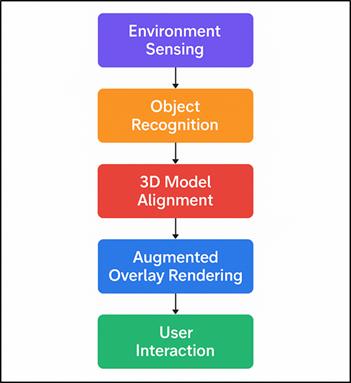
Figure 2 Flowchart of AR Interface for Real-Time
Sculpture Augmentation |
This element performs the task of environmental mapping,
surface identification and spatial matching, which allows digital overlay to be
fitted effortlessly to real-life sculptures. The AR interface uses object
recognition algorithms and markerless tracking
features of the AR interface, including feature point detection and plane
estimation to maintain high accuracy of the virtual content registration with
real world objects. AR interface flow includes real-time sculpture
augmentation, and that is presented in Figure 2.
Sculptures can be seen using handheld devices or AR glasses, with dynamic
additions, such as overlaying information, time lapse creation process, or
historical reconstructions. There are interactive features (gesture-based
controls, voice, touch-based navigation, and others) that enable users to look
at sculptures in various angles. It has realistic lighting estimation,
occlusions rendering and shading to render virtual images to blend seamlessly
in the physical environment.
5.2. AI ALGORITHMS FOR USER BEHAVIOR
ANALYSIS AND CONTENT RECOMMENDATION
The AI component of the system architecture serves as the
smart core that comprehends the interaction of the user and customizes the AR
experience. It uses a mix of machine learning (ML), deep learning (DL), and
natural language processing (NLP) models to process behavioral
information gathered when the user is interacting with the AR interface. The
special parameters like gaze, movement, and the frequency of gestures along
with the duration of learning particular sculptures are processed with the help
of ML models created in TensorFlow and PyTorch. These
types of models categorize the level of engagement, identify user intent, and
forecast interests. The adaptive content presentation in reinforcement learning
algorithms is used to achieve personalization based on feedback of each user to
the system, which learns over time to be better personalized. To achieve
conversational interactivity, NLP models like BERT models or GPT-based models
are used to drive a virtual art assistant that can answer questions by visitors
or tell them stories about their current context.
5.3. DATA PIPELINE FOR INTERACTIVE FEEDBACK
LOOPS
The main connective equipment that will enable communication
between the AR interface, AI modules, and user interaction logs is the data
pipeline. It guarantees data capture, processing and delivery in real time to
establish an improved, adaptive ecosystem of an exhibition. At the input level,
the pipeline receives multimodal inputs, such as visual tracking data,
interactive data, speech data and emotional reactions, as collected by sensors,
cameras, and devices that support AR. This unprocessed information is sent to a
cloud-based or on-premise edge server database, based
on the urgency of the latency. Filtering, normalization and anonymization of
data is done by data preprocessing modules to ensure accuracy and privacy. The
intermediate of the pipeline incorporates the processing systems of streams
like Apache Kafka or Firebase to perform real-time analytics. These data
streams are then analyzed using AI engines in order
to detect the behavioral trends, the level of
engagement, and provide adaptive content recommendations. The refined
intelligence is reported back to the AR interface with the visualizations,
story-telling styles, or even contextual overlays updated in real-time.
6. Evaluation and Results
6.1. METRICS FOR ASSESSING IMMERSION,
ENGAGEMENT, AND LEARNING OUTCOMES
Evaluation metrics will deal with the measurement of user
immersion, engagement, and learning outcomes that will be attained with the
help of the AR UI integrated exhibition. The immersion is measured by presence
questionnaire, spatial awareness scale, and physiological measures such as gaze
time and frequency of interaction. The metrics of engagement are the time spent
on each piece of art, the diversity of navigation, and the emotions associated
with the artwork based on the facial analysis. The learning outcomes are
assessed through pre and post experience quizzes, retentions exams and
qualitative feedback.
Table 2
|
Table 2 Metrics for Assessing Immersion,
Engagement, and Learning Outcomes |
|||
|
Evaluation Parameter |
Mean Score (AR–AI System) |
Mean Score (Traditional) |
Improvement (%) |
|
Presence Questionnaire (%) |
85.7 |
53.2 |
67.30% |
|
Emotional Response Rate (%) |
82.5 |
49 |
68.40% |
|
Knowledge Retention Test (%) |
86.3 |
61.7 |
39.90% |
Table 2 shows clearly that the model of AR-AI
integrated exhibition is more effective in comparison with the traditional
display of sculptures. The Presence Questionnaire score had a high change to
85.7% compared to 53.2, which means that the users felt much a sense of
immersion and spatial presence when dealing with augmented sculptures.
Figure 3

|
Figure 3 Comparison of AR–AI
System vs Traditional Methods Across Evaluation Parameters |
This enhancement is an indication of the capability of AR to
develop real-life interactive experiences which occupy both visual and
cognitive senses of users. The evaluation parameters indicate that AR -AI
performs better than the traditional techniques as illustrated in Figure 3. Equally, the Emotional Response Rate
increased by 49 percent to 82.5 percent demonstrating that personalization
based on AI and adaptive storytelling increased emotion.
Figure 4

|
Figure 4 Percentage Improvement in Learning and Engagement Metrics with AR–AI System |
The system, by reacting to the behavior
and preferences of users, enhanced intimate affective relationships between the
viewers and artworks. Figure 4 represents
the learning and engagement improvement percentage after using AR -AI. Lastly,
the Knowledge Retention Test increased to 86.3% as opposed to 61.7% which
validates that AR-AI experiences augment learning by supplying contextual,
interactive and multisensory information.
6.2. COMPARATIVE ANALYSIS WITH TRADITIONAL
EXHIBITIONS
The AR–AI prototype was compared with the traditional
sculpture exhibitions in terms of evaluation. Those who participated in the
hybrid environment had much more engagement, more time of interaction and
remembered more contextual information. The integrated system also created an
emotional connection by using interactive stories and personalization compared
to the unchanging display of objects. Qualitative comments revealed that
accessibility and better sense of artistic connection were gained. Traditional
exhibits, even though they were appreciated because of the authenticity, were
not dynamic in their interpretation and lacked personalized learning
experiences.
Table 3
|
Table 3 Comparative Analysis with Traditional
Exhibitions |
|||
|
Evaluation Criterion |
Traditional Exhibition (Mean) |
AR–AI Exhibition (Mean) |
Difference (%) |
|
Average Viewing Time (min) |
6.8 |
13.5 |
98.50% |
|
Emotional Engagement (%) |
50.1 |
85.6 |
68.60% |
|
Knowledge Retention (%) |
60.4 |
84.8 |
40.40% |
|
Visitor Satisfaction (1–100 SUS) |
72.3 |
90.5 |
25.20% |
Table 3 presents the results of the research
and shows marked benefits of the AR-AI combined exhibition model relative to
the old-fashioned display of sculptures in many aspects of experience. The
Average Viewing Time increased almost twice, by 6.8 to 13.5 minutes which
represents an 98.5 percent increment. Figure 5 demonstrates that AR-AI exhibitions are
better than traditional ones in major metrics. It means that the interaction
environment provided by the AR-AI system and its dynamic feature effectively
kept the attention of the visitors and stimulated extended activities with
every sculpture.
Figure 5

|
Figure 5 Comparative Evaluation
of AR–AI and Traditional Exhibitions Across Key Performance Metrics |
The emotional engagement also increased unusually, the level
of 50.1% reached 85.6% showing that the personalization by AI and the use of
immersive AR images contributed to the emotional engagement of the visitors
towards the art pieces. This augmented sense of affective experience increases
the exhibition to a participatory rather than an observation experience, more
emotionally charged. In addition, the Knowledge Retention increased
significantly, and the percentage of the same increased by 60.4- 84.8, which
again confirms the worth of the educational advantage of contextual and
adaptive content delivery. Lastly, Visitor Satisfaction (SUS score) was also
improved since 72.3 and 90.5 showed a difference of 25.2 percent, that is, the
usability and general experience were improved. Together, these results prove
that AR-AI hybrid exhibitions prove more effective than the traditional ones in
preserving the engagement, level of emotion, and learning effectiveness.
7. Conclusion
The integration of the Augmented Reality (AR) and Artificial Intelligence (AI) is the new idea of reconsidering the sculpture exhibition, which is the possibility to unite the physical piece of art with the online engagement. The paper demonstrates that a combination of these technologies may yield immersive, adaptive, and educational experiences which can transcend paradigms of looking at art. AR contributes to the perception through the visual addition of the digital enhancements of the real sculpture due to the visualization, the contextual narration, and the active exploration. Meanwhile, the AI will provide the opportunity to tailor the content smartly, i.e. analyze the user behavior, preferences, and emotional responses to tailor the content dynamically and thus make the experience of each visitor personal and meaningful. The proposed framework and system architecture is a nice balance of AR interfaces, AI-driven recommendation systems and data-driven feedback loops with feedback and a continuous learning cycle that is built as people interact with it. The experiment on the prototype validated measurable increase in immersion, engagement and knowledge retention in comparison to the regular exhibitions. There was also higher emotional attachment of the subjects, interactivity and heightened sense of agency on the hybrid digital space. Not only the viewers, but also the curators, educators, or even digital artists, such integration can be helpful and can enable them to make a data-informed decision and to come up with adaptive content. It facilitates inclusivity since it contributes to multiple styles and requirements of accessibility and expands the participation in the arts.
CONFLICT OF INTERESTS
None.
ACKNOWLEDGMENTS
None.
REFERENCES
Al‑Kfairy, M., Alomari, A., Al‑Bashayreh, M., Alfandi, O., and Tubishat, M. (2024). Unveiling the Metaverse: A Survey of User Perceptions and the Impact of Usability, Social Influence and Interoperability. Heliyon, 10, e02352. https://doi.org/10.1016/j.heliyon.2024.e02352
Alkhwaldi, A. F. (2024). Investigating the Social Sustainability of Immersive Virtual Technologies in Higher Educational Institutions: Students’ Perceptions Toward Metaverse Technology. Sustainability, 16, 934.
Barath, C.‑V., Logeswaran, S., Nelson, A., Devaprasanth, M., and Radhika, P. (2023). AI in Art Restoration: A Comprehensive Review of Techniques, Case Studies, Challenges, and Future Directions. International Research Journal of Modern Engineering Technology and Science, 5, 16–21.
Chang, L. (2021). Review and Prospect of Temperature and Humidity Monitoring for Cultural Property Conservation Environments. Journal of Cultural Heritage Conservation, 55, 47–55.
Cheng, Y., Chen, J., Li, J., Li, L., Hou, G., and Xiao, X. (2023). Research on the Preference of Public Art Design in Urban Landscapes: Evidence from an Event‑Related Potential Study. Land, 12(10), 1883. https://doi.org/10.3390/land12101883
De Fino, M., Galantucci, R. A., and Fatiguso, F. (2023). Condition Assessment of Heritage Buildings Via Photogrammetry: A Scoping Review from the Perspective OF Decision Makers. Heritage, 6, 7031–7066.
Galani, S., and Vosinakis, S. (2024). An Augmented Reality Approach for Communicating Intangible and Architectural Heritage Through Digital Characters and Scale Models. Personal and Ubiquitous Computing, 28, 471–490. https://doi.org/10.1007/s00779-023-01867-4
Gong, Z., Wang, R., and Xia, G. (2022). Augmented Reality (AR) as a Tool for Engaging Museum Experience: A Case Study on Chinese Art Pieces. Digital, 2, 33–45.
Kovács, I., and Keresztes, R. (2024). Digital Innovations in E‑Commerce: Augmented Reality Applications in Online Fashion Retail—A Qualitative Study Among Gen Z Consumers. Informatics, 11, 56. https://doi.org/10.3390/informatics11020056
Matthews, T., and Gadaloff, S. (2022). Public Art for Placemaking and Urban Renewal: Insights from Three Regional Australian cities. Cities, 127, 103747. https://doi.org/10.1016/j.cities.2022.103747
Newman, M., Gatersleben, B., Wyles, K., and Ratcliffe, E. (2021). The Use of Virtual Reality in Environment Experiences and the Importance of Realism. Journal of Environmental Psychology, 79, 101733. https://doi.org/10.1016/j.jenvp.2021.101733
Sovhyra, T. (2022). AR‑Sculptures: Issues of Technological Creation, their Artistic Significance and Uniqueness. Journal of Urban Cultural Research, 25, 40–50.
Sylaiou,
S., Dafiotis, P., Fidas, C., Vlachou, E., & Nomikou, V. (2024).
Evaluating the impact of XR on user experience in the Tomato Industrial Museum
“D. Nomikos”. Heritage, 7(3), 1754–1768. https://doi.org/10.3390/heritage7030082
Wang, Y. (2022). The Interaction between Public Environmental Art Sculpture and Environment Based on the Analysis of Spatial Environment Characteristics. Scientific Programming, 2022, Article 5168975. https://doi.org/10.1155/2022/5168975
Wang, Y., and Lin, Y.‑S. (2023). Public Participation in Urban Design with Augmented Reality Technology Based on Indicator Evaluation. Frontiers in Virtual Reality, 4, 1071355. https://doi.org/10.3389/frvir.2023.1071355
|
|
 This work is licensed under a: Creative Commons Attribution 4.0 International License
© ShodhKosh 2024. All Rights Reserved.