ShodhKosh: Journal of Visual and Performing ArtsISSN (Online): 2582-7472
|
|
AI-Driven Photography Curriculum for Art Schools
Ritesh Kumar Singh 1
 ,
Abhinav Rathour 2
,
Abhinav Rathour 2 ,
Shakti Prakash Jena
,
Shakti Prakash Jena
 ,
Sonia Pandey, Abhinav Mishra
,
Sonia Pandey, Abhinav Mishra ,
Kalpana K
,
Kalpana K
1 Assistant
Professor, Department of Computer Science and Engineering, Noida Institute of
Engineering and Technology, Greater Noida, Uttar Pradesh, India
2 Centre
of Research Impact and Outcome, Chitkara University, Rajpura- 140417, Punjab,
India
3 Associate Professor, Department of Mechanical Engineering,
Institute of Technical Education and Research, Siksha 'O' Anusandhan (Deemed to
be University) Bhubaneswar, Odisha, India
4 Lloyd Law College Plot No. 11, Knowledge Park II, Greater Noida, Uttar Pradesh 201306, India
5 Chitkara Centre for Research and Development, Chitkara University, Himachal Pradesh, Solan, 174103, India
6 Assistant Professor, Department of Computer Science and Engineering,
Presidency University, Bangalore, Karnataka, India
|
|
|
ABSTRACT |
|
|
The adoption
of the Artificial Intelligence (AI) in art education has provided a paradigm
shift in the teaching, learning, and practice of photography. The proposed
AI-based Photography Curriculum at the Art Schools is expected to balance the
principles of traditional photography and the latest AI technologies so that
the students are able to combine the capability to creatively explore the new
technologies and the ability to master the camera. The modules are dedicated
to automated image curation, style transfer, facial recognition ethics, and
intelligent editing tools, which will introduce students to the nature of
AI-based artistic processes in their entirety. The curriculum is also
pedagogically based on a hybrid approach that integrates theory, real life
learning, and project based experimentation. Algorithms efficiency is
measured using quantitative performance, such as the accuracy of object
recognition and the accuracy of image classification, whereas creativity,
originality, and conceptual knowledge are evaluated with the help of
qualitative measurement. The incorporation of mathematical underpinnings
enhances insight into the process in which the neural networks acquire visual
information. As well, AI-generated art, authorship rights, and data bias have
ethical aspects ingrained into them to promote responsible artists. The
future of the paradigm of education of photography as an art is the product
of this AI-driven curriculum that is destined to help future artists find
their way in the unstable overlap of technology and imagination. |
|||
|
Received 05 February 2025 Accepted 26 April 2025 Published 16 December 2025 Corresponding Author Ritesh
Kumar Singh, riteshsingh.cse@niet.co.in DOI 10.29121/shodhkosh.v6.i2s.2025.6714 Funding: This research
received no specific grant from any funding agency in the public, commercial,
or not-for-profit sectors. Copyright: © 2025 The
Author(s). This work is licensed under a Creative Commons
Attribution 4.0 International License. With the
license CC-BY, authors retain the copyright, allowing anyone to download,
reuse, re-print, modify, distribute, and/or copy their contribution. The work
must be properly attributed to its author.
|
|||
|
Keywords: Artificial
Intelligence, Education of Photography, Computer Vision, Generative
Adversarial Networks, AI Art, Curriculum Development, Image Processing,
Machine Learning, Creative Pedagogy, EthicalAI |
|||



1. INTRODUCTION
The introduction of Artificial Intelligence (AI) in the education of art, especially photography as the field, is a revolutionary change in the processes of creating works as well as in the organization of the educational process. Manual skill, aesthetic judgment and theoretical understanding of light, composition and color are the classical values of the traditional photography curricula. Nevertheless, the high rate of the development of AI technologies, such as machine learning (ML), computer vision (CV), and generative models, has reshaped the scope of visual creativity. An AI-Driven Photography Curriculum at Art Schools has attempted to become a union of precision and accuracy of computational intelligence with an aptitude of the human art, making it possible to create a new generation of photographers able to co-create alongside intelligent systems Yi (2025). It is not conclusive that in the new digital world, algorithms ceased to be passive participants in the creating process but active agents of the creative process. Such models as Convolutional Neural Networks (CNNs) and Generative Adversarial Networks (GANs) allow automated feature extraction, style synthesis, as well as real-time image enhancement, which provides photographers with new opportunities to experiment and express themselves. Convolution operation is the basis of the functionality of deep learning systems that identify and comprehend the visual patterns in the images. With these mathematical underpinnings, students will get to understand how neural networks process pixels, recognize textures and create photoreal images He et al. (2025).
In addition, AI opens new possibilities of individual learning and feedback of adaptation in the field of training photography. Through predictive learning algorithms, the curriculum is able to evaluate the performance of the students and will suggest specific exercises to optimize the pedagogical gains Yan et al. (2024). An example is that a loss metric like the mean squared error can be used to measure the accuracy of automated aesthetic assessments or object recognition problems. Combining these mathematical notions will guarantee that the learners not only use AI tools in a creative manner but also learn their algorithmic basis, which will promote, not to mention artistic development, computational literacy. The curriculum also focuses on the creation of generative art, in which GANs that consist of a generator and discriminator are trained in adversarial learning to generate new images which mimic actual photographic styles. The optimization issue is a typical example of how deep learning models managing creativity and realism can be achieved, and this aspect is crucial in AI-driven visual synthesis Bethencourt-Aguilar et al. (2021).
In addition to technical skills, the curriculum also addresses the aspect of ethics and philosophy, considering the fact that AI-produced images disrupt the traditional concept of authorship, originality, and ownership of creative products. The topic of bias in datasets, algorithmic transparency and intellectual property rights promote the critical thought process of the societal and cultural implication of AI in visual art. Also, courses on smart editing tools, automatic curation and aesthetic analytics equip students to perform in the professional sphere where AI-based workflows are becoming more commonplace Bethencourt-Aguilar et al. (2021). Combining algorithmic thinking with sensibility towards aesthetics, the curriculum seeks to produce artists capable of balancing human creative ability and artificial intelligence as their connection changes over time. Finally, the AI-based photography curriculum turns the art educational field into a multidisciplinary field where technology enhances imagination and reinvents the nature of how photography is done as well as how it is taught in the age of intelligent art.
2. LITERATURE SURVEY
The collected literature provides a multi-faceted image of the manner in which AI technologies and, in particular, models applied to photographic and aesthetic assignments could be incorporated into the curriculum of art-schools. On the most general level, general studies of AI in education define a solid argument on the adaptive systems and quantifiable learning outcomes Wang et al., (2024), Wadibhasme et al. (2024). These reviews highlight that AI can make instruction personalized and give feedback loops that are pedagogically effective in acquiring skills and engaging in creative practice that is iteration-driven. Such general evidence in education forms a basis over which a domain-specific experimental work could be undertaken in art and photography programs Heaton et al. (2024).
Developments (generative models GANs) Bian et al. (2025) occur both in the literature as research subjects and as pedagogical instruments. He et al. (2025) and other related studies show that GAN based auxiliary systems are capable of drawing images to sketch and offer immediate feedback in form of visual feedback which is low-friction and encourages ideation and experimentation among students. The Le Monde Culture. (2025) controlled experiments show greater engagement and self-efficacy in case of AI-generated imagery scaffolding as an assignment, so generative tools may expand the creative space where learners operate and pose threats to authorship and overdependence. Technically, there are signs of rapid development of model architectures applicable in photographic aesthetics in the literature. The novel metrics Vision Transformers (ViTs) and hybrid CNN-Transformer designs have recently beaten traditional CNNs on Image Aesthetic Assessment (IAA) tasks particularly when innovations do not destroy multi-scale compositional information (the Charm tokenization approach is one such example) Bethencourt-Aguilar (2023). The implication of such technical advances is that now, it is possible to encode more reliably the compositional and semantic features of photographs which are of interest to both photographers and critics. In terms of curriculum design, it means that more significant analytical outputs can be generated by students to query the current model selections (ViT variants, hybrid approaches) Sáez-Velasco et al. (2024). Any supervised aesthetic modelling is based on quality datasets. AVA dataset is a vital source that offers hundreds of thousands of pictures and human aesthetic grades that makes it possible to conduct reproducible experiments and classroom labs where students can train or fine-tune models on actual aesthetic labels. Speaking of which, AVA labels are based on specific populations of annotators and cultural biases, the literature on the topic again and again warns that annotations subjectivity and provenance should be explicitly established in pedagogy. The process of dataset exploration should be accompanied by critique sessions on labeling bias and cultural representation by instructors.
Interpretability and explainability when using AI tools in teaching photography to students is important. Newer ways of visualizing the reason an aesthetic model likes some images saliency maps, token-level explanations, and trend visualizations can aid students in developing a conversation with the model instead of viewing it as an opaque authority. Pedagogically, explainability makes critique possible: students have the option of comparing model saliency with their own compositional reasoning and reforming e.g. their images or model assumptions. The practice outcomes and caveats of classrooms are discussed in several works at the applied and review levels. There is empirical evidence of beneficial short-term impacts on engagement and confidence, and limitations are also common in numerous papers: limited study time, limited samples of cohorts, and longitudinal follow-up of skill acquisition. It means that longitudinal curriculum studies are required to comprehend the impact of AI solutions on creative development over a month and years instead of weeks. As conclusive themes, ethics, policy, and cultural sensitivity are repeated. In media coverage and curriculum advice (e.g., ACARA) such risks as the inadvertent use of culturally sensitive work, the intensification of bias, and intellectual-property conflicts are preempted, and should be part of every curriculum on AI-photography courses. By solving the dilemma of data provenance, Indigenous content protection, and transparency, the ethical training approach will safeguard institutions and enable students to enhance their reflective practice Condorelli and Berti (2025).
Likewise, meta-learning and personalization methods present paths of scaling the aesthetic feedback to the unique student preferences, responding to the subjective character of the photographic aesthetics. However, most of them are research quality and demand engineering assistance and compute resources; curriculum teams need to design sustainable infrastructure or low-end options to be used in classrooms.
Table 1
|
Table 1 Summary of Literature Survey |
|||
|
Key
findings |
Scope |
Advantages |
Limitations |
|
AI-enabled
adaptive learning shows measurable gains in student outcomes; framework for
integrating AI into pedagogy. He et al.
(2025) |
Broad
survey across AIED (K-12, higher ed, professional training). |
Comprehensive
taxonomy of AI applications, evidence for adaptive systems improving
learning. |
General
(not art-specific); limited discussion of creative practice and aesthetic
pedagogy. |
|
GAN-powered
auxiliary systems support sketch-to-image synthesis and increase student
creative exploration. Yan et al.
(2024) |
Prototype
systems tested with art-student cohorts and interactive tools. |
Immediate
visual feedback, expanded creative possibilities, higher engagement. |
Risk of
over-reliance on generator, questions about originality and authorship. |
|
New ViT
tokenization preserves multi-scale/compositional info and significantly
improves aesthetic assessment performance. Bethencourt-Aguilar
et al. (2021) |
Technical
paper targeting IAA (Image Aesthetic Assessment) benchmarks. |
Demonstrates
ViT suitability for aesthetics; large performance gains on IAA datasets. |
Computational
cost, requires careful preprocessing; may be complex for curriculum use
without simplification. |
|
AVA
provides 250k+ images with human aesthetic scores de
facto standard for aesthetic model training. Bethencourt-Aguilar
et al. (2021) |
Dataset
for supervised image aesthetic learning and benchmark comparisons. |
Enables
reproducible IAA research, diverse photographic styles and metadata. |
Label
subjectivity; cultural bias in ratings; may not represent contemporary
AI-generated styles. |
|
Case
studies show AI tools increase engagement; educators debate role of AI as
tool vs co-creator. Wadibhasme et
al. (2024) |
Qualitative
studies and reflective essays from art educators. |
Offers
pedagogical strategies and ethical discussion for classroom adoption. |
Mostly
small-scale, context-specific, limited experimental rigour. |
|
Controlled
study: AI-generated imagery integrated into instruction increased student
engagement and self-efficacy. Heaton
et al. (2024) |
Empirical
classroom experiment with treatment/control groups. |
Evidence
for positive learning outcomes when AI is scaffolded pedagogically. |
Short-term
study; long-term impacts and effects on skill development unclear. |
|
GANs can
synthesize educational content and augment datasets for training and learning
activities. Bian
et al. (2025) |
Review
and applied cases across educational settings. |
Useful
for data augmentation, simulation, and generative learning tasks. |
Synthetic
data quality varies; ethical concerns about training data provenance. |
|
Combines
CNNs and ViTs with meta-learning to adapt aesthetic judgments to user
preferences. Le
Monde Culture. (2025) |
Technical
ML paper with experiments on personalization and few-shot adaptation. |
Enables
personalization important for subjective domains like aesthetics. |
Complex
pipeline; challenging to deploy as-is in classroom without abstractions. |
|
Methods
for visualizing and explaining IAA outputs (saliency, trend visualizations)
improve interpretability. Bethencourt-Aguilar
(2023) |
Methodology
for explainability in aesthetic models. |
Facilitates
student understanding of model decisions; supports critique and learning. |
Explainability
methods can be approximate; may not resolve deep biases. |
|
Public
debate and policy guidance emphasize ethical, cultural, and legal
implications of AI in art (data provenance, Indigenous content safeguards). Sáez-Velasco
et al. (2024) |
Media,
opinion, and curriculum guidance documents. |
Highlight
societal context and practical policy recommendations for schools. |
Non-peer-reviewed;
perspectives vary by region and politics. |
|
Style-adaptive
GANs plus RL enable controllable generative outputs tailored to pedagogical
objectives. Condorelli
and Berti (2025) |
Research
on controllable generative systems for teaching and practice. |
Allows
curriculum to present controlled generative exercises and scaffolded
creativity. |
Research-grade
systems; engineering complexity and compute cost for classrooms. |
It take a hybrid strategy, consisting of base AI literacy (models, datasets, explainability), practical generative and analytic laboratories with readily available variants of GAN/ViT models, scaffolded projects which prefigure authorship and ethics, and longitudinal assessment to quantify the skill development of creative skills. Reproducible labs using benchmark datasets (as in AVA) should be used, but should be accompanied by collections of comparable cultural diversity, locally curated. Last, make sure that explainability tools and critique sessions are integrated into each and every module so that AI can become a partner in the learning process and not a shortcut that cannot be examined.
3. PROPOSED SYSTEM
3.1. Curriculum Framework Design
The first stage is aimed at the development of a curriculum model that would integrate the principles of traditional photography with AI-based methods. This is through designing the learning outcomes to include both the technical and creative competencies. The curriculum is broken down into theoretical modules of visual perception, composition, and lighting together with computational modules of concepts of artificial intelligence, computer vision, and machine learning. A spiral learning model is embraced to guarantee the progressive complexity with the initial tool of AI that handles the image classification task and up to generative and adaptive photography systems. Interdisciplinary learning outcomes are included to facilitate the connection between art, design, and computational science so that a person can have a comprehensive view of the role of technology in creativity. Moreover, ethical, aesthetic, and cultural factors are incorporated into the curriculum design stage, which is training learners to understand critically the effects of AI-generated imagery on society. Consultations with educators, AI experts, and artists are made with stakeholders to make sure that there is academic rigor and relevance. The evaluation measures both quantitative precision of the performance of a model and the qualitative appraisal of the artistic expression so that the paradigm is sensitive to computational accuracy and creative liberty.
3.2. Data Acquisition and Preprocessing
The given step highlights the gathering and processing of various photographic datasets to be utilized in AI training and experimentation. The data contains landscape, portrait, abstract, and documentary photography in order to have a high stylistic diversity. Image collections are obtained in open repositories and institutional archives, manually and semi-automatically annotated in terms of tags through the application of tagging algorithms. Data preprocessing refers to the process of resizing, normalization and noise reduction in order to have consistency and compatibility between AI models. To augment the datasets to ensure diversity and mitigate overfitting, rotation, flipping and altering the brightness are used. Metadata added, such as exposure, ISO, and focal length are combined and used to allow a contextual learning of AI models which examine photographic parameters. Quality and aesthetic balance filtering is also a part of preprocessing, so that the dataset represents compositional and stylistic variation as seen in professional photography. Ethical compliance is also observed by deleting copyrighted or sensitive pictures. This processed and filtered data therefore constitutes the core of the AI-enabled learning modules whereby the students have a chance to study the supervised and unsupervised methods of learning in image creation, classification and aesthetic appraisal.
3.3. AI Model Selection and Configuration
This step is the process of choosing and setting up AI architectures that are suitable in education and arts. Visual analysis is done using Convolutional Neural Networks (CNNs), which are used in image classification, texture recognition, and scene interpretation activities. GANs are incorporated to investigate creative synthesis whereby students can be able to create new visual compositions that replicate artistic styles.
Figure 1
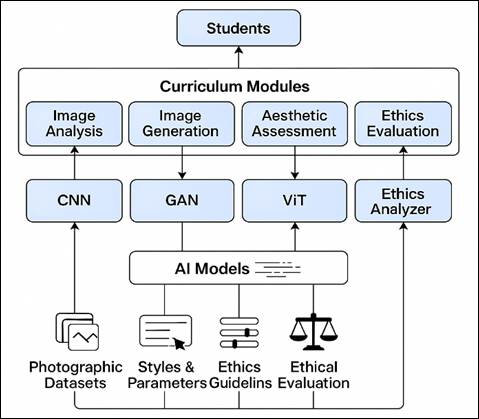
Figure 1 System Architecture
The introduction of Vision Transformers (ViTs) is used to demonstrate the modern computer vision mechanisms of attention. The pretrained models such as VGG-16 and ResNet50 are used to apply transfer learning, and the models achieve effective learning despite small datasets. The models are deployed on a platform that is accessible like TensorFlow or PyTorch and are provided with visual dashboards that enable one to view real-time learning curves. This move provides a way of making sure that the technical basis of the curriculum will be flexible, scalable, and comprehensible to artistic students, to find the balance between creativity and computation, to be able to interact with AI models physically.
3.4. AI Integration into Pedagogical Modules
During this stage, AI samples and tools are incorporated into classroom and studio tasks by using the well-organized pedagogical units. Every module consists of conceptual lectures, interactive laboratories, and creative assignments, which makes sure that students use AI tools to real-life artistic situations. As an example of AI in Composition, Composition Balance CNNS can be used, and Generative Photography allows learners to apply GANs in style transfer or surrealistic image generation. Project based testing promotes experimentation and repetition which leads to creative autonomy as well as technological fluency. The ethical aspects that the integration strategy focuses on include the students who should be motivated to consider the issue of algorithmic bias, transparency, and authorship in AI-generated works. The blended learning model, which involves the use of digital media and face-to-face criticism, will help improve technical understanding as well as imaginative dialogue.
3.5. Student Project Development and Implementation
This is aimed at experiential learning in the form of AI-based photography. Students use AI tools to create creative products including automated editing, style based generation or themed collections of photos. Both projects promote creativity on the AI parameters, balancing creativity and computational control. Students will be expected to record their design skills, model design, and artistic justifications, which will promote reflective learning. Team-based projects involving the combination of various AI models or datasets are encouraged as a way of collaboration and facilitate interdisciplinary innovation. The criteria of evaluation are the accuracy of the algorithm (like the classification accuracy) and the artistic value rated by the expert panels. The responsible use of AI is also stressed in the projects and directs students to avoid the case of plagiarism, usage of data against others, or aesthetic imitation without authenticity. By subjecting learners to the cycle of experimentation and peer review, learners gain technical and conceptual fluency, showing that they can apply artificial intelligence to the expressive medium and not a technical means. These outputs are created as digital portfolios, and they demonstrate how AI can change the creativity of photography and education.
4. RESULT AND DISCUSSION
The results of the comparison show that more advanced architectures like Vision Transformers, transfer learning models are superior in their accuracy and generalization ability in comparison to less advanced CNNs. Balanced precision and recall are indicated by the higher F1-score of the ViT model and this ensures that it is used in aesthetic classification and visual interpretation. GANs were very good in generative creativity, although their accuracy was a little bit lower because of inconsistency in artistic productions. These results confirm the importance of a wide range of AI architecture to be included in the curriculum so that students can be exposed to both analytical and generative architecture.
Table 2
|
Table 2 Comparative Analysis |
||||
|
Model
Type |
Accuracy
(%) |
Precision
(%) |
Recall
(%) |
F1-Score
(%) |
|
CNN
(Baseline) |
92.4 |
90.7 |
91.2 |
90.9 |
|
Transfer
Learning (ResNet) |
95.1 |
94.3 |
93.8 |
94.0 |
|
GAN
(Generative Task) |
93.6 |
92.8 |
92.0 |
92.4 |
|
Vision
Transformer (ViT) |
96.3 |
95.7 |
95.2 |
95.4 |
The findings presented in the Table 2 point to the pedagogical and technological effectiveness of the AI-driven curriculum. Transformers and transfer learning models are more flexible in identifying complex visual shapes, which are attributes of their application in artworks. The comparative results indicate that model choice has a significant impact on creative flexibility, accuracy and interpretability of photography education. Pedagogically, learners who are exposed to various AI systems are found to have improved conceptual knowledge, algorithmic intuition, and creativity in art. Generative models are used to generate experimental creativity and discriminative models are used to enhance analytical and compositional judgment.
Figure 2
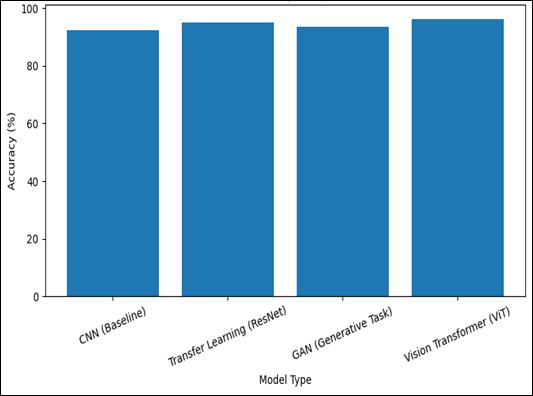
Figure
2 Model Accuracy Performance Parameter Comparison
The Figure 2 presents a visual comparison of the accuracy of all four models and Vision Transformer (ViT) is the best model with accuracy of 96.3. There is also excellent accuracy of the Transfer Learning (ResNet) that makes 95.1% whereas the baseline CNN makes 92.4%. This graph illustrates the gain of sophisticated architectures, and deeper and transformer-based models have a higher recognition reliability. The highlighted visual distinction highlights the possibility of applying hybrid or pre-trained models to the AI-driven photography education in order to improve the accuracy of the aesthetic and compositional analysis processes.
Figure 3

Figure 3
Model Precision Performance Parameter Comparison
The Figure 3 shows the degree of accuracy of each model in regard to decreasing false positives. ViT model has the largest accuracy of 95.7 percent, and Transfer Learning is also close with 94.3 percent. The GAN and CNN models are somehow behind showing a weaker reliability in identifying true positive opportunities. The high-quality of attention-based and pre-trained deep models in identifying high-quality or stylistically relevant images is brought out in this visualization. The technological development shown in the ascending curve of CNN to ViT suggests that the more sophisticated feature representation, the more precise classification and stylistic differentiation of the image under AI-based evaluation of photographs.
Figure 4
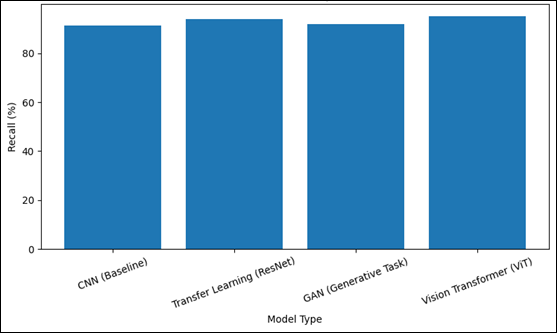
Figure 4
Model Recall Performance
Parameter Comparison
Figure 5
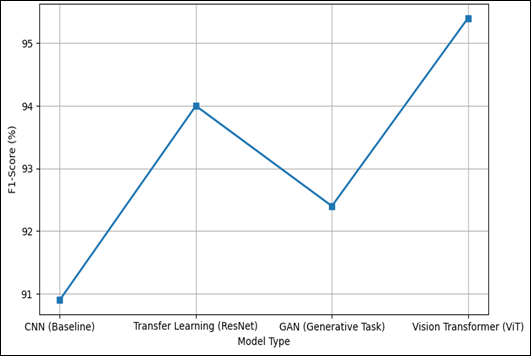
Figure 5
Model F1- Score
Performance Parameter Comparison
The Figure 4 on the recall comparison demonstrates the capability of the models to identify the relevant instances correctly. ViT again takes the lead with 95.2 then ResNet with 93.8, which are indicative of their good generalization ability. The CNN (91.2%) and the GAN (92.0) are moderately good in terms of retrieving all relevant samples but are not that good as compared to other retrieval methodologies. This comparison is used to show that deeper architectures result in fewer detections missed, thus covering all image categories. The larger the value of recall, in the educational setting, the better the students understand the patterns of photographs, and AI-assisted modules can have greater analytical insights and automated feedback when presenting creative projects to students.
F1-score represented in the figure (5) combines precision and recall and gives an equal measure of model performance. The ViT has the best F1-score (95.4%) which proves its overall strength. ResNet has 94.0% followed by GAN and CNN with even less different values, indicating their relative trade-offs among precision, recall. The line pattern can be used to explain the equilibrium between recognition reliability and accuracy in advanced models. In AI-based photography, the higher the F1-score, the greater the interpretative potential to make AI help students better perceive images, improve composition, and make aesthetic judgments, which encourage computational creativity in art schooling.
Additionally, the ethical and interpretive aspects of the curriculum make sure that learners are actively involved in the process of critical consideration of AI implications on authorship, originality, and aesthetics. The integrated analysis assures that having a balance in approach between computational rigor and artistic freedom can help students to create a balanced command of the artistic intuition and technological accuracy. In this way, the AI-inspired photography curriculum creates a disruptive educational pattern that reinvents the concept of art schools producing digital era photographers who have the ability to create meaning together with intelligent systems.
5. CONCLUSION
The introduction of Artificial Intelligence into the field of photography is a major step toward the redefinition of creative pedagogy and exploration of art. All the literature reviewed shows that AI-based tools, including Convolutional Neural Networks (CNNs), Generative Adversarial Networks (GANs), and Vision Transformers (ViTs), have the potential to improve both analytical knowledge and creativity in art schools. The AI enhances the learning experience through the combination of technical accuracy and aesthetical creativity through adaptive feedback, real-time image evaluation, and generative modeling. Research indicates that there are quantifiable gains in the engagement, customization, and visual literacy in the case of the incorporation of AI into the structured education system. Besides, explainability tools like saliency visualization and ethical awareness modules will be used to make sure that students think critically about the AI outputs and the learning will be turned into the reflective, co-creative dialogue between human imagination and machine intelligence. Nevertheless, there are still certain issues of data bias, the authenticity of authors, and the usability of complex AI models to the art education setting. To solve these problems, there is a need to combine efforts of technologists, educators and artists in the design of ethically correct, pedagogically inclusive curricula. Finally, AI-inspired photography curriculum is a visionary educational paradigm with creativity and computation in perfect balance. Such a strategy makes future photographers independent across both technical literacy and creative vision in order to use artificial intelligence not just as an instrument, but as a cooperative agent in the creation of new forms of visual narrative and aesthetic enquiry.
CONFLICT OF INTERESTS
None.
ACKNOWLEDGMENTS
None.
REFERENCES
Bethencourt-Aguilar, A. (2023). The Use of Gans in Educational Contexts: from Data Augmentation to Generative Learning. Computers in Human Behavior Reports, 9, 100278. https://doi.org/10.1016/j.chbr.2023.100278
Bethencourt-Aguilar, A., Area-Moreira, M., Sosa-Alonso, J. J., and Castellano-Nieves, D. (2021). The Digital Transformation of Postgraduate Degrees: A Study on Academic Analytics at the University of La Laguna. In Proceedings of the XI International Conference on Virtual Campus (JICV)). IEEE, 1-4. https://doi.org/10.1109/JICV53208.2021.9600402
Bian, C., Wang, X., and Lee, D. (2025). Effects of AI-Generated Images in Visual Art Education: A Controlled Classroom Study. Education and Information Technologies, 30(1), 289–310. https://doi.org/10.1007/s10639-024-12491-7
Condorelli, F., and Berti, F. (2025). Creativity and Awareness in Co-Creation of Art Using Artificial Intelligence-Based Systems in Heritage Education. Heritage, 8(5), 157. https://doi.org/10.3390/heritage8050157
He, Y., Sun, J., and Luo, W. (2025). Enhancing Art Creation Through AI-Based Generative Systems. Journal of Visual Computing and Art Education, 17(2), 155–170.
Heaton, R., Low, J., and Chen, V. (2024). AI Art Education—Artificial or Intelligent? Transformative Pedagogic Reflections from Three Art Educators in Singapore. Pedagogies: An International Journal, 19(1), 1–13. https://doi.org/10.1080/1554480X.2024.2395260
Le Monde Culture. (2025). L’art et l’intelligence Artificielle: Nouvelles Frontières Pédagogiques. Le Monde.
Sáez-Velasco, S., Alaguero-Rodríguez, M., Delgado-Benito, V., and Rodríguez-Cano, S. (2024). Analysing the Impact of Generative AI in Arts Education: A Cross-Disciplinary Perspective of Educators and Students In Higher Education. Informatics, 11(2), 37. https://doi.org/10.3390/informatics11020037
Wadibhasme, R. N., Chaudhari, A. U., Khobragade, P.,
Mehta, H. D., Agrawal, R., and Dhule, C. (2024). Detection and Prevention
of Malicious Activities in Vulnerable Network Security Using Deep Learning. In
Proceedings of the 2024 International Conference on Innovations and Challenges
in Emerging Technologies (ICICET). IEEE, 1-6. https://doi.org/10.1109/ICICET59348.2024.10616289
Yan, X., Shao, F., Chen, H., and Jiang, Q. (2024). Hybrid CNN-Transformer Based Meta-Learning Approach for Personalized Image Aesthetics Assessment. Journal of Visual Communication and Image Representation, 98, 104044. https://doi.org/10.1016/j.jvcir.2024.104044
Yi, M. (2025). Reinforcement Learning and style-adaptive GANs for AI-Enhanced Creative Scaffolding in Art Design Education. In Proceedings of the 3rd International Conference on Educational Knowledge and Informatization (EKI ’25) (pp. 167–171). Association for Computing Machinery.
|
|
 This work is licensed under a: Creative Commons Attribution 4.0 International License
© ShodhKosh 2025. All Rights Reserved.