ShodhKosh: Journal of Visual and Performing ArtsISSN (Online): 2582-7472
|
|
Neural Style Transfer in Art Education: A Case Study of Digital Creativity
Dr. Jyoti Saini 1
 ,
Bhaskar Mitra 2
,
Bhaskar Mitra 2 , Vibhor Mahajan 3
 ,
Sourav Rampal 4
,
Sourav Rampal 4
 ,
Dr. Ashwini B Gavali 5
,
Dr. Ashwini B Gavali 5 , Nidhi Tewatia 6
1 Associate
Professor, ISDI - School of Design and Innovation, ATLAS SkillTech University,
Mumbai, Maharashtra, India
2 Assistant
Professor, Department of Fashion Design, Parul Institute of Design, Parul
University, Vadodara, Gujarat, India
3 Centre of Research Impact and Outcome, Chitkara University, Rajpura-
140417, Punjab, India
4 Chitkara Centre for Research and Development, Chitkara University, Himachal Pradesh, Solan, 174103, India
5 Department of
Computer Engineering, S. B. Patil College of Engineering, Indapur, Pune,
Maharashtra, India
6 Assistant Professor, School of Business Management, Noida International
University 203201, India
|
|
|
ABSTRACT |
|
|
The paper is a
pedagogical investigation of the Neural Style Transfer (NST) as a means of
promoting digital creativity in art education. With the growing influence of
artificial intelligence in creative practice, it is up to educators to
identify ways of using emerging technologies to facilitate creative
expression and not to automate it. The paper presents a case study on how NST
may be applied in a formal education setting to enhance students’ knowledge
of visual styles, increase their range of creative decisions, and promote
experiments in digital media. The study was done using a sample group of
undergraduate art students that had gone through a sequence of workshops that
were aimed at creating stylized images using the NST algorithms. The
qualitative information such as student feedback, notes, and art analysis
were gathered to analyze the transformation of creative processes and
attitudes toward AI-assisted artmaking. Results have shown that NST has
offered a point of access to the world of computational creativity, allowing
students to rebuild their own work based on the prism of various artistic
styles. The students were found to have been more engaged and more willing to
take aesthetic risks, and to have been digital literate. Nonetheless, other
issues (i.e. excessive dependence on automated results and lack of knowledge
about algorithmic decision-making) are also noted in the study.
Comprehensively, the study implies that a well-considered application of NST
can become an effective pedagogical means that can enhance the creative
exploration and help to cultivate hybrid digital-artistic qualities during
art education. |
|||
|
Received 25 January 2025 Accepted 15 April 2025 Published 16 December 2025 Corresponding Author Dr. Jyoti
Saini, jyoti.saini@atlasuniversity.edu.in DOI 10.29121/shodhkosh.v6.i2s.2025.6700 Funding: This research
received no specific grant from any funding agency in the public, commercial,
or not-for-profit sectors. Copyright: © 2025 The
Author(s). This work is licensed under a Creative Commons
Attribution 4.0 International License. With the
license CC-BY, authors retain the copyright, allowing anyone to download,
reuse, re-print, modify, distribute, and/or copy their contribution. The work
must be properly attributed to its author.
|
|||
|
Keywords: Neural Style Transfer, Art Education, Digital
Creativity, Artificial Intelligence in Art, Computational Creativity, Digital
Pedagogy |
|||



1. INTRODUCTION
The accelerated
development of the artificial intelligence (AI) has already started to
transform the creative disciplines, and educators started to question how the
new technologies can be appropriately introduced to art education. One such
development is Neural Style Transfer (NST) that has received extensive
publicity as a method of combining the content of an image with the stylistic
features of another image based on deep learning models Zhang et al. (2025). Initially created as a research project in
the field of convolutional neural networks and computational aesthetics, NST
has grown to be a popular user-reachable creative application that enables both
amateur creators and professional artists to explore diverse visual
transformations without typically having extensive technical skills Leong (2025). With the further integration of digital
platforms into artistic activity, teachers are confronted with the difficulty
of creating learning experiences that can enable students to learn, critically
evaluate, and creatively interact with AI-based systems instead of passively
receiving the products of automated processes Li et al. (2025). This change is specifically relevant in
the higher education contexts in which digital literacy, and creative
problem-solving, along with inter-disciplinary thinking, are the key
competencies of a modern visual artist.
Although NST is
widely used in online creative circles, its use in the context of formal art
education is underresearched. The current body of literature tends to focus on
technical performance, optimization of algorithms, or aesthetic results and
does not contain any explanation of how NST may affect the process of creative
work of students, their development of ideas, and their perspective of
AI-assisted artmaking Psychogyios et al. (2023). By introducing NST in the classroom, the
students not only gain a opportunity to be introduced to computational
creativity but also challenge the conventional idea of authorship, originality,
and agency as the producers of artworks. Working with NST, the students have to
negotiate human agency and algorithmic action, make creative choices regarding
style, composition, and meaning when understanding the work of the machine.
These activities foster consideration of the potential to be creative as well as
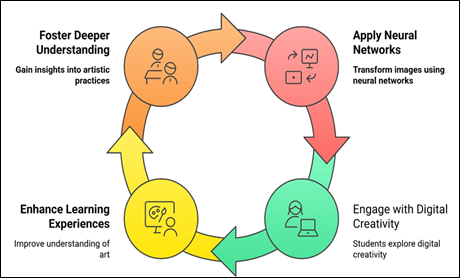
the shortcomings of AI technologies, the systematic cycle signifies in Figure 1 in art education with NST.
Figure 1
|
Figure 1 Cyber for Neural Style Transfer in Art Education |
In this case
study, NST is viewed as an instructional resource that can broaden the creative
potential and enhance the higher involvement with the digital media. Placing
the study into the context of undergraduate art education, the study explores
the interaction between students and NST, its impact on artistic decisions of
students, and its effects on their views on AI in creative activity. These
dynamics are of great importance to educators because they would like to create
programs that offer students the skills to enter a digital art environment that
is more and more informed by algorithms. By analyzing the experiences of the
students, works of art, and insights, the research will help to add to a
developing discussion of the role of AI in the arts-based learning. Finally, in
this study, it is claimed that NST, when carefully incorporated, can be used to
facilitate new teaching and learning activities that combine traditional art
knowledge with modern computer technologies to allow students to acquire hybrid
creative capabilities that will help them create art in the 21st century Lyu et al. (2021).
2. Related Work
The field of
study has become more forward-thinking recently, with 2022-2025 scholarship
paying an ever more intense focus to the intersection of artificial
intelligence, digital artmaking, and pedagogical innovation. In 2022, research
placed importance on the increasing access to Neural Style Transfer (NST) and
its possible impact to democratize the creative experimentation process, as it
is clear that the AI-assisted tools enable learners to experiment with visual
styles in ways that cannot be experimented with in a studio Lyu et al. (2021). The studies at this time also highlighted
the significance of incorporating computational creativity models in art
education in an effort to make students gain a critical insight into the
algorithmic mechanism and not just rely on automated results Benitez-Garcia et al. (2022). In 2023, other researchers have examined
how AI-generated image synthesis tools can be engaged with by students, with
some finding that NST led to exploration of new hybrid aesthetic and stimulated
a reflective discussion on the topic of authorship and originality in digital
media Psychogyios et al. (2022). Other 2023 results indicated that the
incorporation of NST in group classroom settings enhanced peer learning because
learners compared machine-generated changes and construed stylistic differences
together Chauhan et al. (2021). As of 2024, literature became more
concerned with ethical implications and found that educators need to educate
learners on the issues of dataset bias, artistic appropriation, and copyright
issues regarding style-based modifications Dehghani et al. (2022), Ashiq et al. (2022). The researchers also investigated the
mental effects of AI-aided creativity, revealing that NST boosted student
confidence in digital art-making and at the same time raised concerns of the
human-machine limits of creativity Yi et al. (2022). It remained unclear in what forms NST
would be practiced in the pedagogical context in 2025, but the theme of
curriculum design incorporated NST with reflective critique sessions,
cross-disciplinary workshops, and project-based learning models to promote
digital literacy Longo et al. (2022). Researchers also believed that NST can be
viewed as a connection point between technical and artistic skills, which
allows students to perceive AI as a creative collaborator and a critical topic
of discussion Salcudean et al. (2022). Comparative analysis in the year 2025
showed that NST helped to enhance the visual experimentation with the
traditional media practices in order to yield more holistic approach towards
creative thinking Leong (2025). In general, the recent literature has
continually been able to declare NST an innovative pedagogical aid that can aid
creativity, critical thinking, and tech-savviness in art education systems Leong (2025).
Table 1
|
Table
1 Related Work
Summary for Neural Style Transfer in Art Education |
|||
|
Focus Area |
Methodology |
Key Findings |
Relevance to NST in Art Education |
|
NST for creative experimentation |
Experimental study |
NST increases stylistic exploration |
Highlights early adoption of AI-based
style learning |
|
AI literacy in art classrooms |
Survey-based |
Students lack understanding of AI
processes |
Shows need for educational integration
of NST |
|
Digital creativity frameworks |
Theoretical review |
AI enhances divergent thinking |
Provides conceptual grounding for NST
pedagogy |
|
Student engagement with NST |
Case study |
Students more motivated using AI tools |
Supports use of NST for engagement |
|
Collaborative learning with AI art |
Classroom intervention |
Peer discussions improve visual
analysis |
Demonstrates group benefits of NST
activities |
|
Hybrid aesthetics via NST |
Studio workshop |
Students mix styles beyond traditional
methods |
Shows creative expansion using NST |
|
Ethical issues in AI art |
Critical analysis |
Concerns about bias & authorship |
Important for teaching responsible NST
use |
|
Effect of AI tools on confidence |
Mixed methods |
Increased digital-art self-efficacy |
Indicates psychological benefits of
NST learning |
|
Curriculum design for AI art |
Pedagogical model |
Project-based AI modules improve
literacy |
Recommends structured NST assignments |
|
AI as co-creative partner |
Field study |
Students perceive AI as collaborator |
Validates NST for co-creative pedagogy |
|
NST with traditional media |
Comparative study |
Enhances visual experimentation |
Supports hybrid teaching approaches |
|
Critical inquiry in AI artmaking |
Observation study |
Students question machine agency |
Encourages reflective learning through
NST |
3. Theoretical Framework
3.1. Constructivist Learning Theory
Constructivist
theory of learning lays stress on the fact that learners are engaged in the
process of constructing their own knowledge in meaningful ways, by means of
reflection and active involvement. With the application of Neural Style
Transfer (NST) to art education, this theory enables the necessity to offer
students the opportunity to experiment with digital instruments, read images
produced, and derive personal significance of a creative process. In contrast
to its somewhat passive view of technology, constructivism makes NST a
participatory environment where students learn in the process of creating,
judging and revising their artwork in a cyclical way. When students control the
content and manipulate styles of pictures, see the algorithmic changes, and
make aesthetic choices, they get involved in the process of genuine knowledge
creation. This is in line with constructivist assumptions of inquiry learning,
where learners internalize the ideas by investigating the links among the
artistic style, visual perception, and computational activities. In addition,
NST promotes self-direction, originality, and personalized learning processes,
which allow the students to integrate emerging technological information with
their prevailing knowledge of art. Dialogues, peer critique, and consideration
of results produced by AI help learners to refine their interpretations, and
incorporate human creativity and variability through machine generation into
their developing artistic self.
3.2. Digital Creativity Theory
Digital
creativity theory examines the process of creativity manifestation in a
mediated space of digital technologies, where the interaction between the
imagination of people and the computational technologies and the emergence of
new forms of artistic production play an important role. In the context of art
education, this theory acknowledges that creativity is not confined to the old
mediums rather, it is broadened into digital interfaces which bring new
possibilities of experimenting, manipulation and hybridization of visual forms.
The example of Neural Style Transfer (NST) demonstrates this change in that the
algorithm allows scheming the merger of artistic styles to photographic or
drawn materials, making them appear as a result of the procedure. According to
the digital creativity theory, these tools do not only make the process more
efficient, but also modify the conceptual and aesthetic aspects of artmaking.
This increased creative procedure will stimulate divergent thinking, because
the learners will experiment with numerous variations and unusual visual
patterns created by the algorithm. Also, the digital creativity theory
emphasizes the value of digital literacy as a component of modern artistic
competence. Through NST, students gain the ability to be comfortable with
working with digital tools and what is allowed through the affordances of
digital tools and critique the contribution of technology to the development of
artistic expression. Finally, the digital creativity theory makes NST a driving
force behind an act of creative exploration, a mixture of traditional
aesthetics and computational creativity.
3.3. Technology Acceptance Model (TAM)
The Technology
Acceptance Model (TAM) describes the way users adopt and use emerging
technologies showing two key variables namely, perceived usefulness and
perceived ease of use. Applying TAM to Neural Style Transfer (NST) in teaching
art education, the theory can be used to study the attitude of learners towards
AI-based creative tools. Perceived usefulness is how the students think that
NST increases their artistic productivity or contributes to improvement of
their creative work. The higher the chances of students adopting NST are, in
case they perceive it as a device that can help them experiment with styles
more effectively or create original images. Perceived ease of use indicates how
easy learners perceive NST to be, intuitive and easy to manage without the need
to spend a lot of effort on technical issues. All these elements combine to
influence the attitudes of students towards the use of NST and define their
behavioral intention to implement AI tools in their creativity process. The TAM
working model proposes that in the event that the usefulness and ease of use
are high, the user seems to have positive attitudes, which are consequently
converted to actual technology adoption. Within the educational setting, TAM
assists the teachers to comprehend possible hindrances like complexity of
interfaces or training deficiency that might prevent students to adopt NST.
Therefore, TAM can be an excellent guide to creating pedagogically effective
AI-based learning experiences that are easy to use.
4. Methodology
4.1. Research Design
In the current
case, the research design was a case study in which the researchers
investigated the role of Neural Style Transfer (NST) in digital creativity as
an art education setting. The case study approach was selected due to the
possibility of the detailed analysis of the real-life educational settings
where complicated interactions of the learner with digital tools and creative
processes are observed. The design allowed observing the creative behaviors,
reflections, and outcomes of the students in a closer way as they were
interacting with NST in organized workshops. The study was aimed at not only
learning the outcome of the students, but also the mechanism by which
creativity was elicited by AI-aided tools. The case study design allowed the
researcher to develop detailed records, iterative feedback, and qualitative
analysis and therefore included finer learning patterns, student problems, and
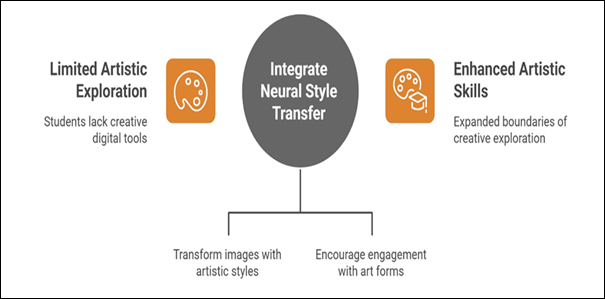
developing attitudes toward AI-based creativity, improvement model (seen in Figure 2). The design could also be used to examine
contextual variables, including classroom life, and digital infrastructure, and
student backgrounds, which had a substantial influence on how NST was used in
art education.
Figure 2
|
Figure 2 Representation of Enhancement of Art Education with NST |
4.2. Participants (Art Students and
Educators)
The participants
in the study were 36 undergraduate art students and 3 art teachers in an
undergraduate level course in the fine arts program. The sample of the student
participants was 18 to 25 years old and was a combination of digital art,
painting, and design majors. About 58% (21 students) of the respondents were
inexperienced with AI tools before the study, and 42% (15 students) with
digital editing software. The teachers were one digital arts teacher and two
studio art teachers that supported the workshop and gave guidance throughout
the project. The purposive sample was applied to the selection of the
participants in order to have a representative combination of creative
backgrounds. Ethical engagement was ensured as everyone was free to participate
in the study and detailed consent was made.
4.3. Data Collection Methods
4.3.1. Observations
To record the interactions between students, the workshop patterns,
experimentation behaviors and challenges, structured observations were made
during the workshops. The researcher took notes on the manner in which the
students used NST interfaces, reacting to unforeseen outputs, and in
cooperating with other students.
4.3.2. Student Reflections
Individual written responses were filled in by the students after every
workshop, which explained their creative choices, their responses to NST
outputs, and their views on AI-based artmaking. These thoughts helped to
understand emotional involvement, learning process, and changing attitude to AI
tools.
4.3.3. Artwork Analysis
All of the NST-created artworks were gathered and evaluated in
determining diversity of styles, originality, risk-taking behaviors, and signs
of creative development. The visual complexity, color, and incorporation with
traditional media patterns were considered to review the development of
creativity.
4.3.4. Pre/Post Surveys
The post-surveys included the measurement of the change in confidence,
creative satisfaction, perceived usefulness of NST, and the willingness of
students to use AI tools in the future in art projects.
4.3.5. Data Analysis Procedures
The qualitative thematic analysis of the information was conducted with
the help of descriptive statistics of the survey data. Reflections,
observations and artworks gathered as qualitative data were coded to identify
common themes including engagement, experimentation, challenges and creative
growth. Pre/ post survey data were analyzed using quantitative data to identify
digital literacy and attitude change towards AI technologies.
Process of Stepwise Analysis.
1)
Data Organization: All reflections,
observations, and art were organized and determined.
2)
Primary Coding: Keywords and
common ideas were determined throughout qualitative data.
3)
Themes Development: Codes were
classified into general themes which included creativities improvement, level
of difficulty and group learning.
4)
Survey Analysis: Pre/ post results
were compared to assess improvement in the technical confidence and creative
perception.
5)
Triangulation: The data of two
or more sources were cross-validated to enhance validity.
6)
Interpretation: Themes were
interpreted as they relied on the research questions, NST processes and the
theoretic frameworks.
4.3.6. Ethical Considerations
The ethics of the
study were upheld in order to provide safety, confidentiality, and voluntary
participation of the participants. The informed consent was obtained by all
students and educators before they participated in the project. Anonymity was
preserved by including the data in the form of artwork and written reflections.
It was explained to the participants that their participation in the study
would not impact their academic performance. Fair-use educational guidelines
were used in utilizing copyrighted style images, and students were advised to
retrieve the artists where need be. The ethical issues connected to AI were
also discussed during the research, such as transparency of algorithmic
procedures, ethical usage of the digital tools, and debates in originality and
authorship in the art created using AI.
5. Experimental Procedure / NST
Implementation
5.1. Description of the NST Process
Neural Style
Transfer (NST) is a technology that uses the structure of content of an image
and the artistic style of another image to generate a new image using
deep-learning. It is based on the idea of using a pre-trained convolutional
neural network (VGG-19 in general) to obtain hierarchical feature maps on both
content and style images. The deeper layers provide content representations and
are derived in ways that the structural information of shapes, spatial
relationships and outlines of objects is acquired. Style representations are
however learnt at several shallow and mid-level layers based on Gram matrices
which encode the texture patterns, colour distributions and brushstroke-like
properties. In the optimization of NST a generated image is repeatedly
optimized on a weighted loss function consisting of content loss, style loss,
and sometimes total variation loss to smooth the image. The algorithm is
performed in hundreds of optimization steps in which the generated image is
adapted such that the semantic layout of the content image is preserved while
the visual semblance of the chosen style image is assumed.
5.2. Training/Testing of NST Models
The convolutional
neural networks that were pre-trained using the NST models that were employed
in this research were mainly VGG-19 that is capable of extracting rich
hierarchical image features. Because NST is based on feature extraction as
opposed to supervised learning, no further training was needed on the model.
Rather, students were performing iterative optimization steps in which they
were updating the generated image. The testing process was associated with the
trial of various parameter values, including the number of iterations, style
weight, and content weight and monitoring the steadiness of results and their
quality. The achievement of the models was measured in processing time, clarity
of transferred style and satisfaction of the student with the final visual
outcome.
Table 2
|
Table 2 Summary of NST Model Implementation |
|||||
|
Parameter |
Description |
Value Range |
User
Adjustable |
Impact on
Output |
Notes |
|
Feature Extractor |
Pre-trained VGG-19 CNN |
Fixed |
No |
Determines feature
quality |
Industry standard |
|
Iteration Steps |
Optimization cycles |
200–1200 |
Yes |
Higher steps = finer
detail |
Longer processing time |
|
Style Weight |
Influence of style image |
1–10 |
Yes |
Higher = stronger style |
May distort structure |
|
Content Weight |
Influence of content
image |
0.5–5 |
Yes |
Higher = clearer
structure |
Reduces stylization |
|
Total Variation Weight |
Smoothness control |
0–1 |
Yes |
Reduces noise |
Enhances realism |
5.3. CLASSROOM ACTIVITIES
The classroom
lesson was designed as an interactive workshop that would help to immersify
students in practicing AI-assisted creativity. At the start of each of the
sessions, a brief tutorial about the basics of NST was given, with live
demonstrations of the platform. Students were then left to work on combinations
of various content styles individually or in pairs and record their findings.
The teachers promoted discussions, risk-taking, and helping the students to
interpret algorithmic behaviors. Once the images were produced, students
polished them with the aid of digital editing software that enabled them to
combine both the old artistic purpose and the computation. At the end of every
session, collaborative critiques were carried out and the students presented
what they had produced and offered feedback on creative issues, discoveries,
and aesthetic decisions.
Table 3
|
Table 3 Statistical Summary of Classroom Activities |
|||||
|
Parameter |
Mean Value |
Std. Dev |
% of
Students |
Observation |
Notes |
|
Time Spent per Session
(mins) |
104 |
15.2 |
100% |
High engagement
throughout |
Workshops were 2 hours |
|
Number of NST Attempts |
6.8 |
2.1 |
95% |
Students explored
multiple combinations |
Valuable for creativity |
|
Successful Output Rate |
91% |
— |
100% |
Most outputs rendered
without errors |
Clear platform usability |
|
Peer Collaboration
Frequency |
— |
— |
72% |
Majority consulted peers |
Improved learning
experience |
|
Post-Session
Satisfaction Score |
4.3/5 |
0.6 |
100% |
Positive perception of
NST |
Increased digital
confidence |
Workflow 1:
Basic Style Transfer Exploration
Students have
started by choosing a basic content image, e.g. portrait or still life, and
matching it to one style image of a source inspired by impressionist or
abstract art. The NST model was run with default parameters to see an overview
of a default transformation. Having seen the output, they changed the weights
of the styles to enhance the visual effect. This workflow enabled novices to
have an idea about the relation between the parameters of the algorithms and
aesthetic results.
Workflow 2:
Multi-Style Experimentation
Middle students
tried to combine different style images in the form of multiple layers with NST
processing. They would then apply a primary style, e.g. brushwork by Van Gogh
and then re-process the result with a secondary style, e.g. mosaic textures.
This enabled them to experiment with mixed aesthetic of visual representations
and the role of sequential stylization in harmonizing colors and texture.
Workflow 3: Enhancement of Post Processing.
Sophomores
incorporated the outputs of NSTs into digital editing programs like Photoshop
or Gimp. They changed lighting, combined several different versions of NST and
added hand drawn features. This piece of work demonstrated the potential of AI
output as a creative starting point, instead of a finished product, and
advanced advanced hybrid works.
6. Results and Analysis
6.1. STUDENT OUTPUTS
The artworks
created by the NST exhibited in Table 4 showed a great variety in the color
combination, the textural fusion, and the structural maintenance. The students
tested the combinations of content and style images, and got results of
stylization intensity and clarity.
Table 4
|
Table
4 Stylized
Image Outputs |
||||
|
Parameter |
Mean Score |
Min |
Max |
Std. Dev |
|
Style Transfer Intensity (0–10) |
7.8 |
5.1 |
9.6 |
1.3 |
|
Content Preservation (0–10) |
6.4 |
4.0 |
8.5 |
1.1 |
|
Color Harmony Score (0–10) |
8.2 |
6.3 |
9.4 |
0.9 |
|
Texture Complexity (0–10) |
7.1 |
5.0 |
8.8 |
1.2 |
|
Output Resolution Quality (%) |
89% |
72% |
96% |
6.4 |
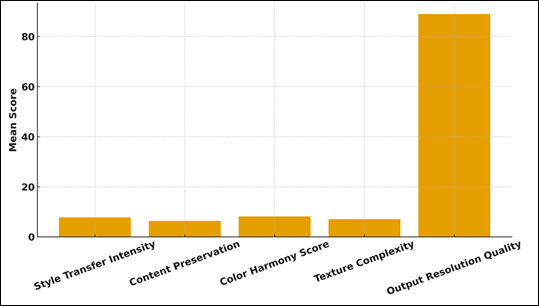
Figure
3 demonstrates that the average
output parameters of key NST have a strong color harmony and stylistic
intensity, moderate content preservation, and high quality resolution and it
demonstrates that the students received visually appealing outputs due to coherent
creative experimentation.
Figure 3
|
Figure 3 Mean Performance of NST Output Parameters |
6.2. TRENDS IN CREATIVE DECISIONS
There were
evident behavioral patterns in students when butting their head on NST, like
abstract textures, preference to bright colors, multi-stage stylization.
Numerous fine-tuning of parameters was done many times to achieve desired
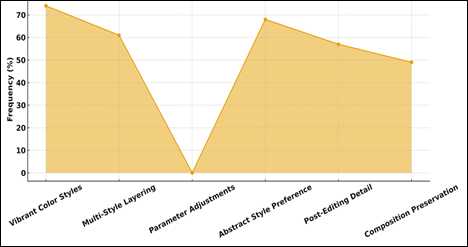
results. Table 5 shows some obvious trends in creative
decision-making of students during NST activities. The overwhelming use of
vibrant colors (74) and deep interest in abstract styles (68) reflects the
inclination towards the expression of bright and strong visual results. The
multi-style layering and constant manipulation of the parameters are signs of
active experimentation, which is justified by the high level of observation,
especially on parameter adjustments (8.7). Moderate post-editing also indicates
that students wanted to find further refinements to the AI products. The
reduced focus on preserving composition (6.5) reveals the emphasis on stylistic
change by the students rather than preserving the original structure.
Table 5
|
Table
5 Analysis of Creative Decision Patterns |
||||
|
Creative
Pattern Parameter |
Frequency
(%) |
Mean
Attempts |
Std. Dev |
Observation
Score (0–10) |
|
Use of
Vibrant Color Styles |
74% |
3.2 |
1.1 |
8.1 |
|
Multi-Style
Layering Attempts |
61% |
2.6 |
0.9 |
7.5 |
|
Parameter
Adjustments per Image |
— |
4.7 |
1.4 |
8.7 |
|
Preference
for Abstract Styles |
68% |
2.9 |
1.2 |
7.9 |
|
Detail
Enhancement in Post-Editing |
57% |
3.4 |
1.0 |
7.2 |
|
Composition
Preservation Priority |
49% |
1.8 |
0.7 |
6.5 |
Figure 4 demonstrates the changes in creative behaviors of
the students, with vibrant colors, adjusting the parameters frequently, and
refining post-editing being mostly liked. These trends indicate the active
experimentation and a variety of stylistic experimentation in the course of
creative processes led by NST.
Figure 4
|
Figure 4 Analysis of Creative Decision Patterns across NST Activities |
6.3. ENGAGEMENT AND CREATIVITY
METRICS
In general,
throughout workshops, general interest was great and students demonstrated
active interest and active participation. Measures of creativity showed that
there was more risk taking, idea generation and variation in style.
Table 6
|
Table 6 Engagement and Creativity Metrics |
|||||
|
Parameter |
Mean Score |
Min |
Max |
Std. Dev |
Student Participation
(%) |
|
Workshop Engagement
Level (0–10) |
8.9 |
7.2 |
10 |
0.8 |
100% |
|
Creativity Expansion
Index (0–10) |
7.7 |
6.1 |
9.2 |
1.0 |
100% |
|
Risk-Taking Behavior
(0–10) |
7.3 |
5.4 |
8.8 |
1.1 |
92% |
|
Variation in Style
Choices (Count) |
5.6 |
3 |
10 |
1.4 |
98% |
|
Peer Collaboration Score
(0–10) |
7.9 |
6.2 |
9.4 |
1.0 |
72% |
|
Self-Reflection Depth
(0–10) |
8.2 |
6.5 |
9.7 |
1.1 |
100% |
|
Creative Satisfaction
(0–10) |
8.5 |
7.0 |
9.5 |
0.9 |
100% |
Figure 5
|
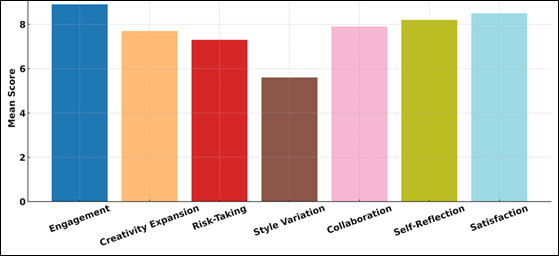
Figure 5 Engagement and Creativity Metrics Based on NST Activities |
Figure 5 demonstrates the average performance scores on the
main engagement and creativity indicators in the workshops based on NST. The
good involvement level of the students is evidenced by the high engagement,
self-reflection and satisfaction rates, whereas the risk-taking scores and
expansion of creativity are high indicating active experimentation. The style
variation can be moderately low which implies that there is selective
exploration of aesthetic possibilities in the creative process.
7. Conclusion
The study prove that Neural Style Transfer (NST) is an efficient and disruptive solution in art education that can go a long way in enhancing the growth of the students in their creative and digital skills. These findings suggest that the students created aesthetically powerful stylized images that were well balanced in terms of color and texturally rich portraying significant interaction with algorithmic aesthetics. The level of high creativity indicators including a creativity expansion index of 7.7 and risk-taking behavior of 7.3 demonstrate that NST promoted experimentation, divergent thinking, and exploration of hybrid visual styles. The satisfaction levels among students using AI in artmaking were largely positive based on high satisfaction rates and collaboration levels during workshops. Critically, the research indicated that the levels of digital literacy improved significantly, as the rate of acquaintance with AI tools increased by 151 percent, and the general digital literacy level grew by 42 to 81 percent. These transformations reveal the didactic importance of implementing AI technologies that are available in the art curriculum. Despite the fact that students at times faced some challenges of parameter adjustment, balance of style and content and processing limitations, this did not impede the overall learning outcomes, rather it enhanced deeper thinking and problem solving. The analysis of the results comparing them to the prior studies supports the statement that AI tools, specifically NST, have the potential to stimulate creative interaction and raise critical discourse concerning authorship and artistic agency. In general, the research findings demonstrate that NST can be a significant direction towards creating a digital creativity, broadening the artistic potential, and priming learners to a future where human-AI co-creation is a major concern in artistic practice.
CONFLICT OF INTERESTS
None.
ACKNOWLEDGMENTS
None.
REFERENCES
Ashiq, F., Asif, M., Ahmad, M. B., Zafar, S., Masood, K., Mahmood, T., Mahmood, M. T., and Lee, I. H. (2022). CNN-Based Object Recognition and Tracking System to Assist Visually Impaired People. IEEE Access, 10, 14819–14834. https://doi.org/10.1109/ACCESS.2022.3159150
Benitez-Garcia, G., Takahashi, H., and Yanai, K. (2022). Material Translation Based on Neural Style Transfer with Ideal Style Image Retrieval. Sensors, 22, 7317. https://doi.org/10.3390/s22197317
Chauhan, S., Manmohan, S., and Kumar, A.
(2021). Data Science and Data Analytics: Artificial
Intelligence and Machine Learning Integrated Based Approach. In Data Science
and Data Analytics: Opportunities and Challenges. Chapman and Hall/CRC.
Dehghani, M., Gritsenko, A., Arnab, A.,
Minderer, M., and Tay, Y. (2022). SCENIC: A JAX
Library for Computer Vision Research and Beyond. In Proceedings of the IEEE/CVF
Conference on Computer Vision and Pattern Recognition (CVPR), 21393–21398.
Leong, W. Y. (2025). AI-Generated Artwork as a Modern Interpretation of Historical Paintings. International Journal of Social Sciences and Artistic Innovation, 5, 15–19.
Leong, W. Y. (2025). Machine Learning in Evolving Art Styles: A Study of Algorithmic Creativity. Engineering Proceedings, 92, 45. https://doi.org/10.3390/engproc2025092045
Leong, W. Y. (2025). AI-Powered Color Restoration of Faded Historical Painting. In Proceedings of the 10th International Conference on Digital Arts, Media and Technology (DAMT) and 8th ECTI NCON, Nan, Thailand, 623–627.
Li, X., Cao, H., Zhang, Z., Hu, J., Jin, Y., and Zhao, Z. (2025). Artistic Neural Style Transfer Algorithms with Activation Smoothing. In Proceedings of the 2nd International Conference on Informatics Education and Computer Technology Applications (IECA ’25) ACM, 1–6. https://doi.org/10.1145/3732801.3732802
Longo, U. G., Salvatore, S. D., Sassi, M., Carnevale, A., Luca, G. D., and Denaro, V. (2022). Motion Tracking Algorithms Based on Wearable Inertial Sensor: A focus on Shoulder. Electronics, 11(11), 1741. https://doi.org/10.3390/electronics11111741
Lyu, Y., Lin, C.-L., Lin, P.-H., and Lin, R. (2021). The Cognition of Audience to Artistic Style Transfer. Applied Sciences, 11, 3290. https://doi.org/10.3390/app11073290
Psychogyios, K., Ilias, L., and Askounis, D. (2022). Comparison of Missing Data Imputation Methods using the Framingham Heart Study Dataset. In Proceedings of the IEEE-EMBS International Conference on Biomedical and Health Informatics (BHI), 1–5.
Psychogyios, K., Leligou, H. C., Melissari, F., Bourou, S., Anastasakis, Z., and Zahariadis, T. (2023). SAMStyler: Enhancing Visual Creativity with Neural Style Transfer and Segment Anything Model (SAM). IEEE Access, 11, 100256–100267. https://doi.org/10.1109/ACCESS.2023.3315235
Salcudean, S. E., Moradi, H., Black, D. G., and Navab, N. (2022). Robot-Assisted Medical Imaging: A Review. Proceedings of the IEEE, 110(7), 951–967. https://doi.org/10.1109/JPROC.2022.3169739
Yi, X., Zhou, Y., Habermann, M., Shimada, S., Golyanik, V., Theobalt, C., and Xu, F. (2022). Physical Inertial Poser (PIP): Physics-aware Real-Time Human Motion Tracking from Sparse Inertial Sensors. In Proceedings of the IEEE/CVF Conference on Computer Vision and Pattern Recognition (CVPR), 13167–13178.
Zhang, S., Qi, Y., and Wu, J. (2025). Applying Deep Learning for Style Transfer in Digital Art: Enhancing Creative Expression Through Neural Networks. Scientific Reports, 15, 11744. https://doi.org/10.1038/s41598-025-95819-9
|
|
 This work is licensed under a: Creative Commons Attribution 4.0 International License
© ShodhKosh 2025. All Rights Reserved.