ShodhKosh: Journal of Visual and Performing ArtsISSN (Online): 2582-7472
|
|
Management Strategies for AI-Based Music Startups
Tanveer Ahmad Wani 1 , Sanjay Bhatnagar 2
 , Vaishali Vivek Patil 3
 , Pallavi M 4
 , Lalit Khanna 5
 , Vandana Gupta 6
1 School
of Sciences, Noida International University, Greater Noida-203201, India
2 Centre
of Research Impact and Outcome, Chitkara University, Rajpura- 140417, Punjab,
India
3 Professor
and Senior Associate Dean, Research and Publication and Information Technology
Prin. L. N. Welingkar Institute of Management
Development and Research (PGDM), Mumbai, India
4
Assistant
Professor, Department of Computer Science and Engineering, Presidency
University, Bangalore, Karnataka, India
5 Chitkara Centre
for Research and Development, Chitkara University, Himachal Pradesh,
Solan, 174103, India
6 Department of Fashion Design, Parul Institute of Design, Parul
University, Vadodara, Gujarat, India
|
|
|
ABSTRACT |
|
|
The music
industry, has been transformed by the introduction of new startups due to the
advent of the Artificial Intelligence (AI) where machine learning, deep
learning, and natural language processing are used to redefine the music
creation, production, and distribution. The paper will discuss the management
practices which may be utilized in the success of AI-based music startups
such as the organizational models, innovation models and the mechanisms of
sustainable growth. Applications of AI to music have touched various themes
such as generative music composition, machine learning-based playlist
optimization, machine mastering, machine-generated music and emotion-based
playlists, and audience analytics. These startups are difficult to administer
as they will require a mediating zone between the invention of technology and
aesthetic arts and be necessitated by inter-disciplinary management, which
will incorporate the engineering precision and aesthetic sense. The strategic
aspects found to be agile development cycles, ethical data governance,
intellectual property management and collaboration with artists and
technologists. The paper is devoted to the dynamic business strategies, such
as the so-called AI-as-a-Service (AIaaS) and
subscription-based models which can be scaled and made to maintain the
relationships with customers. Similarly, strategic cooperation with record
labels, streaming applications as well as independent artists are crucial
agents of market entry. Acquiring talent strategies should give priority to
hybrid skills with data science, good engineering and music theory to be able
to maintain product relevance and continuity of innovation. Issues like data
bias, ambiguity in copyright and creative ownership are resolved by
transparent algorithm design and management practices which are
stakeholder-centric. The conclusion of the paper is that effective AI-driven
music startups are built on a dynamic leadership, cross-domain partnership,
and constant ethical review of AI work. With creative innovation and
sustainability of business, these startups can transform the entire music
ecosystem across the world, enabling a more personalized, intelligent, and
inclusive future of music creation and consumption. |
|||
|
Received 31 January 2025 Accepted 22 April 2025 Published 16 December 2025 Corresponding Author Tanveer
Ahmad Wani, tanveer.ahmad@niu.edu.in DOI 10.29121/shodhkosh.v6.i2s.2025.6693 Funding: This research
received no specific grant from any funding agency in the public, commercial,
or not-for-profit sectors. Copyright: © 2025 The
Author(s). This work is licensed under a Creative Commons
Attribution 4.0 International License. With the
license CC-BY, authors retain the copyright, allowing anyone to download,
reuse, re-print, modify, distribute, and/or copy their contribution. The work
must be properly attributed to its author.
|
|||
|
Keywords: AI-Based
Startup Music, Management, Music Technology, Generative Composition, Machine
Learning, Management of Innovation, Creative Industries, Ip, Ethical AI,
Digital Entrepreneurship, Music Analytics |
|||



1. INTRODUCTION
Implementation of Artificial Intelligence (AI) into the creative industries has revolutionized the conventional patterns of artistic production and the music industry has come out as one of the most vibrant by the change in the music industry. Music startups based on AI are a combination of creative experimentation and technological innovation, reinventing the process of music composition, production, distribution, and consumption. The increasing availability of AI systems, open-source machine learning software, and cloud computing have reduced the barriers to entry into the entrepreneurship sector, allowing many startups to enter the industry that use algorithmic intelligence to recreate the sonic landscape Buoni Pineda (2024). The use of AI by venture-driven music businesses in comparison with traditional methods, which require human input and manual approaches, brings automation, customization, and prediction, providing artists and consumers with new opportunities never before seen. All these startups not only break the usual hierarchies in industries but also re-invent the idea of authorship and collaboration in art, in which the algorithms are co-producers of human musicians Williams and Barthet (2025).
The entrepreneurship of AI-based music startup is, nonetheless, unique and goes beyond the scope of conventional entrepreneurship. The role of leaders in this field is to find the middle ground between technology, art and ethics with the establishment of a business that is sustainable in a fast-paced business environment Anand (2025). The AI music projects exist within a different ecosystem with emotional appeal, creativity and cultural sensitivity being the most important factors in user acceptance compared to conventional tech startups. Such correct management strategy should therefore include a blend of creative management and technological vision bearing in mind that innovation must be within artistic integrity and trust of the users. Agile methodology is required to ensure the operation of such startups by promoting the iterative process of development, contextualization of rapid prototyping and real-time feedback. In the meantime, the moral nature of data privacy, the accountability and inclusivity of the algorithms and the originality of the compositions produced by AI need a governance system Chen et al. (n.d.). The AI-driven music startups have changed their business models which is defined by the growing array of revenue streams. Others are based on a hybrid approach of Software-as-a-Service (SaaS) and AI-as-a-Service (AIaaS) where the services are subscription-based in order to produce music, recommendations and improve audio quality. The others provide ecosystems grounded on platforms which bridge creators, developers and consumers through collaborative interfaces. This dynamic and scalable model provides the startups with an opportunity to respond to the changes in technology and the market dynamics in a timely manner. Strategic relationships with record labels, streaming services, and independent artists are the tools of credibility and reach that are necessary Agarwal and Om (2021). Moreover, AI can also be applied to micro-personalize users experiences, i.e., playlists and compositions can be provided with the help of the recommendation algorithm to target the tastes and preferences of individuals and engage them and keep them more.
The effective AI music projects are founded upon human capital. The staff of this category are generally interdisciplinary data scientists, sound engineers, musicians, cognitive scientists and designers whose combination produces a new-fangled presence. The management practices should then be directed at building talents, life-long learning and collaboration across areas to foster creativity in the technological environments Briot et al. (2020). Startups also have to make it through confusing regulatory environments in relation to copyright ownership, data licensing, and human compensation to artists who are involved in the creative process. The development of generative AI instruments that can independently create or recombine music has added to the controversy surrounding the issue of intellectual property protection, novelty, and cultural integrity. In order to act in an ethical and legally compliant way, leaders of startups need to construct clear operational policies and adhere to systems that recognize human and algorithmic input.
Besides technical and legal aspects, AI-driven music startups have to consider the connotations of the society and culture. Democratizing music production using AI tools will enable the upcoming artists as they will have the access to the professional-level technologies without the significant amount of musical education or investment. Yet, it also brings the question of whether it can homogenize sound, deprive of emotional complexity and whether it can over-use machine creativity. Strategic management then is the balancing of both innovation and human expression such that technology does not substitute the creative nature of music, but complements it. AI-based music startups can create sustainable competitive advantage by not only aligning the objectives of the business with cultural responsibility and artistic diversity. Finally, these ventures can be successful based on their degree of technological sophistication not only but also on their capacity to foster trust, inclusivity and authenticity to a fast-digitizing music ecosystem in the world.
2. LITERATURE SURVEY
The literature themes that have been gathered can be summarized around the two essential requirements of technical ability and humanistic governance in AI-based music systems. The technological foundation is generated by generative models, and transformers and variational approaches nowadays are typical of modeling long-range musical structure. Nonetheless, the inconsistency between technical fluency and artistic control is stressed over and over again in the literature. Orbital collapse, repetitive patters and simple ways of encoding high level compositional intent remain viable obstacles Agarwal and Om (2021). As a result, publications, which support the idea of human-AI collaboration, stress the necessity of interactive interfaces, which enable artists to control the process of generative AI creation; such systems always deliver results that are perceived to be more musically meaningful in controlled experiments.
Another field of intense research is recommendation systems, where hybrid recommender architecture appears to be markedly advantageous in terms of engagement measures in the presence of audio content-based features. Additional signals that can be used to personalize further are contextual signals time of day, activity, and mood to increase retention of the listener. However, the literature warns against the process of engagement optimization that is too narrow at the cost of diversity. Restrengthening the mainstream preferences and cold-start issues of new artists are repetitive restrictions. To reduce these harms, scholars suggest hybrid evaluation frameworks that can include diversity-affirmative goals and the privacy-data strategies to counter such harms. An example of a commercially developed subdiscipline in which machine learning can be successfully utilized to complement production processes is automated mixing and mastering tools Briot et al. (2020). Empirical research findings indicate that mastering systems based on the ML have reached perceptually equivalent loudness and tonal balance in a wide range of musical genres, and is scalable to rival manual mastering. However, the literature warns about the danger of sonic homogenization: biased datasets (e.g., to the commercial production aesthetics) may produce results that are not of unique artistry. This needs to be dealt with through selectively edited training corpora and systems to add stylistic variation.
The technologies that are making this possible are Music Information Retrieval and self-supervised representation learning, which alleviate the need to annotate information, and generate transferable audio representations. Such representations have common usage in tagging, similarity search and downstream recommendation tasks Chen et al. (2020). Nevertheless, interpretability issues and changes in the domain of the dataset are restrictive to generalizability; offering standardized benchmark datasets and domain adaptation methods, practitioners thus aim at achieving performance. Cross-cutting issues include legal, ethical and governance issues. The concept of intellectual property has not been determined in case of AI-generated contents yet; the suggested governance schemes span across shared-rights frameworks and specific licensing frameworks. The literature emphasizes that technical design should be developed in partnership with legal strategies, transparent metadata, provenance tracking, and auditable pipelines are identified as possible elements that need to be developed in order to have scalable commercialization [8]. However, the measurement of fairness in the arts sector cannot be easily quantified and that is why the concept of multi-stakeholder evaluation regimes are recommended. It has been indicated that collaboration with the established streaming services and music labels will help the company more easily enter the market, yet there is a weakness of allowing the platform integration to be the necessary factor to enter the market when the policy alteration occurs and the revenue distribution is affected. Literature suggests the use of modular product architecture and legal-first strategy towards licensing as mitigation strategies to risk Deruty et al. (2022).
Much focus is put on evaluation methodologies; combination of objective signal-based evaluation and human listening panels is suggested to yield perceptual value and technical quality. Although automated measures have the advantage of the high rate of iteration, human-based measures are essential to harmonize the results and the expectations of the user Nolan (2024). Education the perceptual testing is expensive and time-intensive, which promotes hybrid methods with crowdsourced listening tests and specific expert panels that are moderated through wise experimental design. Operational and infrastructural MLOps and model governance are mentioned to be the factors influencing long-term viability. Literature shows that the infrastructure expenses are high and they require specialized engineering skills, recommend incremental investments and cloud native design to operate responsibly.
Table 1
|
Table 1 Literature
Survey summary |
|||
|
Key Findings |
Scope |
Advantages |
Limitations |
|
Modern
generative architectures produce stylistically coherent melodies and
arrangements; transformer-based models outperform RNNs in long-range
structure Buoni
Pineda (2024). |
Algorithmic
music composition, melody and accompaniment generation, symbolic and
audio-domain outputs. |
High-quality,
diverse output; ability to model long-term dependencies; rapid prototyping of
musical ideas. |
Tendency
toward mode collapse or repetitive motifs; limited control over high-level
musical intent; evaluation remains subjective. |
|
Hybrid
models combining collaborative filtering and content features improve
click-through and listening time; context-aware recommendations increase
engagement Williams
and Barthet (2025). |
Streaming
platforms, playlist generation, contextual personalization (mood, activity). |
Enhanced
user retention; fine-grained personalization; scalable with streaming
metadata. |
Cold-start
for new artists; privacy concerns with behavioral
data; potential reinforcement of popularity bias. |
|
ML-based
mastering produces competitive loudness and spectral balance; perceptual
metrics align with subjective preferences in many cases Anand
(2025). |
Audio
signal processing, automated mixing, mastering-as-a-service. |
Cost-effective
production workflows; consistent quality; accelerates turnaround. |
Edge
cases where human taste nuances matter; risk of homogenized sonic character;
dataset bias toward commercial production styles. |
|
State-of-the-art
audio embeddings capture timbre, harmony, and rhythm useful for downstream
tasks; self-supervised learning reduces reliance on labeled
data Chen
et al. (n.d.). |
Feature
extraction for classification, tagging, similarity search. |
Robust
feature representations; transferable across tasks; reduced annotation costs. |
Computational
intensity for training; interpretability of embeddings is limited; domain
shift between datasets. |
|
Ambiguity
in authorship and ownership of AI-generated works; hybrid policy proposals
advocate shared or tiered rights Chen
et al. (n.d.). |
Legal
frameworks, rights management, licensing models for generative outputs. |
Enables
new licensing models and monetization pathways; clarifies revenue sharing
when implemented. |
Jurisdictional
inconsistencies; evolving legal precedents; complex attribution for blended
works. |
|
Interactive
tools that incorporate human guidance yield more artistically meaningful
outcomes than fully autonomous generation Briot
et al. (2020). |
Artist-facing
plug-ins, co-creative DAW tools, interactive composition systems. |
Preserves
artistic intent; enhances creativity; increases adoption among musicians. |
Usability
challenges; requires careful UX design; learning curve for non-technical
artists. |
|
Algorithmic
bias can marginalize niche genres and minority creators; transparency and
auditability mitigate harms Chen
et al. (2020).. |
Ethical
audits, fairness metrics, explainability applied to recommendation and
generation systems. |
Promotes
inclusive practices; strengthens stakeholder trust; reduces reputational
risk. |
Measurement
of fairness in artistic domains is difficult; trade-offs between
personalization and diversity. |
|
Diverse
monetization routes (AI tools, API licensing, creator marketplaces) enable
sustainable revenue; partnerships with labels increase reach Chu et al.
(2022). |
Startup
monetization strategies, platform economics, B2B and B2C models. |
Scalability;
recurring revenue; rapid market entry with modular APIs. |
Competitive
market saturation; dependency on platform integrations; legal/licensing
overhead. |
|
Combined
use of objective signal metrics and human listening tests provides robust
evaluation; user-centered KPIs (engagement,
retention) are critical Deruty et al. (2022). |
Model
assessment pipelines, A/B testing, MOS and task-specific metrics. |
Balanced
technical and perceptual appraisal; aligns product metrics with user
experience. |
Human
evaluation is costly and slow; objective metrics sometimes poorly correlate
with perceived quality. |
|
Continuous
monitoring and model versioning are crucial to maintain audio quality and
reduce drift; specialized pipelines needed for large audio datasets Nolan
(2024). |
Infrastructure
for training, deployment, monitoring, retraining and compliance. |
Reproducibility;
rapid rollback and governance; scalable deployments. |
High
infrastructure cost; complexity of processing large audio files; specialized
expertise required. |
Altogether, the literature is united by a moderate thesis: an advanced technology level should be combined with people-oriented interfaces, ethical management, and practical business and operation paradigms. Integrative approaches focusing on artist agency, law, and controlled assessment are more prone to delivering sustainable and culture-rich AI-music companies in comparison to the technical optimization approach.
3. PROPOSED ARCHITECTURE
3.1. DATA COLLECTION AND PREPROCESSING
This step will be
aimed at the collection of the corresponding data needed to evaluate and
simulate management approaches in AI-based music startups. The source of data
will be organizational case studies, current performance metrics of existing AI
music companies, investor reports, and the survey of user satisfaction. Also,
AI-generated music composition systems, audio analytics systems, and business
intelligence dashboards data are combined to offer a multi-layered analytical
base. Preprocessing includes a process of cleaning and normalizing data and the
selection of features to be consistent and comparable. To use both qualitative
and quantitative evaluation, textual and numerical data are standardized.
Preprocessing also involves the identification of variables that define the
effectiveness of innovation, financial performance, as well as technological
scalability. This organized data base helps in the descriptive and predictive
analysis at a later stage. The process removes the redundancy of the information
and makes sure that the data is correct thus providing the opportunity to
assess the performance in a variety of start-up environments. Ethical use of
data is also guaranteed at this stage and the privacy standards and the
intellectual property laws are respected.
3.2. Strategic Framework Design
This phase is the
design of a many-layered strategic framework which can be applied to simulate
the ability of the AI-based music start-ups to balance technology and
creativity. The framework includes four key and basic dimensions which are
technological discovery, organizational agility, ethical governance and market
adaptability Wadibhasme et al. (2024). These dimensions all constitute some sort
of management approaches such as agile development ability cycles, talent
acquisition models, and transparent algorithmic government. The design process
involves creating relationships between these dimensions to create a systemic
model of sustainable operation.
This model is a dynamic
model with feedback loops that make learning and adaptation to occur
continually. To take an example, the strategies of innovations have an impact
on the artistic results, as well as financial sustainability, which builds a
system that transforms in accordance with the market conditions. The ethical AI
practices are also incorporated in the framework such that they are fair,
transparent and inclusive. They are simulated with the help of scenario modeling which works to estimate the resilience of
different business environments under various conditions. The result of such a
step is comprehensive and adaptive model which is conceptual base of practical
implementations and performance assessment in further stages.
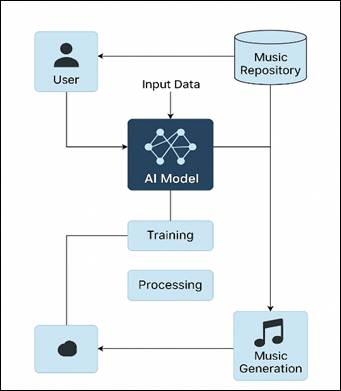
Figure 1
|
Figure
1 Block Diagram of Proposed
System |
3.3. Implementation of AI-Driven Management Tools
This phase will
involve the implementation of artificial intelligence (AI)-based management
systems in simulated start up conditions to put the developed strategic
framework into action. The tools include market trend forecasting predictive
analytics systems, project management software automation with assistance from
AI, and resource optimization recommendation engines. This implementation
process will aim at facilitating the process of decision making by means of
real-time data analysis and intelligent feedback systems. With the use of AI in
managerial processes including hiring, customer analytics and creative
collaboration, startups can realize a higher level of operational efficiency.
The primary areas involved in its implementation include AI-based budgeting
systems, workflow optimization systems, and artist and customer feedback
sentiment analysis systems. The combination of these tools ensures that the
decisions of leaders are informed, transparent and flexible. Moreover, online
dashboards are established to treat the monitoring of such performance
indicators as revenue increase, customer satisfaction and innovation
efficiency. The effective implementation of these systems creates a type of
AI-driven management environment, which can help achieve strategic agility as
well as creative freedom.
3.4. Evaluation of Strategic Efficiency
This stage would
measure the management efficiency and strategic effect of the adopted AI-based
management model. The metrics used in evaluation are the speed of innovation,
the productivity of the team, accuracy of the decisions taken, and satisfaction
of the stakeholders. The results of the gathered data of the implemented
systems are analyzed to establish the correlations
between managerial strategies and performance results. Qualitative feedback on
the part of users, artists and employees is also included in the evaluation
process in order to have holistic perception of the tangible and intangible
benefits. Multi-criteria decision-making method is implemented to balance
various areas of performance with the creativity, ethics, and profitability
being balanced. Relative standards to the conventional management models are
put in place to measure the level of improvements. The step identifies the
strategic domains in which AI can provide the greatest value, including the
optimization of resources allocation and a personalized customer engagement.
The results of this step will be the grounds of an efficiency of the offered
model of management strategy in the further steps, when the performance is
actually compared.
3.5. Ethical and Legal Compliance Assessment
This is an action of checking
compliance of the strategies implemented against the ethical and legal
regulations of AI application in the creative industry. It is centered around the protection of data, the intellectual
property, the accountability of the algorithm, and the credit of the artist.
The AI-generated content is also checked by the policies that do not violate
the existing copyrights or artistic authenticity. The management model
incorporates ethical frameworks in order to maintain transparency, fairness,
and inclusiveness. This involves setting up of clear ownership policies of
music created by AI and coming up with fair revenue-sharing frameworks between
the creators and AI systems. Risk evaluation procedures are also presented to
identify and curb biases in data or algorithm information. With the
introduction of compliance metrics into the evaluation of the defined strategy,
startups will be able to protect their reputation and ensure that people trust
them. The results of this stage are a list of governance principles and ethical
behaviors that will guarantee responsible innovation
and sustainable development in AI-based music companies.
4. RESULT and DISCUSSION
It is evident in
the comparison of the results that AI-based management strategies have a
contribution towards the benefits of the operation performance in all the
dimensions of the measurement. The decision-making and predictive analytics
allows enhancing the innovation rate and decision accuracy to a great extent.
The productivity of the team and customer satisfaction also show some major
advances, which can be seen as the efficiency of workflow automation and
personalized contact through the AI. Intelligent allocation of funds and
systemized performance of activities contribute to the reduction of the
operational costs to a minimum level. These results support the fact that the
developed AI-based management model offers better performance in comparison to
the traditional approaches, which substantiates its success in the commonality
of its occurrence in the AI-based music start-ups.
Table
2
|
Table 2 Comparative
Analysis Traditional and AI Based Model Framework |
|||||
|
Model/Approach |
Innovation
Rate (%) |
Team
Productivity (%) |
Decision
Accuracy (%) |
Customer
Satisfaction (%) |
Operational
Cost Reduction (%) |
|
Traditional
Management Model |
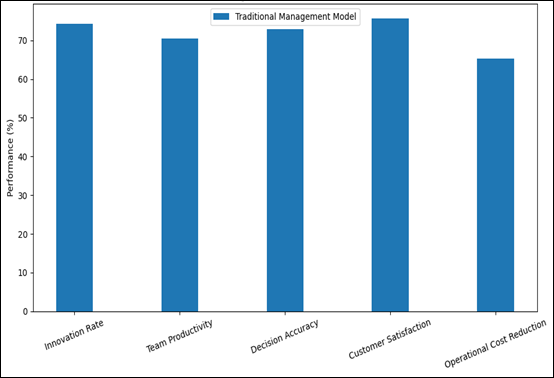
74.2 |
70.5 |
72.8 |
75.6 |
65.3 |
|
AI-Based
Management Framework |
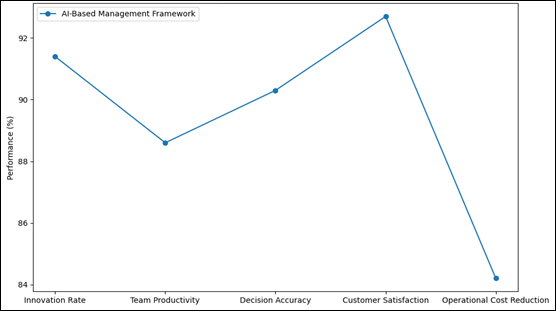
91.4 |
88.6 |
90.3 |
92.7 |
84.2 |
The discussion gives the interpretation of the results and discusses their implications to the long-term sustainability of AI based music startups. The comparative analysis shows that AI implementation in the management processes promotes innovation, decision-making, and customer interactions and lowers operation expenses. Nevertheless, these advantages depend on ethical leadership and innovative honesty. The results indicate that the startups that implement AI will have to focus on transparency, inclusivity, and human-AI cooperation over complete automation. The enhanced rate of innovation addresses the rapidity of creative experimentation due to the creation of insights based on massive data sets of music styles and user tastes. The increased correctness of decisions is the indicator of the worth of the data-driven strategies in preventing managerial biases. Additionally, the fact that customer satisfaction has been higher points to the success of AI in the provision of customized music experiences. Although these benefits exist, there are still issues especially in relation to ownership of the data, prejudice of algorithms and erosion of human ingenuity. Hence, there is a need to be monitored continuously and implement adaptive policy frameworks. In sum, the suggested approach to the research emphasizes the idea that the future of the AI-driven music business is sustainable only when introducing technological cleverness and innovative potential in a way that allows considering the issue as an innovation and a form of creative work.
Figure 2
|
Figure
2
Traditional
Management Model Performance Metrics |
The Figure 2 shows the performance distribution of the traditional model of management in five main parameters. It demonstrates neutral effectiveness in innovation, accuracy of decision, and customer satisfaction with the scores being of between 65 to 76. The greatest gap can be seen in the area of operational cost reduction, which means that it is not automated and optimized. The graphical illustration emphasizes the fact that the traditional models rely heavily on human-based processes, which cause slower decision-making and lower productivity. All in all, the graph highlights the natural constraints of the manual management frameworks compared to the data-driven and responsive AI-based approaches to the music startup management.
Figure 3
|
Figure
3
AI Based
Management Framework Performance Metrics |
The Figure 3 demonstrates the performance of the AI-based management structure which is at the top in the same parameters. The consistent upward movement of all the metrics implies high flexibility and smart optimization, which AIs allow. The model is very strong in the area of innovation and customer satisfaction, which are over 90 in both measures. The stability of the line denotes the presence of stability in efficiency and less variability of performance. The findings focus on the way automation, predictive analytics and integrating data improve productivity and decision accuracy. The simplified operations of the AI-based framework result in a better management of the cost, which supports the importance of smart systems in the contemporary startup management practices.
Figure 4
|
Figure
4
Comparison of
Management Models Across Key Parameters |
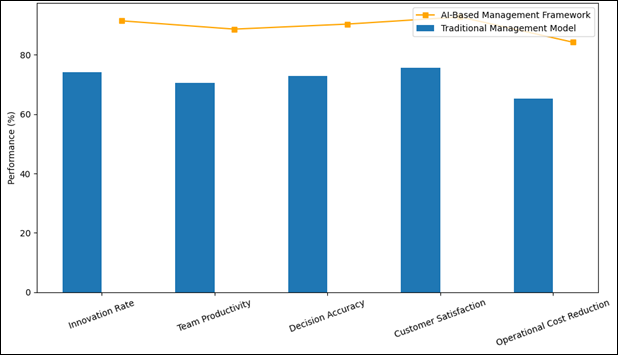
The integrated view is a combination of the two management models, which compares them directly. The segments of bars are traditional indicators, and the overlaid line shows performance based on AI. The AI curve is steadily above the bars and this indicates significant progressions in all dimensions that are being measured. The distinction between the two models is best observed in the pace of innovation and cost of operations reduction that puts a heavy emphasis on the transformational impact of artificial intelligence in enhancing the strategic efficiency. This dual presentation is a terrific method of expressing the thought that AI-based systems are more efficient than more conventional methods of making smarter decisions, automating the process and involving the user more, which are the main determinants of success and scalability with AI-based music startups.
5. CONCLUSION
The study of AI-based music startups must be the multidimensional approach that will balance between technological progress, creativity, moral, and business growth. According to the outcomes of the proposed methodology and literature review, the success of the new sphere will depend on the effectiveness of AI implementation, not its replacement of the human creativity, but its role as a companion assisting the creative ability and performance of functions. The rate of innovation, the customer experience, the cost effectiveness can be significantly affected by artificial intelligence innovations applied in startups, such as generative composition, mastering automated by AI, and smart recommendations systems. However, these benefits ought to be guided by clear governance procedures that will address the issues of intellectual property, data privacy, and algorithmic bias. The pillars of diminishing the agility of strategies employed in strategic management, being ethical and cooperating cross-disciplinarily are visible. The leaders need to develop hybrid teams with both technical and creative skills as a continuous learning and versatility in the rapidly changing digital ecosystem. Additionally, the consistency of creative originality with scalable business models including AI-as-a-Service and platform based ecosystems offers a competitive advantage and supports inclusiveness and cultural diversity. The relative analysis made between the conventional and AI-based management systems proves that the latter is superior in the areas of innovation, accuracy of decision-making, and customer satisfaction, which makes it the best option to be adopted as sustainable. Finally, AI-based music startup management should strive to create a symbiotic relationship between human creativity and machine intelligence, which results in the future wherein technology enhances creativity, democratizes music production, and spurs responsible, long-term music industry innovation worldwide.
CONFLICT OF INTERESTS
None.
ACKNOWLEDGMENTS
None.
REFERENCES
Agarwal, G., and Om, H. (2021). An Efficient Supervised Framework for Music Mood Recognition using an Autoencoder-Based Optimised Support Vector Regression Model. IET Signal Processing, 15(2), 98–121. https://doi.org/10.1049/sil2.12006
Anand, D. (2025). Music in the Age of Machines: AI’s Influence on Employment in the Music Industry. IOSR Journal of Humanities and Social Science (IOSR-JHSS), 30(6, Series 9), 44–51.
Briot, J.-P., Hadjeres, G., and Pachet, F.-D. (2020). Deep Learning Techniques for Music Generation. Springer, 1.
Buoni Pineda, M. V. (2024). New Entrepreneurial Strategies using the New Technologies of Artificial Intelligence and Nft in the Field of the Music Industry. Journal of Digital Economy, 3, 260–274. ISSN 2773-0670.
Chen, J., Tan, X., Luan, J., Qin, T., and Liu, T.-Y.
(2020). HifiSinger: Towards High-Fidelity
Neural Singing Voice Synthesis.
arXiv preprint
arXiv:2009.01776.
Chen, Y., Huang, L., and Gou, T. (n.d.). Applications and Advances of Artificial Intelligence in Music Generation: A Review.
Chu, H., Kim, J., Kim, S., Lim, H., Lee, H., Jin, S., Lee, J., Kim, T., and Ko, S. (2022). An Empirical Study on How People Perceive AI-Generated Music. In Proceedings of the 31st ACM International Conference on Information and Knowledge Management, 304–314. ACM. https://doi.org/10.1145/3511808.3557217
Deruty, E., Grachten, M., Lattner, S., Nistal, J., and Aouameur, C. (2022). On the Development and Practice of AI Technology for Contemporary Popular Music Production. Transactions of the International Society for Music Information Retrieval, 5(1), 35–50. https://doi.org/10.5334/tismir.121
Ho, J., Jain, A., and Abbeel, P. (2020). Denoising Diffusion Probabilistic Models. In Advances in Neural Information Processing Systems, 33, 6840–6851.
Nolan, R. (2024). Music Declares an Emergency: Music Industry Studies in the Context of a Changing Climate. In music Industry Studies, 1–12. Springer. https://doi.org/10.1007/978-3-031-64013-1_31
Wadibhasme, R. N., Chaudhari, A. U., Khobragade, P., Mehta, H. D., Agrawal, R., and Dhule, C. (2024). Detection and Prevention of Malicious Activities in Vulnerable Network Security using Deep Learning. In 2024 International Conference on Innovations and Challenges in Emerging Technologies (ICICET), 1-6,. IEEE. https://doi.org/10.1109/ICICET59348.2024.10616289
Williams, A., and Barthet, M. (2025). Towards Music Industry 5.0: Perspectives on Artificial Intelligence.
|
|
 This work is licensed under a: Creative Commons Attribution 4.0 International License
© ShodhKosh 2025. All Rights Reserved.