ShodhKosh: Journal of Visual and Performing ArtsISSN (Online): 2582-7472
|
|
A NAVARASA BASED ANALYSIS OF SONGS FROM THE MOVIE LAGAAN
R. Sailaxmy 1 , Dr. Prabakaran V. 2
1 Research
Scholar, Department of Journalism and Mass Communication, Faculty of Science and
Humanities, SRM IST, Ramapuram, Chennai, India
2 Professor and Head - School of Media Studies, Faculty of Science and Humanitie, SRM Institute of Science and Technology, Ramapuram, Chennai, India
|
|
|
ABSTRACT |
|
|
The necessity
for sound in a film is undebatable. Music, as sound, can be diegetic and
non-diegetic depending on the demands of the story. Music also plays a
pivotal role in Indian films as it happens to be an integral part of our
culture and audience. It enhances the emotions and adds magic to the overall
output of the scene. Despite holding tremendous importance, film music has
not been studied adequately. This paper seeks to analyse
how music enhances the scenes in films. This analysis will be carried out
through the Navarasa Theory from the Natya Shastra. This theory seeks to facilitate our
understanding of the emotions that the songs convey to the scene. Every Rasa
has got certain Ragas or tunes that convey its appropriate mood. The study
shall also draw parallels between these Ragas, their pertaining Rasas and the
scenes in the film to understand the correlation between the three. Songs
from the movie Lagaan – Once Upon a Time In India,
have been selected for the study. |
|||
|
Received 22 February 2025 Accepted 16 May 2025 Published 16 December 2025 Corresponding Author R. Sailaxmy, sr4180@srmist.edu.in DOI 10.29121/shodhkosh.v6.i2s.2025.6689 Funding: This research
received no specific grant from any funding agency in the public, commercial,
or not-for-profit sectors. Copyright: © 2025 The
Author(s). This work is licensed under a Creative Commons
Attribution 4.0 International License. With the
license CC-BY, authors retain the copyright, allowing anyone to download,
reuse, re-print, modify, distribute, and/or copy their contribution. The work
must be properly attributed to its author.
|
|||
|
Keywords: Bollywood, Hindi Cinema, Navarasa
Theory, Indian Classical Music, Hindustani, Carnatic, Ragas |
|||



1. INTRODUCTION
The dual purpose of arts is to entertain and to educate and Films are no exception to this notion. Often, we walk into a theatre with the sole motive of being entertained and walk out feeling more educated. Thus, films have faithfully served Indian society for over a century now. An integral part of Indian films is music which can be in the form of songs, background music or film theme songs. Music played an important role in Indian cinema distinguishing it from the rest of the world. It not only gave a very unique character to Indian cinema but also bestowed it a different identity in world cinema. Talented lyricists, music composers, dynamic singers enriched Indian cinema with different musical genres Kaur (1936). In Indian cinema, songs enable the depiction of emotions and scenes that even dialogues may fail at. Sometimes, over a span of three to four minutes, a song may depict a child grown into an adult or two people falling in love and being married. Although it may be unrealistic, the audience understand and enjoy the montage with the songs. That said, the existence of songs is commonly justified with similar arguments, scholars reminding their reader that music is a part of the Indian and social culture. This justification only goes so far as the presence of songs in the narrative but stops short of saying that the songs are an interactive part of the narrative as a whole Lal (2019). This paper seeks to study the use of music in the Hindi movie Lagaan, directed by Ashutosh Gowariker in 2001, by enhancing the emotions in scenes and trying to analyse the songs with the help of Navarasas. The navarasas are nine different types of emotions mentioned in the Naatya Shastra that was scripted by Bharata Muni. The nine different Rasas or emotions are Shringara (love/beauty), Hasya (laughter), Karuna(sorrow), Raudra (anger), Veera (heroism/courage), Bhayanaka (terror/fear), Bibhatsa (disgust), Adbutha (surprise/wonder), Shantha (peace or tranquility).
1.1. ROLE OF MUSIC IN HINDI CINEMA
The role of music in Indian Cinema is vital and Hindi Cinema is no exception. The Hindi film song has been an integral and integrated part of a Hindi film’s script. It not only exists in a musical Hindi movie but is also used as a narrative device in films of every genre from comedies and romances to crime thrillers and horror films, most of which, routinely, may have five or more songs. The lyrics of songs are used to convey progressions in sequence and character moods much more succinctly than volumes of dialogues and visual sequences, accompanied by vocal music backed by an appropriate orchestral tenor in both popular and art-house Hindi movies Vijayakar (2013). The songs are able to connect to its audience individually despite the vast number of listeners of various genres. The large scale of production, distribution and consumption of film songs make this category a ‘wonder’ in popular culture Dhole (2017). This popular genre of Hindi film music that is enjoyed by the audience today initially stemmed out of Hindustani classical form in the 1930s – 1940s. Hindi film music is produced for the masses which also broke the notion of elite entertainment. Hindi film songs’ role became visible in every aspect of Indian culture. As a new genre, it assimilated the aspects of classical music, western music and popular music Kaur (2021). Of late, the influence of Western music on Hindi film music has been greater with most of the youngsters enjoying western music predominantly due to globalization. Interjection of westernization in Bollywood opening up many new and experimental music, as per the time is changing the industry of Hindi Film Music is prepared to evaluate the involvement of young and experimental artists Bhateja (2015).
1.2. RAGAS
The Indian classical music can be classified into the Carnatic school and Hindustani school. The Classical Music tradition followed in India’s Northern region is known as Hindustani, while tradition followed in the Southern region is Carnatic. This distinction of music was observed around the 16th century. Both aspects were evolved from a common ancestor. Bhakti Movement gave birth to Carnatic strain while Hindustani strain during the Vedic phase Sharma et al. (2021). Both these forms of Indian Classical music are made of Raga and Tala. In simple terms, Raga is nothing but tune or melody. There are hundreds of Ragas in classical music. In the Hindustani school of music, the ragas were organized into Thaats. Thaats – similar to “modes” in Western music – are musical scales or frameworks for classifying ragas based on the notes used in the raga Bhattacharjee and Srinivasan (2011). In the Carnatic school of music, the Raagas are classified into Janaka or Melakartha Ragas and Janya Ragas. They are the 72 Janak Ragas or Parent Ragas also called complete Ragas and the Janya Ragas or Child Ragas Kaimal and Barde (2018).
1.3. NAVARASA
Navarasa or nine emotions is an ancient Indian concept that was written by Bharata Muni in the Natyashastra. A manuscript, a work of literary significance and of the highest importance for a deeper insight on navigating
into the world of Indian drama, dance and music is Natya Shastra. This was authored by Sage Bharata around the 2nd C. BCE. This is a very important veda for artists and learners as it is the factor that brings the classicism in the foreground while looking at Indian classical dances Nandan and Rele (2022). Rasa is the final or lasting state of emotion born from the union of the play with the performance of the actors, as realised by the audience Roy (2012). These nine emotions are evoked in various performing arts like dance, music and drama. The nine different Rasas or emotions are Shringara (love/beauty), Hasya (laughter), Karuna(sorrow), Raudra (anger), Veera (heroism/courage), Bhayanaka (terror/fear), Bibhatsa (disgust), Adbutha (surprise/wonder), Shantha (peace or tranquility). From the sets, to the kind of performance, importance of song and dance, evocation of emotions, costumes and performance of characters; how a certain story or character should be performed. Indian classical arts and folk-art both take its roots from Natyashastra Arya and Verma (2021).
2. REVIEW OF LITERATURE
In order to understand the topic better, some existing literature was reviewed. Music played a very significant role in the growth of Indian cinema. It not only gave a very unique character to Indian cinema but also bestowed it a different identity in world cinema Kaur (1936). The paper takes us through a detailed history of music in Indian Cinema. Lal discusses the role of songs in Indian films and how the songs are intertwined into the film narratives. This justification only goes so far as the presence of songs in the narrative but stops short of saying that the songs are an interactive part of the narrative as a whole Lal (2019). While talking about the role of Hindi songs, Vijaykar provides a historical perspective on the beginning of Hindi songs and sheds light on some of the greatest legends of the Hindi film music fraternity. In a country accustomed to folk and classical music (with huge diversities across states and languages), the audiences now got to hear their simpler, hum-worthy variants in the movies. Hence film songs became instantly popular Vijayakar (2013). Dhole discusses the blend of modernism and its aspects in Hindi film songs with reference to an urbanized, city lifestyle with respect to the lyrics. The most dominant theme of such negotiation in India is its project with modernity and an important site of manifestation of this project is the modern metropolis. Therefore, the representation of modern, industrial and secular metropolis in HFS can be constructed as an indicator of the deeper negotiations with modernity in India Dhole (2017). Kaur writes about the historical evolution of hindi film music and the impact it has on the common man and silently becomes a part of our culture and daily life of the people. Since earlier times, Hindi remains a dominant language of India because of its wider range of speakers. From then, Hindi cinema and cinematic songs became part and parcel of the life of people. Indian cinema began to produce occasional songs that played a role in every aspect of the life of people Kaur (2021). Bhateja discusses the influence of western music on hindi film songs and the usage of western instruments in traditional hindi film music. A few creative artists of our classical heritage, such as Hindustani musicians Brijbhushan Kabra and Vishwamohan Bhatt (guitar), and Carnatic musicians U. Shrinivas (C-mandolin) and Kadri Gopalnath (saxophone) have skillfully Indianized instruments of their adoption wedding band in some small Indian region is very interesting Bhateja (2015). Sharma and etc. have classified the Indian classical music and segregated its types in their paper. In this paper, two approaches are used to implement classification models. MFCCs are used as features and implemented models like DNN (1 Layer, 2 Layers, 3 Layers), CNN (1 Layer, 2 Layers, 3 Layers), RNN-LSTM, SVM (Sigmoid, Polynomial and Gaussian Kernel) as one approach. A 3 channels input is created by merging features like MFCC, Spectrogram and Scalogram and implemented models like VGG-16, CNN (1 Layer, 2 Layers, 3 Layers), ResNet-50 as another approach. 3 Layered CNN and RNN-LSTM model performed best among all the approaches Sharma et al. (2021). Kaimal and Barde have explained the basics of Raga correlation between the Hindustani and Carnatic schools of music and how the Ragas can be identified. Both the branches of Indian classical music or shastriya sangeet have originated from a common base called the “Samveda” which is one of the four Vedas of the Aryans. In northern India, with the influence of Persian and Arabic invaders gave rise to Hindustani Sangeet whereas the south India which was un-influenced by intruders, continued the same tradition and was called Carnatic sangeet Kaimal and Barde (2018). Nandan and Rele provide an introduction to the origin of Navarasa in their analysis of classical dance in their paper where the basics of Natya Shastra has been simplified. A manuscript, a work of literary significance and of the highest importance for a deeper insight on navigating into the world of Indian drama, dance and music is Natya Shastra Nandan and Rele (2022). Roy analyzes in detail the concept of Navarasa, particularly Karuna Rasa, with relation to Sanjay Leela Bhansali’s “Devdas” film. Rasa is the final or lasting state of emotion born from the union of the play with the performance of the actors, as realised by the audience Roy (2012). Arya and Verma have studied Shringara Rasa through two different decades of Cinema and analysed how portrayal of love has varied thus. Also love/ romance/ erotica has stayed in Hindi cinema as a permanent emotion; most films in Hindi cinema have love stories as major or minor plot. This paper charts the territories of middle cinema and Bollywood within the world of Hindi cinema and analyses an adaptation; and especially portrayal of love within that film; recreated during two different decades and two dissimilar genres; this scrutiny is done using the elements of rasa- theory; especially sringara which represents love Arya and Verma (2021).
3. OBJECTIVE OF STUDY
The aim of this study is to -
1) To draw parallels between the Ragas/ tunes of the songs with the Navarasa Theory
2) To analyse how the songs enhance and add meaning to situations in the movie
3) To examine if the Raga fits the Rasa in a given situation in the movie
Songs from the movie Lagaan have been selected for the study. It is to be noted that only songs with lyrics have been studied with respect to the above objectives.
4. METHODOLOGY
This paper will be studied through the qualitative method of analysis focusing mainly on interpretational analysis of the songs from the film Lagaan. The method involves listening to the songs closely and interpreting the songs with regard to the music, tune and instrumentation. With limited drawbacks, qualitative methods give an author the freedom of interpretation and improvisations.
5. ANALYSIS
The movie is woven around six songs and two instrumental pieces. We will be analysing only the six songs.
5.1. GHANAN GHANAN
The song is rendered by Alka Yagnik, Udit Narayan, Sukhwinder Singh, Shankar Mahadevan and Shaan. It is set to a situation where all the villagers are eagerly waiting for the downpour that would facilitate their crops as agriculture is their means of livelihood. With an onomatopoeic sound of thunder, the song begins as a call for celebration while the sun is enveloped by the dark clouds as shown in the movie. The song is based on the Raag Megh Malhar from the Hindustaani School of Music and pertains to Shaantha Bhava in the Navarasa theory. There is a prominence of Dhol and Duffli which are typical Indian percussion instruments along with a steady presence of chords for the melody.
5.2. MITWA
The song is sung by Udit Narayan, Sukhwinder Singh, Alka Yagnik and Srinivas and is contextual to encouraging the villagers to be courageous amidst the dire situation they are facing. The crops have failed due to lack of rains and the only way to escape the Lagaan is to accept the challenge to a game of cricket with the British. While everybody in the village has no hope of winning the game, Bhuvan, the protagonist, coaxes the villagers through this song. The beginning of the song is with a couplet that declares the victory of courageous men. The song is based on Raag Desh and pertains to Veerya Bhava from the Navarasa theory. There is a steady presence of Dhol in the song along with Ektara, flute, Santoor and Sarangi.
5.3. RADHA KASIE NA JALE
Asha Bhosle, Udit Narayan and Vaishali Samant have sung this song. Contextually, the song is on the lines of a silly confrontation and confession by Gauri, the heroine, towards Bhuvan for not expressing his feelings implicitly. It also hints at the unrequited love of Elizabeth towards Bhuvan while Bhuvan expresses his feelings for Gauri in a teasing yet reassuring manner. The song portrays the love triangle between Gauri, Elizabeth and Bhuvan. The song begins with the Taal playing foreshadowing the festivity of Dandiya along with the steady presence of Dhol and other instruments like flute, Sitar and chords on strings. It is based on the Raag Bhimplaas from the Hindustaani school of music and pertains to Shringara Rasa.
5.4. O REY CHHORI
The song is rendered by Udit Narayan, Alka Yagnik and Vasundhara Das. It is a typical “love song” where Bhuvan and Gauri confess their love to each other while Elizabeth is still enjoying her unrequited love for Bhuvan. The song begins with the Taal instrument and a grim background of chords. There is an interweave of Western Waltz during which Elizabeth is shown to accept her love for Bhuvan and imagine them together. The Waltz portion is instrumented with an orchestra of violins and piccolo along with cymbals. The rest of the song sees the presence of Dhol, Sarangi and chords on strings. The song is based on Raag Natakurunji which pertains to Karuna Rasa from Navarasa Theory.
5.5. CHALE CHALO
The song is sung by A R Rahman and Srinivas. It is picturised to the rigorous training and practice session of the villagers for their cricket match against the British. The song roars a sense of confidence and teamwork as the whole village gears up and supports the team in various activities like chiselling a bat and stitching the knee pad. The song is based on Raag Jog which belongs to either Shanta, Karuna or Shringara Rasa from the Navarasa theory. The song is upbeat from the start with Dhol, Talam, Tabla, Santoor, Sarangi and Violin.
5.6. O PAALANHAARE
This song is sung by Lata Mangeshkar and Udit Narayan. It is set to a tone of fervent prayer and desperation seeking refuge in the almighty. The whole village is seated at the temple pleading to the Lord and seeking his grace with regard to the match. The song is based on the Raag Tilak Kamod which pertains to either Sringara or Karuna Rasa. The song has got a somber music set to a prayerful mood with flute and chords for melody and mild percussion on Tabla and Taal.
6. FINDINGS/ RESULTS
All the songs have been composed by A R Rahman and were written by Javed Akhtar. The songs seem to be tailor made to the story and the mood of the plot at any particular time.
The first song in the film is Ghananghanan that onomatopoeically refers to the rumbling of thunder and is a celebratory rain song that heralds the long awaited downpour. All the villagers have come out to dance and enjoy as the clouds overshadow the sun indicating a good harvest. The song is based on Raag Megh Malhaar that is associated with rain as the name suggests. It is equivalent to Madhyamavathi from the Carnatic school of music. It is said that when the great Tansen would render this Raag at Emperor Akbar’s court, it would begin to rain profusely. He had so much expertise over the ragas that he could paint pictures, brought rains, lighted fire with his singing The Times of India. (2016). The use of Megh Malhaar for a song that announces rain fits in perfectly. The lyrics Duvidha ke Dine beet gaye, Bhaiya! Malhar Sunao also translates to stating that the bad days have gone asking each other to sing Malhaar, the tunes of rain. The instrument that is used in this song predominantly is Dhol which is an integral part of village celebrations in rural India.
Figure 1
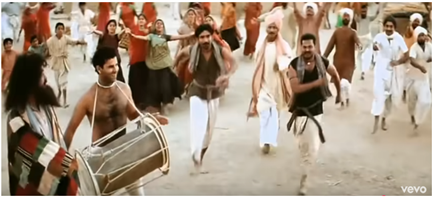
Figure 1
The Villagers Using Dhol in the Song Ghanan Ghanan
Source Sonymusicindiavevo,
https://youtu.be/GmCn31pq8i0?si=lm84cVn8rsAZUxoV
Along with the Dhol, there is the use of cymbals that we call Taalam in India and Duffli which fall into a perfect synchronization for the percussion instruments. The song owns a persistent chord sequence for the melody aspect. The song, although high on the percussion aspect, does not have an upbeat feel. It is a raw and rustic expression of happiness. This can also be associated with Shantha Rasa that is symbolic of peace and tranquility. Raag Megh Malhaar is a seasonal Raga as Pandit Jasraj says Wikipedia Contributors (2025) and is the Hindustani equivalent to Madhyamavathi in carnatic Wikipedia Contributors (2025). Madhyamavathi belongs to the Shanta Rasa in the navarasa Jasmine Strings (2009) thus explaining the peace and tranquility of the song and its association with Shaantha Bhava.
The song Mitwa comes as a message of encouragement to all the villagers to take the challenge in the game of cricket as nothing is impossible for people who try. The villagers are at a state of hopelessness as none of them know how to play the English sport. Mitwa delivers the message of hardwork and hope to the villagers. The song starts with an Ektara and an Aalap of a couplet. The couplet is as follows -
Har Sant Kahe, Sadhu Kahe
Every saint and sage says that
Sach aur Saahas jiske man mein, Anth mein jeeth usiki rahein
Those with a true and courageous heart, in the end they always win
The verse motivates the villagers stating that the wise men have postulated that victory belongs to those who carry courage and truth in their heart.
Figure 2
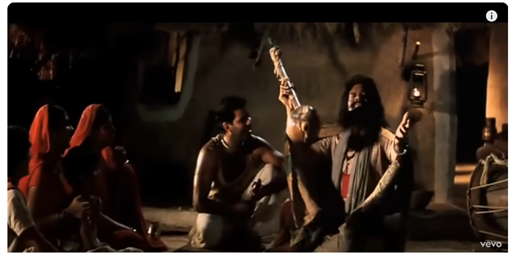
Figure 2
The Use of Ektara in
the Song Mitwa
Source Sonymusicindiavevo
https://youtu.be/uC3DmRfEigg?si=YOlC0Gf6PqQCadVo
The Ektara is usually played by saints, fakirs and folk singers. The percussion offers a slow swing like beats predominantly on the Dhol and Taal. There are some projections on Sarangi and Santoor along with Shehnai that are used on auspicious occasions rekindling hope for good times that lie ahead. The song is based on Raag Desh from the Hindustani school of music. Raag Desh has a resonance to patriotism and depicts Shringara and Veera out of the Navarasas Koduri (2022). In this context, Raag Desh is used to personify Veera or Valor thus encouraging the villagers.
Radha Kaise Na Jale is a playful romantic song that is like a conversation between Bhuvan and Gauri where the latter confronts Bhuvan for not being expressive of his feelings to her. Guari, also being aware of Elizabeth’s intentions for Bhuvan expresses some insecurity through this song in her own innocent way. Bhuvan reassures her in the most comforting manner stating that even if there are many women who are interested in him, Gauri will always remain special and stand out for him. The below lyrics translate to questioning Gauri on her insecurity despite being aware that she will remain the moon while others will be just the numerous stars existing in the sky.
Oh! Gopiyan tare hain, chand hai Radha
Gopis are stars and Radha is the moon
Phir kyun hai usko
Biswas aadha?
Then why doesn't she trust me fully?
The song begins with Taal and Dhol along with the sound of Dandiya sticks as the visuals portray a Dandiya night. The usage of Dandiya is symbolic of Lord Krishna’s Raas Leela with the Gopikas as a similar situation is portrayed in this particular song.
Figure 3
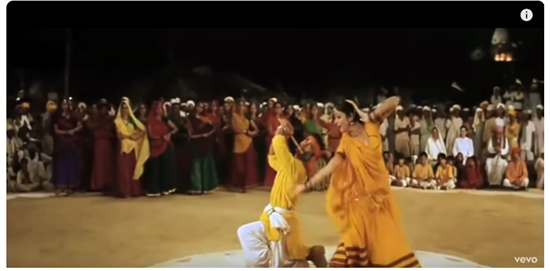
Figure 3
The Main Characters
Posing as Radha and Krishna in the Song Radha Kaise Na Jale
Source Sonymusicindiavevo
https://youtu.be/qNnvL0ztJhA?si=nqShWGdL4UWrAipc
As the lyrics suggest, Guari’s character is a cinematic portrayal of Radha’s character while Bhuvan’s is a cinematic interpretation of Lord Krishna’s character. All through the song, Gauri hints at Elizabeth’s intentions for Bhuvan asking him to clearly claim his feelings for her. There is a constant presence of chords and Sitar in the interlude adding some breeziness to the slow swing beat that the song is set in. There is a dominant presence of flute, especially in the end with the vocals during the Jugalbandi. The dominance of flute is emphatic of the cinematic portrayal of Lord Krishna who plays the flute during Raas Leela. Set to the Hindustaani Raag Bhimplaas, it is the equivalent of Abheri in Carnatic Wikipedia Contributors (2025) and belongs to Shringara Rasa from the Navarasa theory. Shringara Rasa pertains to love and romance justifying the use of Bhimplaas for the song Koduri (2018).
The next song O Rey Chori is an expression of love between Bhuvan and Gauri accepting and promising their steadfast feelings for each other. This song is also intertwined with some English lyrics and music depicting Elizabeth declaring her love for Bhuvan in a Waltz music. This song brings a smooth fusion of Indian and Western music instruments and styles. The song begins with Taal and chords giving it a soft romantic feel and there is Dhol as the song moves further. When the English stanza begins, the instruments used are a quartet of violins along a lead. The occasional cymbals, double bass and recorder offer a complete waltz experience. The song is set to Raag Natakurunji which corresponds to Karuna Rasa of the Navarasa theory which is symbolic of compassion Unknown (2012). Although the romantic mood of the song does not theoretically fit Karuna Rasa from the Navarasa theory, the song convinces the audience to believe otherwise.
Chale Chalo is a song similar to a warcry that depicts a full swing preparation of the practice sessions and training that the players representing the village are undergoing. This song also shows how the entire village is involved in the game through activities like manufacturing the bat or the other essentials like knee pads. It depicts the motivation of the entire village to win the game.
Figure 4
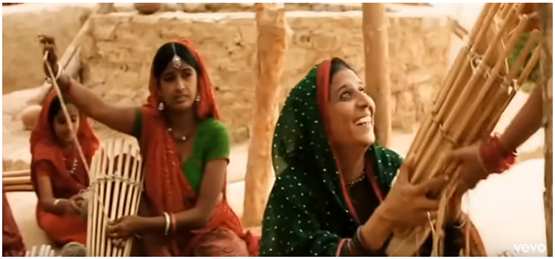
Figure 4
Villagers Stitching
Leg Pads for Batters in the Song Chale Chalo
Source Sonymusicindiavevo https://youtu.be/LQmHKl3oNu0?si=6aGRS9vxgFwLQ66n
Toot gayi jab ungli uthi
The accusing finger was smashed
Paanch Ungli toh bangayi
Mutthi
All five together form a fist
The above lyrics translate to how the accusing finger will be broken and all the five fingers together form a fist depicting how the entire village is united and determined to beat the British. The song starts on an upbeat with beats that are accompanied by occasional Dhol and there are chords that add some grim to the sober nature of the song. Interludes have Taal, violin, Sarangi and strings that sound royal along with Santoor and mild flute and double bass for the melody. But the projected voices of A R Rahman and Srinivas hold the grip of the song. The song is based on the Raag Jog from the Hindustani school of music that corresponds to Karuna, Shanta and Shringara Rasa Toth (n.d.). Despite the song not theoretically fitting into the traditional classification of the Rasa the raga proves to be an excellent choice for the situation of the song.
The next song O Palanhaare is a prayerful song suffused with devotion and surrender. It is a desperate prayer to God for their victory in the match. The village is pleading as all are desolate and have turned to seek refuge in God.
Oh! Paalanhar, Nirgun Aur Nyaare
O nurturant God, you're the greatest
Tumhare bin hamra kauno nahi
We have no one else, but you
Hamri Uljhan Suljhao Bhagwan
Solve our difficulties, oh God
Tumhare bin hamra kauno nahi
We have no one else, but you
The above-mentioned chorus of the song translates to complete surrender to the Almighty who is described as loving and a provider as the devotees plead stating that they have no one else apart from him. The song starts with Taal adding to its mood as a prayer or Bhajan and there is an addition of Tabla. The chords fill the melody along with the flute adding to the essence of the song as a Bhajan. And the use of flute in a song that is a prayer to Lord Krishna is a well thought out move. This song is based on Raag Tilak Kamod from the Hindustani School of music. The song is set to evoke Shringara and Karuna Rasa Tanarang (n.d.). The use of Tilak Kamod would fit the Karuna Rasa or compassion.
7. CONCLUSION
The popularity of the songs even these days is a testimonial to Rahman’s musical genius. While most of the Ragas of the songs correlated to the Rasa they pertain to, film music gives the flexibility to experiment and explore otherwise. However, all the songs were devoid of complexities like choir and harmonies so as to portray the simplicity of the villagers and their music. The use of Dhol is a common string running through all the songs reminding us of how important the instrument is in villages. The songs are also light and simple with a dominance of Indian instruments used for obvious reasons.
The Rasa theory thus gives us an Indian perspective to understanding and analysing Indian arts. Whether Rahman deliberately used the correlative Ragas to the Rasa or mood of the scene at that particular point in the film is something which only he can tell. This analysis ultimately encourages the study of Indian forms of art from an Indian perspective. Especially when the Navarasa theory is so structured and ancient.
CONFLICT OF INTERESTS
None.
ACKNOWLEDGMENTS
None.
REFERENCES
Arya, K. K., and Verma, M. (2021). A Navarasa-Based Analysis
of Love (Śṛṅgāra) in Middle Cinema’s Chitchor versus domestic drama’s Main Prem Ki Diwani Hoon. 10(2), 310–327.
Bhateja, R. (2015). Western Influence on Bollywood music (6).
Bhattacharjee, A., and Srinivasan, N. (2011). Hindustani Raga Representation and Identification: A Transition Probability-Based Approach. International Journal of Mind, Brain and Cognition, 2, 71–99.
Dhole, V. (2017). Music and the Metropolis in Hindi Cinema: Negotiating the Modern City Through Songs. Media Watch, 8(2, Special Issue), 6–18. https://doi.org/10.15655/mw/2017/v8i1A/48938
Gayathri, E. (n.d.). Ragas, Navarasas and Emotions. Blogspot.
Jasmine Strings. (2009, August 5). Ragas/Navarasas/Emotions.
Kaimal, V., and Barde, S. (2018). Introduction to Identification of Raga in Carnatic Music and its Corresponding Hindustani Music. International Journal of Computer Sciences and Engineering, 6(6), 955–958. https://doi.org/10.26438/ijcse/v6i6.955958
Kaur, A. (1936). Indian Cinema and
Music: A Historical Journey
(1–3).
Kaur, B. (2021). Evolution and Cultural Impact of Hindi Film Music from the 1940s. 9(12), 1–6.
Koduri, G. (2018, July 15). Indian ragas: Introduction to Raag Bhimpalasi. Riyaz – Practice, Learn to Sing.
Koduri, G. (2022, January 28). Embrace the spirit of Raag Desh: An introductory singing course. Riyaz – Practice, Learn to Sing.
Lal, R. (2019). Everyday Life, Everyday Songs: A Re-Evaluation of Song Sequences in Popular Hindi Films
of the 1950s (Doctoral dissertation, Boston University).
ProQuest Dissertations and Theses.
Nandan, M. R., and Rele, U. (2022). Gap Bodhi Taru Classicism in Indian Dance Styles: Natya, Nṛtta and Nṛtya. III, 46–50.
Riyaz App. (n.d.). Introduction to Raag Bhimpalasi.
Riyaz App. (n.d.). Introduction to Raag Desh.
Roy, P. (2012). Filming a Metaphor: Cinematic Liberties, Navarasa Influences and Digressions in Adaptation in Sanjay Leela Bhansali’s Devdas. The South Asianist, 1(1), 31–49.
Saadhakam. (n.d.). Nattakurinji. Blogspot.
Sharma, A. K., Aggarwal, G., Bhardwaj, S., Chakrabarti, P., Chakrabarti, T., Abawajy, J. H., Bhattacharyya, S., Mishra, R., Das, A., and Mahdin, H. (2021). Classification of Indian Classical Music With Time-Series Matching Deep Learning Approach. IEEE Access, 9, 102041–102052. https://doi.org/10.1109/ACCESS.2021.3093911
Tanarang. (n.d.). Raag Tilak Kamod.
The Times of India. (2016, September 27). Tansen: The Master of Raag Deepak and Raag Megh Malhar.
Toth, Szabi. (n.d.). Raga Jog. raga.hu. Retrieved December 19, 2025, from
Unknown. (2012, December 16). Nattakurinji. World of Music And Culture.
Vijayakar, R. (2013). The Role of a Song in a Hindi Film. The South Asianist, 2(3), 48–73.
Wikipedia contributors. (2024, December 31). Megh Malhar. In Wikipedia. Retrieved December 19, 2025, from
Wikipedia contributors. (2025, December 18). Abheri. In Wikipedia. Retrieved December 19, 2025, from
|
|
 This work is licensed under a: Creative Commons Attribution 4.0 International License
© ShodhKosh 2024. All Rights Reserved.