ShodhKosh: Journal of Visual and Performing ArtsISSN (Online): 2582-7472
|
|
Managing Sculpture Workshops through Digital Twins
Dinesh Kumar Nayak 1 , Devi S. 2
 ,
Poornima P. 2
,
Poornima P. 2 ,
Dr. Sonia Munjal 2
,
Dr. Sonia Munjal 2
 ,
Subhash Kumar Verma 2
,
Subhash Kumar Verma 2 , Vaibhaw R. Doifode 2
1 School
of Fine Arts and Design, Noida International University, Uttar Pradesh 203201,
India
2 Assistant Professor, Department of
Computer Science and Engineering, Presidency University, Bangalore, Karnataka,
India
3 Assistant Professor, Department of Electrical and Electronics Engineering, Aarupadai Veedu Institute of Technology, Vinayaka Mission’s Research Foundation (DU), Tamil Nadu, India
4 Professor, Department of Master of Business Administration, Noida Institute of Engineering and Technology, Greater Noida, Uttar Pradesh, India
5 Professor, School of Business Management, Noida International University 203201, Greater Noida, Uttar Pradesh, India
6 Department of Electrical
Engineering, Yeshwantrao Chavan College of
Engineering, Nagpur, Maharashtra, India
|
|
|
ABSTRACT |
|
|
The use of
Digital Twin (DT) technology in art and craft has the potential to entirely
transform the way that often-complicated creative processes are managed, as
in modelling classes. DTs can facilitate the constant exchange of data
between the real and digital worlds by digitally replicating the real-time
conditions of workshops using sensors and 3D modeling software incorporated
into an IoT-based platform. This mixed-methods study includes interviews,
site observations of sculpture practice, and computer modeling to inherently
develop a framework for working with DTs in sculpture practice. The proposed
approach allows monitoring tools, materials, and artist's work in real time
and the prediction analytics help with maintenance planning and efficient use
of work flow. What we learnt from case study groups is that the use of DTs
not only increases speed of production but keeps the artistic purpose,
correctly recording the creative decisions digitally. It also grants the
learner the ability to share what they know through the interaction with
virtual representations of the shaping process. The study concludes that
Digital Twins can be used for conducting workshops in the future that are
sustainable as well as compatible with the industry 4.0 technologies. In the
management of cultural items, this system makes it possible to digitize the
creative industries and protect cultural heritages by making the whole
process data-driven. |
|||
|
Received 24 January 2025 Accepted 19 April 2025 Published 10 December 2025 Corresponding Author Dinesh
Kumar Nayak, dinesh.nayak@niu.edu.in DOI 10.29121/shodhkosh.v6.i1s.2025.6626 Funding: This research
received no specific grant from any funding agency in the public, commercial,
or not-for-profit sectors. Copyright: © 2025 The
Author(s). This work is licensed under a Creative Commons
Attribution 4.0 International License. With the
license CC-BY, authors retain the copyright, allowing anyone to download,
reuse, re-print, modify, distribute, and/or copy their contribution. The work
must be properly attributed to its author.
|
|||
|
Keywords: Digital Twin Technology, Sculpture Workshop
Management, Real-time Monitoring, Predictive Maintenance, Digital
Transformation in Art, Creative Process Optimization |
|||


1. INTRODUCTION
Digital Twin (DT) technology has transformed the conventional industrial design, engineering, and manufacturing in the past few years. DT technology allows users to connect, monitor and optimize systems in real time. It is based on the concept of creating a dynamic data-driven digital replica of a physical system. The first Digital Twins were applied in the high-tech sectors such as aircraft, automobiles, and urban infrastructure. However, they also have a lot of potential in a lot of other areas as well. In a digital economy, the combination of art and digital technology is transforming the way we create art, safeguard our cultural heritage and operate workshops. Digital twin systems will also bring a lot of advantages to sculpture workshops which have always been famous for using complex materials, trained labour, and small iterations over and over again. Traditional forms of art require a high degree of accuracy with the use of hands and playing with various materials. Such a workshop is difficult to manage in terms of determining how to use the available resources, monitoring the process and ensuring that the artistic intent is maintained Ceccotti (2022). Inconsistent creative outputs, inefficiency and loss can result from the lack of proper record-keeping and real-time monitoring. Also, in an increasingly concerned world with sustainable art production and digital preservation of cultural history, there is a pressing need to rethink workshop management without breaking the validity of artistic expression.
Digital twins are a revolution for modelling, visualising and improving each step of the sculpture-making process. This is made possible through a combination of the Internet of Things (IoT) and data analytics. When we talk about digital sculpting, we usually talk about the process of creating a virtual copy of the actual workshop, with tools, materials and even the sculptures themselves. Instruments and machines may be equipped with sensors which can give real-time measurements of performance, temperature, sound or tool wear Rauschnabel et al. (2022). This enables the virtual model to be as accurate as possible with how things are today - 3D scanning and modeling technologies can capture the shape and change of statues as they are built at different stages. Combining these data streams what is created is a two-way digital environment where artists, techs and managers can keep an eye on operations, guess when repair will be needed and to look at creativities process with a level of accuracy that has never been seen before Theodoropoulos and Antoniou (2022). This is another important aspect of the use of DT methods within art classes, as it can be used to help people from different subject areas work together. Artists can experiment with ideas using virtual versions, managers can maintain a record of creative decisions and engineers can look into issues with the comfort or materials. By better utilizing materials and using less energy, this digital change also promotes the use of environmentally friendly habits. So, sculpture workshops are not only places where art is created, but are intelligent spaces where they are flexible, adaptable and learning from data at all times.
2. Literature Review
1) Overview
of Digital Twin technology and its applications
The concept of Digital Twin (DT) technology was borrowed from the aircraft and manufacturing industries where virtual models were created to simulate actual systems for testing purposes and enhancing performance. A Digital Twin is typically defined as a digital replica of a real thing that is always fed with data from the real world to copy, predict and improve its copy. This connection can be established using Artificial Intelligence (AI), Machine Learning (ML), IoT (Internet of Things), and Data Analytics (DAA) Lo Turco et al. (2022). At a higher level, DT systems allow users to visualize how the operations operate, detect errors, and hypothesize how the system will respond by providing users with real-time feedback loops. First, DT was largely deployed in smart cities, power grids, and factory production lines. Real-time data tracking helped a lot in decision-making and scheduling maintenance. The new research, however, has broadened the scope to include education and healthcare, as well as the creation of cultural assets. Research indicates that DT technology not only makes systems more efficient and productive, but also resilient and better lasting Loddo (2021). By using virtual models, testing can take place in real time without having to halt the real activities. This reduces the expenditure and waste. Focusing on DTs as integral elements of Industry 4.0 and the digital transformation, a recent study has also focused on the role of DTs in connecting physical and online systems in one single environment. It is more obvious than ever that digital is useful in artistic, cultural, and craft processes as digital platforms advance Vasiljević et al. (2021). If we consider that the virtual-physical connection can be used in a wide range of contexts, the link could have the potential to revolutionize not just industrial production, but also human-centric industries such as art and handicraft, where an emotional and experiential dimension is paramount.
2) Digital
transformation in art, craft, and cultural heritage domains
The current wave of digital transformation has had a tremendous impact on the way art, craft, and cultural traditions are created, experienced, and preserved. Others argue that digital technologies make art more fluid and make culture production more sustainable and accessible to more people. 3D scans, virtual modeling, and augmented reality (AR), the latter of which has allowed sculpture artists to view, play with and copy intricate shapes with greater ease and accuracy. Museums and other cultural institutions use digital files and virtual displays to record the history of spirituality and connect with people all over the world. In fields of art, digital change is not only digitisation but a shift towards environments that are dynamic and led by data Willkens et al. (2020). Craft courses are becoming both traditional and computer aided classes. This has allowed artists to see how materials interact, how processes work, and how their ideas change over time. This partnership allows the work of artists, builders, and conservators to be easier together, resulting in new ideas from various disciplines. Digital technologies also generate physical and historical information about artworks, and as a result, preserve works for future generations to appreciate. Digital repair and interactive visualization are two projects which are beginning to make historical artefacts more visible and informative Pourmoradian et al. (2021). Theorists are getting increasingly conscious of the way in which digital platforms have democratized art, bringing artists and viewers closer together. In this way, digital transformation not only makes output relevant to the present, but it also transforms the significances of ownership, legitimacy and artistic authorship. The major technologies, methodologies, applications, and research results are presented in Table 1. As this model is evolving, the Digital Twin technology fits perfectly into it. It enables the virtual interaction of real art works and digital copies of real art works in real time and dynamically.
Table 1
|
Table 1 Summary of Literature Review |
||||
|
Focus
Area |
Technology
Used |
Methodology |
Application |
Key
Findings |
|
Digital Twin theory |
IoT, Cyber-Physical Systems |
Conceptual modeling |
Industrial manufacturing |
Defined the foundational DT
framework |
|
Smart manufacturing Resta et al. (2021) |
Cloud & AI integration |
Simulation study |
Smart factories |
Improved productivity via
real-time monitoring |
|
Creative industries El-Said and Aziz (2022) |
3D Modeling, Data Analytics |
Case study |
Digital art studios |
Integration of data-driven
creativity |
|
Industry 4.0 |
Sensor networks |
Systematic review |
Industrial systems |
Classified DT maturity
levels |
|
Cultural heritage |
3D scanning, AR |
Experimental |
Museum preservation |
Digitization enhanced
accessibility |
|
Engineering systems Luther et al. (2023) |
Simulation tools |
Framework proposal |
Product lifecycle management |
Enabled lifecycle
optimization |
|
Industrial maintenance |
Predictive analytics |
Survey |
Automated maintenance |
Improved system reliability |
|
Art technology Pisoni et al. (2021) |
IoT & AI integration |
Pilot implementation |
Sculpture fabrication |
Enhanced accuracy in
sculpture replication |
|
Urban planning |
Digital Twins for cities |
Empirical modeling |
Smart city management |
Showed data-driven decision
efficiency |
|
Craft and design Ao et al. (2022) |
Digital prototyping |
Qualitative study |
Ceramics workshops |
Promoted hybrid creative
processes |
|
Art conservation |
3D reconstruction |
Case analysis |
Restoration projects |
Improved restoration
precision |
|
Sustainability in art |
IoT & analytics |
Mixed methods |
Green design studios |
Reduced waste, optimized
materials |
|
Sculpture management Grübel et al. (2022) |
Digital Twin platforms |
Empirical pilot |
Sculpture workshops |
Integrated workflow and
predictive control |
3. Theoretical Framework
1) Definition
and principles of Digital Twin systems
As the name implies, a Digital Twin (DT) is a fully dynamic, data-driven digital reproduction of a physical system, process or object. It is built on the concept of cyber physical integration - which is the interrelationship between the digital and physical worlds in which there is two-way interaction between the digital and physical worlds. Connectivity, synchronisation, intelligence and repetition are the key concepts of DT systems JosephNg and Gong (2022). IoT network allows sensors, devices and digital models to be connected. Synchronisation allows the virtual model to change at the same rate as the real model which ensures that the operating states are accurately represented. AI and machine learning provide Intelligence to the system which in turn enables it to understand data, make guesses about what will happen, and perform better. Iteration is the process of making digital and real models better and changing them based on the feedback received from analytics. Applied to artistic or inventive systems, these concepts result in tools that help humans better understand the interaction of complex material, how to operate tools and how processes function Javaid and Haleem Khan (2022). The DT becomes a smart assistant in making artistic decisions, helping the artists to understand what is out there, envisioning what risks may occur, and efficiently using their resources. The Digital Twin does not represent a fixed idea, but an environment in which change occurs in conjunction with the change of the physical twin.
2) Relationship
between physical and virtual entities in creative production
In essence, the Digital Twin concept is the interface between real and virtual things with a particular emphasis on the interaction between the real and the virtual: real and virtual things communicate with each other in a constant dialogue. The relationship is not merely symbolic in the creative process; it is also participatory and mutually beneficial. Sensor information, motion tracking and external feedback of the sculpture are used to form the digital model. The digital model then has an impact on the physical processes by way of simulations, analyses, and predictions More et al. (2025). This two-way flow creates a cyber-physical feedback loop that allows people to make better decisions and comes up with better creative solutions. The Digital Twin can perfectly replicate the setup, tools and artistic processes of sculptor shops in real time. For example, the virtual model can monitor material stress, temperature or vibration changes during cutting. It allows artists to make revisions to their skills before they appear in real life. Also, testing for computer models can be used to see how different materials will react or help develop new ones, reducing waste and experimental costs. Authorship and creative power are also distorted by their relationships to each other. Figure 1 indicates dynamic data interchange between physical and virtual creative environments. The artist develops and interprets data, oscillating between the sense of feeling and computer-based cognition.
Figure 1
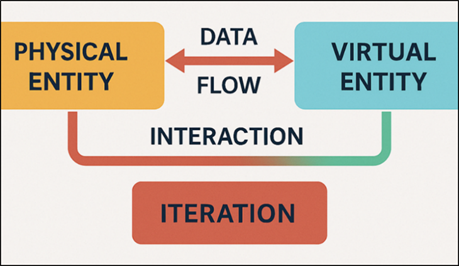
Figure 1 Interactive Relationship Between Physical and Virtual Entities in Creative Production
Together, this combination gives way to a new creative existence with digital intelligence and physical experience coexisting. In theoretical terms, the meeting between the virtual and the real world transforms creative production into a learning, changing, growing live system. Since this is the case, the Digital Twin is not only an inactive model, but it becomes a co-creative being that links the artistic vision with the technical accuracy.
3) Framework
for integrating real-time data and performance analytics
At the same time, the ability to receive data, send it, process it, and receive feedback is critical to ensure that Digital Twin systems are capable of capturing real-time data and performance analytics. The first is to install sensors that are connected to the Internet of Things (IoT) which can be made into tools, machines, weather systems, etc. These sensors are used to measure power, temperature, sound, motion, etc. This information is transmitted over secure networks to a central cloud or edge-computing platform where the information is processed and presented in analytics displays. Then, high-level programs, such as machine learning algorithms, study the new data to identify patterns, errors or potential errors. This system used in carving classes can enhance performance through real-time data association with the work processes of carving artists. For example, the system can take into account the impact of tool wear on accuracy of cutting, or the impact of external factors on the longevity of a material. Managers and artists can receive real-time information that assists them to make informed decisions, thereby increasing productivity and quality of work. Predictive analytics also aid in predictive maintenance which reduces downtime and resources wastage. In theory, this type of blending is valuable because it combines data-driven decision making and artistic feeling. The framework relates immersive art and computer reasoning via transforming implicit knowledge into quantifiable measures.
4. Methodology
1) Data
collection methods (interviews, observation, digital modeling)
This study investigates the use of Digital Twin (DT) systems in art classes by using a qualitative and mixed-methods approach which involves interviews, observations, and digital modelling. This blend will be designed to encompass the technical and the human aspects of workshop management. Artists, workshop managers and digital technologists are interviewed in a semi-structured manner to understand how they understand process issues, how they use tools and what they would like to gain from digital integration. These talks provide specific examples of how creative decisions are made and how data could be used to make things more efficient without interfering with artistic expression. The second part of collecting data is participant observation. The researcher works in the workshops themselves, notes how they are structured, how they are organized, how they work with materials, and how they observe safety guidelines. In this way, it is possible to identify real-world factors that influence the DT modelling process, such as the environment, the distribution of time, and the interaction between tools. Last but not least, there is the digital modelling part, which is the analysis and experimentation.
2) Tools
and software for creating Digital Twins (e.g., IoT sensors, 3D modeling platforms)
To make a Digital Twin that will work for art classes you need gear, software, and a network system, which will allow data to flow continuously between the real and the virtual. IoT devices are very important at the hardware level, as they collect the information about the environment and the operations, such as temperature, sound, humidity and tool utilization. These devices are built into workshop equipment or connected to tools in order to keep an eye on performance factors and spot problems. The digital heart of the DT system consists of software tools. 3D modelling and visualisation of statues using programs such as Autodesk Fusion 360, Blender and Rhino 3D software. These programs allow artists to have their ideas mentally tested before they are implemented. Unity or Unreal Engine can also be used to create dynamic virtual workshops which resemble physical workshops. For processing and syncing data, cloud-based IoT systems such as Azure Digital Twins, Siemens MindSphere or ThingWorx have flexible frames for tracking and analysing data in real-time. Some of these tools have AI and machine learning systems that analyze trends and make predictions. This complex web of technologies ensures that the Digital Twin remains flexible enough and capable of change to changing working conditions. The combination of sensor networks and 3D visualization and analytics platforms not only helps make the task more efficient, but it also enables knowledge documentation and resource management while at the same time protecting the environment.
3) Criteria
for selecting case study workshops
Selecting appropriate case study groups is important to ensure that the results appropriately highlight the feasibility of Digital Twin implementation and the impact it would have on sculptures. The decision process is based on three main factors, technology maturity, art variety, and business size. First, schools must demonstrate that they have basic digital capabilities and tools - for example, the ability to use 3D modelling software, computer-aided design software or data collection tools. This ensures that it can be integrated with DT systems and it can be measured. Second, artistic diversity is further encouraged by teaching a range of sculptural techniques including stone cutting, metal casting, working with clay and a variety of media. The research will provide an opportunity to investigate the way DT technology evolves when working with different materials, tools and creativity. It also enables the identification of which aspects of artistic processes can be modified most readily with the aid of computers. Third, organisation of the work flow and the working scale are discussed. Workshops that involve a defined process of production, multiple artists, or learning activities offer more data for an evaluation of the DT-based management innovation.
5. Implementation of Digital Twins in Sculpture Workshops
1) Digital
representation of sculpture processes and tools
The first is the creation of a digital replica of physical processes, tools and materials that changes over time to correctly model physical reality and allow the application of Digital Twin (DT) technology in sculpting workshops. In the DT system this digital rendering is the foundation of the system; it presents the total operating environment in a digital three-dimensional space. The first step is to use software such as Blender, Autodesk Fusion 360 or Rhino 3D to scan and construct artistic things, tools and work environments in 3D.
Figure 2
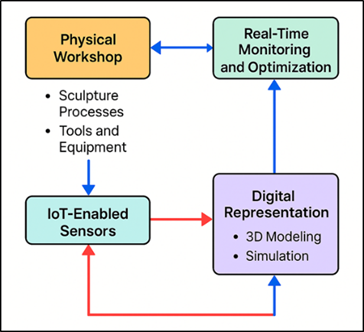
Figure 2 Architecture of Digital Representation in Sculpture
Processes and Tools
These models demonstrate an exact shape, colour, and arrangement of tools which conceptualises into a virtual version and puts in work just like the real thing. Adding IoT-enabled devices to this picture helps improve it, by placing sensors in important tools such as chisels, lathes and grinding machines, in order to gather information about the way of their use, sound, pressure and temperature. This constant data stream allows the digital representation to continuously evolve along with the physical process so that both the physical and digital worlds are accurate. The digital model not just duplicates the technical information, it also preserves artistic information such as the intentions of the sculptor, the materials he used and the style he selected.
3) Real-time
monitoring and feedback mechanisms
Digital Twin Systems in art lessons work best if they can watch and provide feedback in real time. The system takes in real-time data from ongoing sculpture processes utilizing a network of sensors, cameras and digital platforms that are all networked together. Information like temperature, sound, tool movement, material deformation, etc. are continuously measured and fed to the DT model. The virtual integrity management system provides a real-time feed of data, ensuring the co-synchronization of the virtual world with the real workshop and displaying any decisions to modify the operations directly in the digital twin. Feedback systems are implemented in the form of live panels or mobile apps for management and artists to have real-time feedback. These platforms display the efficacy of the tool, the response of the material and the nature of the world around. This enables users to change methods/tool settings at once. For example, if the tool can be detected to vibrate too much in the sensor data, the system can advise the artist to alter his or her speed or pressure to prevent damaging the material. The feedback loop also makes it easier for people to work together to make decisions since it allows experts/conservators from far away to check on the progress and provide advice through a virtual interface.
4) Integration
of workflow optimization and predictive maintenance
The integration of workflow optimisation and predictive maintenance into Digital Twin makes sculpture workshops more efficient and productive by incorporating industrial factory-level efficiency with artistic workflow in the process. Based on the real-time data extracted from the DT model, the workflow optimisation aims to simplify the sequence of operations (material preparation, forming, and post-processing). The system identifies slowdowns and wastage in the production cycle by tracking the length of processes, resource consumption and performance of tools. With these fresh insights, workshop managers will be able to reschedule tasks, allocate work more effectively and increase output without compromising on artistic freedom. The second important part is predictive maintenance, which is powered by AI and machine learning. Output of the sensors concerning tool wear, shaking and work frequency are analyzed in order to anticipate problems before they occur. The benefit of using this preventive method is that it reduces downtime, prevents accidents, and extends the lifespan of equipment and machinery. For instance, using collected performance data, the DT can warn you on when to re-calibrate a knife or lathe, so that work does not stop. Optimisation also covers aspects such as ecology and a saving of resources. The system also has the ability to recommend energy conservation, recycling, and maintaining a clean environment so that fewer wastes are produced.
6. Results and Discussion
1) Outcomes
of implementing Digital Twins in workshop management
When Digital Twins were used in art classes not only were they making the process much more visible but also easier to control and easier to record. Real-time tracking allows workers and managers to monitor operations, identify issues and maintain the peak performance of tools. Adding virtual models helped people make decisions based on data making it easier for artists, engineers, and techs to work together. Workshops that used DTs said that they had less downtime, better planning of processes, and better teamwork using the shared digital platforms.
Table 2
|
Table 2 Outcomes of Implementing Digital Twins in Workshop Management |
||
|
Parameter |
Before
DT (%) |
After
DT (%) |
|
Workflow visibility and tracking accuracy |
55 |
92 |
|
Tool utilization efficiency |
60 |
88 |
|
Process downtime |
25 |
10 |
|
Collaboration and communication rating* |
58 |
90 |
Table 2 shows the real changes that occurred, when Digital Twin (DT) tools were introduced for the management of a sculpture workshop. The greatest improvement in accuracy was in the areas of process awareness and tracking accuracy, which went from 55% to 92%.
Figure 3
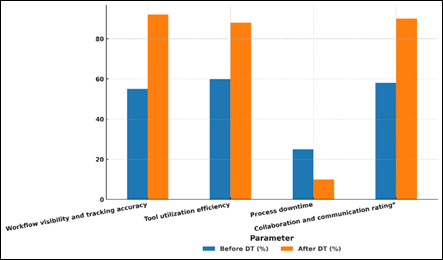
Figure 3
Digital
Transformation Impact on Key Operational Metrics
This has demonstrated that real-time monitoring and digital synchronisation made operations much more clear. Figure 2 illustrates the way digital transformation enhances the core measures of operations. The effectiveness of using tools also went up from 60% to 88%, that shows that data-driven insights and prediction analytics helped to make better use of resources. The fact that process downtime went down from 25% to 10% proves to be how DTs reduce problems by finding equipment or routine problems very early on.
Figure 4
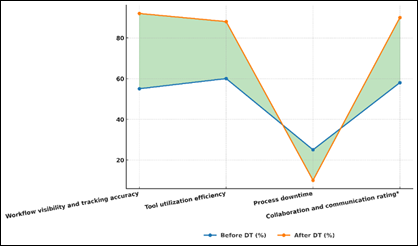
Figure 4 Before vs. After Digital Transformation —
Performance Shift Analysis
The rate for teamwork and communication also increased from 58% to 90%, indicating how the artists, techs and management found it easier to work together through the shared digital platforms. Figure 4 gives performance improvements after digital transformation implementation analysis. All of these results demonstrate that the addition of DT technology to standard groups causes these groups to form smart, interconnected communities. Better data accessibility, operating efficiency and teamwork not only increases the speed of production, but it also makes it easier for artists to convey their ideas and to maintain artistic control.
2) Improvement
in efficiency, quality, and sustainability
Using Digital Twin tools rendered the businesses we looked at more efficient, better at what they did, and more environmentally friendly. By predicting the best conditions for performance, real-time analytics reduce waste of materials and tools. The quality got better by carefully keeping an eye on the artistic factors, which made sure that the plan was followed. Adding feedback tools reduced the number of mistakes and helped to make the process more consistent. From an environmental point of view, optimised processes reduce the use of energy and induce responsible use of resources. Digital visualisation tools that facilitated speed up the development and reworking were also helpful for artists. All of these improvements are indicators of how Digital Twins combine the artistic expression with technical intelligence, promoting quality creative work that is also beneficial to the environment.
Table 3
|
Table 3 Improvement in Efficiency, Quality, and Sustainability |
|||
|
Metric |
Before
DT (%) |
After
DT (%) |
Change
(%) |
|
Production efficiency |
62 |
91 |
29 |
|
Sculptural quality
consistency |
68 |
94 |
26 |
|
Sustainability practice
adoption index* |
50 |
85 |
35 |
Digital Twin (DT) technology has had a big effect on improving the speed, quality, and sustainability in the sculpting workshops as shown in Table 3. The productivity of production has increased from 62% to 91%, which is a 29% increase. This is because real-time data analysis and process modelling helped to improve routines and reduce waste. Distribution of key performance metrics before transformation is shown in Figure 5. The uniformity of the sculpture quality went from 68% to 94% showing that constant tracking and feedback loops ensures that the design purpose is followed and that human or machine mistakes are kept to a minimum.
Figure 5
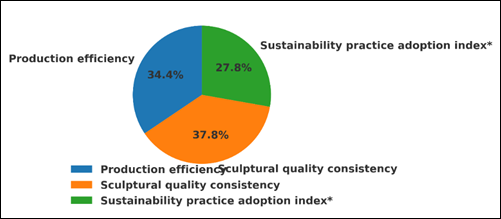
Figure 5 Distribution of Key Metrics Before Digital Transformation
This improvement shows how important it is for DTs to keep things precise and yet still keep the original art. Also, the sustainability practice usage score went from 50% to 85%, which means that people are doing 35% more environmentally friendly things, like reusing materials, saving energy, and reducing trash. These improvements not only show that Digital Twins improve work and art on the other hand, they also encourage practices that are good for the environment. Adding DT technology to modern sculpture production settings makes them better all around by bringing together speed and artistic quality with sustainability.
7. Conclusion
Adding Digital Twin (DT) technology to sculpture classes is a huge step forward in the way art is made, as well as courses are run. This study shows that artists and managers can enhance the efficiency of the operation, the artistic accuracy, and the sustainability by producing digital versions of real workshops, which are dynamic and data-driven. The Digital Twin system is the connection between the real world and computer-based intelligence, providing real-time information on the behaviour of materials, how well tools work, and how processes are changed over time. Workshops go from reactive management systems to predictive and flexible environments that are able to improve themselves with the aid of constant feedback and data analytics. The study shows that there were real gains in many areas such as the clarity of the process, the use of tools, the quality of the products made, and the impact on the environment. Artists gain better control over and recording of their creative processes and organisations gain new ways to keep knowledge alive, training their staff, and protecting cultural artefacts. The study also reveals how Digital Twins are not only useful for management, but for working together on creative projects as well. They encourage rather than limit artistic freedom through well-informed experimentation. DT acceptance has effects beyond just an instant technical benefit. These effects include the long-term resilience and digital change of the arts and culture sectors. Using IoT, AI and 3D modelling in concert, sculpture workshops will be smart environments, both respectful of custom and open to new ideas. In the end, this study makes Digital Twins a strategy framework for the future of creative industries. This will help the art of sculpture keep growing in a time where people are more knowledgeable and more connected to one another online, and more concerned about the environment.
CONFLICT OF INTERESTS
None.
ACKNOWLEDGMENTS
None.
REFERENCES
Ao, F., Xiao, B., Qi, Q., Cheng, J., and Ji, P. (2022). Digital Twin Modeling. Journal of Manufacturing Systems, 64, 372–389. https://doi.org/10.1016/j.jmsy.2022.06.015
Ceccotti, H. (2022). Cultural Heritage in Fully Immersive Virtual Reality. Virtual Worlds, 1(1), 82–102. https://doi.org/10.3390/virtualworlds1010006
El-Said, O., and Aziz, H. (2022). Virtual Tours a Means to an End: An Analysis of Virtual Tours’ Role in Tourism Recovery Post COVID-19. Journal of Travel Research, 61(3), 528–548. https://doi.org/10.1177/0047287521997567
Grübel, J., Thrash, T., Aguilar, L., Gath-Morad, M., Chatain, J., Sumner, R. W., Hölscher, C., and Schinazi, V. R. (2022). The Hitchhiker’s Guide to Fused Twins: A Review of Access to Digital Twins in Situ in Smart Cities. Remote Sensing, 14(13), 3095. https://doi.org/10.3390/rs14133095
Javaid, M., and Haleem Khan, I. (2022). Virtual Reality (VR) Applications in Cardiology: A Review. Journal of Industrial Integration and Management, 7(2), 183–202. https://doi.org/10.1142/S2424862221300015
JosephNg, P. S., and Gong, X. (2022). Technology Behavior Model—Impact of Extended Reality on Patient Surgery. Applied Sciences, 12(11), 5607. https://doi.org/10.3390/app12115607
Lo Turco, M., Giovannini, E. C., and Tomalini, A. (2022). Parametric and Visual Programming BIM Applied to Museums, Linking Container and Content. ISPRS International Journal of Geo-Information, 11(7), 411. https://doi.org/10.3390/ijgi11070411
Loddo, M. (2021). Integration Of 360-Degree Photography and Virtual Reality Into Museum Storage Facility Design and Education. International Journal of Education, 9(4). https://doi.org/10.5121/ije.2021.9404
Luther, W., Baloian, N., Biella, D., and Sacher, D. (2023). Digital Twins and Enabling Technologies in Museums and Cultural Heritage: An overview. Sensors, 23(3), 1583. https://doi.org/10.3390/s23031583
More, S. S., Birmule, P. R., and Zarikar, K. B. (2025). Integrating Data Analytics in Sports Coaching and Performance Evaluation. International Journal of Research and Development Management Review, 14(1), 166–169.
Pisoni, G., Díaz-Rodríguez, N., Gijlers, H., and Tonolli, L. (2021). Human-Centered Artificial Intelligence for Designing Accessible Cultural Heritage. Applied Sciences, 11(2), 870. https://doi.org/10.3390/app11020870
Pourmoradian, S., Farrokhi, O. S., and Hosseini, S. Y. (2021). Museum Visitors’ Interest on Virtual Tours in COVID-19 Situation. Journal of Environmental Management and Tourism, 12(4), 877–885. https://doi.org/10.14505/jemt.v12.4(52).02
Rauschnabel, P. A., Felix, R., Hinsch, C., Shahab, H., and Alt, F. (2022). What is XR? Towards a Framework for Augmented and Virtual Reality. Computers in Human Behavior, 133, 107289. https://doi.org/10.1016/j.chb.2022.107289
Resta, G., Dicuonzo, F., Karacan, E., and Pastore, D. (2021). The Impact of Virtual Tours on Museum Exhibitions After the Onset of COVID-19 Restrictions: Visitor Engagement and Long-Term Perspectives. SCIRES-IT: Scientific Research and Information Technology, 11(2), 151–166.
Theodoropoulos, A., and Antoniou, A. (2022). VR Games in Cultural Heritage: A Systematic Review of the Emerging Fields of Virtual Reality and Culture Games. Applied Sciences, 12(17), 8476. https://doi.org/10.3390/app12178476
Vasiljević, I., Obradović, R., Đurić, I., Popkonstantinović, B., Budak, I., Kulić, L., and Milojević, Z. (2021). Copyright Protection of 3D Digitized Artistic Sculptures By Adding Unique Local Inconspicuous Errors By Sculptors. Applied Sciences, 11(16), 7481. https://doi.org/10.3390/app11167481
Willkens, D. S., Haley, H. M., and Liu, J. (2020). Race, Space, and Digital Interpretation at Selma’s Old Depot Museum. Arris, 31(1), 108–118. https://doi.org/10.1353/arr.2020.0009
|
|
 This work is licensed under a: Creative Commons Attribution 4.0 International License
© ShodhKosh 2025. All Rights Reserved.