ShodhKosh: Journal of Visual and Performing ArtsISSN (Online): 2582-7472
|
|
AI-Generated Concept Art in Film and Gaming Education
Dr. Praveena K N 1
 ,
Dr. Netaji Maruti Jadhav 2
,
Dr. Netaji Maruti Jadhav 2 , Dr. Anand Kumar
Gupta 3
, Dr. Anand Kumar
Gupta 3
 , Nittin
Sharma 5
, Nittin
Sharma 5 , Prateek Garg 5
 , Dr. Prakash Divakaran
6
, Dr. Prakash Divakaran
6
1 Assistant
Professor, Department of Computer Science and Engineering, Presidency
University, Bangalore, Karnataka, India
2 Director
of Sports and Physical Education, Bharati Vidyapeeth University, Pune,
Maharashtra, India
3 Professor, Department of Computer Science and Engineering (AI), Noida
Institute of Engineering and Technology, Greater Noida, Uttar Pradesh, India
4 Centre of Research Impact and Outcome, Chitkara University, Rajpura,
Punjab, India
5 Chitkara Centre for Research and
Development, Chitkara University, Himachal Pradesh, Solan, India
6 M.com, MBA, M. Phil, Ph. D, Professor,
Department of Management, Himalayan University, Itanagar, Arunachal Pradesh,
India
|
|
|
ABSTRACT |
|
|
The fast
development of artificial intelligence (AI) has changed the creative fields,
especially film and game education, as AI concept art is starting to redefine
the way images are developed. This paper examines the role of AI technology,
including Generative Adversarial Networks (GANs) and Diffusion Models, in the
development of concept art, the optimization of the creative process, and the
increase in the creative potential of students. GANs can create new visual
concepts using vast collections of existent pieces of art, which makes it
possible to create original landscapes, characters, and environments.
Diffusion Models, conversely, enhance the quality of images by solving male
noises in iterative steps providing photorealism in imagery, which can be used
in film and game design classes as a way of previsualization. The AI
approaches implemented in the curricula will enable students to create and
develop ideas quickly, experiment with their aesthetics, and learn about the
connection between technology and creativity. In addition to technical
proficiencies, students gain critical sensitivity with regards to ethical and
aesthetic aspects of AI-generated content that includes originality,
authorship, and bias. The use of AI-based art generation can help the
educators to promote interdisciplinary learning uniting the spheres of
design, storytelling, and computer science. In the end, AI-generated concept
art will fill in the divide between conventional artistic presentation and
computational creativity by providing future levels of filmmakers and game
creators with the capability to cooperate successfully with clever machines.
Such synergy improves artistic creativity and productivity remaking the
borders of visual education in digital age. |
|||
|
Received 23 January 2025 Accepted 18 April 2025 Published 10 December 2025 Corresponding Author Dr.
Praveena K N, praveenakn@presidencyuniversity.in DOI 10.29121/shodhkosh.v6.i1s.2025.6623 Funding: This research
received no specific grant from any funding agency in the public, commercial,
or not-for-profit sectors. Copyright: © 2025 The
Author(s). This work is licensed under a Creative Commons
Attribution 4.0 International License. With the
license CC-BY, authors retain the copyright, allowing anyone to download,
reuse, re-print, modify, distribute, and/or copy their contribution. The work
must be properly attributed to its author.
|
|||
|
Keywords: AI-Generated Art, Concept Design, Film Education,
Gaming Education, Generative Adversarial Networks (GANs), Diffusion Models |
|||



1. INTRODUCTION
The advent of Artificial Intelligence (AI) has transformed almost all the spheres of creative production, including the area of digital illustration and animation, film design, and video game creation. In this radicalized environment, concept art, a key phase of pre-production in the art of visual media, has undergone a radical technological transformation. Concept art has traditionally been based on visualizing characters, scenes and environments through the use of artistic ability, imagination and manual skill of designers prior to their actual creation. The increasing use of AI-generated tools, however, has brought a new paradigm of the convergence of computational intelligence and human creativity Yang et al. (2023). This development has serious consequences to the field of film and gaming education in which students are no longer being trained solely as artists, but as innovators who can also work with intelligent systems.
The concept art of AI applies advanced machine learning algorithms that have the ability to analyze large data volumes of visual images to generate original work. Generative Adversarial Networks (GANs) and Diffusion Models are among the most prominent ones, and both models allow artists to generate distinctive visual results based on the simplest prompts or drawings. The concept of GANs is a two-network system (including a discriminator and a generator) which progressively enhances the quality and novelty of generated images Khan et al. (2023). Diffusion Models, on the other hand, create a photo-realistic and fine-density set of visuals by inverting a noise procedure, and are thus especially applicable in the creation of cinematic scenery and game-based realistic textures. These AI techniques have enabled the rapid concept design, increased visual variety and shortened the production time without compromising artistic quality Wollowski (2023).
The concept art tools powered by AI have an opportunity to offer the student in an educational context a chance to experiment without the restraints of a more traditional media. Using AI applications like Mid journey, DALLE, or Stable Diffusion as a part of coursework, learners have the opportunity to conduct style experiments and visualize more complex concepts automatically. This will hasten the creative process, and stimulate the thinking process of the interdependence of technology, aesthetics, and originality. Moreover, the experience of AI techniques equips students with the changing nature of the industry where proficiency in technology is as essential as artistic ability Du et al. (2023). Nevertheless, critical pedagogical and ethical issues are also brought up in this change. Training should, thus, be aimed at giving the learners both technical and ethical knowledge so that AI should not be considered as a substitute of creativity; instead, it should be seen as a mini bootstrap that enhances human imagination. With the field of film and gaming education in its ever-changing state, the advancements of AI-generated concept art represent the future point of convergence between art and technology - shaping how the future generation of visual storytellers learn, create and envision worlds to come.
Figure 1

Figure 1 Framework for AI-Generated Concept Art in Film and
Gaming Education
This framework describes in Figure 1 the way AI techniques, such as GANs and Diffusion Models, can be used to express concept art, be integrated into education, and understand morality. It lays emphasis on the relationship between technology and creativity, which prepares students to redefine themselves in the context of changing roles in film and gaming design education.
2. Related Work
The interplay of generative artificial intelligence (AI) and creative visual work is examined in an expanding literature on how these areas of interactive, educational, and entertainment-media application intersect. Recent empirical studies in the field of game design have revealed that generative AI tools are much faster in ideation and prototyping of visual assets, but also bring about issues of originality and the human creativity factor Avlonitou and Papadaki (2025). Specifically, game developers noted that AI assists in efficiency and speed in creating assets, but there is fear regarding creative reliance and loss of a sense of authorship Alharthi (2025).
In art education and generative AI, exploratory research based on the constructivist theory of learning proposes that AI-generated art can be used as an environment where students actively engage in the learning and critical evaluation of the aesthetic decision-making process, instead of passively automating the production process Gao et al. (2023). Such studies highlight the importance of education to be based not on outsourcing creativity to machines, but on enabling the co-creative processes in which the learners are reflective and intentional Gao et al. (2023). Further analyses of generative AI in the educational game design have emphasized the movement away towards manual creation of assets in favor of adaptive and individualized content scaffolding, with AI concept generation being a means of pedagogy and not merely production Khalil and Er (2023).
In concept-art processes used to create visual effects in film and games, the application of AI to create visual art is also becoming highly documented. Industry commentary reports indicate that concept art created with AI facilitates more rapid iteration, lower expenses, and extends artistic capabilities of visual teams when creating games Saeidnia and Lund (2023). However, technical and ethical drawbacks of these sources, including style homogenisation, dataset bias and inconsistency in character generation, that can compromise the integrity of art or the integrity of narrative are also noted King and ChatGPT (2023). The systematic review of AI-based generation of 3D environment highlights that despite the high-fidelity scene generation guaranteed by algorithms, there are still difficulties in providing the stylistic coherence and quality generalisation across domains Worthley et al. (2025).
Collectively, the literature unites around a few major themes: generative AI has enormous potential as a creative accelerator in the context of film and game education; its application provokes the redefinition of the role of the student-artist as not an author but a companion of algorithmic processes; and the educational consequences are not limited to the questions of production efficiency to critical problems of authorship, ethics and aesthetic agency. Nevertheless, there are still gaps concerning the way the curricula must incorporate these AI processes, the ways in which learners can negotiate co-creation with machines, and how the assessment systems can measure both creative and ethical performance in AI-based visual pedagogy.
Table 1
|
Table 1 Summary of Related Work in Domain of AI-Generated Art and Education |
||||
|
Study/Work |
Focus / Domain |
AI Methods Employed |
Educational Setting |
Gaps Identified |
|
Review of AI-driven art
education: enhancing creativity through deep learning Prendergast et al. (2024) |
Art education broadly |
Deep-learning generative
models |
Higher ed art/design courses |
Limited coverage of
film/gaming concept art contexts. |
|
Artificial intelligence in fine arts: systematic review
of empirical work Gorakh et al.
(2025) |
Fine arts and visual creativity |
Various AI image generation / analysis tools |
Art schools and studios |
Less focus on pedagogy in game/film design settings. |
|
AI in Art Education:
Innovation, Ethics, and the Future of Creativity Ogunleye et al. (2024) |
Visual arts education +
ethics |
Generative image models,
human-AI collaboration |
University art programmes |
Needs more domain-specific
application (e.g., gaming). |
|
Impact of Artificial Intelligence on Art Education:
Narrative Review |
Art education practice |
AI-enabled tools for creative tasks |
Schools and tertiary art education |
Doesn’t deeply address workflow integration in
film/gaming. |
|
A Literature Review on
Generative AI within Art Education, Teaching Practice and Future Directions |
Generative AI + art
education |
GANs, style transfer, prompt
systems |
Art education curricula |
Minimal empirical work in
gaming/film concept art. |
|
Integrating AI in Art Education: Opportunities,
Challenges, Future |
Visual arts teaching and learning |
AI content-generation, adaptation tools |
Visual arts classes |
Lacks specific focus on concept art workflows for
film/games. |
|
Analysing the Impact of
Generative AI in Arts Education: A Cross-Sectional Study Bond et al. (2024) |
Student/educator perceptions
in arts |
Generative models,
image-creation tools |
Higher-education arts
programmes |
Doesn’t anchor to film/game
production pipeline. |
3. AI in Concept Art Creation
1) Definition
and Significance of AI-Generated Art
AI-created art is art that has been created using algorithms, machine learning or neural network models that are designed to mimic human creativity. It is a combination of computational intelligence and creative imaginations in the concept art category, where machines can help an artist visualize ideas fast and creatively. The importance of the art created through AI is that the creative limits are extended literally to an infinity since it offers unlimited possibilities of designs, style, and formulation that otherwise could be challenging or time-consuming to generate using human hands. It makes imagination more scalable and enables creators to experiment with new aesthetics and come up with various artistic solutions using scant few resources. As a teacher and a student in the field of film and gaming design, AI-generated art will become a learning impetus - it will make educators and learners experiment, create prototypes fast, and work together with the technology and conventional art fields.
Figure 2

Figure 2 AI-Based Concept Art Generation and Evaluation
Workflow
This Figure 2 shows us the flow of the concept art generation with AI-based work during education. It bridges the gaps between students, AI systems, and instructors by incorporating looping directed by prompt engineering, model training, and performance evaluation and partners with the idea of collaboration, refinement, and curriculum modification to improve the problem-solving and creativity of design education.
2) Integration
of AI Tools in Visual Development Processes
Visual development of AI tools has revolutionized the process by which concept art is ideated, developed and refined in film and games sectors. Generative Adversarial Networks (GANs), Diffusion Models, transformer-based systems like DALLE and Mid journey, and other creative pipelines, are now able to generate a fine-detailed visual representation given a text input. These devices simplify the pre-production processes generating mood board, character sketches and environment ideas within minutes, a process that normally took weeks to complete. The flexibility of AI enables designers to perfection ate designs until they are coherent between the project requirements and the artistic vision of the design. This synthesis, as applied in the learning context, will contribute to design thinking and innovation, making the learners comprehend not merely the artistic products but the computation process of imaging synthesis. Thus, AI has been integrated as a collaborative visual culture co-producer, improving the efficiency of the visual development process, assisting the creativity, and equipping the learners with the skills to work in an industry that will be more and more mediated by intelligent tools and data arts.
4. AI Methods in Art Generation
1) Generative
Adversarial Networks (GANs)
Generative Adversarial Networks (GANs) refer to a type of machine learning network that aims at creating new data samples that follow the same distribution like a certain dataset. The GAN architecture includes two neural networks: Generator (G) which generates artificial data and Discriminator (D) which assesses whether a produced data are real data or not. Both networks are refined by adversarial training, the discriminator made more accurate, the generator made more realistic, and the results of the adversarial training process are real and fake images.
GANs have also become the key to concept art generation, creating new characters, landscapes, and textures that can be used by the artist as inspiration to create creative work or as a base layer to generate something more. It has been used in the fields of character design, environment visualization and style transfer as a method in visual experimentation in film and gaming education. High visual variety and data-driven creativity, as well as the ability to create prototypes quickly, are some of the benefits of GANs. Their interactive training system contributes to the emergence of individual artistic productions that reflect on the imagination of humanity where students and practitioners get an opportunity to experiment with creative fields beyond a traditional approach.
Algorithm 1: Generative Adversarial Network (GAN)
Input: Training dataset X
Output: Generator model G capable of producing realistic art
1) Initialize Generator G and Discriminator D with random weights
2) for number of training iterations do
3) Sample random noise vector z from latent space
4) Generate fake image G(z)
5) Sample real image x from dataset X
6) Compute discriminator loss: LD = -[log D(x) + log(1 - D(G(z)))]
7) Update D by minimizing LD
8) Compute generator loss: LG = -log D(G(z))
9) Update G by minimizing LG
10) end for
11) return G
2) Diffusion
Models
Diffusion Models are newer and more stable models of image generation, having better results in generating photorealistic and high-resolution images than GANs. These models operate in a two-step process a forward diffusion, during which noise is gradual added to an image until it turns into pure noise, and reverse diffusion, in which the model learns to produce the original image step by step, removing the noise. Diffusion models, in the context of design learning, enable students to create highly detailed visual content and have fine control over the texture, light and realism. They promote the exploration and critical insight into the process of transposing the random into the structured, a crucial idea to students learning computational creativity. By enabling design students to instantaneously visualize multidimensional ideas via text-to-image generators such as Stable Diffusion, design learners can become more creative and conscious of their technical knowledge.
Algorithm 2: Diffusion Model for Image Generation
Input: Noise vector z, trained denoising model εθ
Output: Generated image x0
1) Initialize xT ← random Gaussian noise
2) for t = T to 1 do
3) Predict noise εθ(xt, t)
4) Compute denoised image: xt-1 = f(xt, εθ(xt, t), t)
5) Add small random noise for stochasticity (optional)
6) end for
7) return x0 = x1 (final generated image)
Both GANs and Diffusion Models change the concept art teaching and practice of creative work- from a manual art to a collaborative, data-driven art.
5. Educational Integration
1) Incorporating AI-Based Tools in Film and Game Design Curricula
The use of AI-based solutions in the design courses of film and games is a ground-breaking move in creative education. Institutions are able to provide students with a real-life experience in production with the help of systems like Generative Adversarial Networks (GANs) or Diffusion Models where the fields of technology and art collide. These applications assist learners in creating concept art, environment, and characters faster and in a greater variety than ever before. The educators can develop exercises that require the students to feed AI with some creative inputs, refine the output, and critically see visual outputs. This will cultivate technical literacy, and creative autonomy, and educate the learners on how to work with AI as a creative partner but not as a substitute. Also, the AI can be used to help instructors to assess the impact of algorithmic tools on visual style, artistic intent, and narrative.
Table 2
|
Table 2 Integration of AI Models in Curriculum |
|||||
|
Model Type |
Task |
Accuracy / Quality Score (%) |
Time Reduction (%) |
Student Satisfaction (1–10) |
Instructor Evaluation (1–10) |
|
GAN |
Character Design |
87.4 |
52 |
8.2 |
8 |
|
Diffusion Model |
Environment Rendering |
94.8 |
65 |
9.1 |
8.9 |
|
Combined Use |
Storyboard Visualization |
90.5 |
58 |
8.7 |
8.4 |
Table 2 shows the performance comparison of the AI models implemented into the film and game design programs. Diffusion Model scored the highest at 94.8 percent and was the most time efficient model with a 65 percent workload reduction which implies it has a lot of strength in creating photorealistic environmental renderings. GAN model was effective with a 87.4% success rate in character design that gives a variety of stylistic results though it is slightly less efficient. The fusion produced a mix of creativity and realism in terms of storyboard visualization, with the creativity of GAN and the realism of the Diffusion Model. The overall satisfaction of the students, as well as the assessment of the instructors in all models, turned out to be very high and proved that the pedagogical values were quite high. All in all, the findings indicate that AI implementation has a positive impact on creative learning, and it can streamline the workflow to improve the technology-supported artistic growth in the educational setting.
Figure 3
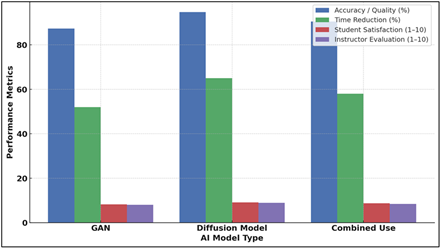
Figure 3
Integration of AI
Models in Curriculum
2) Enhancing
Creativity, Experimentation, and Design Thinking Among Students
The creative process of learning has been revamped with the help of AI-driven tools, which have led to experimentation and rapid iteration, with reflective design thinking. The students are not restricted to design steps anymore, but they can prototype, analyze and refine visual ideas in a dynamic way. On the platforms that are driven by GANs and Diffusion Models, learners are able to participate in a production-assessment-refinement cycle, which promotes a deeper comprehension of composition, coloring, and subject unity. The AI is also a kind of a mentor as it can provide visual feedback, provoking new creative directions. This interaction does not only produce artistic fluent behavior, but problem-solving and critical thinking, a key part of design education in the 21st century. This also leads to the role of the student shifting towards a less active, more of an active participant of a human-AI creative ecosystem, which enriches his or her creative identity and technical skills.
Table 3
|
Table 3 Creativity and Design Thinking Enhancement |
|||||
|
Model Type |
Creativity Improvement (%) |
Experimentation Frequency
(per project) |
Design Thinking Score (1–10) |
Peer Review Rating (1–10) |
Project Success Rate (%) |
|
GAN |
62 |
8 |
8.4 |
8.1 |
85 |
|
Diffusion Model |
75 |
11 |
9 |
8.8 |
91 |
|
Combined AI Workflow |
70 |
10 |
8.7 |
8.5 |
89 |
These results explain the idea that both GANs and Diffusion Models play a major role in promoting superior learning results, quicker concept creation, and more creative interaction in the field of film and game design education.
The numbers in the table indicate the relative impact of the GANs, Diffusion Models and Combined AI Workflows to creativity and design thinking in film and gaming educational programs. Diffusion Model has the best improvement of creativity of 75 percent and the highest frequency of experimentation of 11 iterations per project, highlighting its ability to produce a wide range of photo real images that spurs more creative investigation. It has a better design thinking score (9.0) and a peer review score (8.8), which means that it is widely accepted by both students and instructors, which confirms its usefulness in improving conceptual visualization and artistic innovatio.
Figure 5
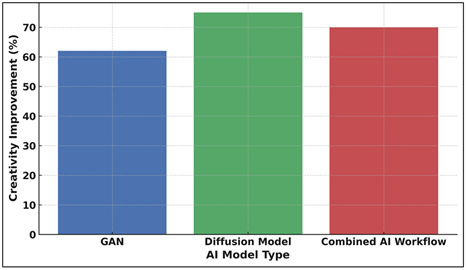
Figure 4
Creativity
Improvement Across AI Models
The GAN model with a slightly less improvement in creativity of 62 percent, is nonetheless useful in stylistic exploration and fast ideation especially in character generation. Combined AI Workflow- a combination of GAN and Diffusion techniques- achieves balanced performance with a focus on diversity and realism with an impressive 70 percent improvement in creativity and 8.7 score in design thinking. In total, these results support the fact that AI-assisted methodologies foster the culture of iterative learning, experimentation, and critical thinking. In addition to creating superior-quality art, it can be considered that students also learn to create more sophisticated design rationale and collaborative problem-solving, making AI a driver of pedagogical creativity in art education.
Figure 5
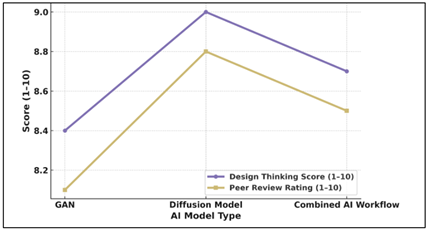
Figure 5
Design thinking vs
Peer Review across AI Models
6. Ethical and Aesthetic Considerations
1) Issues
of Originality, Authorship, and Algorithmic Bias
The emergence of AI-generated art has once again brought up many old arguments concerning originality and authorship within the creative industries. In conventional concept art, the originality comes through the personal viewpoint of an artist and his ability to interpret things. Nevertheless, with AI systems creating images that are inspired by extensive collections of already existing pieces of art, the distinction between inspiration and imitation becomes indistinct. This poses some very important questions, who owns the creative work, the artist who selected the stimuli or the AI that generated the image? Moreover, AI models are usually trained on copyrighted or stylistically different artwork and usually unknowingly copy the similarities or style without giving due credit. This does not only undermine the concept of artistic integrity but intellectual property regulations in learning and commerce. In addition to authorship, there is another significant ethical issue, namely algorithmic bias. The AI models, which are trained on the imbalanced datasets, might unintentionally support the cultural stereotypes or the homogenization of the styles hence producing the visual outputs, which marginalize the various artistic styles. As an example, concept art of characters or settings may be unintentionally western-centric, ignoring other culturally informed stories.
2) Responsible
and Informed Use of AI in Creative Education
The learners should not only be taught the effective usage of AI tools but also be taught to be critical of their social, ethical, and aesthetic consequences. The first step to responsible AI use is to be familiar with the workings of generative systems, what they are trained on, their constraints, and what biases they have incorporated. Educators have a significant role to play in positioning AI as a supportive partner as opposed to an independent creator, which creates awareness that human judgment is still needed in the establishment of artistic meaning and narrative authenticity.
Ethical guidelines should also be part of educational programs where the learners are encouraged to record their creative processes with a reference to the contribution made by AI made openly. This tradition maintains responsibility and respect towards intellectual property. Furthermore, sustainable AI practices, which include reducing excessive dependence on computational instruments but fostering creativity based on human experience and critical thinking should be a key part of the curriculum. Students who are trained to be AI literate will be enabled to challenge, refine, and ethically practice emerging technologies in their artistic work. Finally, responsible AI education means that creativity is innovative and responsible in applying technological progress towards human values, diversity, and integrity in the changing future of digital art and design.
7. Conclusion
The introduction of concept art powered by AI into the field of film and gaming education has profoundly changed the way the three fields of creativity, technology, and pedagogy interconnect. With the application of Generative Adversarial Networks (GANs) and Diffusion Models, it has also been evident that those models enhance the productivity of the arts, can visualize quickly, and can experiment with creative ideas. The students develop the capability of ideating and iterating with great efficiency, making standard workflow dynamic and co-creative. Moreover, AI tools help to get more engaged in design thinking and make learners combine computational logic with artistic instincts. All these benefits enhance the education experience making the students ready to work in a media environment where intelligent systems become a part of visual storytelling. Nonetheless, creative education does not assume AI implementation easily. The questions related to authorship, originality and ethical responsibility remain a controversial issue, and it is important to note that commendable awareness and open practices are obligatory in the academic setting. Teachers also have to overcome the issues of algorithmic bias, data ethics, and human creativity in a world of technological reliance. Towards the future, the way forward is to create AI- Literacy curricula that are not only technical but also reflective of ethical issues. Artists, technologists, and educators will have to conduct research together to make sure that AI is not used as a replacement tool. Finally, the combination of human imagination and machine intelligence will be the establishment of the next stage of visual education and creative innovation.
CONFLICT OF INTERESTS
None.
ACKNOWLEDGMENTS
None.
REFERENCES
Alharthi, S. A. (2025). Generative AI in Game Design: Enhancing Creativity or Constraining Innovation? Journal of Intelligence, 13(6), Article 60. https://doi.org/10.3390/jintelligence13060060
Avlonitou, C., and Papadaki, E. (2025). AI: An Active and Innovative Tool for Artistic Creation. Arts, 14(3), Article 52. https://doi.org/10.3390/arts14030052
Bond, M., Khosravi, H., De Laat, M., Bergdahl, N., Negrea, V., Oxley, E., Pham, P., Chong, S. W., and Siemens, G. (2024). A Meta Systematic Review of Artificial Intelligence in Higher Education: A Call for Increased Ethics, Collaboration, and Rigour. International Journal of Educational Technology in Higher Education, 21(1), Article 4. https://doi.org/10.1186/s41239-023-00436-z
Du, H., Teng, S., Chen, H., Ma, J., Wang, X., Gou, C., Li, B., Ma, S., Miao, Q., Na, X., et al. (2023). Chat with ChatGPT on Intelligent Vehicles: An IEEE TIV Perspective. IEEE Transactions on Intelligent Vehicles, 8, 2020–2026. https://doi.org/10.1109/TIV.2023.3253281
Gao, C. A., Howard, F. M., Markov, N. S., Dyer, E. C., Ramesh, S., Luo, Y., and Pearson, A. T. (2023). Comparing Scientific Abstracts Generated by ChatGPT to Original Abstracts using an Artificial Intelligence Output Detector, Plagiarism Detector, and Blinded Human Reviewers. NPJ Digital Medicine, 6, Article 75. https://doi.org/10.1038/s41746-023-00819-6
Gorakh, J., Jaiswal, N., Satfale, P., Japulkar, A., and Choudhary, A. (2025). T-Junction Blind Spot Indication System at Flyover, Metro and Bridges. International Journal of Electrical Engineering and Computer Science, 14(1), 187–192.
Khalil, M., and Er, E. (2023). Will ChatGPT get you Caught? Rethinking of Plagiarism Detection. arXiv.
https://dx.doi.org/10.29121/shodhkosh.v6.i1s.2025.6623
King, M. R., and ChatGPT. (2023). A Conversation on Artificial Intelligence, Chatbots, and Plagiarism in Higher Education. Cellular and Molecular Bioengineering, 16, 1–2. https://doi.org/10.1007/s12195-022-00754-8
Ogunleye, B., Zakariyyah, K. I., Ajao, O., Olayinka, O., and Sharma, H. (2024). A Systematic Review of Generative AI for Teaching and Learning Practice. Education Sciences, 14(6), Article 636. https://doi.org/10.3390/educsci14060636
Prendergast, M., Pinto, A. M. C., Harvey, C.-J., and Muir, E. (2024). Burnout in Early Year Medical Students: Experiences, Drivers and the Perceived Value of a Reflection-Based Intervention. BMC Medical Education, 24, Article 7. https://doi.org/10.1186/s12909-023-04948-0
Saeidnia, H. R., and Lund, B. D. (2023). Non-fungible tokens (NFT): A Safe and Effective Way to Prevent Plagiarism in Scientific Publishing. Library Hi Tech News, 40(2), 18–19. https://doi.org/10.1108/LHTN-12-2022-0134
Wollowski, M. (2023). Using ChatGPT to Produce Code for a Typical College-Level Assignment. AI Magazine, 44(1), 129–130. https://doi.org/10.1002/aaai.12086
Worthley, B., Guo, M., Sheneman, L., and Bland, T. (2025). Antiparasitic Pharmacology goes to the Movies: Leveraging Generative AI to Create Educational Short Films. AI, 6(3), Article 60. https://doi.org/10.3390/ai6030060
Yang, W., Lee, H., Wu, R., Zhang, R., and Pan, Y. (2023). Using an Artificial-Intelligence-Generated Program for Positive Efficiency in Filmmaking Education: Insights from experts and students. Electronics, 12(23), Article 4813. https://doi.org/10.3390/electronics12234813
|
|
 This work is licensed under a: Creative Commons Attribution 4.0 International License
© ShodhKosh 2025. All Rights Reserved.