ShodhKosh: Journal of Visual and Performing ArtsISSN (Online): 2582-7472
|
|
POLITENESS IN SOCIAL MEDIA CAMPAIGNS: A CASE STUDY OF THE 2024 TEBING TINGGI REGIONAL ELECTIONS
Mahriyuni 1 , T. Thyrhaya Zein 1, Emilia Ramadhani 2, Puan Maharani 1, Dian Marisha Putri 1
1 Faculty
of Cultural Sciences, Universitas Sumatera Utara, Indonesia
2 Faculty
of Social and Political Sciences, Universitas Sumatera Utara, Indonesia
|
|
|
ABSTRACT |
|
|
This study
aims to investigate language politeness in social media campaign in the 2024
Tebing Tinggi regional head election (TTRHE). This study departed from Brown
and Levinson (1987), and Leech (2014) who developed the principles of
politeness through the principles of language politeness or maxims. This
study used qualitative content analysis design. The data consist of 100
social media posts distributed by candidate and deputy candidate pairs from
the 2024 TTRHE collected from social media platforms such as Facebook,
Instagram, YouTube, and TikTok. The data collection time was from September
30 to November 10, 2024. Based on the results of the analysis, it was found
that there are six maxims found namely: maxim of wisdom with 20 data, maxim
of generosity with 20 data, maxim of praise with 20 data, maxim of humility
with 15 data, maxim of approval with 15 data, and maxim of sympathy with 10
data. Of the 100 data points, most adhered to Leech's politeness principle;
however, there were also 12 violations, including statements that emphasized
personal gain, excessive criticism, or a lack of public sympathy. These
violations generally occurred in statements that tended to emphasize personal
achievements without balancing them with humility, thus contradicting the
maxims of modesty and tact. Thus, this distribution shows that the majority
of campaign statements attempted to maintain politeness. |
|||
|
Received 28 December 2025 Accepted 29 January 2026 Published 25 February 2026 Corresponding Author Mahriyuni,
mahriyuni@usu.ac.id DOI 10.29121/shodhkosh.v7.i1.2026.6600 Funding: This research
received no specific grant from any funding agency in the public, commercial,
or not-for-profit sectors. Copyright: © 2026 The
Author(s). This work is licensed under a Creative Commons
Attribution 4.0 International License. With the
license CC-BY, authors retain the copyright, allowing anyone to download,
reuse, re-print, modify, distribute, and/or copy their contribution. The work
must be properly attributed to its author.
|
|||
|
Keywords: Campaign, Politeness, Political Communication,
Pragmatics, Regional Election |
|||



1. INTRODUCTION
Tebing Tinggi regional head election (TTRHE) 2024 campaign has ended, but crucial moments in documenting political campaign communications on social media can still be scrutinised. Therefore, the documentation of the campaign via social media provides an interesting context for study from a pragmatic perspective, focusing on linguistic politeness. The politeness of various forms of speech delivered by regional head candidates in debates, speeches, and political campaigns on social media reflects their choice of linguistic strategies in building their image and establishing relationships with the public.
Pragmatics is a field of linguistics that examines how context affects the understanding and interpretation of speech. According to Levinson, pragmatics focuses on how speakers recognize and interpret unseen meanings in interactions. In the study of pragmatics, it is essential to examine the shared assumptions between speakers and listeners, as this offers insight into the deeper, often implicit meanings underlying communication (Clark, 2014). According to Leech (1984), the Politeness Principle outlines six main maxims: the maxim of tact, the maxim of generosity, the maxim of approbation, the maxim of modesty, the maxim of agreement, and the maxim of sympathy. Each maxim functions to maintain balance. Social relationships can minimize the potential for conflict in communication Leech (2014). The focus of this research aligns with recent studies in pragmatics, which show that politeness functions as a rhetorical strategy for shaping self-image and managing power in political communication, particularly on social media Culpeper (2021), Haugh (2015), Fetzer and Weizman (2019). Research into the forms and types of politeness maxims in the Tebing Tinggi regional election campaign can provide a comprehensive picture of the candidates' communication styles.
Politeness is a fundamental aspect of realising effective and harmonious communication. Politeness is a fundamental principle that cannot be ignored in any speech act. This aligns with Yule (1996) view that politeness helps speakers avoid conflict and maintain harmonious social relationships. This is certainly in line with the principle of politeness as a strategy to maintain the "face" of the interlocutor, including their dignity and self-respect Brown and Levinson (1987). This is evident in the Tebing Tinggi mayoral election campaign, which utilizes social media, communication with constituents, and debates, characterized by careful word choice, avoidance of attacks on political opponents, and a diplomatic use of language.
According to Khasanah et al. (2024), violations of politeness occurred during the 2024 Presidential and Vice Presidential Candidate debate. The study found that the most frequent violations of the maxims of tact and praise occurred, illustrating the dynamics of political debate that maintained the boundaries of politeness while remaining competitive and aggressive. However, in contrast to the findings of Niazi et al. (2024), the 2024 Pilkada campaign volunteers utilized social media ethically and morally, emphasizing the importance of the principle of digital politeness as a means of building a positive image of the candidate and communication ethics tended to be more successful in forming a good public perception of the candidate being nominated. Likewise, Zainab et al. (2024) described politeness and its violations in the 2024 Vice Presidential Candidate debate. Using a pragmatic approach, this study found that the maxims of agreement and sympathy were used in communication between candidates. However, violations of the maxims of tact and generosity were found with the presence of competitive persuasive strategies in digital political communication.
Similarly, Mahriyuni (2022) provide an important contribution to identifying the political meanings contained in animated films. This study employs a semiotic approach to analyze the symbols present in the animation "Pak Tani and Mawar Kecil." The research findings indicate that the animation's symbols, such as the rose symbolizing the PSI Party, the buffalo trampling on the rose representing the PDIP Party, and the eagle snatching the rose symbolizing the Gerindra Party, contain connotative political meanings that refer to the dynamics of Indonesian politics. The political metaphors generated by this animation offer a glimpse into the struggle, competition, and dedication in Indonesian politics, demonstrating how political messages can be conveyed through seemingly indirect media, such as animations that illustrate impoliteness or politeness in campaign language.
This study aims to explain the role of politeness in shaping the quality of ethical political interactions and contribute to the development of public political literacy. An example of discourse that reflects the application of politeness can be seen in the speech of the candidate for mayor of Tebing Tinggi, Iman Irdian: "Thank you to all the volunteers and everyone present today.
Therefore, understanding and applying politeness in language becomes increasingly important in forming a healthy, just, and civilised democratic culture. The focus of this research is on analysing the forms of politeness maxims that appear in the speech of regional head candidates in the 2024 Tebing Tinggi Pilkada. This study employs a pragmatic approach and Leech's politeness theory, focusing on political communication strategies in campaigning, specifically the application of politeness principles in language. This research provides a crucial foundation for future studies on politeness in political communication, particularly in the context of the 2024 Tebing Tinggi Pilkada.
2. THEORETICAL FRAMEWORK
2.1. Politeness
Politeness is a crucial aspect of pragmatics, closely related to strategies for maintaining social relations through language use. This concept was first popularised by Brown and Levinson (1987) and then expanded by Leech (2014)through the Politeness Principle, which consists of six maxims: tact, generosity, approbation, modesty, agreement, and sympathy. This principle aims to minimise conflict and maximise social harmony in communication, particularly in formal and public interactions such as political speeches.
Politeness is a principle that must be observed in communication to foster a harmonious atmosphere of mutual respect and comfort for others. According to Rustono (1999), linguistic politeness is not concerned with linguistic rules, but rather with linguistic strategies, such as: a) performing speech acts directly, without further ado, while adhering to Grice's (1975) cooperative principles; b) performing speech acts using positive politeness; c) performing speech acts using negative politeness; d) performing speech acts off-record; and e) not performing speech acts or remaining silent. Leech in Rahardi (2005) divides the principles of politeness into: a) the maxim of tact; b) the maxim of generosity; c) the maxim of appreciation; d) the maxim of simplicity; e) the maxim of agreement; and f) the maxim of sympathy.
Sifianou (2013) demonstrate that the boundaries between politeness and impoliteness in political communication are becoming increasingly blurred, particularly in the digital context. In the era of social media, public speech has become more spontaneous, direct, and often disregards norms of politeness. This has led to an increase in the use of cynical, sarcastic, and even aggressive language, both by politicians and the public. Therefore, the analysis of politeness now focuses not only on linguistic structures but also on the surrounding social, media, and ideological contexts. Archer and Grundy (2019) suggest a dynamic pragmatics approach to assessing the function of politeness in political discourse.
They emphasize that analysis needs to consider situational context, participant identities, and the power dynamics at play. Therefore, in this study, politeness is viewed as a crucial element in fostering ethical, representative, and constructive political communication.
2.2. Political Campaigns
According to Perloff (2014), a political campaign is a persuasive communication process designed to shape voter attitudes and behaviour through the delivery of structured political messages. Scammell (2014) adds that campaigns involve not only policy promotion but also building a candidate's personal image using various media. Meanwhile, Benoit (2007) explains that campaigns have three main functions: self-promotion, attacking opponents, and defending against criticism, all of which shape the dynamics of political communication during the campaign period.
In the context of modern democracy, political campaigns are also closely related to communication ethics and public political education. Norris and Inglehart (2019) emphasize that campaigns conducted politely and openly can strengthen public trust in the democratic process, while campaigns based on hate speech and hoaxes actually damage the quality of political discourse. Chadwick and Stromer-Galley (2016)
In the context of modern democracy, political campaigns are also closely linked to communication ethics and public political education. Norris and Inglehart (2019) emphasize that campaigns conducted politely and openly can strengthen public trust in the democratic process, while campaigns based on hate speech and hoaxes actually damage the quality of political discourse. Chadwick and Stromer-Galley (2016)
Highlight the role of digital media in transforming the campaign landscape into a hybrid form, which opens up space for direct interaction but also increases the risk of negative campaigning. Therefore, political campaigns ideally prioritize polite language as a communication strategy that not only builds the candidate's image but also supports the creation of an ethical, inclusive, and educational public space.
3. METHOD
This research employs qualitative content analysis. This study aims to describe the use of polite language in social media campaigns to maintain positive social relationships between candidates. This research approach includes a comprehensive research plan and procedures, including external assumptions, detailed data collection methods, data analysis, and data interpretation Creswell (2019). The instrument in this study was the researcher herself; the researcher plays a crucial role in qualitative research. The data analysis process consists of the following stages: collecting social media data, selecting data, inventorying, selecting, classifying, analyzing, interpreting the results, drawing conclusions, and reporting the research findings Nasim et al. 2016, Sudaryanto (2016). The data were from social media post related to political campaign content produced and posted by regional head candidate pairs in TTHRE 2024 obtained from social media platforms such as Facebook, Instagram, YouTube, and TikTok. The data studied includes campaign video uploads, captions, public comments, and other interactions that occurred during the official campaign period.
Data were collected using listening and note-taking techniques, as well as observing campaign content recordings, contextual note-taking, and transcribing verbal interactions from videos or uploads. Researchers also recorded non-verbal context (facial expressions, voice intonation, and gestures) as suggested by Spradley (1980) in communication ethnography. Limited interviews were conducted with relevant parties (the campaign team, the General Elections Commission (KPU), local political observers, and academics) to enrich understanding of campaign messages. Data analysis was conducted with reference to pragmatic theory, particularly Leech's politeness theory. Data validity and reliability were assessed using triangulation techniques, encompassing both sources and data collection methods. This triangulation was carried out by comparing the results of text analysis of campaign content with conversation transcripts and field notes Denzin (1989).
4. RESULT AND DISCUSSION
4.1. Linguistic Politeness
Based on the results of this study, several principles of politeness were identified in the fifth presidential debate of the 2024 candidates. These results are explained through data discussion, resulting in a systematic, detailed, and descriptive qualitative analysis in accordance with Geoffrey Leech's Principles of Linguistic Politeness (1984), which consist of six maxims: Tact, Generosity, Approbation, Modesty, Agreement, and Sympathy. Analysis of Linguistic Politeness in the 2024 Tebing Tinggi Regional Election Campaign on Social Media.
Table 1
|
Table 1 Distribution of Politeness Maxims Classification |
|||||
|
No |
Types
of Politeness |
Dominant
Information |
Violation |
|
Number Polite
Data |
|
1 |
(Maxims) |
Collaborative
invitation, avoids coercion |
2 |
18 |
|
|
2 |
Tact |
Emphasises
public service, self-sacrifice |
3 |
17 |
|
|
3 |
Generosity |
Public
appreciation and recognition |
2 |
18 |
|
|
4 |
Approbation |
Candidate
is self-deprecating, but claims personal accomplishments |
3 |
12 |
|
|
5 |
Modesty |
Emphasises
consensus and understanding |
1 |
14 |
|
|
6 |
Agreement |
Empathy
for the unfortunate and emotional support |
1 |
9 |
|
|
12 |
88 |
||||
The analysis of 100 campaign speeches on social media (facebook, tiktok, instagram) reveals significant variation in the distribution of politeness principles, as outlined by leech (1984). the data are divided into six maxims: 20 tact maxims, 20 generosity maxims, 20 praise maxims, 15 humility maxims, 15 approval maxims, and 10 sympathy maxims. of the 100 data points, most adhered to leech's politeness principles; however, there were also 12 violations, including statements that emphasized personal gain, excessive criticism, or a lack of public sympathy. thus, this distribution indicates that the majority of campaign statements aimed to maintain politeness, while a small portion deviated for the sake of specific political strategies.
4.1.1. Tact Maxim
Generosity, as a principle of politeness in communication, requires the speaker to minimise personal and group benefits by maximising the benefits of the interlocutor. Therefore, speakers must avoid words or actions that give the impression that they and their group are superior or better than others. The maxim of generosity is employed by regional head candidates on social media, emphasising public service and self-sacrifice. The following social media data demonstrates efforts to use the maxim of generosity as a polite language:
· "Let us build Tebing Tinggi together without discrimination based on ethnicity and religion." (fb/C01/MP
· "We want the development of Tebing Tinggi to benefit all, not just a select few." (ig/C02/MK)
The maxim of wisdom conveyed by the candidate was "Let us build Tebing Tinggi together without discrimination based on ethnicity and religion." The phrases "Let us build Tebing Tinggi together" and "...provide benefits for all, not just a select few." The phrases "let's" and "benefit all" are key words and phrases that demonstrate wisdom as a selling point, hoping to garner sympathy from constituents as voters.
Figure 1
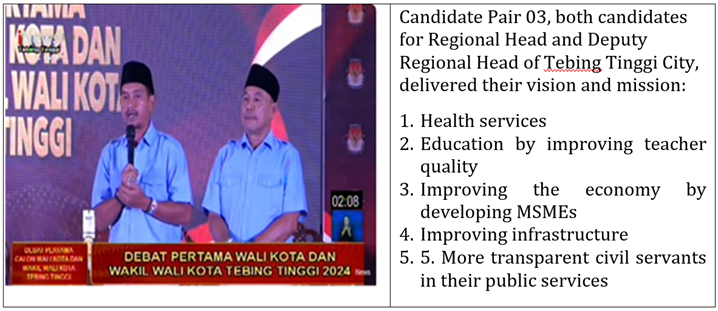
Figure 1
Tebing Tinggi
Election Commission (KPU) Regional Head Election Debate - Saturday, October 19,
2024
Sumber: https://www.youtube.com/watch?v=4SbGs9KSREYsumut 4 Novemver 2024
The words demonstrate the concept of speech, adhering firmly to the principle of the maxim of politeness, which minimises one's own benefit while maximising the benefit of others. Politeness in language on social media platforms, such as Facebook and Instagram, falls under the category of the maxim of politeness, with 18 statements cited by each candidate pair. The maxim of politeness refers to efforts to minimise the harm to the addressee and maximise the benefit to the addressee in the speech. The speaker does not emphasize himself, but instead invites the community to participate in developing Tebing Tinggi City. The social media data from Facebook and Instagram above emphasizes mutual benefit, rather than benefiting a particular group. This speech is polite because it adheres to the maxim of politeness. Compliance with the maxim of politeness, speech that maximises the benefit to the addressee and minimises the harm to the addressee, is polite. This description aligns with the phenomenon observed in the data above, where the candidate invites constituents and voters to collaborate in building Tebing Tinggi and ensure that development benefits all members of society.
4.1.2. Maxim of Generosity
Generosity, as a principle of politeness in communication, requires the speaker to minimise personal and group benefits by maximising the benefits of the interlocutor. Therefore, speakers must avoid words or actions that give the impression that they and their group are superior or better than others. The maxim of generosity is employed by regional head candidates on social media, emphasizing public service and self-sacrifice. The following social media data demonstrates efforts to use the maxim of generosity as polite language:
· "We are here for MSMEs, not for personal gain." (tt/MK/C02)
· "We are ready to sacrifice our time and energy for the benefit of the Tebing Tinggi community." (fb/MK/C01)
The Maxim of Generosity conveyed by the regional head candidates was expressed in a sentence aimed at helping small traders, with the caption, "We are here for MSMEs, not for personal gain." Similarly, the data regarding the regional head candidate's desire to help small traders states, "We are ready to sacrifice our time and energy for the benefit of the Tebing Tinggi community." (fb/MK/C01). In the social media data above, the candidate attempts to minimise his own self-interest and emphasises the sacrifices he makes for his interlocutors. This demonstrates adherence to the maxim of generosity.
The data above utilises words that demonstrate the principle of politeness, adhering strictly to the maxim of generosity, which minimises personal and group benefits while maximising the benefits of the interlocutor. Politeness in language on social media platforms like Facebook and Instagram falls into the category of the maxim of tact, with 18 statements used by each candidate pair. The maxim of tact refers to efforts to minimise the harm to the interlocutor and maximise the benefits to the interlocutor. The speaker does not emphasize himself, but instead invites the community to participate in developing Tebing Tinggi City. The social media data from Facebook and Instagram above highlights the mutual benefit, rather than the benefits of a particular group. This speech is polite because it adheres to the maxim of tact. The statement demonstrates a willingness to sacrifice oneself for the community, in accordance with the maxim of generosity. Therefore, the statement above demonstrates the candidate's willingness to position themselves as a public servant.
4.1.3. Approbation Maxim
The maxim of approbation means minimising criticism of the interlocutor and maximising praise. The maxim of praise is also termed the maxim of seduction, namely, as praise that tends to be less sincere and has specific goals. Politeness in language based on compliance with the maxim of praise in the speech of the Tebing Tinggi district head and cawakada in the 2024 regional head and cawakada elections is presented through the following data:
· ”Congratulations to the residents of Tebing Tinggi for successfully
holding a lively cultural festival." (yt/C03/MP)
· "We are proud of the creative and innovative youth of Tebing Tinggi." (ig/02/MP)
Debate 1: Regional and Deputy Regional Head Candidates for Tebing Tinggi City
Figure 2
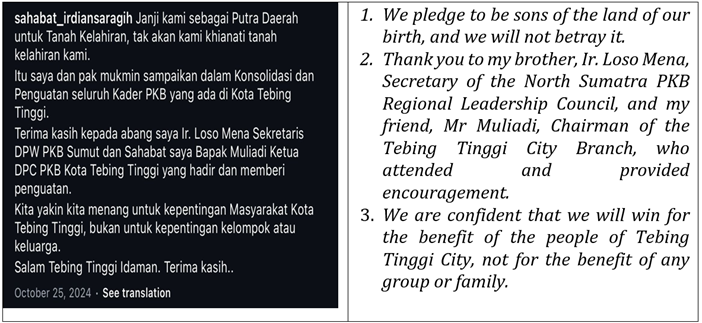
Figure 2 Sumber: instagram #akamsi#putradaerah#tebingtinggi#sumut diunggah tanggal 25 Oktober 2024
In the social media data from YT above, this statement praises the community with the sentence, "Congratulations on your success," without belittling others. This conforms to the maxim of praise. Similarly, the social media data from IG states, "We are proud of the creative and innovative young people of Tebing Tinggi." This sentence conveys positive appreciation for the younger generation. This principle aligns with the maxim of praise. The candidate seeks to maximize public respect by appreciating their participation. From Leech's perspective (1984), this maxim maintains social harmony by minimising criticism and maximising praise.
4.1.4. Modesty Maxim
Polite language is used in the classification of the modesty maxim on social media platforms for regional head and deputy regional head candidates, with 12 out of 100 collected data. Using the maxim of modesty, the speaker praises others by emphasizing their role, thereby maintaining social relationships and avoiding conflict. According to Rahardi (2005), the speaker applies the maxim of humility to his interlocutor by speaking as humbly as possible, with the strategy of minimizing self-praise, in order to avoid being perceived as arrogant. The use of the modesty maxim by the Tebing Tinggi regional head and deputy regional head candidates on social media platforms, Facebook and Twitter, totals 12 data points, and is described more clearly as follows:
· “Tanpa dukungan masyarakat, kami bukan siapa-siapa.” (fb/MKH/C02)
· “Kritik dari warga adalah guru terbaik bagi kami.” (TT/MKH/C03)
The data of the maxim of humility above, as a form of maxim of humility, was conveyed by the regional head and deputy regional head candidates as an effort to minimise self-praise while maximising self-blame. This is evident in the sentence: 'Without public support, we are nothing.' (fb/MKH/C02). The keyword of humility is: 'Without public support,' which is then emphasised with the sentence, ... we are nothing.' This can be interpreted as an effort by the Candidate to humble himself in front of the public. The sentence, "Criticism from citizens is the best teacher for us," suggests that a person who is ready to be criticised is open to learning, and the Criticism serves as a teacher for Candidate 03 (C03). This is the implication of the maxim of humility, with the keywords: Without public support, and Criticism is the best teacher. The sentence serves as an indicator of the maxim of humility for the regional head and deputy regional head candidates, who appreciate public Criticism. Thus, this expression is polite because it suppresses the impression of arrogance that can damage the Candidate's image.
4.1.5. Agreement Maxim
Fourteen agreement maxims were found in the social media data. These maxims demonstrate the politeness of the Tebing Tinggi regional and deputy regional heads (candidates) in an effort to minimise disagreements between speakers and listeners. This means that the greater the agreement between speakers and listeners, the more polite the speech. The maxim of politeness is classified as a politeness principle that describes politeness in accordance with the agreement between the speaker and the interlocutor. This means that the greater the agreement and agreement in communication, the more polite the speech. A more detailed explanation is as follows:
· “Kita sepakat bahwa pendidikan anak-anak harus jadi prioritas utama pendidikan anak-anak Tebing Tinggi.” (fb/MS/C03)
· “Kami setuju dengan usulan warga soal perbaikan drainase kota Tebing Tinggi.” (fb/MK/C01)
In the Facebook social media data, the speech text is reinforced with the keywords "We agree..." and "We agree..." These words reinforce mutual agreement with the community. This is a key indicator of the agreement maxim. The agreement reached by regional and deputy regional head candidates with their constituents as conversation partners can make their speeches more polite. This aligns with the principle of the agreement maxim, which describes politeness manifested through the use of words of agreement between the speaker and the addressee, as constituents who vote. The data above is considered polite because it adheres to the agreement maxim. Politeness is evident in efforts to reduce social friction and strengthen cohesion between leaders and the people. This is in line with Holmes (2013), who emphasised that agreement is key to maintaining community solidarity.
4.1.6. Sympathy Maxim
Sympathy, as a principle in communication, encourages speakers/writers to use language that conveys empathy and sympathy for the listener or reader. For example, if the interlocutor experiences a complaint, a life problem, or a disaster, the speaker employs a strategy that involves showing sympathy and empathy, which involves a feeling of sorrow and condolences Chaer (2010). The use of the principle of sympathy in social media as a campaign medium for regional head and deputy regional head candidates in Tebing Tinggi was found in 9 data points on social media.
· “Doa kami bersama keluarga korban banjir di Tebing Tinggi.” (yt/MSim/C01)
· “Kami turut berduka atas musibah kecelakaan lalu lintas di Jalan Sudirman.” (Ig/MSim/C02)
The phrase used by candidate pair 01, "Our prayers are with the families of the flood victims in Tebing Tinggi," demonstrates the deep empathy expressed by the regional and vice-regional candidates for the suffering of the victims. The phrase sounds very soothing and full of sympathy. Similarly, the phrase, "We express our condolences for the traffic accident..." evokes empathy and sympathy for the community's suffering. The maxim of sympathy means minimising antipathy and maximising sympathy for the interlocutor.
In the context of a campaign, this form of empathy enhances the candidate's emotional closeness with the community as constituents. According to Watts (2003), politeness is not only linguistic but also functions as a social strategy for building positive interpersonal relationships. Therefore, expressions of sympathy are considered polite because they emphasise the candidate's emotional solidarity and social responsibility.
4.2. Violation of Maxims (Language Impoliteness)
The principles of linguistic politeness dictate that each maxim must be emphasized as a means to maintain harmony in communication. Now, when these maxims are violated, the sentence falls into the category of linguistic impoliteness. After all the collected data was analysed and presented above, it was found that some data violated the principles of linguistic politeness, which constitutes linguistic impoliteness.
4.2.1. Violation of the Praise Maxim
Violation of the praise maxim implies criticizing the interlocutor and maximizing self-praise. Conversely, a candidate or regional head speaking curtly tends to praise themselves. Data on violations of the praise maxim in the speech of Tebing Tinggi regional head and deputy regional head candidates on social media revealed two instances:
· “Jangan pilih lawan kami, mereka hanya tukang janji kosong.” (fb/PMPj/Kom.Warga)
· “Cuma copy-paste dari pusat.” (tt/PMPj./ D Relawan C02)
The text of the sentence on social media above on Facebook criticizes political opponents with the sentence: "Don't vote for our opponents, they're just empty promises." A regional head or deputy regional head candidate should not criticize other groups, suggesting that their political opponents are empty promises. However, it's not good to corner an opposing person or group. A wise leader should promote their work program rather than discredit other groups. Similarly, the second sentence is: "Just copy-pasted from the central government." This also violates politeness, particularly in the case of violating the maxim of praise, namely by criticizing political opponents. The most common forms of violation include personal insults, the use of negative labels, and even derogatory metaphors like dolls or snakes. This negates the value of appreciation and leads to negative imagery through ad hominem, rather than substantive discussions about policy.
4.2.2. Violations of the Maxim of Humility
Violations of the Maxim of Humility on social media by regional and vice-regional candidates were identified in three out of 100 datasets. Violations of the Maxim of Humility involve speakers who, instead of praising others, criticise others by emphasising their own role, with the intention of boasting about themselves and their group. Violations of the Maxim of Humility by the Tebing Tinggi regional and vice-regional candidates on social media platforms such as Facebook and Twitter were identified in three datasets. For clarity, they are explained as follows:
· "We are the only competent candidates; the others are just for image." (Ig/PMKRht/C02)
· "We are certain to win; our opponents are just a formality." (fb/PMKRht/C02)
This utterance demonstrates an exaggerated (hyperbolic) depiction of the political opponent's shortcomings. The emphasis on the negative aspects by exaggerating the facts demonstrates a violation of the Maxim of Modesty. This utterance is not objective but tends to create stigma.
4.2.3. Violation of the Maxim of Agreement
One violation of the Maxim of Agreement was found in the social media data. The violation of the Maxim of Agreement refers to disagreement between the speaker and the addressee. This means that the greater the disagreement between the speaker and the addressee, the more the utterance violates the Maxim of Agreement. This means that the greater the disagreement during communication, the greater the violation of the Maxim of Agreement. This is further explained as follows:
· “Kami tidak perlu sepakat dengan kebijakan mereka yang bodoh.” (yt/PMKes/C01)
· “Warga yang masih pilih lawan berarti tidak peduli masa depan kota.” (Ig/PMKS/C02)
The above data demonstrates disagreement in the sentence: "We do not need to agree with their stupid policies." This sentence clearly conveys disagreement. Similarly, the sentence: "Residents who still choose their opponents do not care about the future of the city." The above statement can certainly be divisive by demeaning those with differing views. This widens the communication gap between supporters, violates the principle of consensus, and muddies the campaign waters. Analysis: Refusing to reach an agreement violates the maxim of agreement. Analysis: Impolite, violates the Maxim of Sympathy (cornering voters). This sentence eliminates the opportunity for agreement and violates the maxim of agreement.
4.2.4. Violation of the Maxim of Sympathy
Violation of the Maxim of Sympathy in communication leads the speaker to use language that conveys antipathy toward the listener. This results in the speaker lacking empathy and sympathy for the listener, which naturally creates distance between the two. Based on data on violations of the Maxim of Sympathy on social media, one instance was found. Principle: The speaker minimises antipathy and maximises sympathy.
· “Pemilih lawan sama saja pengkhianat kota.” (Facebook Komentar Netizen) (fb/PMSim/C02)
The data above contains violations of the sympathy maxim, and the sentence contains antipathy, violating the sympathy maxim. The sentence "The opponent's voters are the same as traitors to the city." Violations of the sympathy maxim are viewed as attempts to foster antipathy toward political opponents who are identified with or perceived as traitors to the city. Building a misguided paradigm will certainly make constituents wary of engaging with political opponents. This sentence falls into the category of Violations of the sympathy maxim.
4.3. Discussion
Language politeness in the realm of political communication, particularly on social media, is an aspect that cannot be ignored in the context of TTHRE 2024. Social media platforms, such as Facebook, Instagram, WhatsApp, and TikTok, are extensively used by candidate pairs and their supporters to build their political image and influence public opinion. However, this intense use of social media not only generates positive campaign discourse but also demonstrates the phenomenon of violations of the principles of linguistic politeness as formulated by Leech (1984).
The analysis shows that the most dominant violations occur in the approbation maxim. Many comments in comment sections and official posts demean opposing candidates, for example, by labelling them negatively, such as "failed leader" or "unfit," or using metaphorical language with a mocking tone. These violations highlight a communication strategy aimed at undermining the other party, which actually obscures the substance of political ideas. Furthermore, there were violations of the tact maxim. Instead of emphasizing the benefits to the audience, many statements tended to impose their will, claiming that only one candidate could bring change. This kind of narrative stifled healthy dialogue and undermined the principles of democratic communication, which should provide equal opportunities for all parties to engage. Equally important, the violation of the sympathy maxim was evident in the lack of empathy between supporters. Rather than demonstrating solidarity, the emerging discourse emphasized identity polarisation. An example was the use of language that insulted the candidates' social, economic, and even cultural backgrounds, which not only attacked individuals but also had the potential to widen social gaps within society.
These findings indicate that politeness has not yet become a dominant culture in digital political communication in Tebing Tinggi. Social media, which should function as a means of program dissemination and political education, has instead often become an arena for symbolic battles that negate communication ethics. However, the application of politeness can improve the quality of democracy by encouraging more constructive dialogue, fostering mutual respect, and strengthening social cohesion.
From the examples above, polite language on social media during the 2024 Tebing Tinggi regional election indeed took various forms, although it was often less dominant than impolite speech. Collective appeals emphasizing benefits to society (the maxim of tact). Expressions of willingness to contribute selflessly (maxim of generosity). Praise and appreciation for candidates (maxim of appreciation). Humility and acknowledgement of limitations (maxim of modesty). Efforts to reach an agreement amid political differences (maxim of consensus).
The 2024 Tebing Tinggi regional head election demonstrated that the use of political language on social media (Facebook, TikTok, Instagram) can be clearly mapped into Leech's six maxims. Each maxim serves to maintain a positive image of the candidate, foster social solidarity, and affirm a harmonious relationship between leaders and the community. Referring to Leech (1984), Brown and Levinson (1987), Holmes (2013), and Watts (2003), it can be concluded that politeness in campaigning is not merely a linguistic strategy, but also a pragmatic and social strategy for gaining public support.
These findings demonstrate that Leech's politeness principles remain relevant for analyzing political discourse in the digital age. Polite speech not only maintains harmonious communication but also serves as a pragmatic strategy that can enhance a candidate's image and strengthen cohesion. Social society. In the context of local democracy, the practice of using polite language on social media indicates a positive direction in reducing the potential for conflict, while fostering more civilised political participation.
5. CONCLUSION
This study reveals that politeness in the 2024 Tebing Tinggi regional election campaign via social media was evident in collaborative invitations, expressions of gratitude, and appreciation for the community (adhering to the maxims of tact, agreement, sympathy, and humility). Impoliteness was found in attacks on political opponents, exaggerated claims, and voter bias (violations of the maxims of praise, humility, and agreement). In general, politeness strategies were employed to establish a positive image and garner sympathy, while impoliteness manifested in the form of aggressive and persuasive rhetoric aimed at undermining opponents. Facebook and WhatsApp were the most frequent sources of impolite speech (due to spontaneous comments and chain messages). At the same time, Instagram and TikTok featured more polite speech (due to their visual-public nature).
The most prevalent violation was the Appreciation Maxim (due to the numerous statements involving insults and negative labelling). The most dangerous violation was the Sympathy Maxim, as it directly targeted the dignity of the voting public, not just the candidate. A typical pattern: impolite speech in campaigns often consists of ad hominem attacks and negative labelling, rather than substantive criticism. This suggests that the dynamics of political communication on social media are still far from Leech's (1984) principles of politeness, necessitating improved political and digital literacy among the public and campaign teams.
ACKNOWLEDGMENTS
We would like to thank to the Research Institute of Universitas Sumatera Utara for the Talenta Research Grant year 2025.
REFERENCES
Archer, D., and Grundy, P. (Eds.). (2011). The Pragmatics Reader. Routledge.
Benoit, W. L. (2007). Communication in Political Campaigns. Peter Lang. https://doi.org/10.3726/b18545
Bogdan, R. C., and Taylor, S. J. (1975). Introduction to Qualitative Research Methods: A Phenomenological Approach to the Social Sciences. Wiley.
Bousfield, D. (2008). Impoliteness in Interaction. John Benjamins. https://doi.org/10.1075/pbns.167
Brown, P., and Levinson, S. C. (1987). Politeness: Some Universals in Language Usage. Cambridge University Press. https://doi.org/10.1017/CBO9780511813085
Chadwick, A., and Stromer-Galley, J. (2016). Digital Media, Power, and Democracy in Parties and Election Campaigns. The International Journal of Press/Politics, 21(3), 283–293. https://doi.org/10.1177/1940161216646731
Culpeper, J. (2021). Impoliteness: Using Language to Cause Offence. Cambridge University
Press.
Denzin, N. K. (1989). The Research Act: A Theoretical Introduction to Sociological Methods
(3rd ed.). Prentice Hall.
Dynel, M. (2015). Interpersonal Pragmatics. De Gruyter Mouton.
Fetzer, A., and Weizman, E. (Eds.). (2019). The Construction of “Ordinariness” Across Political Discourse. John Benjamins. https://doi.org/10.1075/pbns.307
Graham, T., Jackson, D., and Broersma, M. (2017). New Platform, Old Habits? Candidates’ Use of Twitter During the 2010 British and Dutch General Election Campaigns. New Media and Society, 19(5), 765–783. https://doi.org/10.1177/1461444814546728
Haugh, M. (2015). Impoliteness and Taking Offence in Initial Interactions: The Role of Expectations. Journal of Pragmatics, 85, 236–249. https://doi.org/10.1016/j.pragma.2015.05.018
Ilie, C. (2010). Strategic Uses of Politeness in Political Discourse. In C. Ilie (Ed.), European Parliaments Under Scrutiny (307–332). John Benjamins. https://doi.org/10.1075/dapsac.38
Kesuma, T., and Marijan, K. (2016). Triangulasi Dalam Penelitian Kualitatif: Pendekatan Dan Praktik. Universitas Airlangga Press.
Khasanah, U., Fahrurrozi, and Nugroho, W. (2024). Pelanggaran Kesantunan Berbahasa Dalam Debat Cakada Dan Cawakada 2024: Relevansinya Sebagai Sumber Bahan Ajar. Hortatori: Jurnal Pendidikan Bahasa Dan Sastra Indonesia, 8(2). https://doi.org/10.30998/jh.v8i2.3446
Khosravizadeh, P., and Sadehvandi, N. (2011). Some Insights into the Pragmatic Aspect of Politeness in Political Discourse. Journal of Language Teaching and Research, 2(4), 714–721.
Leech, G. N. (2014). The Pragmatics of Politeness. Oxford University Press. https://doi.org/10.1093/acprof:oso/9780195341386.001.0001
Mahriyuni, M., et al. (2022). Mengupas Politik Lewat Animasi Pak Tani and Mawar Kecil, Serta
Rahasia di Baliknya. Bahasa, 10(2), 112–125.
Moleong, L. J. (2017). Metodologi Penelitian Kualitatif. Remaja Rosdakarya.
Niazi, H. A., Aini, N., and Rahmawati, A. (2024). Pemanfaatan Media Sosial Yang Beretika Dan Berakhlak: Membangun Citra Positif Bagi Relawan Kampanye Pilkada 2024. Abdi Moestopo: Jurnal Pengabdian Kepada Masyarakat, 8(1). https://doi.org/10.32509/abdimoestopo.v8i1.4373
Niswasani, N., and Juita, N. (2024). Kesantunan Berbahasa Pejabat Legislatif/Tokoh Partai Tingkat Kabupaten Di Sumatra Barat Dalam Media Sosial. Bahasa Dan Sastra Indonesia: Jurnal Penelitian Pendidikan, 13(1), 21–30.
Norris, P., and Inglehart, R. (2019). Cultural Backlash: Trump, Brexit, and Authoritarian Populism. Cambridge University Press. https://doi.org/10.1017/9781108595841
Perloff, R. M. (2014). The Dynamics of Political Communication: Media and Politics in a
Digital Age. Routledge.
Putri, A. R. (2024). Kesantunan Berbahasa Dalam Dialog Kampanye Pemilu 2024 “Warga Semarang Desak Anies Baswedan” Dan “Wargi Bandung, Nyelepet Gus Imin” Di Kanal YouTube Metro TV: Kajian Pragmatik (Undergraduate Thesis, Universitas Pendidikan Indonesia). UPI Repository.
Scammell, M. (2014). Consumer Democracy: The Marketing of Politics. Cambridge University Press. https://doi.org/10.1017/CBO9781139046107
Sifianou, M. (2013). The Impact of Globalisation on Politeness and Impoliteness. Journal of Pragmatics, 55, 86–102. https://doi.org/10.1016/j.pragma.2013.05.016
Spradley, J. P. (1980). Participant Observation. Holt, Rinehart and Winston.
Sugiyono. (2015). Metode Penelitian Kualitatif, Kuantitatif, Dan RandD. Alfabeta.
Yule, G. (1996). Pragmatics. Oxford University Press.
YouTube. (2024, November 17). Debat 3, Minggu, 17 November 2024, Pukul 14:00 WIB [Video].
Zainab, Z., Hidayat, T., and Mukhlis, M. (2024). Kesantunan Berbahasa Dalam Debat Calon Wakil Presiden 2024 Di Akun YouTube Metro TV. PRO: Jurnal Hasil Penelitian Pendidikan Bahasa Dan Sastra Indonesia, 7(1), 45–54.
|
|
 This work is licensed under a: Creative Commons Attribution 4.0 International License
© ShodhKosh 2026. All Rights Reserved.