ShodhKosh: Journal of Visual and Performing ArtsISSN (Online): 2582-7472
|
|
Reading Resemblances and Fluidity between the Zikir songs of Azan Fakir and Other Song Genres in Assam
Dipanjali Deka 1 

1 PhD Research Scholar, Department of Theatre and Performance Studies, School of Arts and Aesthetics, Jawaharlal Nehru University, New Delhi, India
|
|
|
ABSTRACT |
|
|
Zikir songs of Assam are the Assamese Islamic devotional songs composed by the Sufi figure Shah Miran, alias, Azan Peer Fakir, who came to Assam from Baghdad in 17th century. Assamese scholars categorize zikir under the folk Bhakti or Sufi genre. According to Syed Abdul Malik, a pioneer writer on the subject, the word zikir is said to have been derived from the Arabic term ziqr, which means to remember, listen to and to mention the name of Allah. Interestingly, the concept of remembrance of the Divine, like in zikir, also resonates with the Neo-Vaisnavite Bhakti philosophy of Sankardeva and Madhavdeva of 15th century Assam. There exist philosophical and lyrical resemblances not only between zikir and borgeet (Vaisnavite prayer songs), but also between zikir songs and lokageet, and dehbichar geet. Musically, there are resemblances of rhythmic patterns and melodic phrases, which reflect a fluid exchange amongst zikir and other folk genres. This essay is
a musicological exploration and lyrical study of some examples showing these
philosophical resonances and musical fluidities. In doing so, the article
highlights the synthesis of the merging of the Hindu and Islamic
philosophies, lyrical and musical aesthetics, in and through the songs of zikir by Azan Fakir. |
|||
|
Received 10 June 2022 Accepted 01 August 2022 Published 10 August 2022 Corresponding Author Dipanjali Deka, dipanjali.cp2@gmail.com DOI 10.29121/shodhkosh.v3.i2.2022.155 Funding: This research
received no specific grant from any funding agency in the public, commercial,
or not-for-profit sectors. Copyright: © 2022 The
Author(s). This work is licensed under a Creative Commons
Attribution 4.0 International License. With the
license CC-BY, authors retain the copyright, allowing anyone to download,
reuse, re-print, modify, distribute, and/or copy their contribution. The work
must be properly attributed to its author.
|
|||
|
Keywords: Zikir, Bhakti Movement,
Assamese Sufism, Musical Fluidity, Folk Music |
|||



1. INTRODUCTION
I carry no discrimination in my mind O Allah,
I do not see a Hindu different from a Muslim, O Allah!
When dead, a Hindu is cremated
While a Muslim buried under the same earth
You leave this home
To reach that Home
Where all merge into one!
-Azan Fakir
The above is a zikir
(translated from Assamese), which is an Islamic Assamese devotional song-poem,
composed by the 17th century Sufi figure named Shah Miran or Azan Peer Fakir. Azan Peer Fakir is said to have
migrated from Baghdad to Assam via Ajmer and Delhi. On reaching Assam with his
mission of spreading the tenets of Islam, he was surprised to find that the
Muslims were following Islam only in the name. They were merged in the larger
Assamese Hindu mannerisms of social and religious life, which was mostly Neo-Vaisnavite in nature following the Nama-Dharma of Vaisnavite Gurus Srimanta Sankardeva and Srimanta Madhavdeva. Shah Miran is said to
have learnt the Assamese language himself, married a local woman, and merged
into the Assamese lifestyle. He imbibed musically and philosophically with many
existing rhythms, folk melodies, and religious philosophies. It became possible
for him to propagate the Islamic values through this merge with the existing
aesthetic and philosophical values of the folk Assamese life.
Today, multiple levels of synthesis exist amongst zikir and other song genres of Assam. I attribute this
synthesis to the fluid nature of loka parampara or folk traditions working in tandem with the
accommodative and inclusive philosophy of Bhakti or Sufi expressive cultures.
2. PHILOSOPHICAL RESEMBLANCES
In 15th century Assam, two figures, Sankardeva (1449-1569 AD) and Madhavdeva (1489-1596 AD) brought in
a literary and cultural renaissance in Assam through their brand of Vaisnavism that propagated the philosophy of Eka Sarana Nama Dharma, meaning the
single-minded devotion of Vishnu or Krishna. The music forms of borgeet and namakirtan are vocal
music genres originating from this brand of Neo-Vaisnavism.
All the eminent scholars who have written on Azan Fakir and his music,
including Syed Malik (2003),
Hossain (2014),
Deka (2012)
and so on, have paid attention to the influences of the Sankari
arts and philosophy on the music of Azan Fakir.
Nama-Dharma of Sankardeva
preached the remembrance of the Divine Name of God through various modes of
Bhakti: sravana
(listening to the recital of the Name and glories of Hari or Vishnu), kirtana (recital
of the glories and Name of Hari), smarana (recalling or remembrance of the Lord’s Form and
Name) and so on.
Two Vaisnavite songs
reflecting the kind of sacred significance of Nama in Vaisnavite
faith can be Hari Nama rase Vaikuntha
prakase and Naame
Gangaajol loboloi komol boi aase hridayar
maaje. While the first song says that Hari’s Name is the divine ambrosia that
would open the doors of Vaikuntha
heaven, the second song reflects that the sweet nectar of Nama is the pure Ganga flowing
through the devotee’s heart.
One finds resonance of a similar importance given to
the chanting of the Name even in Azan Fakir, who followed the Sufi philosophy
of zikr, meaning remembrance. In Jibar Saarothi Naam O Allah,
the devotee calls the Holy Name of Allah as the only true companion to life. Kevol Naame Kevol Naam, kevol Naame rati, dine rati loba Naam nokoriba khyoti gives an
urgent message to waste no time and surrender oneself to the chanting of the
divine Name, day, and night. In yet another zikir, Momin bhai dosti rakha Allahe param dhan the poet addresses
the bhakta (devotee) companion that
the Name is in fact the ultimate treasure leading to Divinity.
Among other things, many Vaisnavite
songs also talk of the transience of materialistic pleasures and worldly
sufferings of maya. One may take the Borgeet Pawe pari Hari koruhu katori in which the
bhakta surrenders on the feet of Rama, beseeching for the rescue of the soul
from the poisons of the material distractions (bisaya bisadhara bise jara
jara Jivana narahe thoro). A very similar critique of worldly pleasures
and illusory attachments is heard in the Zikir, bisoy khon gologroho bisoykhon bisoy golore mani,
where Azan Fakir rebukes material pleasures as the ominous presence (gologroho)
dangling from the neck Deka (2012) 27-28. The song cautions the devotee to see the reality
that because of this ominous presence she remains dry even within water. This
metaphor of dryness within water is suggestive of the failure to access the
Divine even while being near the Divine, because one
is constantly blinded by the illusory attachments.
However, it is not just Vaisnavite music that zikir is
seen to have resonances with. The other folk music genres of Assam like Kamrupi lokageet, Goalpariya dehbichar geet and tokari geet also find resonances in zikir
in some or the other way. The
Goalpariya lokageet are
songs with the themes of dehtattva and dehbichar that speak of the impermanence of this human
body, the futility of all material wealth, decay, and death.
There is a striking
resemblance of imagery between the zikir, lorali kaal gol haahote khelate bhakti kora kun kaale
and the Goalpariya geet
sung in Western Assam Balyo kale gelo haashite khelite
Joubono kaalo gelo ronge. Goalpara has proximity to Bengal, hence Goalpariya Lokageet in its content and tonality are very similar to
the Baul songs of Bengal. In both the
abovementioned songs, the zikir and the Goalpariya lokageet, there is reflection on the merriment, pleasure-seeking,
and laziness with which one passes youth and childhood, failing to recognize
the time one wastes away from seeking God.
It is evident that there is a close affinity amongst
these songs at the level of philosophical ideas and images as well as language
and metaphors. However, it is also important to understand that there is
not just a conversation (or resemblance) between Azan Fakir and other existing
traditions of Assam but also between Azan Fakir and other Bhakti and Sufi
happenings all around the subcontinent. It is important to place it within the
folk culture of Assam, but it would be a blunder to not look at it under the
larger umbrella of Bhakti as well. In
one bhajan of Kabir, to describe the ignorance of a devotee who searches
for the Truth in the wrong place, he uses the metaphor, paani
me meen pyaasi (Like
the fish who stays thirsty in water). Interestingly, there is a zikir wherein appears a markedly similar metaphor, agni more jaarot pani more piyaahot (the fire
dies of cold and the water of thirst). Clearly the spiritual vocabularies of
disparate regions have much more commonness than one may instantly give credit
for. Hence, one can say that Azan Fakir’s zikir does
not just reflect resonances between the regional bhakti folk philosophies, but
he also stands at the intersection of a larger thread of bhakti philosophy
cutting across different regions of the subcontinent.
3. Melodic Exchanges and Fluidities
To understand the musical fluidity between zikir and other song genres of Assam, I interviewed Anil Saikia,
a renowned folklorist of Assam. Saikia promptly
pointed towards the tune of a biya geet (wedding song) sahurar bore ghor phool aase fuli (Flowers bloom in my in-laws’ house) (personal
communication, Guwahati, June 12, 2018).
He demonstrated to me by singing the musical similarity of the biya geet with the zikir, saahebjaai aagote hoi saheb hoi (Our Guru-Saheb leads us,
Hail O Hail). Both the songs are sung in the kaharwa style
(8-beat) rhythm in the same medium laya (tempo). The musical notation below should give the
readers a little idea of the melodic similarity.
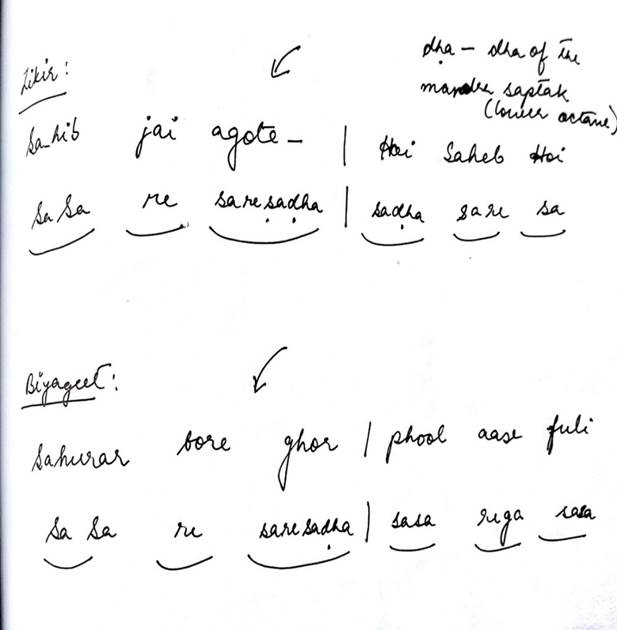
With written notation, one may not be able to fully
articulate the intricate musical particularities. As Barthold Kuijken’s
self-explanatory book-title goes, Kuijken (2013)The Notation is Not the Music (2013). One has to only musically imagine the embellishments in between
the notations. There is a kaaj (musical
embellishment) that is rendered by the singer in the quick succession of the
small melodic phrase sasaresaresadha in the beginning of both the above
songs. This melodic phrase can be sung in numerous ways by a singer with a
permutation and combination of numerous rhythms and tempos. However, it is one
particularly playful and swift motion of swaras (notes) as is done in the
Assamese folk music context, that makes it recognizable. This common way of
performing the musical embellishment is what connects the wedding song and the zikir musically.
In yet
another example, we can see a striking musical resemblance between a huchori and a zikir. A huchori is a form
of choral singing heard during Rongali Bihu, a
spring-season festival of the Assamese. There is one huchori,
deutar podulit gundhaise maloti keteki mole molai, O gobindai ram (My
father’s frontyard is full of the fragrance of maloti and keteki O Gobindai
Rama) (Maloti
and keteki
being two fragrant flowers found widely in Assam). Now the melodic patterns of this huchori are strikingly similar to
that in the zikir, moi tur banda eku najanilu, Allah hey (I am your ignorant servant who
knows nothing O Allah),
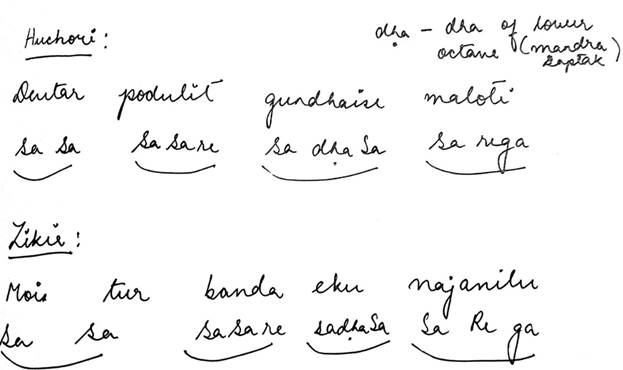
While
one is a folk bihu song celebrating springtime
fertility the other song is a call to the Divine from a devotee. One is
reflective of the laukik
(worldly) affairs while the other sings of the alaukik (other-worldly,
spiritual) relation. However, despite the distinctiveness in the lyrical
content of the two, there is an unmistakable musical resemblance through a
common melodic phrase sasasasaresadhasasarega
sung with a similar kaaj (embellishment) in the movement from
one note to another.
Ismail Hossain, an eminent scholar who has worked
extensively on Azan Fakir and Zikir, speculates that
Azan Fakir with his creative genius composed his songs in accordance with the
music of the places he was settled in at each point of time (personal
communication, Guwahati, April 21, 2018).
This can be an interesting perspective towards understanding the
intra-cultural (intra-musical) exchange that might have happened (or still
happens) between zikir and other songs genres at each
point in the journey. However, more than attributing this to the creative
genius of Azan Fakir alone, I would also accredit the common folk in every
generation that shaped zikir into a song of their
own, linguistically, and stylistically. Because of this traditional oral
fluidity, today in practice one can see ample resemblances and similarities in
the musical characteristics of zikir and many other
Assamese folk forms.
4. Bilateral Exchange of Islamic and Hindu Vocabulary
In one of Madhavdeva’s Borgeet, the dhruvansha
(refrain) says:
Bhoyo
bhai saabodhaan
Jaawe
naahi chute praan |
Gobindero
faraman
Nikote
milobo jaan||
Mahanta (2014)157
O brother, beware!
Your soul is leaving.
It is Govinda’s order,
Meditate on this moment of life.
This borgeet is said to have
been sung by Madhavdeva when Sankardeva’s
son-in-law Hari was about to be beheaded under the orders of the erstwhile Ahom
King (p.158). In that hour of death, till the soul leaves Hari should meditate
on every passing moment of this transient life; that Madhavdeva
says is Govinda’s faraman
(order).
The word faraman however, is not a word from the
erstwhile or current Assamese Hindu vocabulary and is clearly an import from
the Islamic vocabulary. This hints at a fluid unrestrained flow of language
from one side to another, beyond the religious affiliations of the communities
singing the songs.
Again, during my conversation with Ismail Hossain, he
narrated his encounter with a Kamrupi biyanaam (wedding
song) that was being sung by some Brahmin women in the district of Nalbari in Assam.
Arobore
mokka, arobore mokka
doraghoror
namoti misa kothar pakka
The
Arabic mecca, the Arabic mecca,
The
folks from groom side, in lying aren’t they pakka (experts)?
On asked
about the reference of mecca, the women replied that they haven’t seen the mecca,
but they knew it was a sacred site for Muslims. On further probed as to their
motive behind using it, their answer was rather simple. “The groom side women
were teasing us and while retorting back we needed to have a word which would
rhyme with pakka, hence came mecca!” Hossain reflects
on this incident and asks me, “What secularism, isn’t it?” What Hossain was
trying to point at was the cultural syncretism that was reflected in the fluid
borrowing of Islamic vocabulary by the Hindu singing women.
5. Conclusion: Fluidity of the Folk and Bhakti - Sufi Expressions
The
concept behind the word “folk” was born in Euro-America more than two hundred
years ago. In the United States, “folk music” combines a sense of
old songs and tunes with an imaginary “simpler” lifestyle, featuring the
mountaineers of Appalachia and the African American blues singers, all playing
acoustic instruments—guitar, fiddle, banjo—with a hint of social significance.
In Europe, even though the word comes from the German volk (folk), the
genre has different overtones based on local social resonance Slobin (2011) 1. Outside the Western world, “folk” exists as a term
from foreign shores. In India, it bears colonial traces and class markings, as folklorica does in Latin American usage
(p.2).
Folk culture as understood in commonsensical terms is
an “expressive culture” (p. 6)
of the many ways that
people perform feelings and beliefs. Folk culture is what emanates
from the lives of the common people, and like a river, changing shapes,
“routes” and colors from one region to another. Even within one region, there
are numerous styles to one particular ‘folk’ form, due
to the factors of continuous influences from music of neighboring regions,
influences from other genres within the same region, collaborations amongst
different artists and usage of different instruments with changing times,
individual artistic dispositions and so on, which are constantly at work. That
the folk forms or genres are mostly the ones which are circulated in an oral
mode make them suitable for fluidity and change.
The nearest parallel term which defines the ‘folk’ in
the Indian scenario is perhaps Loka, as used in loka parampara,
i.e., people’s traditions or the local traditions. Here we are largely looking
at the umbrella containing local, regional, oral, and vernacular traditions. In
the context of music of Assam, one may say, ‘lokasangeet’
or ‘lokageet,’ literally meaning ‘people’s music’, is
a parallel for folk music.
The Bhakti and Sufi oral traditions of the Indian
Subcontinent are part of this long-standing folk tradition or loka parampara. The Indian Bhakti
movement came into being around seventh century AD in Tamil Nadu and gradually
took hold in the other regions of the subcontinent reaching its expressive
zenith in the medieval period. Music and poetry have been the
predominant modes of expression in this movement. Bhakti, very broadly, has
been a movement which facilitated the personal form of devotion of the devotee,
thus breaking the hegemony of the Brahmin priesthood. Bhakti is not a
monolithic phenomenon as it varies according to different socio-political and
cultural contexts. The musical expression also differs in different contexts,
depending on its employment of local languages, metres, and rhythms. Naturally,
it meant a huge uprising of the vernacular mode of expression, where the
devotees communicated with the Divine in the most day-to-day language, as, in Arundhathi Subramanium’s words,
the vernacular came closest to the “many shifts of the bhakta’s inner weather”
(Subramanium, 2014, xiii)
Hence,
in most cases, the secular folk and the devotional Bhakti expressions have
merged conveniently, in linguistic and musical styles. For both,
travelling spontaneously with time, there is no way to ascertain any one ‘authentic’ sound. Bhakti and Sufi poets have been
travelers from one place to another, reciting and singing their poems in
different regions with distinct musical styles. Each region treats the poems in
their own unique vernacular style. Folk forms in general are by nature fluid
entities, reflecting beliefs of the people, by the people and for the people at
any given time. In the understanding of folk expressive cultures, James Clifford advises us to think
of “routes” rather than “roots.” Slobin (2011) 7. Hence one
gains more by looking at bhakti and the folk expressions, through “routes”
rather than “roots,” in order to understand them as
fluid, malleable and open expressive cultures subject to influence,
assimilation and transformation.
Jin-Ah Kim, in his study of
Cross-Cultural Study of Music regards cross-cultural music as a “distinct,
dynamic-complex process, determined by the configuration of evolving relations
between different systems of reference” Kim (2017) 29. These systems of reference -
ethnic, social, national, regional, institutional, medial, and specific to
groups or persons - do not exist in isolation, but develop in mutual,
ever-changing relations to each other. The actors involved continuously
renegotiate these relations.
I invoke
Jin Ah Kim’s way of looking at cross-cultural music
making in my studying any culture, or cultures, as existing within/along with
other cultures. This allows me to look at the characteristics of any expressive
form, music or not, as fluid objects changing shape with time and other
external influences from surrounding cultures. Standing amidst various genres
of music within a region, I am able to see the samenesses and resemblances amongst them, as a
fluid and continuous exchange under various circumstances.
Applying these frameworks, one can argue that the philosophical, lyrical, and musical exchanges, resemblances, and fluidities that we observe in zikir (with an Islamic Quranic origin) vis-à-vis other song genres of Assam (with a non-Islamic origin), are a part of a constantly evolving cultural performance. These exchanges come through a socially imitative behavior wherein we see a close musical imitation amongst styles within geographical proximity in a region. This hints at the larger notion of a socially cohesive behavior through music. The resemblances of musical embellishments amongst different song genres reflect the sense of belonging to one region, or one larger common musical culture. Like James Clifford, I too would not use the word ‘root’ for folk Bhakti and Sufi oral traditions but would go for ‘routes. Different Bhakti-Sufi folk genres may have roots in various religious or ethnic sources, but their ‘routes intertwine, intersect, share, connect and communicate-socially, philosophically, ideologically, musically; and hence show resemblances and sameness at multiple levels.
CONFLICT OF INTERESTS
None.
ACKNOWLEDGMENTS
I would like to thank the reviewers for their comments. I am grateful to my supervisor Prof. Partho Datta for his support.
REFERENCES
Deka, B. (2012). Asamiya Zikir Aru Zari Gitar Rohghora. Minati Kalita.
Hossain, I. (2014). Azan Peer Aru Zikir Zarir Mulyayan. Jyoti Prakashan.
Hossain, I. (2015). Asomor Musalmanor Oitijya Aaru Sanskriti. Banalata.
Hossain, I. (2015). Edited. Azan Peer Aru Zikir. Chandra Prakashan.
Kim, J. (2017). Cross-Cultural Music Making : Concepts, Conditions and Perspectives. International Review of the Aesthetics and Sociology of Music, 48(1), 19-32. https://www.jstor.org/stable/44259473.
Kuijken, B. (2013). The Notation is Not the Music : Reflections on Early Music Practice and Performance. Indiana University Press. https://www.jstor.org/stable/j.ctt16gz82s.
Mahanta, B. (2014). Borgeet. Student Stores.
Malik, S. A. (2003). Azan Peer Aaru Xuriya Zikir. Students Stores.
Slobin, M. (2011). Folk Music A Very Short Introduction. Oxford University Press.
Subramanium, A. (2014). Eating God : A Book of Bhakti Poetry. Penguin Ananda.
|
|
 This work is licensed under a: Creative Commons Attribution 4.0 International License
© ShodhKosh 2022. All Rights Reserved.